




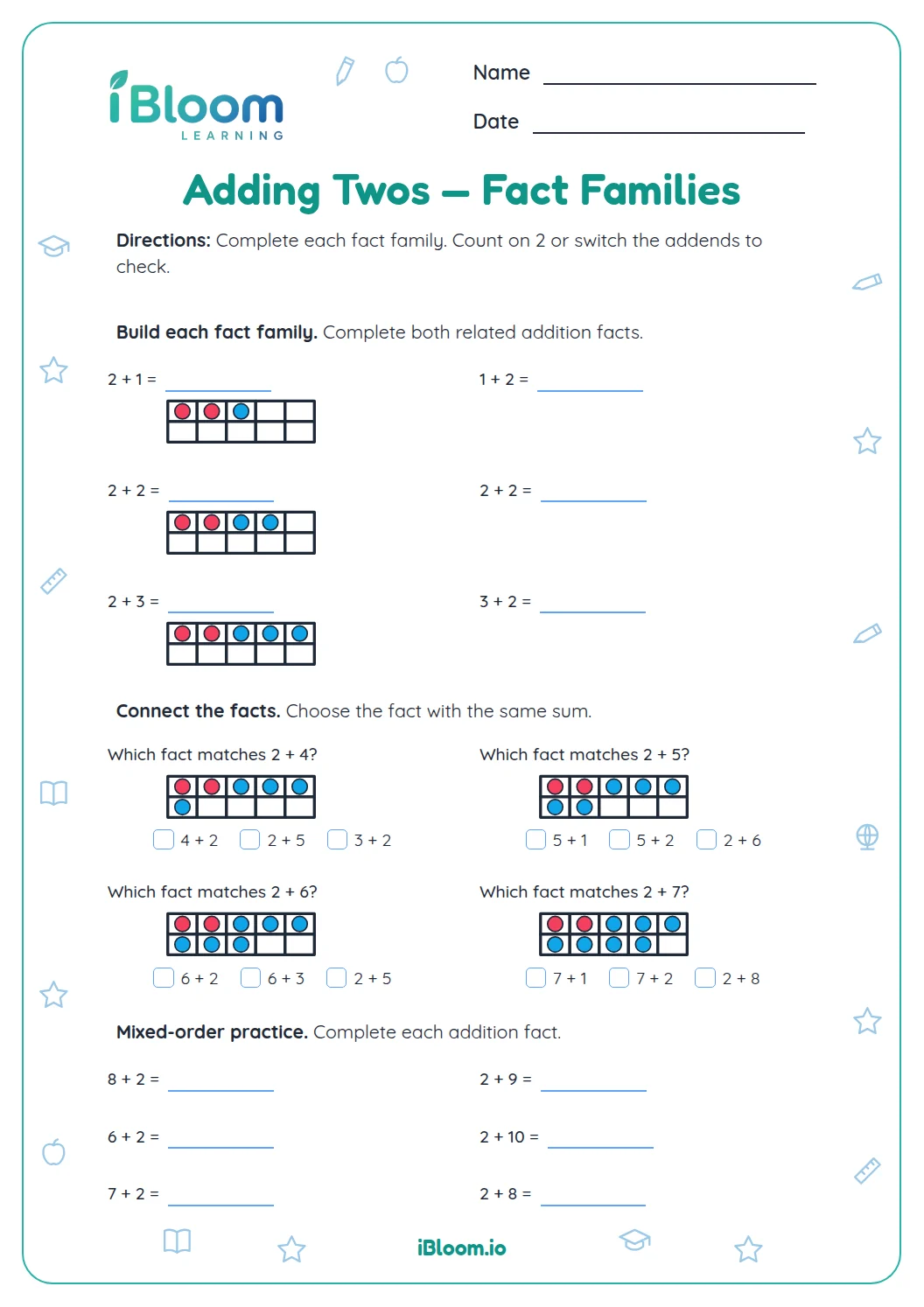

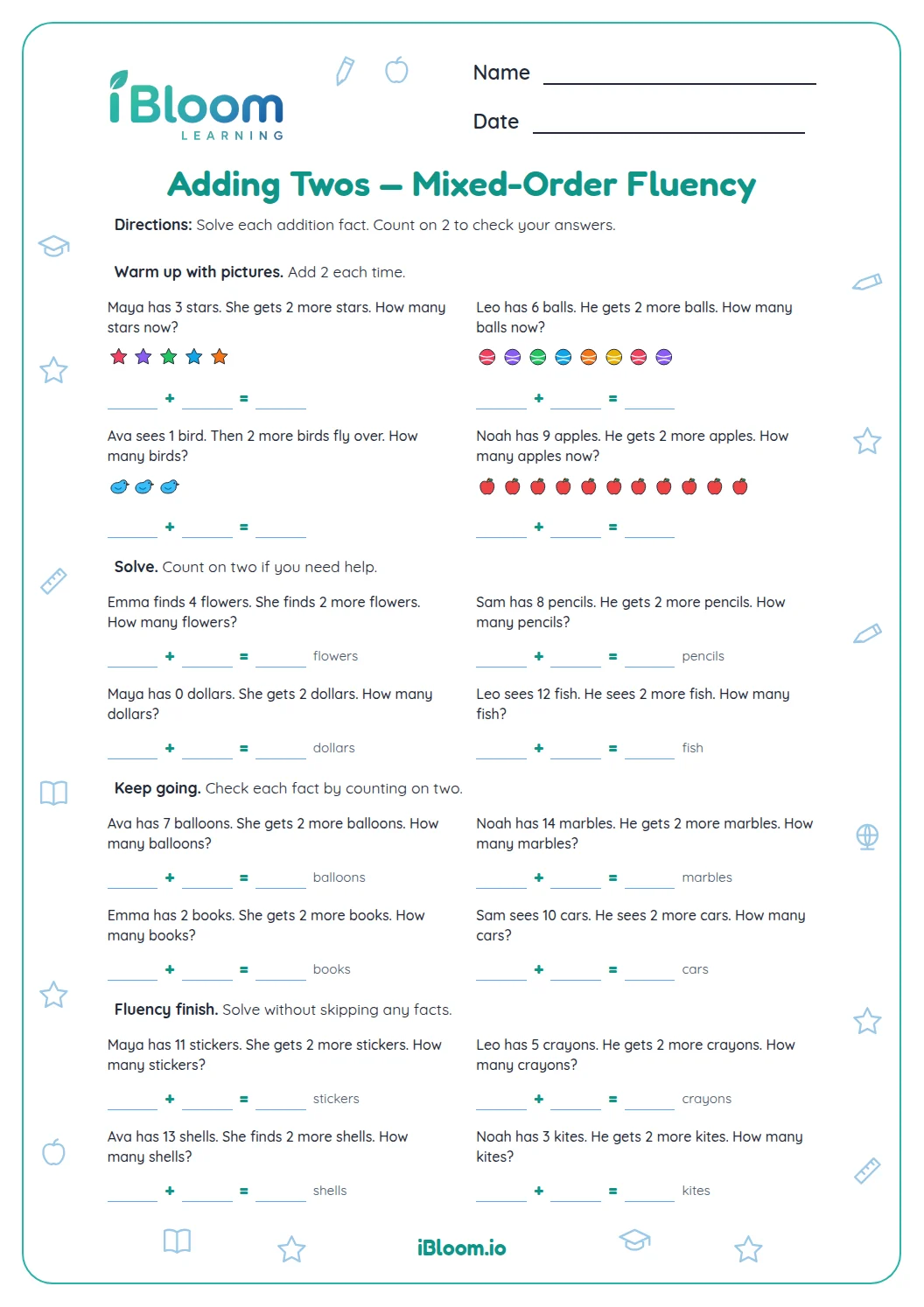
About this worksheet
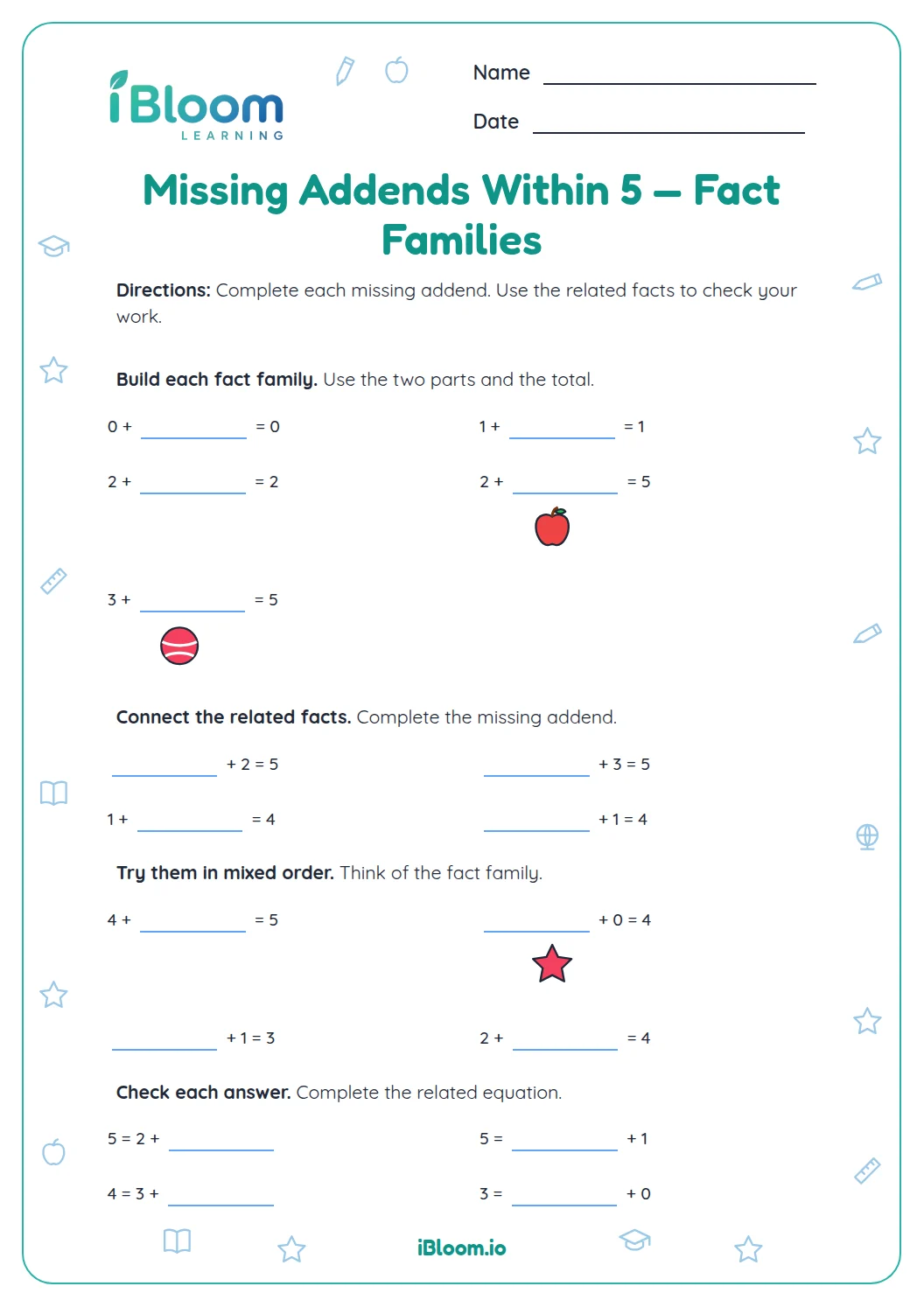
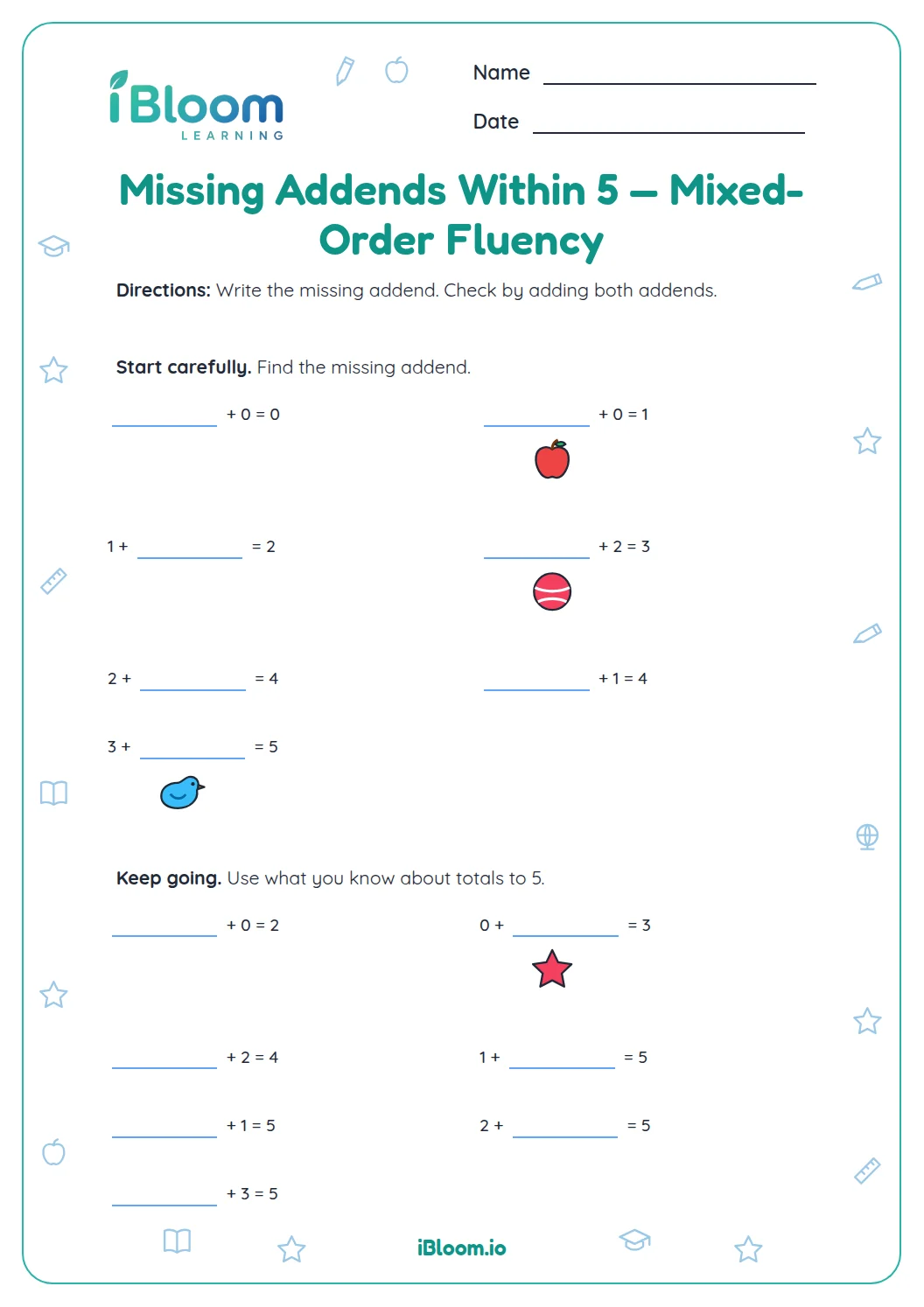
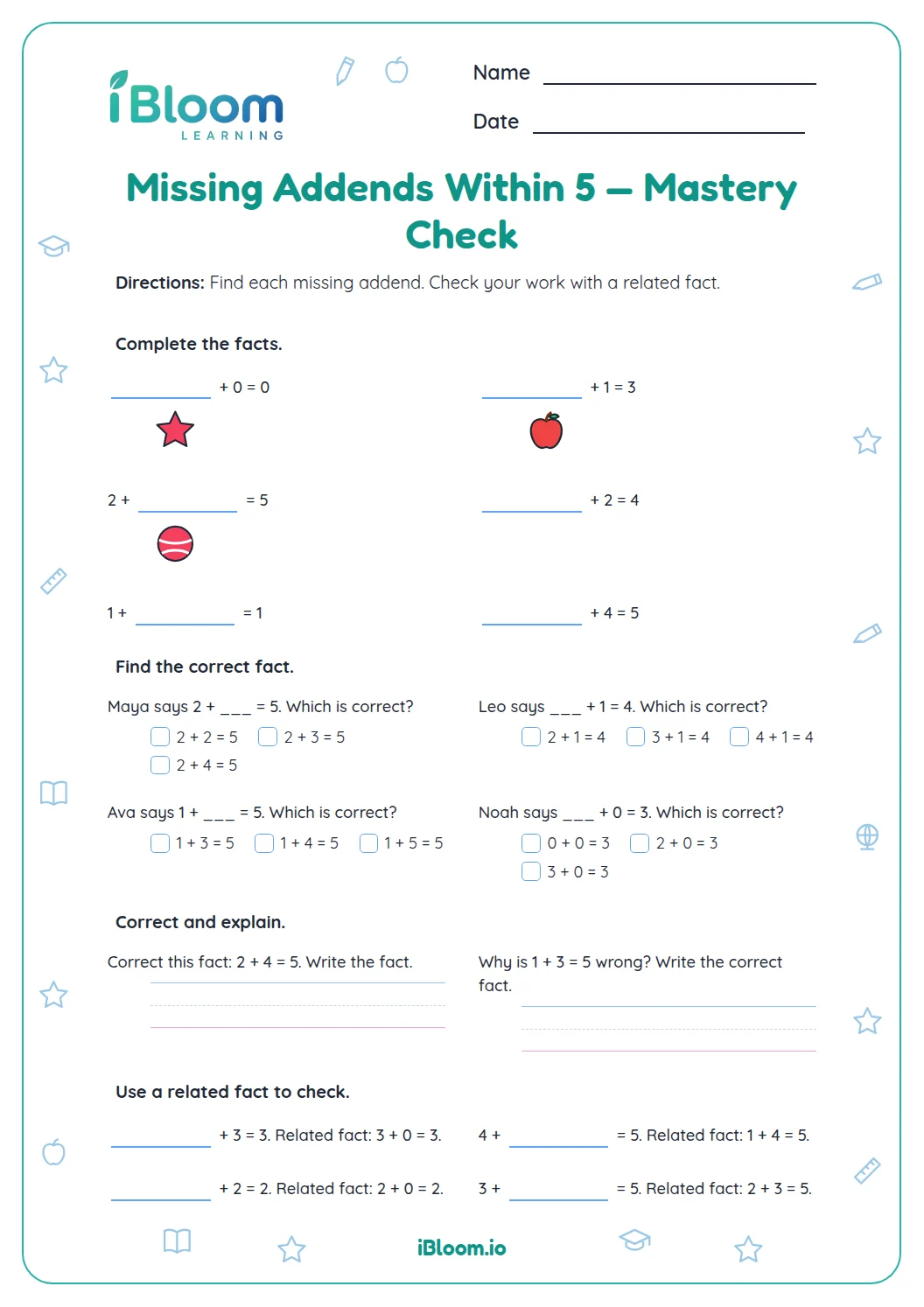
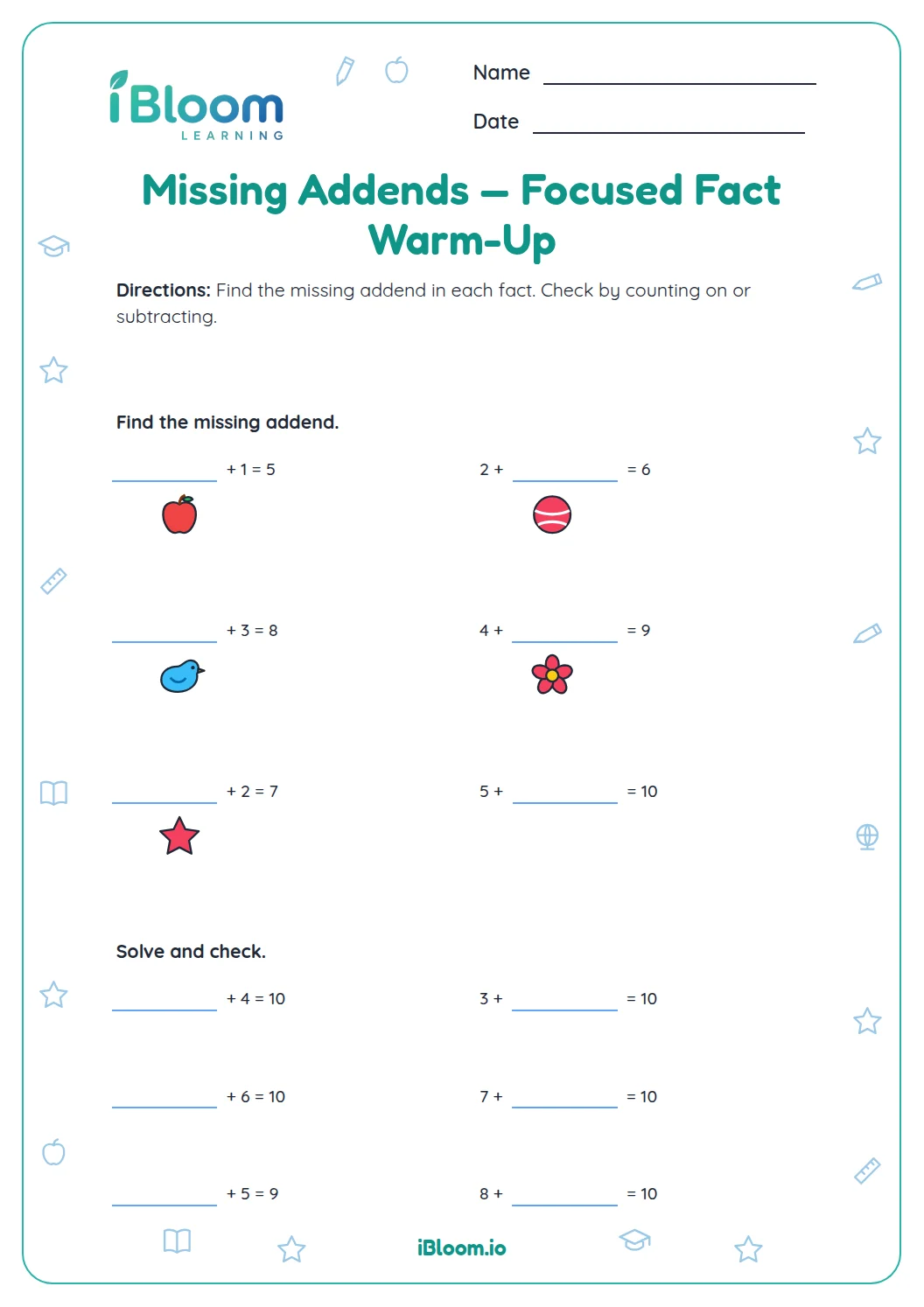
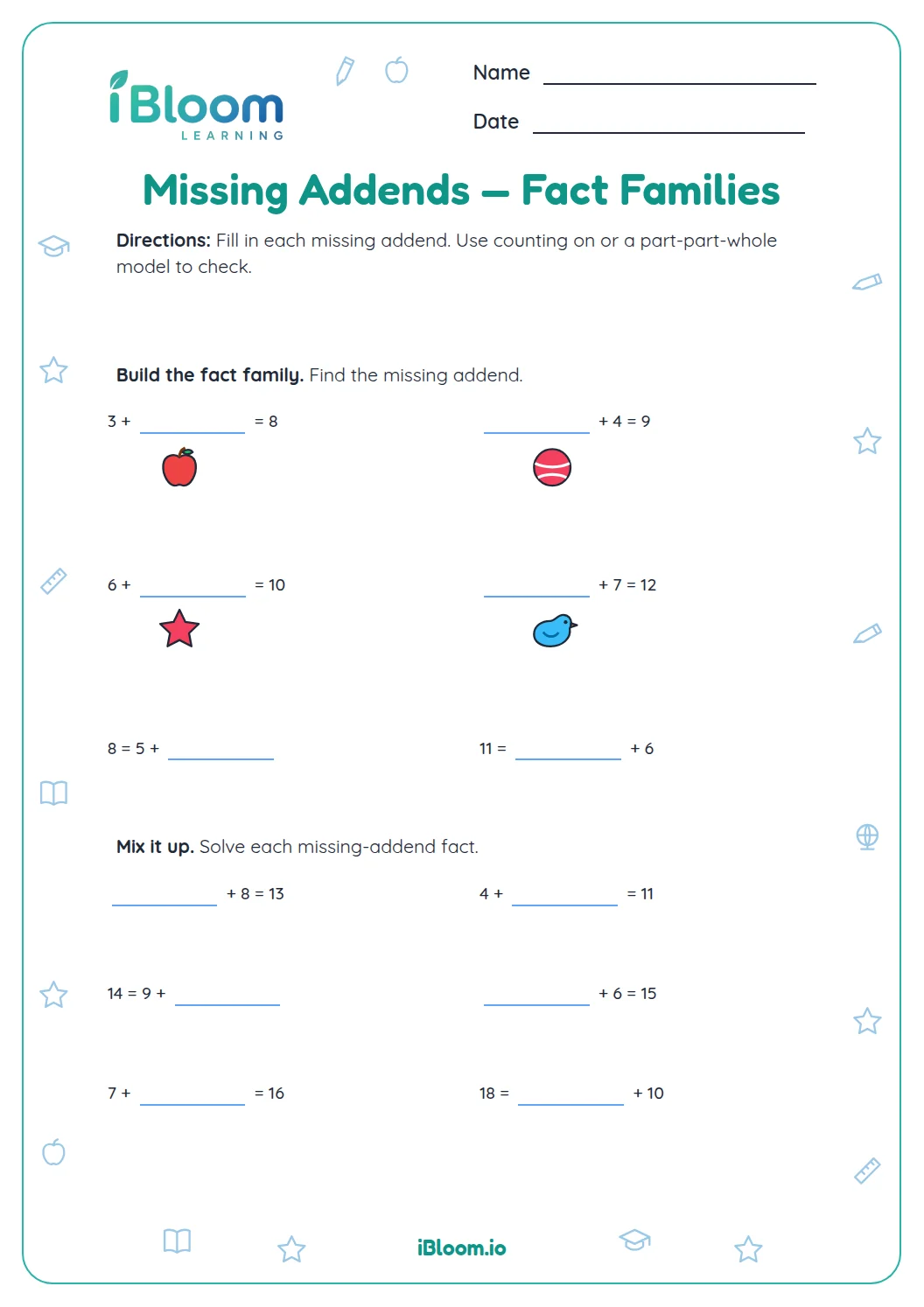
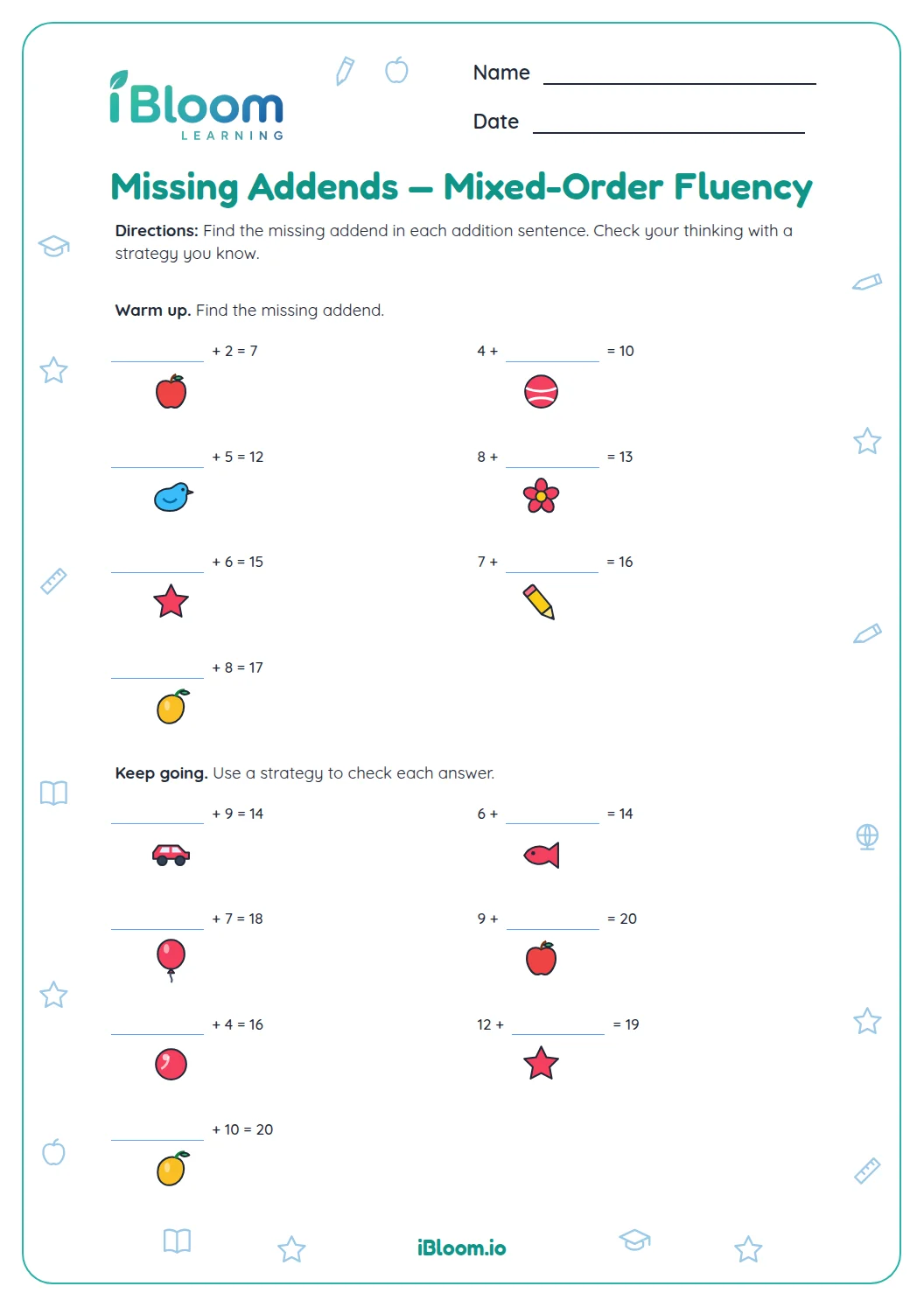
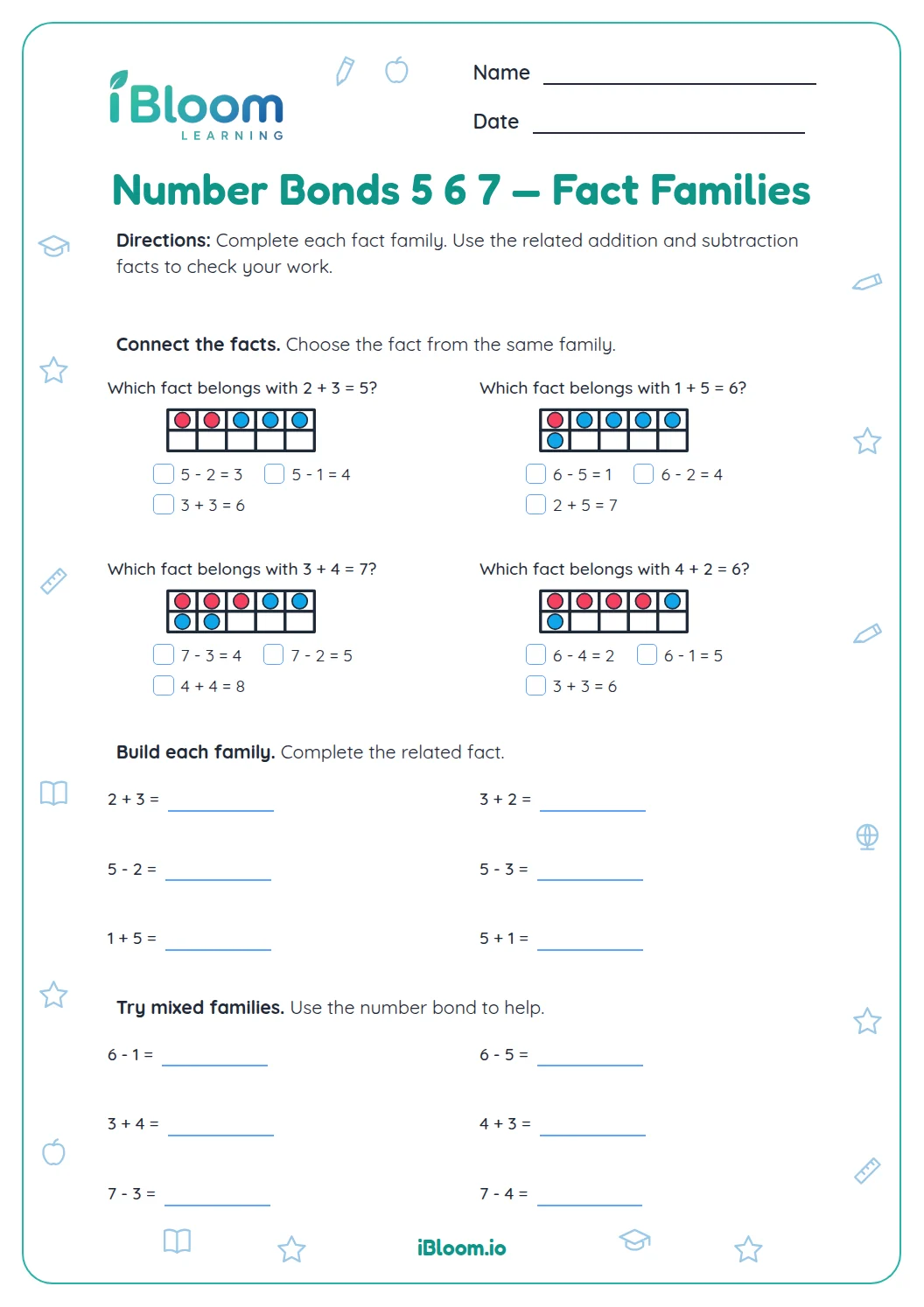
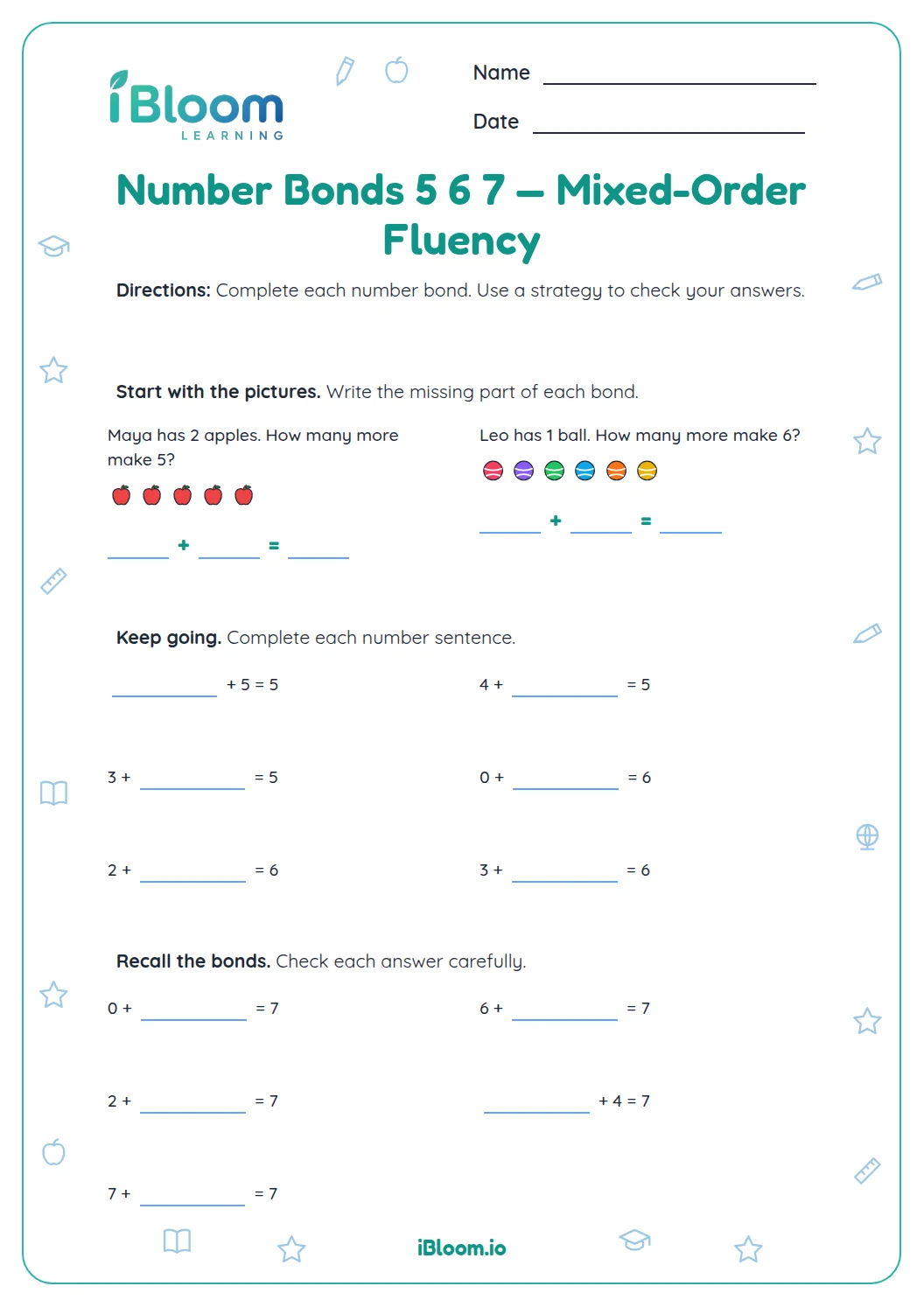
This printable gives Grade 1 students 18 missing-addend items with sums or wholes no greater than 5. Fifteen are addition facts, and six include a complete check equation with its own blank. Three number bonds provide a visual way to find a missing part. The answer key lists each answer in order. It supports addition fluency within 10, as described in CCSS 1.OA.C.6.
Aligned to 1.OA.C.6
What is a missing addend?
An addend is a number being added. In 2 + ___ = 5, the missing number is 3 because 2 + 3 = 5.
How does the check fact work?
Some problems include the same two addends in switched order. If 2 + 3 = 5, then 3 + 2 = 5. Fill both blanks to check that the missing number makes the sum.
What numbers will students use?
The 15 equations have sums of 5 or less and missing values in either addend position. Six include a check blank. Three number bonds show a whole and a known part, with the other part left to find.
How to use this worksheet
- 1Read the whole addition fact, including the sum.
- 2Count on from the known addend to the sum.
- 3Write the number you counted in the first blank.
- 4For a check item, use the same number in the switched-addend equation.
- 5Read the complete fact aloud to see whether it is true.
Common mistakes and how to fix them
The mistake
Writing the sum in the blank.
The fix
The sum is already printed; find the number that joins the known addend.
The mistake
Filling the first blank but skipping the check blank.
The fix
Read after “Check:” and fill its blank too.
The mistake
Changing the total when the addends switch order.
The fix
Keep the same two addends and sum; only their order changes.
Common Core alignment
These facts build addition fluency using small sums and unknown addends.
Add and subtract within 20; build fluency within 10.
On this sheet: Students find addends in addition facts with sums no greater than 5.
Show the official wordingHide the official wording
Add and subtract within 20, demonstrating fluency for addition and subtraction within 10. Use strategies such as counting on; making ten (e.g., 8 + 6 = 8 + 2 + 4 = 10 + 4 = 14); decomposing a number leading to a ten (e.g., 13 - 4 = 13 - 3 - 1 = 10 - 1 = 9); using the relationship between addition and subtraction (e.g., knowing that 8 + 4 = 12, one knows 12 - 8 = 4); and creating equivalent but easier or known sums (e.g., adding 6 + 7 by creating the known equivalent 6 + 6 + 1 = 12 + 1 = 13).
What to practice next
Make more practice
Further reading
Questions parents and teachers ask
What does addend mean?
An addend is one of the numbers being added. In 2 + 3 = 5, the addends are 2 and 3, and 5 is the sum. A missing-addend fact gives one addend and the sum, then asks for the other part.
How can a child find the missing number?
Start with the known addend and count on until reaching the sum. In 2 + ___ = 5, say 3, 4, 5; that is three counts, so the missing addend is 3. A small object group can help check.
Why does the check switch the addends?
Switching the order keeps the same total. For example, 1 + 4 and 4 + 1 both equal 5. The six check items have a second blank so students can complete the matching fact and see that the sum stays the same.
Are all totals within 5?
Yes. Every equation sum and number-bond whole on the page is no greater than 5. The equations use totals from 0 to 5, while the three number bonds ask students to find a missing part of a whole from 4 or 5. The key includes these bond answers too.
What should I look for in the answer key?
For the first nine facts, the key gives one missing number. For the next six, it lists two entries in order: first the missing addend, then the value for the check equation. The last three entries give the missing number-bond part.