

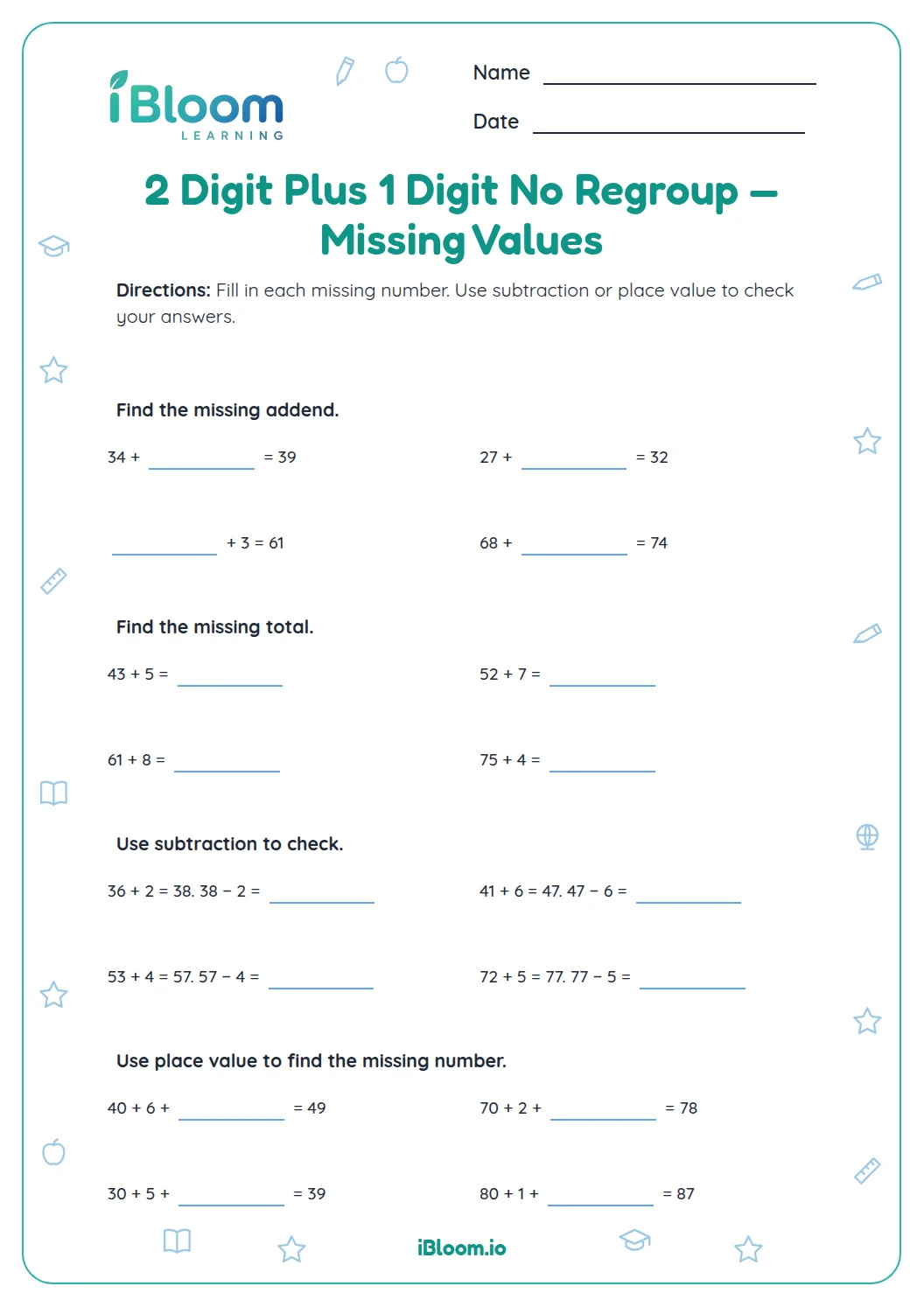
About this worksheet
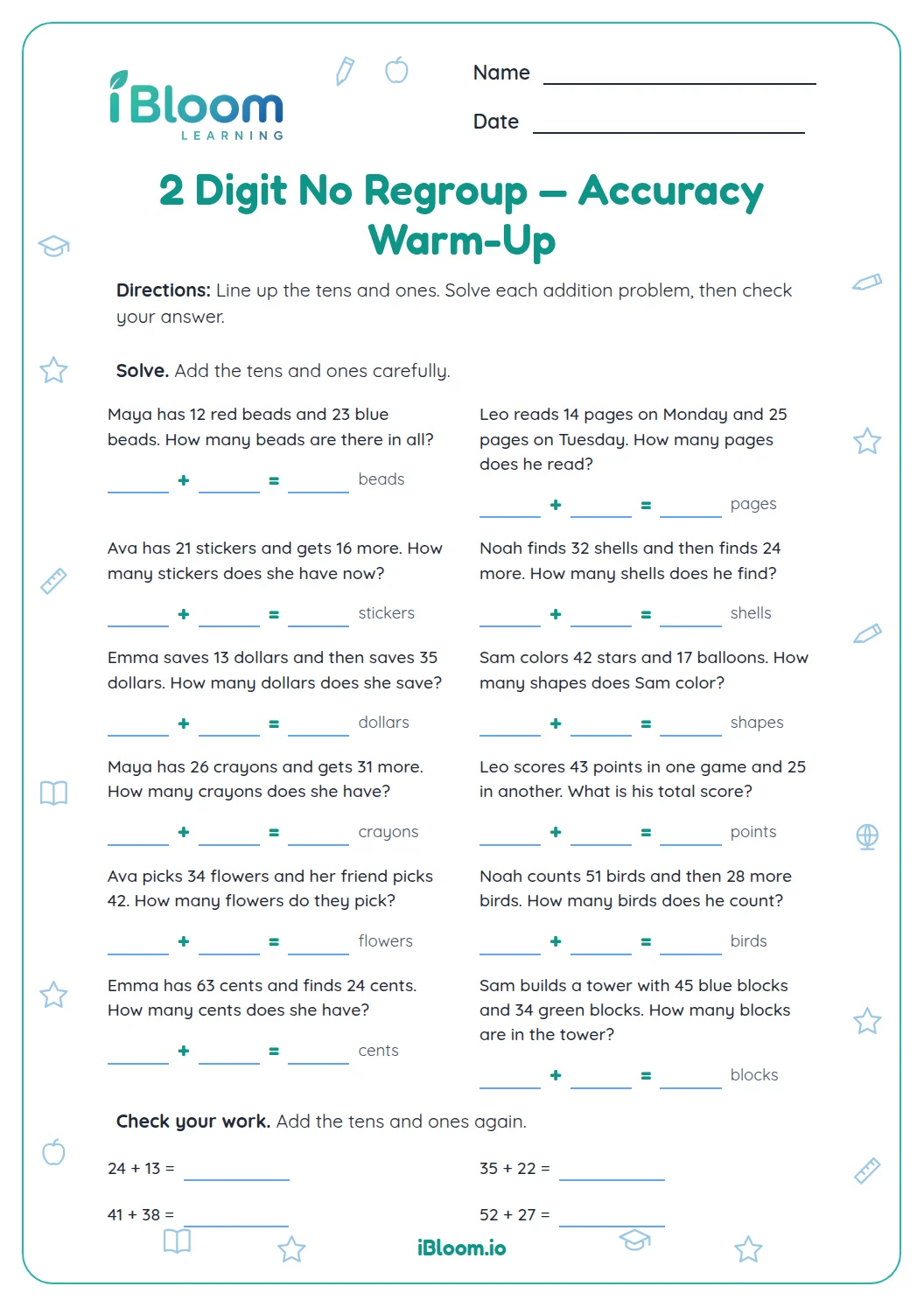
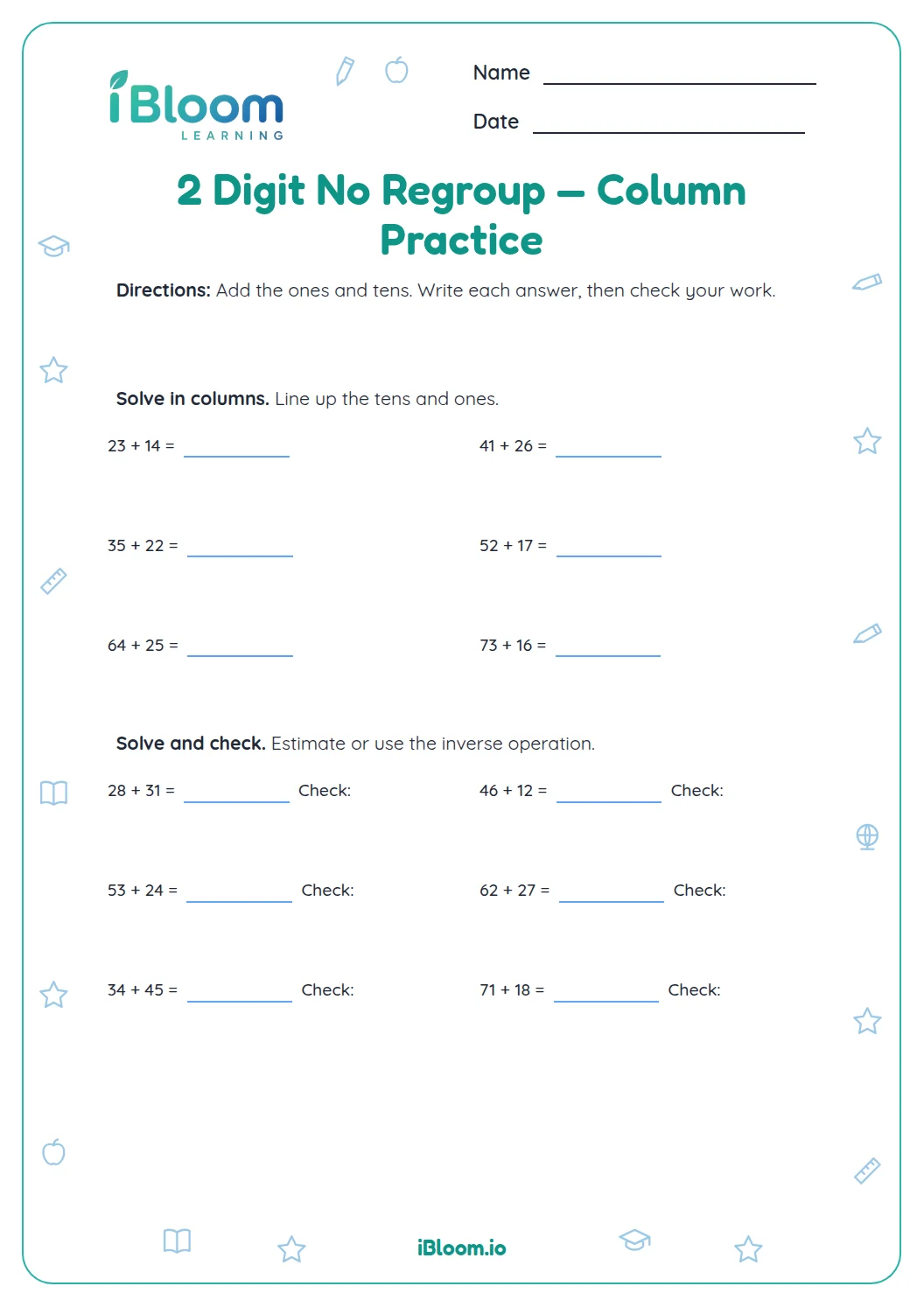
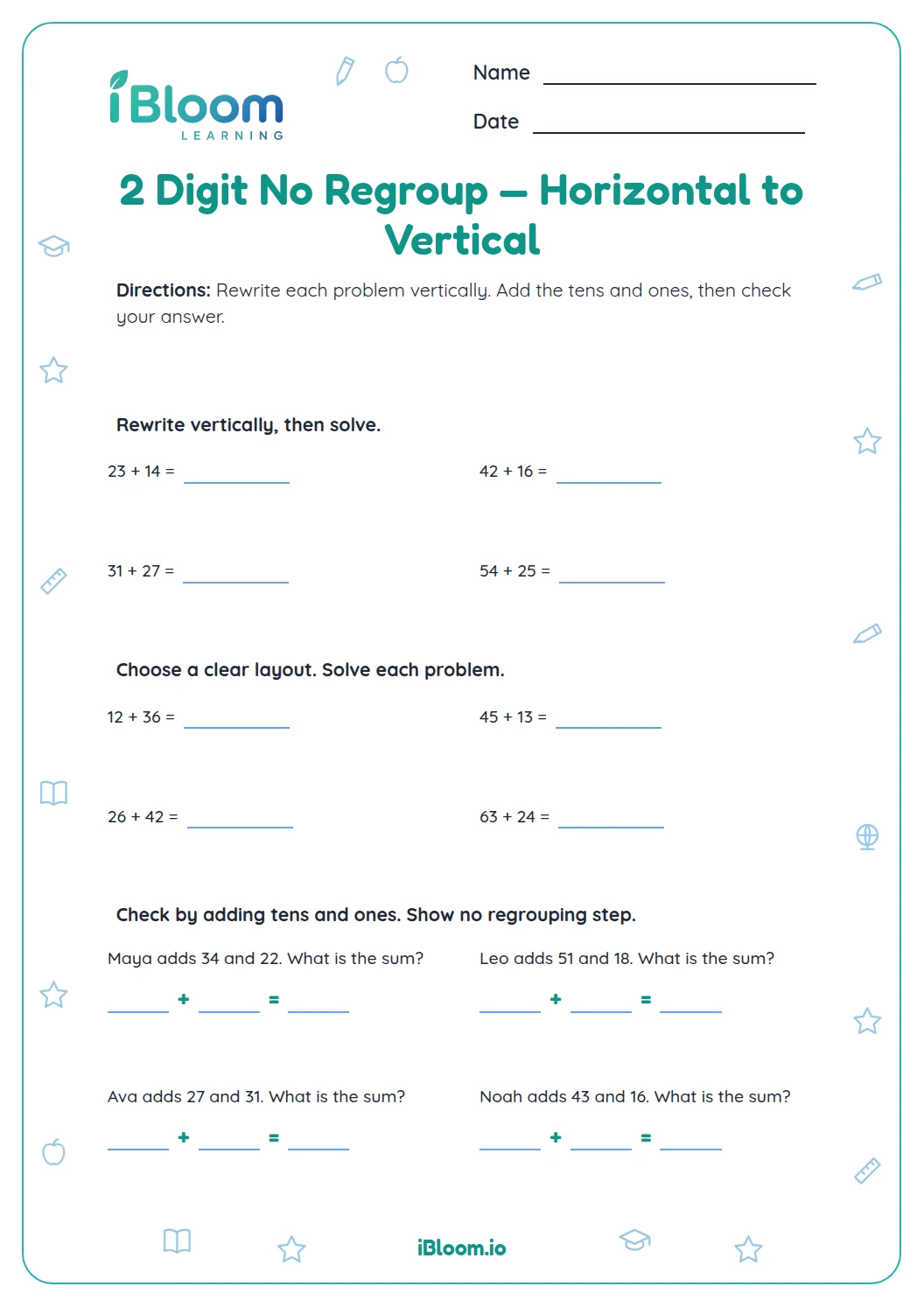
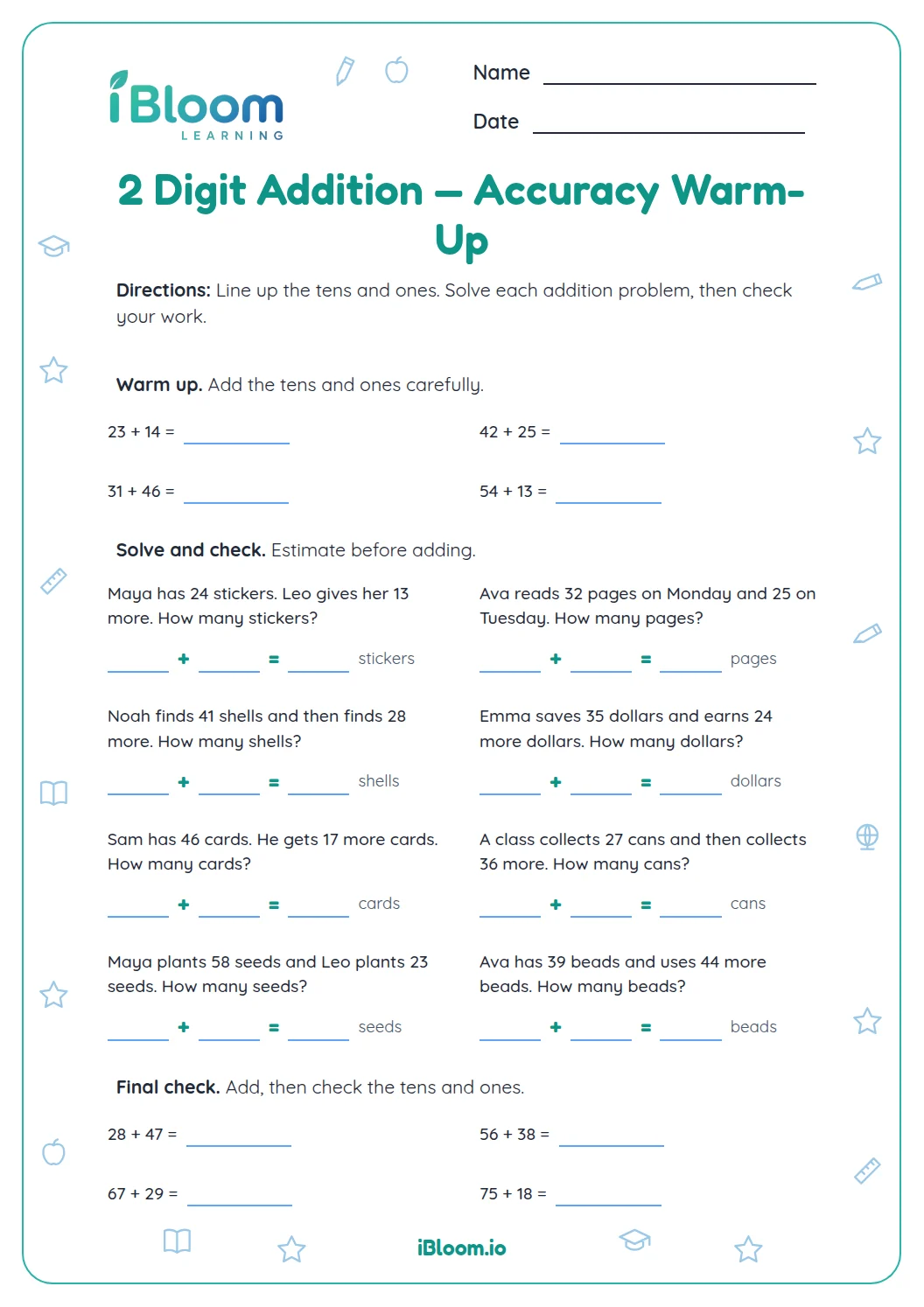
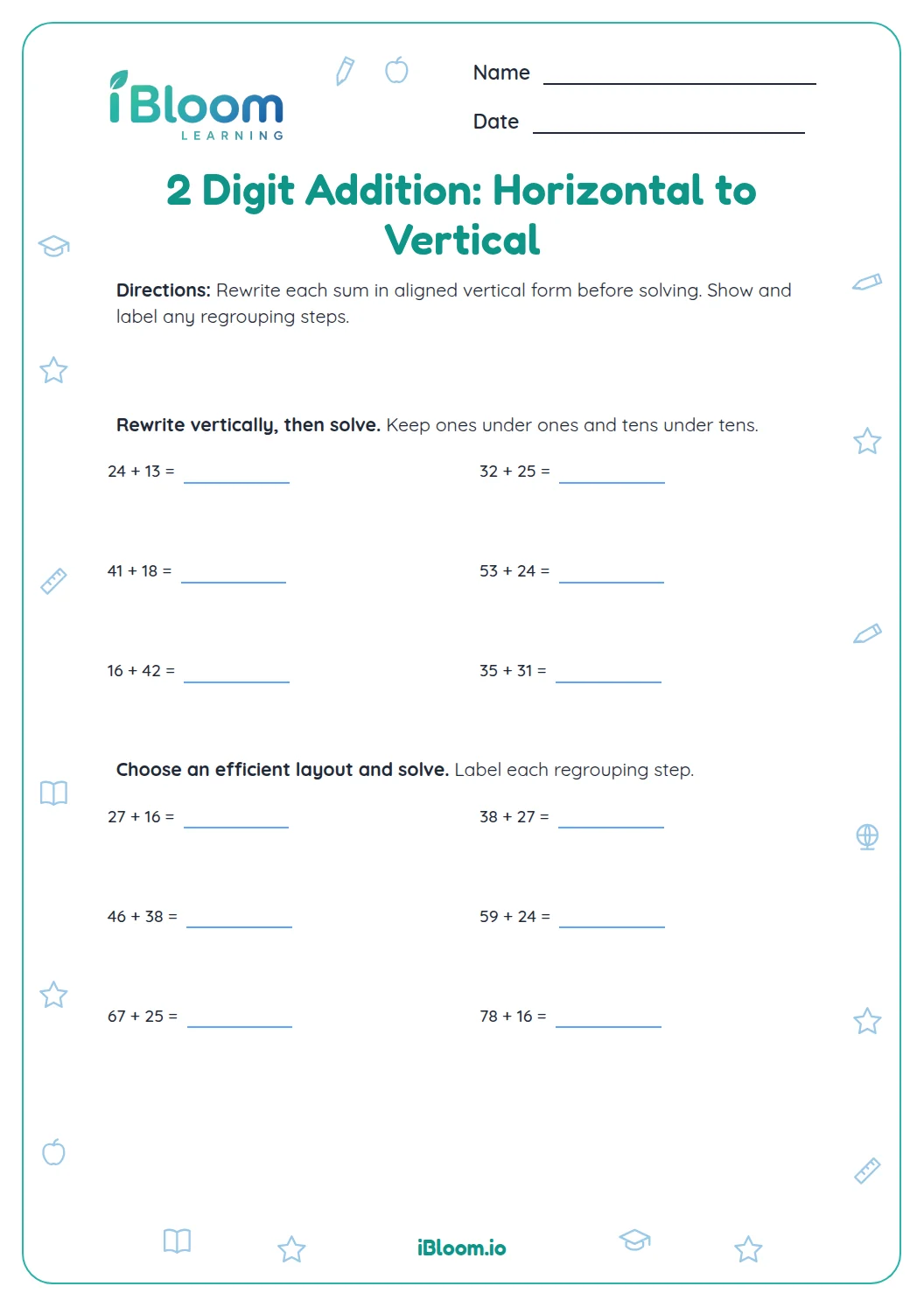
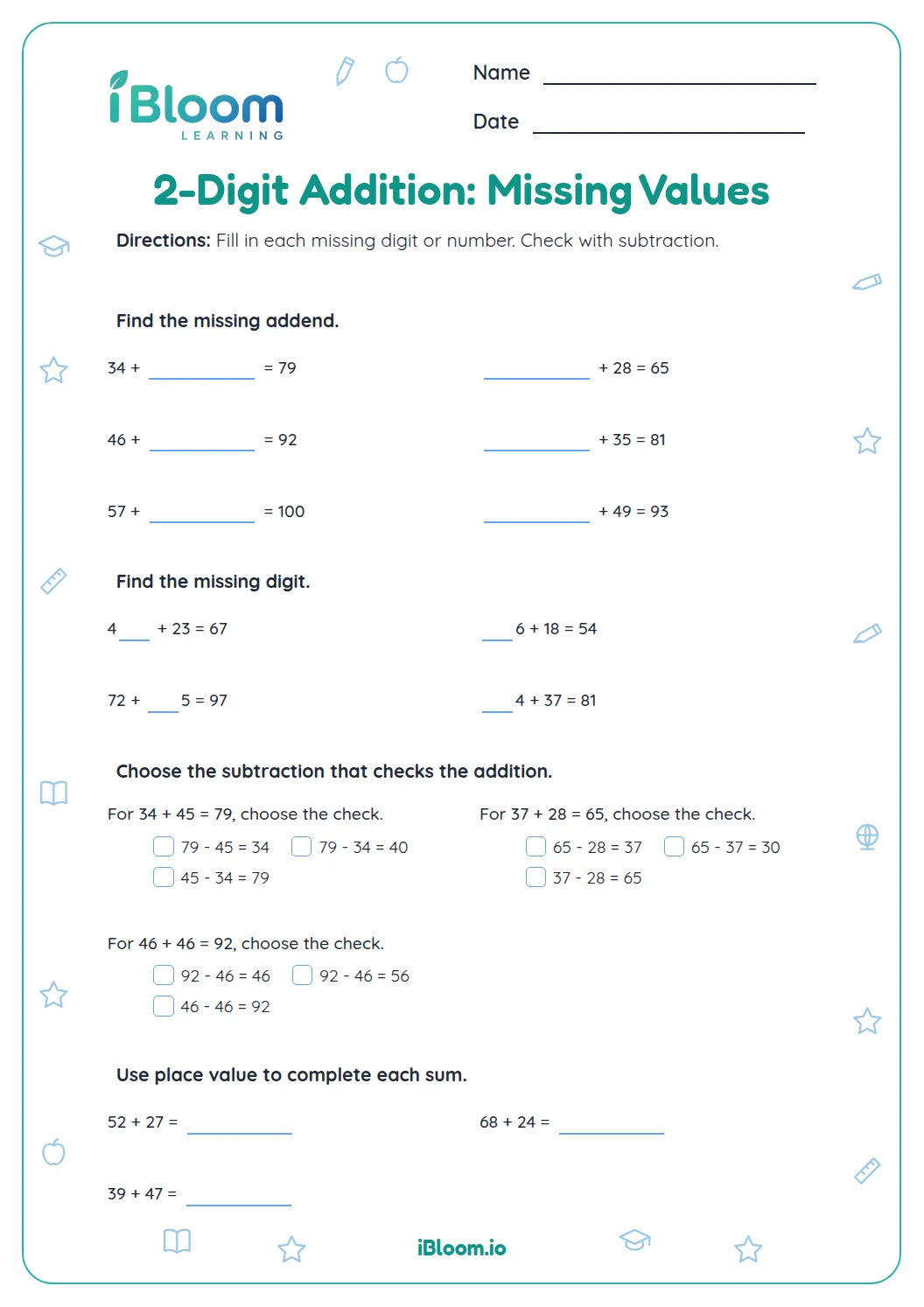
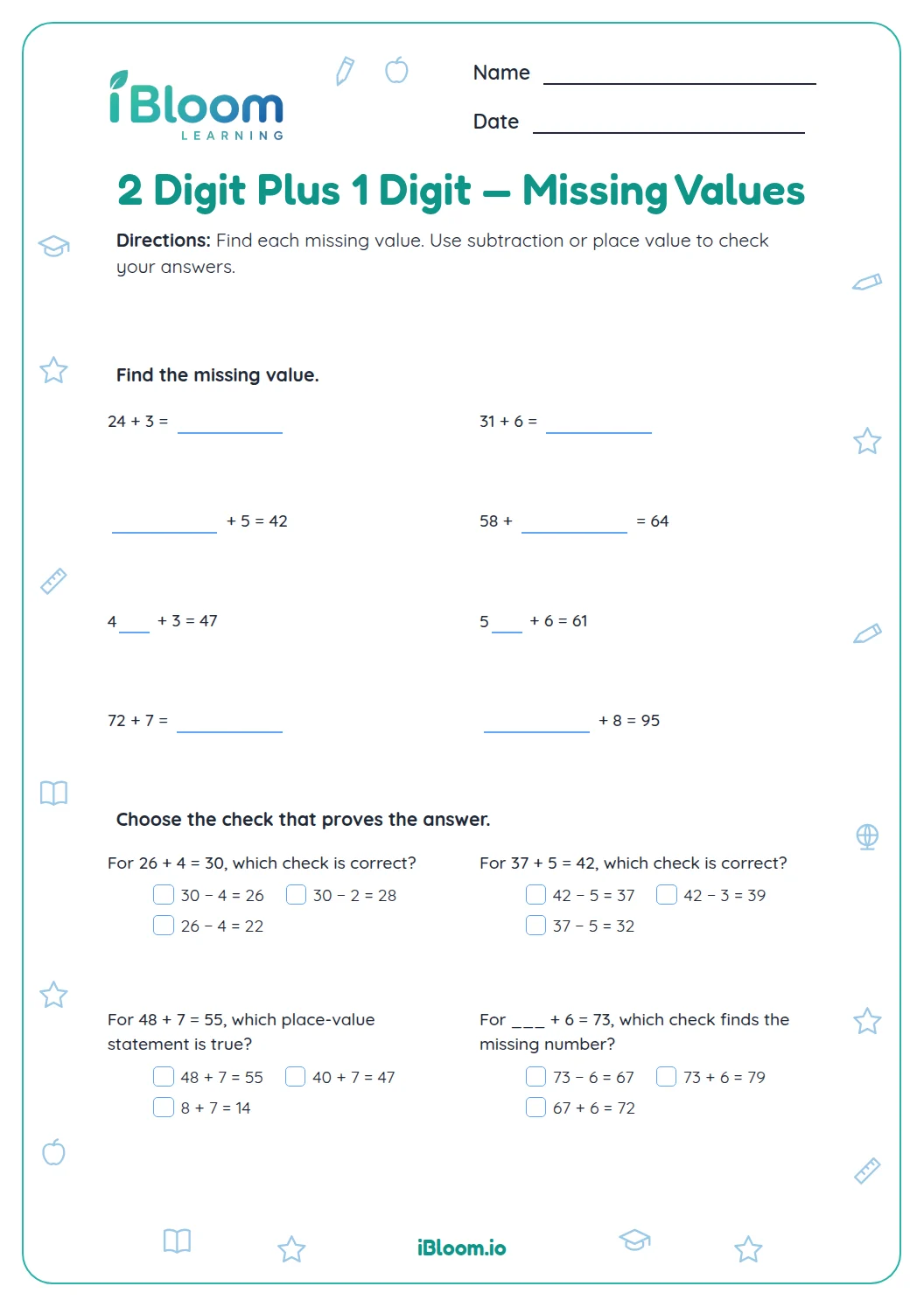
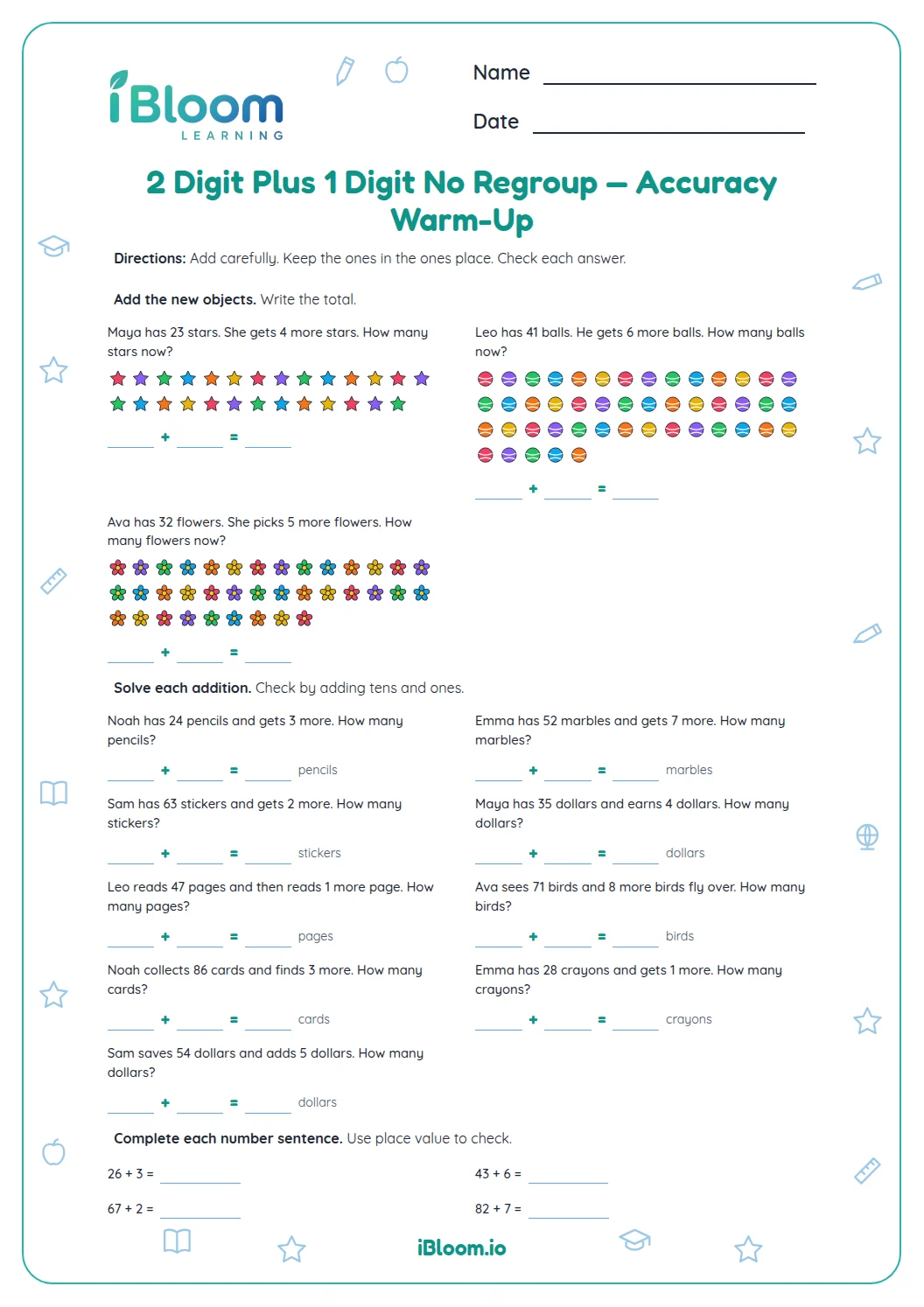
This Grade 2 printable mixes 14 two-digit addition tasks without regrouping: six number sentences, four short story problems, and four estimates rounded to the nearest ten. The exact sums stay below 100, and each addend pair can be added by place value without making a new ten. A separate answer key lists all responses. The number-sentence practice aligns with CCSS 2.NBT.B.5.
Aligned to 2.NBT.B.5
What does the mixed practice include?
Part A gives six direct addition equations. Part B puts the skill into four brief contexts about beads, pages, money and birds. Part C asks for estimates to the nearest ten using four different addend pairs.
In the exact-sum parts, each ones column totals less than 10, so students can add the tens and ones without regrouping. The last part adds the exact values first and rounds the resulting sum.
- Part A, questions 1–6: direct two-digit addition
- Part B, questions 7–10: story problems with addition equations
- Part C, questions 11–14: sums rounded to the nearest ten
- The answer key includes exact sums and estimates
How do you add without regrouping?
For 34 + 25, add the tens: 30 + 20 = 50. Add the ones: 4 + 5 = 9. Then combine them to get 59. For an estimate, first find the sum and round it: 59 rounds to 60.
- 134 + 25 = ___
- 230 + 20 = 50; 4 + 5 = 9; the sum is 59.
How can students keep an estimate separate?
Use the exact sum in Part C, then round that one number. The estimate for 26 + 43 is 70 because the sum is 69; write only 70 as the answer.
How to use this worksheet
- 1Add the tens and ones in Part A, keeping each place value separate.
- 2For each story, identify the two amounts and write an addition equation.
- 3Check that the ones digits do not make a new ten.
- 4For Part C, calculate the exact sum before rounding to the nearest ten.
- 5Use the key to check story answers, sums and estimates.
Common mistakes and quick fixes
The mistake
Adding tens to ones, such as combining 30 + 5 as 35 before adding the other parts.
The fix
Keep tens and ones in their places: 30 + 20 = 50 and 4 + 5 = 9.
The mistake
Regrouping when the ones sum is below 10.
The fix
Check the ones first; if their sum is less than 10, write that digit and add the tens.
The mistake
Rounding both addends and writing a different result from the requested estimate.
The fix
Find the exact sum first, then round that total to the nearest ten as Part C directs.
Common Core alignment
The worksheet practices number operations and place-value reasoning in the Common Core State Standards for Mathematics.
Fluently add and subtract within 100 using strategies based on place value.
On this sheet: The sums use two-digit addends without regrouping; a final part rounds each sum to the nearest ten.
Show the official wordingHide the official wording
Fluently add and subtract within 100 using strategies based on place value, properties of operations, and/or the relationship between addition and subtraction.
What to practice next
Make more practice
Further reading
Questions parents and teachers ask
What does no regrouping mean?
The ones digits add to less than 10, so no new ten needs to be carried into the tens place. For example, 4 + 5 = 9 in 34 + 25. Add the tens and ones separately, then combine the partial sums.
What is in the story-problem part?
Part B has four short addition stories about beads, pages, money and birds. Each gives two amounts and asks for their total. Students can write an addition equation in the work area before solving. All four stories have one exact two-digit total to find.
How should students answer the estimate questions?
Find the exact sum, then round that sum to the nearest ten. For 26 + 43, the exact sum is 69 and the estimate is 70. Part C uses a fresh pair of addends for each estimate. That total is the estimate requested in the prompt.
What grade is this worksheet for?
The exact addition practice is designed for Grade 2 and keeps sums within 100. Students add two-digit numbers without regrouping, apply the skill to short stories and round totals to the nearest ten. This page keeps the exact sums within the two-digit range.
Does the answer key give story answers with units?
Yes. It includes the total and its context, such as 59 beads or 68 pages. The key gives the dollar total for the money story, plus each rounded estimate in Part C. Students can match each estimate to its own question.