
About this worksheet
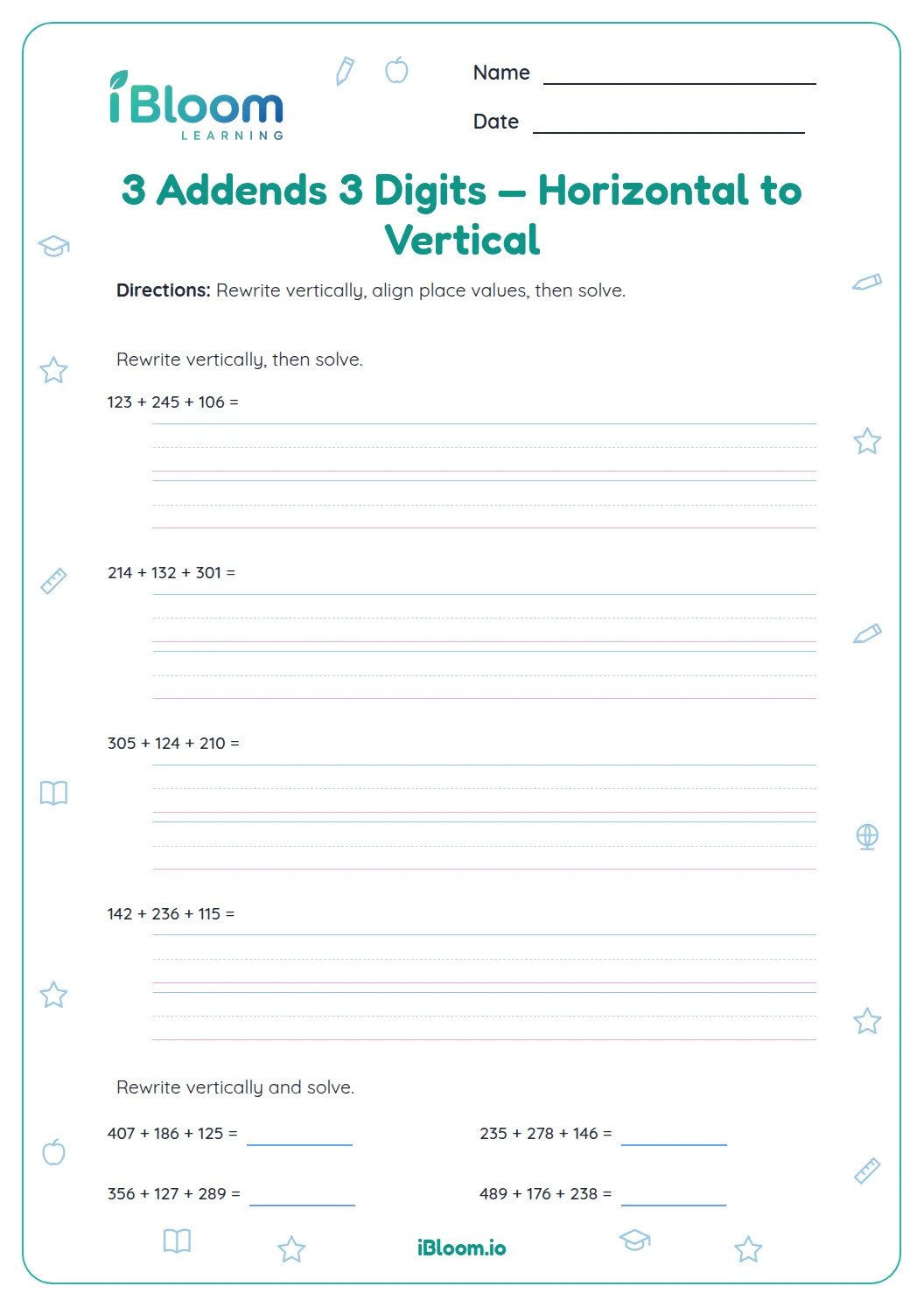
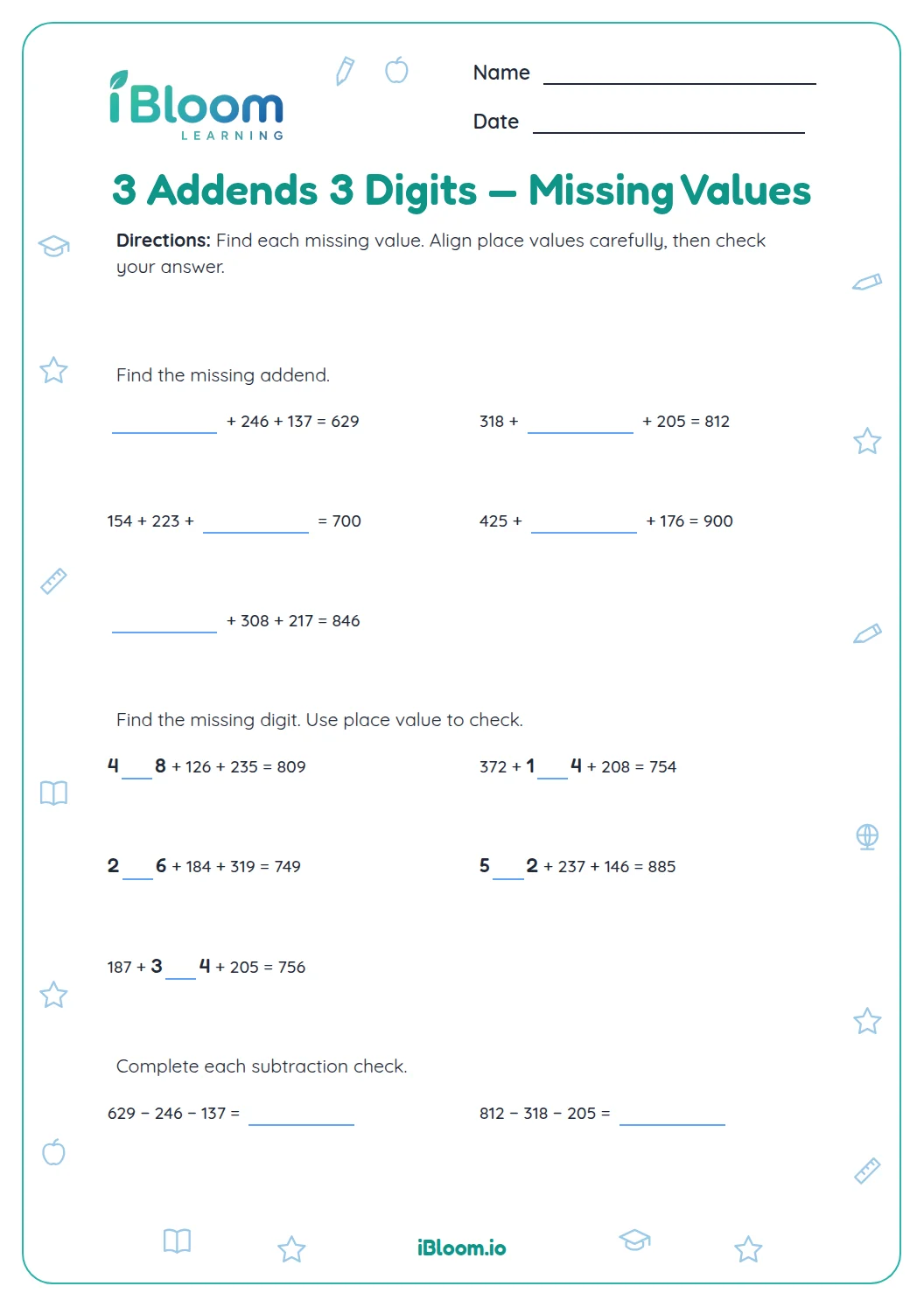
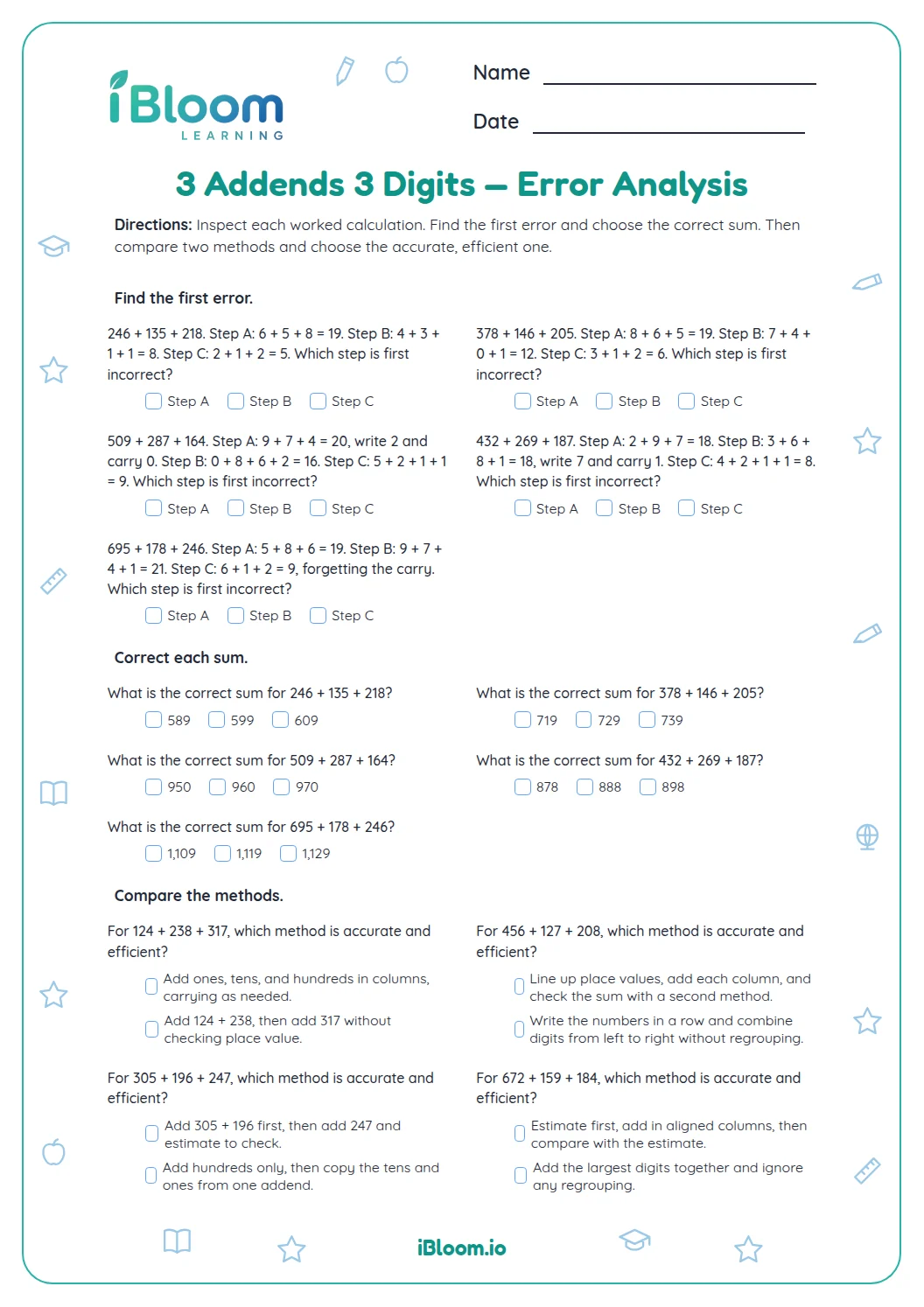
This Grade 3 worksheet offers 15 sums, each with three three-digit addends. Students see every addend and plus sign, then line up the ones, tens, and hundreds to add in columns. The first part builds the routine, the next practices regrouping, and the final part mixes the skills. An answer key accompanies the two-page practice sheet.
Aligned to 3.NBT.A.2
How do students add three three-digit numbers?
Place each addend on its own row so the ones digits line up. Add the ones, regroup if needed, and continue with the tens and hundreds columns. The same column routine works with three addends as it does with two.
- 1246 + 137 + 205
- 2Add ones first, then tens and continue from right to left.
- 3Record each regrouped ten above the next place-value column.
When should a student regroup?
Regroup whenever a column total is 10 or more. For example, 6 + 7 + 8 ones make 21 ones, which can be written as 1 one and 2 tens. Those 2 tens join the tens digits in the next column.
How can the answer be checked?
Round each addend to the nearest hundred and add the rounded numbers. Compare that estimate with the exact sum. Subtraction also works as a check: subtract two addends from the total and see whether the third remains.
What does the written column method show?
It keeps ones with ones, tens with tens, and hundreds with hundreds. The written regrouping marks show how ten units in one place become one unit in the place to the left.
How to use this worksheet
- 1Write each addend on a separate line.
- 2Align all ones digits in one column.
- 3Add the ones and regroup if the total is at least ten.
- 4Continue through the tens and hundreds.
- 5Use rounding or subtraction to check your total.
Common addition mistakes
The mistake
Adding only two of the three addends.
The fix
Touch or mark each addend as it is included in the column total.
The mistake
Regrouping the full total instead of just its tens.
The fix
Write the ones digit in the answer row and move the tens to the next column.
The mistake
Starting with the hundreds column.
The fix
Begin at the ones place so regrouped tens can be carried into the next column.
Common Core alignment
This worksheet practices multi-digit addition with place-value strategies.
Three three-digit addends in columns
On this sheet: Students add multi-digit whole numbers using the column method and check their totals.
Show the official wordingHide the official wording
Fluently add and subtract within 1000 using strategies and algorithms based on place value, properties of operations, and/or the relationship between addition and subtraction.
What to practice next
Make more practice
Further reading
Questions parents and teachers ask
How many sums are included?
The worksheet has 15 sums in three parts. Every question asks students to add exactly three three-digit numbers, and the answer key lists each total. Students can pause after each column to check that the regrouped value moved one place left. This short pause helps keep the written work readable and makes an arithmetic slip easier to locate.
Do all problems require regrouping?
The mix includes sums that make regrouping useful and sums with different column totals. Students should check each column rather than assume the same regrouping pattern every time. Before comparing with the key, ask the student to estimate the total
Why are there plus signs between every number?
Each plus sign marks a separate addend in the expression. It helps students identify all three numbers before copying them into aligned rows. A useful routine is to point to every addend while copying it into a separate row. Once all rows are present, align the ones digits and check that the expression contains the expected number of addends.
What is the estimate for?
Rounding the addends gives a quick sense of the total’s size. An estimate does not replace the exact column sum; it helps spot an answer that is far too large or too small. Students can explain each regrouping aloud: ten ones make one ten, and ten tens make one hundred
Which standard does this practice address?
CCSS 3.NBT.A.2 asks students to fluently add and subtract within 1,000 using place-value strategies and algorithms. These problems practice three-digit addition within that range. Use the answer key after completing a section, then return to the written columns for any incorrect total. The key gives the result, while the student’s aligned rows show which step to revisit.