
About this worksheet
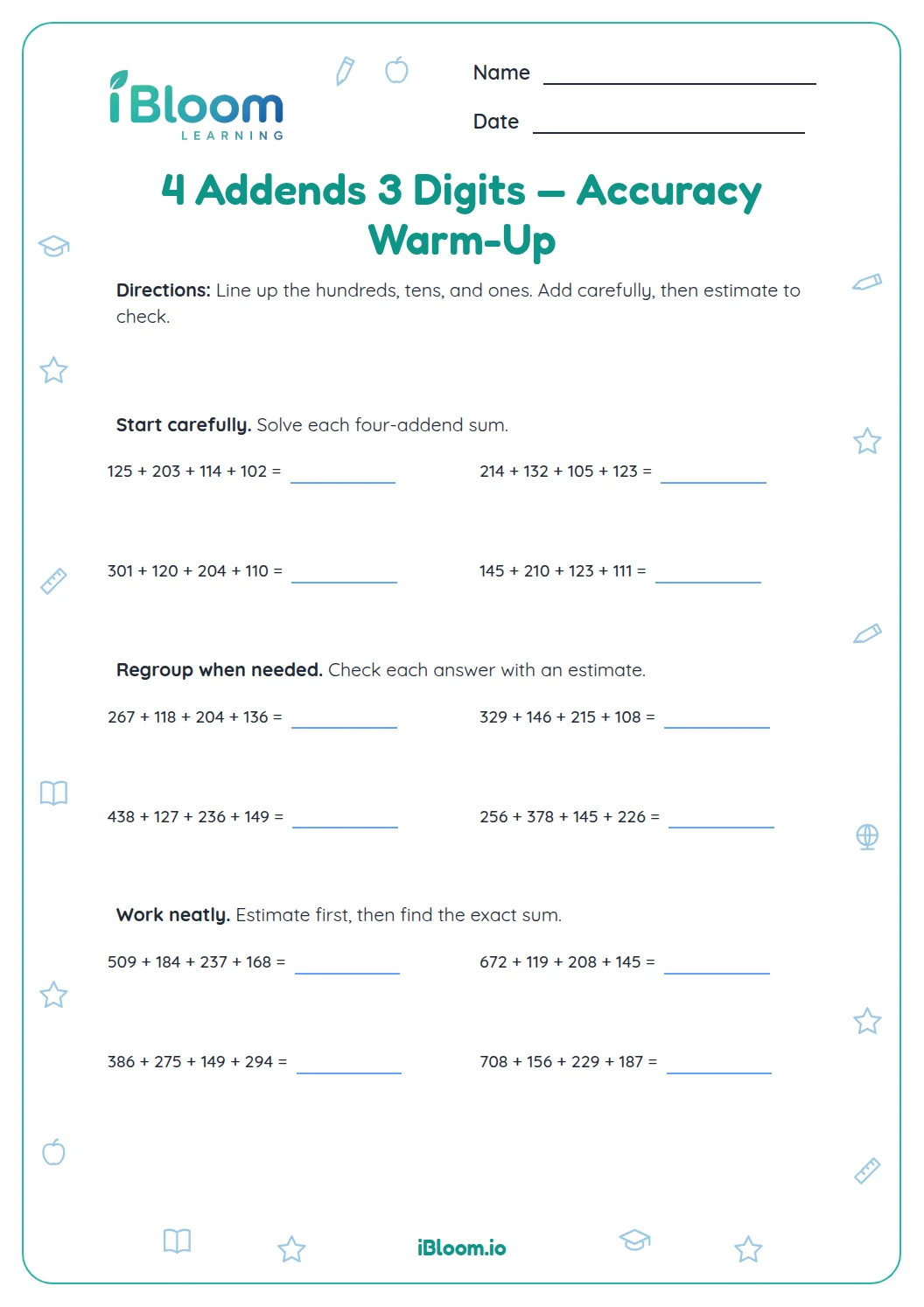
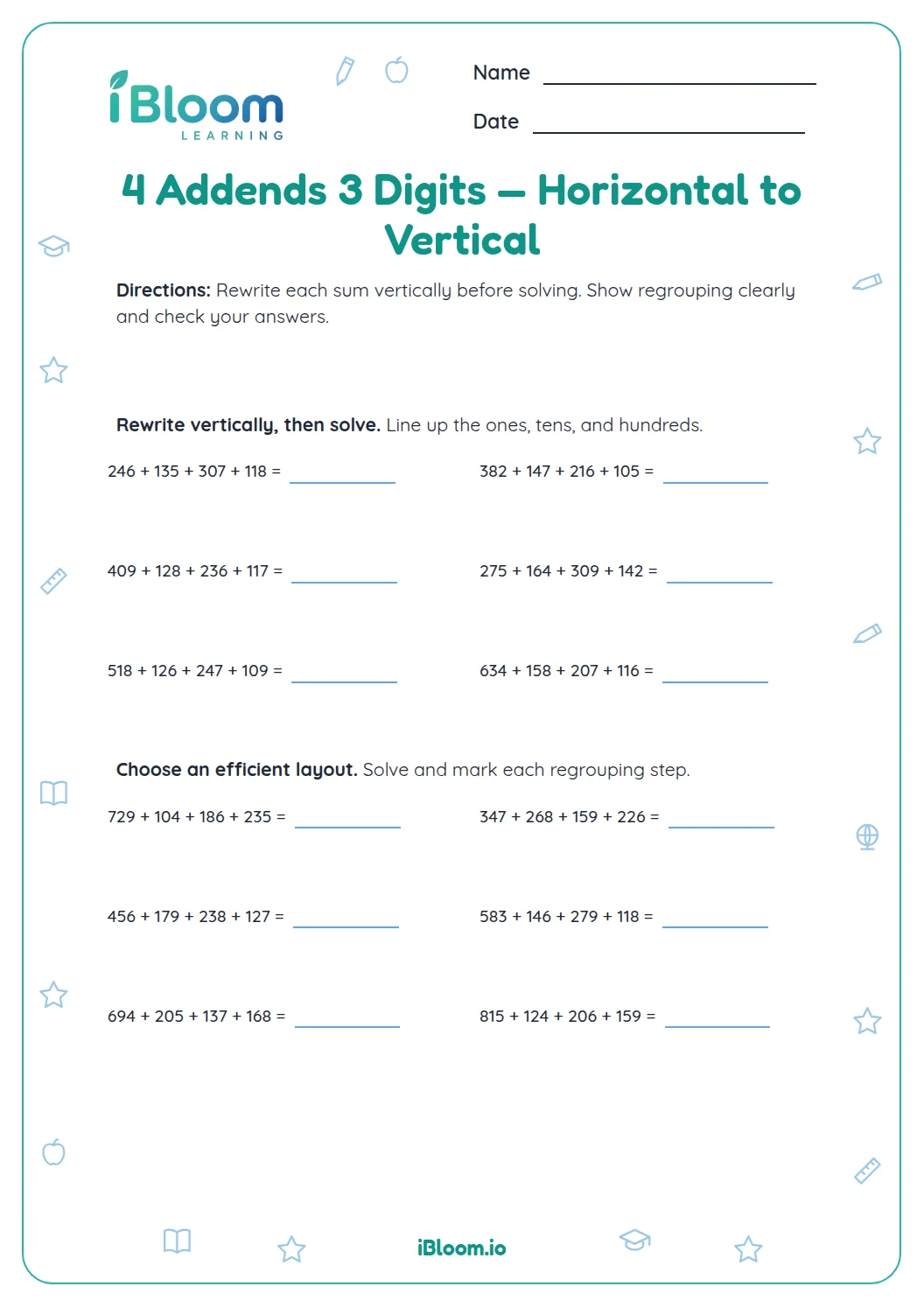
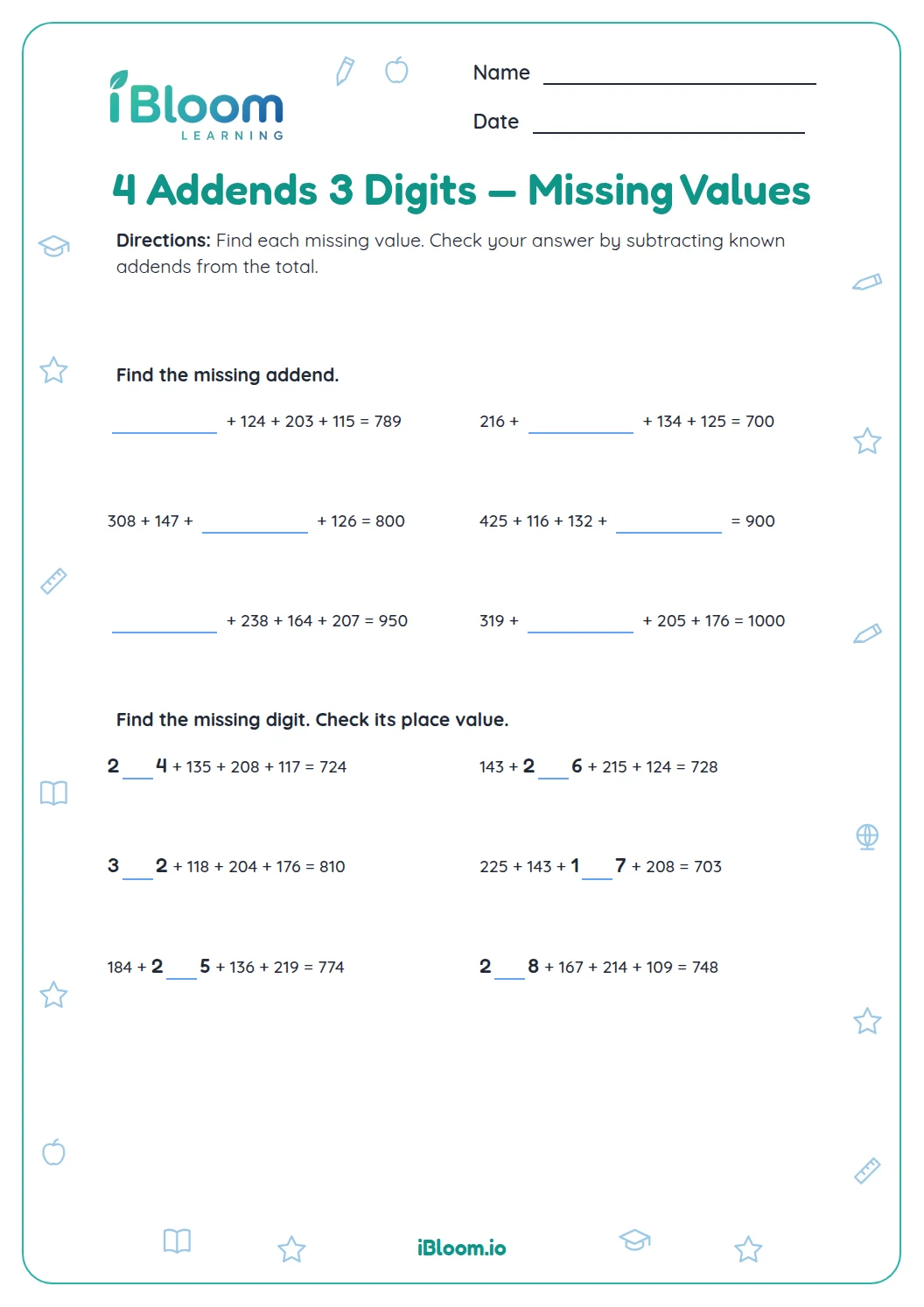
Sixteen drills ask learners to combine four three-digit addends and keep each place value aligned. The printable provides work space and an answer key for checking each result.
Aligned to CCSS.MATH.CONTENT.3.NBT.A.2
How can you work through the sheet?
For 124 + 213 + 102 + 341, place all four numbers in aligned rows before adding down each column.
What should learners check?
Use the place-value columns and directions printed on the worksheet. Work one item at a time, then use the key to locate and correct any calculation error. Use the answer key after completing the student pages to check each response.
How to use this worksheet
- 1Write all four addends in separate rows.
- 2Align the ones, tens, and hundreds places.
- 3Add the ones column and regroup if its total is ten or more.
- 4Add tens and hundreds, including values carried from the prior column.
- 5Estimate and compare your total with the key.
Common mistakes and quick fixes
The mistake
Leaving out an addend: count four rows before starting.
The fix
count four rows before starting.
The mistake
Misaligning a number: place every ones digit in the same column.
The fix
place every ones digit in the same column.
The mistake
Forgetting a carry: bring each regrouped ten or hundred into the next column.
The fix
bring each regrouped ten or hundred into the next column.
Add whole-number addends with place-value strategies and a written algorithm.
On this sheet:
Show the official wordingHide the official wording
Fluently add and subtract within 1000 using strategies and algorithms based on place value, properties of operations, and/or the relationship between addition and subtraction.
What to practice next
Make more practice
Further reading
Questions parents and teachers ask
How many drills are on the page?
There are 16 addition problems split into two sets. Every expression has four three-digit addends, with space to solve and an answer key for checking. Encourage the learner to write each step clearly and review the relevant columns or fraction parts when checking.
What makes these problems different from three-addend practice?
Each sum combines four numbers instead of three. Keeping all four rows visible helps learners track every addend and regrouping step. Encourage the learner to write each step clearly and review the relevant columns or fraction parts when checking. Have learners compare every written step with the place-value or fraction relationship shown by the problem, then correct the work before moving on.
Should all four numbers be added at once?
Yes. Align all four numbers first, then add one place-value column at a time. Regroup whenever a column total reaches ten or more. Encourage the learner to write each step clearly and review the relevant columns or fraction parts when checking.
Can sums be greater than 999?
Yes. Four three-digit addends can total more than 999. Record any regrouping into the thousands place when needed. Encourage the learner to write each step clearly and review the relevant columns or fraction parts when checking. Have learners compare every written step with the place-value or fraction relationship shown by the problem, then correct the work before moving on.
How do I use the answer key?
Solve the expressions first, then compare each result with the key. If one differs, check the alignment and regrouping in each column. Encourage the learner to write each step clearly and review the relevant columns or fraction parts when checking.