
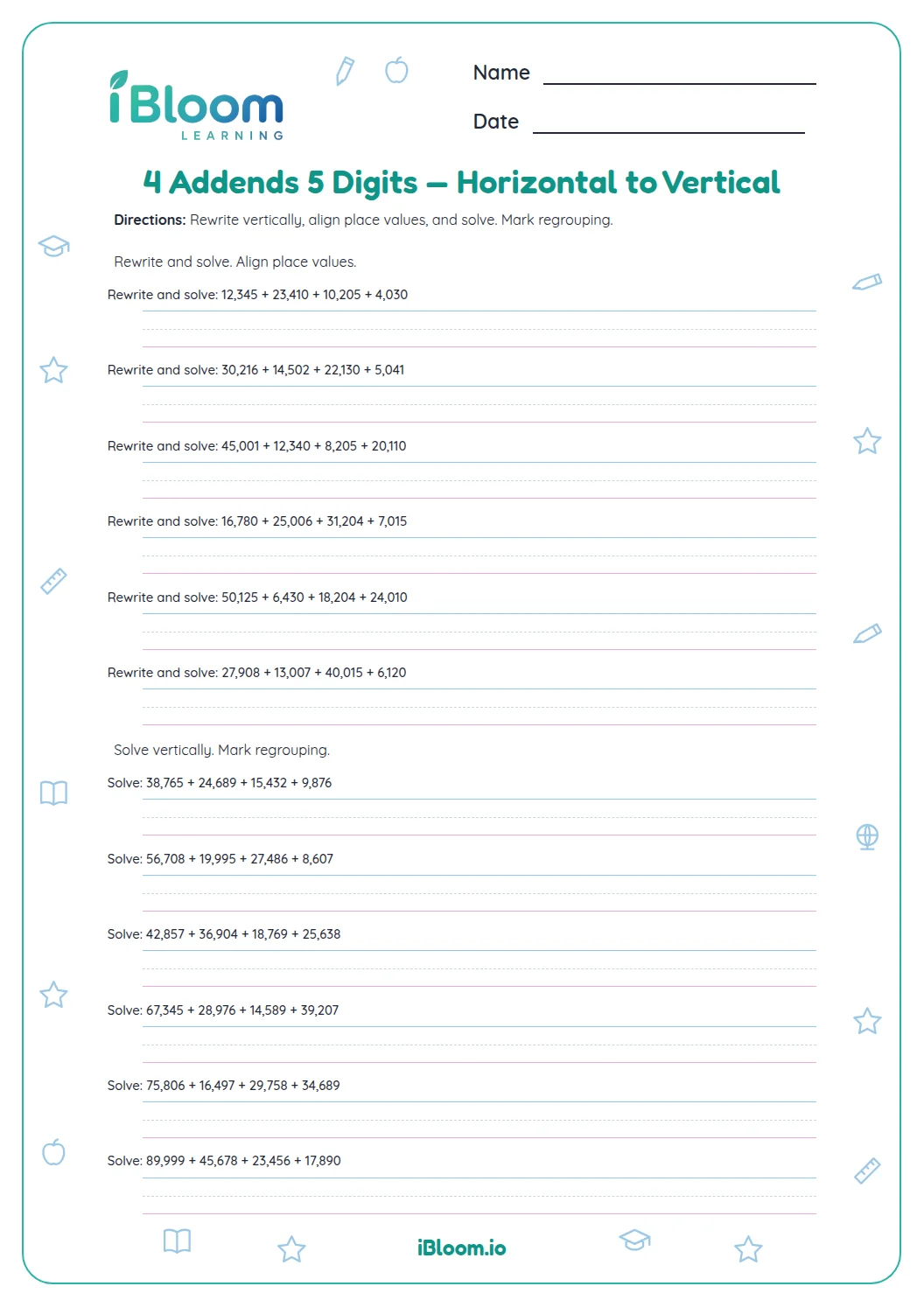
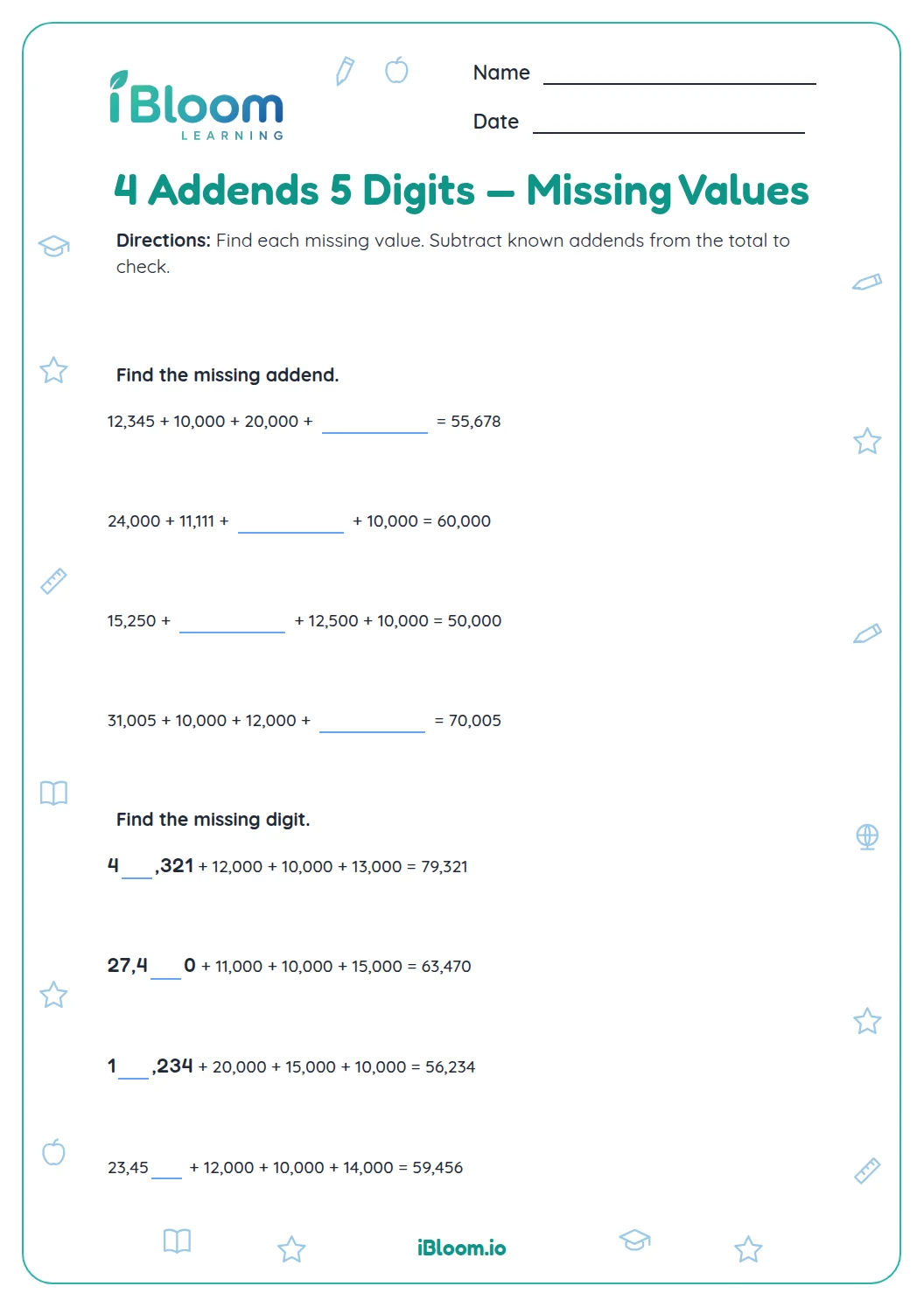
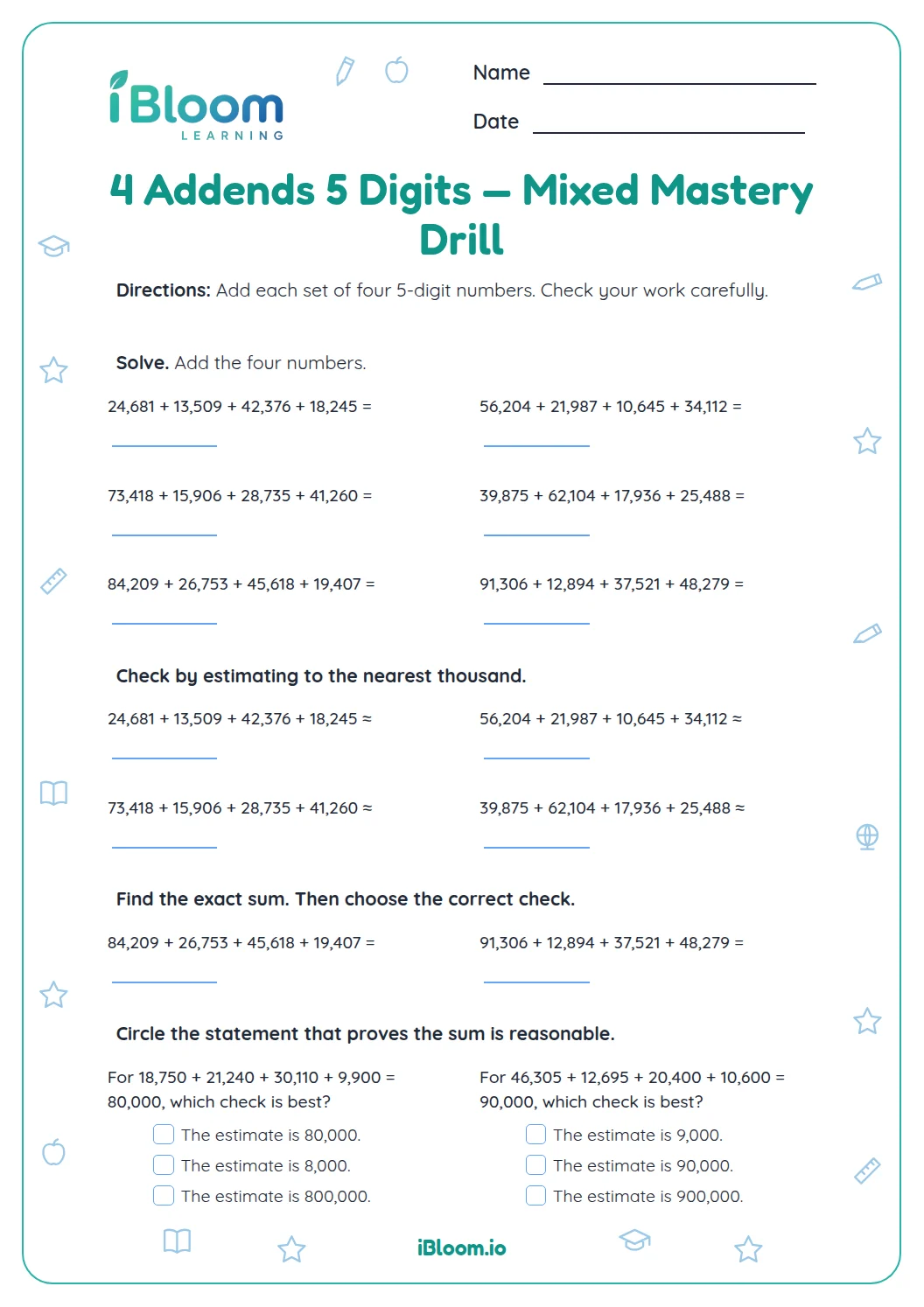
About this worksheet
This free printable adding four five-digit numbers worksheet gives Grade 5–6 students 16 focused problems. It practices Accurately add four five-digit whole numbers by aligning place values and regrouping. The separate answer key makes it easy to check each calculation after students finish.
How can you solve adding four five-digit numbers problems?
Align the ones, tens, hundreds, thousands, and ten-thousands places before adding. In the first problem, the four addends total 56,535. An estimate near 56,000 helps catch a place-value or regrouping error.
- 123,410 + 12,005 + 10,120 + 11,000 = 56,535.
What practice is on the page?
The worksheet moves from direct calculations to choices and short reasoning checks. Each item has one clear answer and the key matches the student page. Keep every plus sign visible, align each place, and check the total with an estimate.
How can you check an answer?
Estimate the size of the result before calculating. Then repeat the operation in a different order or use an inverse relationship to catch a sign, factor, or place-value slip.
How to use this worksheet
- 1Read the directions for the current part.
- 2Copy each operation carefully, including every sign.
- 3Work one step at a time and simplify when appropriate.
- 4Estimate whether the result is reasonable.
- 5Use the separate key to find and correct any missed step.
Common mistakes and quick fixes
The mistake
Changing the operation while copying.
The fix
Point to each symbol and number before beginning the calculation.
The mistake
Stopping before simplifying a fraction.
The fix
Find a common factor in the numerator and denominator and reduce.
The mistake
Trusting an answer that is far from a reasonable estimate.
The fix
Estimate first, then recompute the operation to locate the slip.
What to practice next
Make more practice
Questions parents and teachers ask
How can students check a four-addend sum?
Align all five place values and add by column, regrouping when a column totals ten or more. Estimate the total first, then compare the exact sum with that estimate. The key provides checked totals for all 16 problems. This gives a quick check on regrouping and helps catch a digit placed in the wrong column.
How many questions and pages are included?
The worksheet has 16 sums across two worksheet pages, plus two answer-key pages. The matching answer-key pages list the checked total for every four-addend problem. Students can complete both worksheet pages before using the corresponding answer-key pages. Each page has a clear heading and numbered items.
How should students check their work?
Line up ones through ten-thousands, then add each column and regroup as needed. Estimate the total before calculating. Afterward, compare your sum with the separate key and redo any column where the totals disagree. An estimate can reveal an unlikely total before students spend time checking individual columns.
How long does this worksheet take?
Plan for about 20 minutes, allowing extra time to show column work. Each problem has four five-digit addends, so students practice aligning place values and regrouping across columns. The separate key makes checking each total straightforward. Some students may need additional time to show regrouping clearly for each five-digit addend.
Why does every addend need a plus sign?
Write each addend with its own plus sign, align all place values, and regroup column by column. For example, 23,410 + 12,005 + 10,120 + 11,000 = 56,535. Estimation provides a quick accuracy check. The signs make the four positive addends easy to distinguish when copying the expression.