

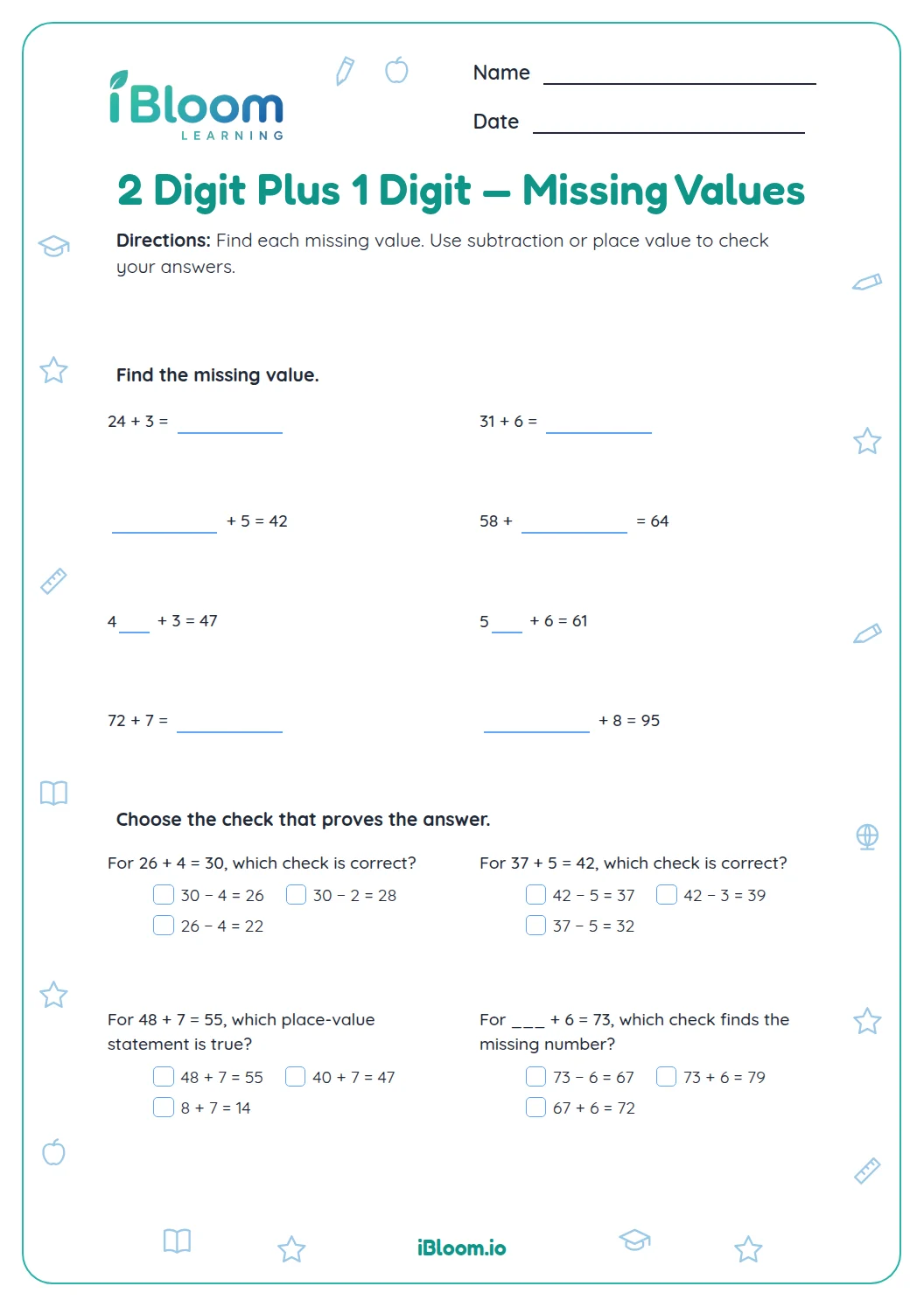
About this worksheet
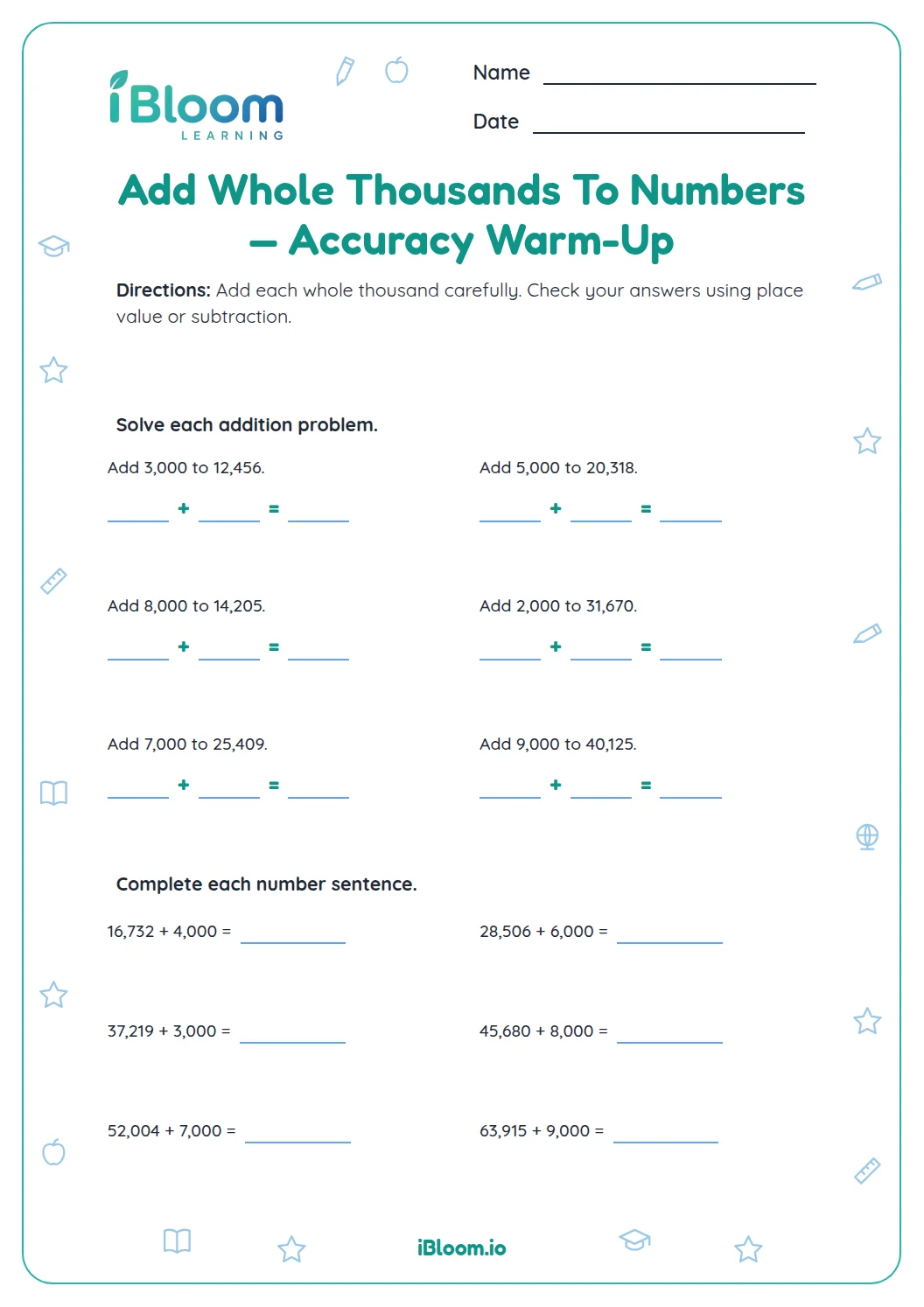
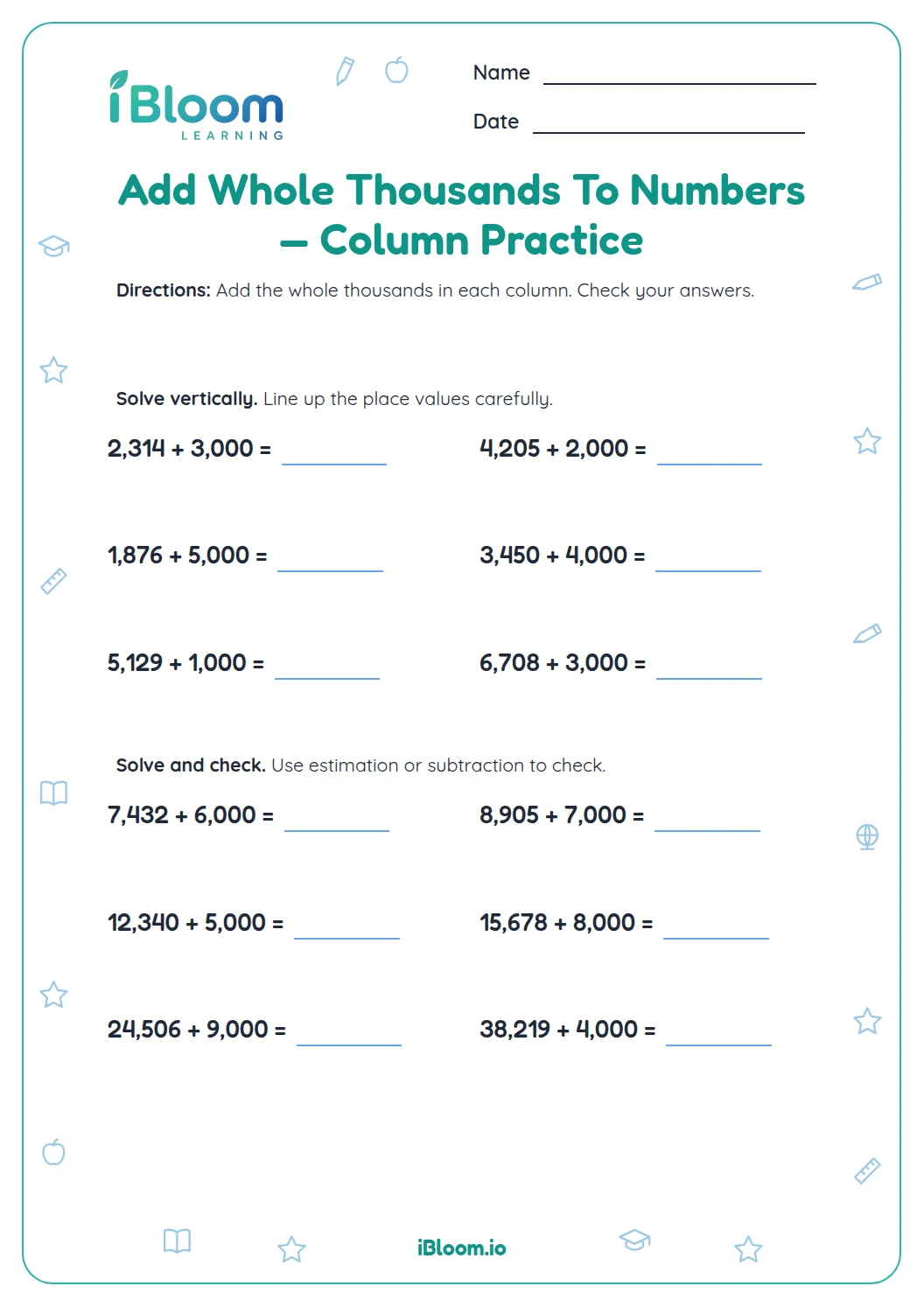
This Grade 5 printable gives students 14 mixed problems on adding whole thousands to larger numbers. It includes six exact sums, four estimates rounded to the nearest thousand, and four missing starting values solved with the inverse operation. Commas separate thousands groups, and the answer key lists every response. The addition practice uses the multi-digit whole-number algorithm described in CCSS 4.NBT.B.4.
Aligned to 4.NBT.B.4
What skills does the whole-thousands drill use?
Part A asks students to add a whole-thousand addend to a larger number. Part B asks for an estimate of a sum to the nearest thousand. Part C reverses subtraction to recover a missing starting value.
The problems include carries across place-value boundaries, including into a new millions group. Keep commas in large answers so each group of three digits is easy to read.
- Part A, questions 1–6: exact sums with whole thousands
- Part B, questions 7–10: sums estimated to the nearest thousand
- Part C, questions 11–14: missing starting values using subtraction
- The answer key includes commas and one answer per problem
How can you add across a place-value boundary?
In 709,999 + 6,000, the sum is 715,999. Adding 6,000 changes the thousands group and carries into the hundred-thousands place. Subtracting 6,000 from 715,999 returns 709,999.
- 1709,999 + 6,000 = ___
- 2709,999 + 6,000 = 715,999; check: 715,999 − 6,000 = 709,999.
What should students check in a large sum?
A carry can move through more than one place. For 2,999,999 + 7,000, the result is 3,006,999; check each place and keep the thousands comma in the answer.
How to use this worksheet
- 1Line up the place values mentally or on scratch paper for each exact sum.
- 2Add the whole-thousand amount and check for carries into higher places.
- 3In Part B, calculate or estimate the sum, then round to the nearest thousand.
- 4In Part C, add the stated difference to the number after the minus sign.
- 5Write commas in large numbers and check with the separate answer key.
Common mistakes and quick fixes
The mistake
Changing only the thousands digits when a carry reaches another place.
The fix
Add from the thousands place and track every carry into the next place.
The mistake
Dropping or moving a comma in a seven-digit answer.
The fix
Group digits in threes from the right and place commas between the groups.
The mistake
Subtracting the difference from the final value in Part C.
The fix
The prompt gives the result after subtraction; add the subtracted amount back to recover the starting value.
Common Core alignment
The worksheet practices number operations and place-value reasoning in the Common Core State Standards for Mathematics.
Fluently add and subtract multi-digit whole numbers using the standard algorithm.
On this sheet: Students use the standard addition algorithm to add whole-thousand addends across place-value boundaries.
Show the official wordingHide the official wording
Fluently add and subtract multi-digit whole numbers using the standard algorithm.
What to practice next
Make more practice
Further reading
Questions parents and teachers ask
What does adding whole thousands mean?
The second addend is a multiple of 1,000, such as 6,000 or 25,000. Add it to the larger number by place value. When a digit passes 9, carry into the next place and continue checking the remaining digits. without changing the other places.
How do I estimate a sum to the nearest thousand?
Find the sum, then round it to the nearest thousand. In 248,735 + 7,000, the sum is 255,735, which rounds to 256,000. Part B gives each of its four estimates its own prompt and keyed answer. The key uses commas in each large answer.
How does the inverse-operation part work?
If a starting number has a stated amount subtracted and the result is shown, add the subtracted amount to that result. For ___ − 6,000 = 74,325, the missing starting number is 80,325. Check the recovered value in the original subtraction equation.
Why are commas used in the answers?
Commas mark groups of three digits, making large numbers easier to read and check. For example, the sum of 709,999 and 6,000 is 715,999. Keep the commas when recording the answers. The key uses the same comma grouping as the prompts.
What grade is this worksheet for?
The page is intended for Grade 5 learners practicing whole-thousands addition with larger numbers. It includes exact sums, estimates and inverse-operation checks, with values extending into the millions. Commas make each value easier to read. The algorithm stays the same across all three sections.