
About this worksheet
This worksheet gives Grade 4 practice adding several whole hundreds at once. Students solve sums with three or four addends, judge whether worked totals are correct, and use a total to find a missing addend. The mixed format rewards careful place-value tracking: each addend ends in two zeros, so the work is about combining hundreds accurately. A separate answer key is included.
Aligned to 4.NBT.B.4
What does the mixed drill ask students to do?
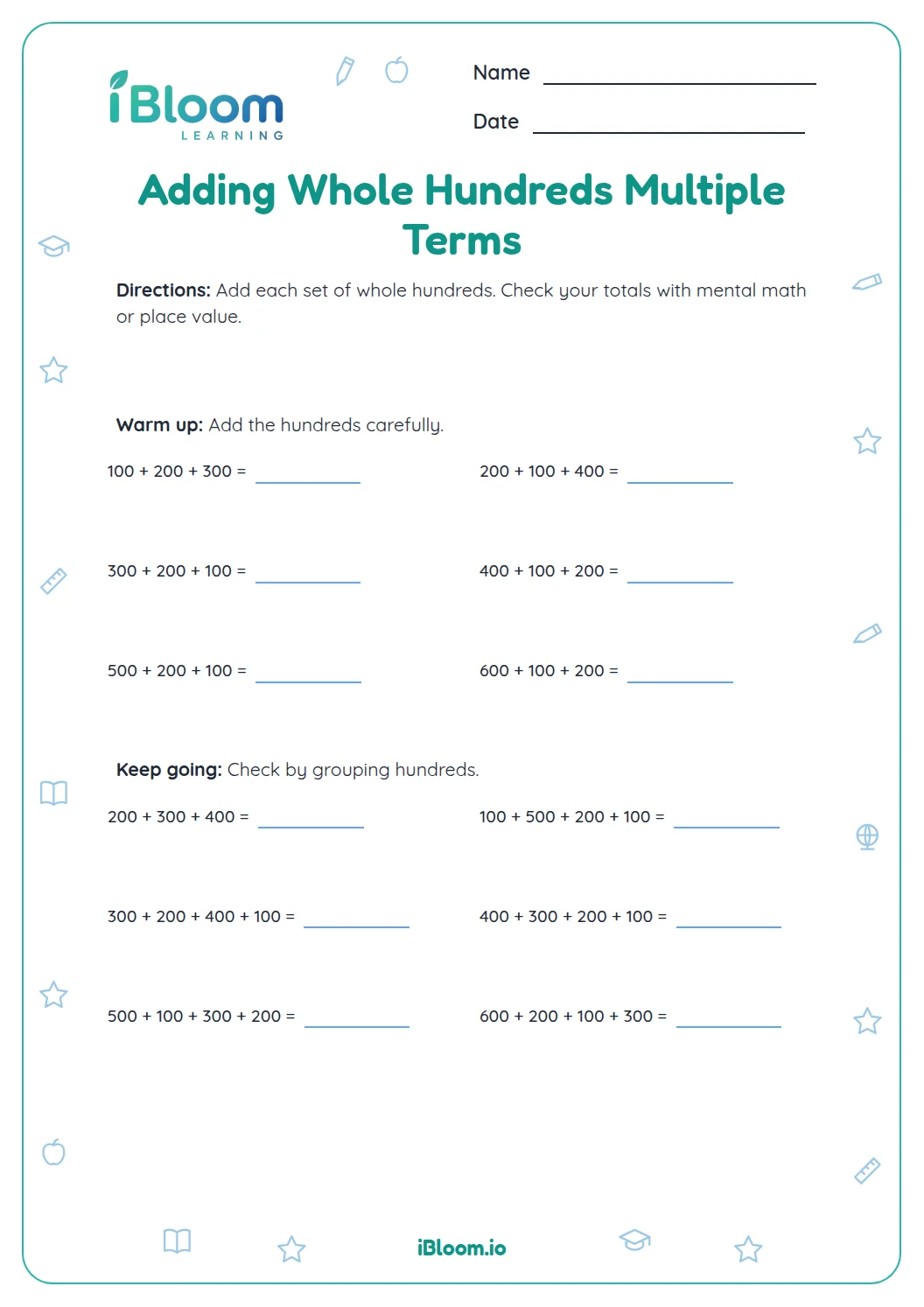
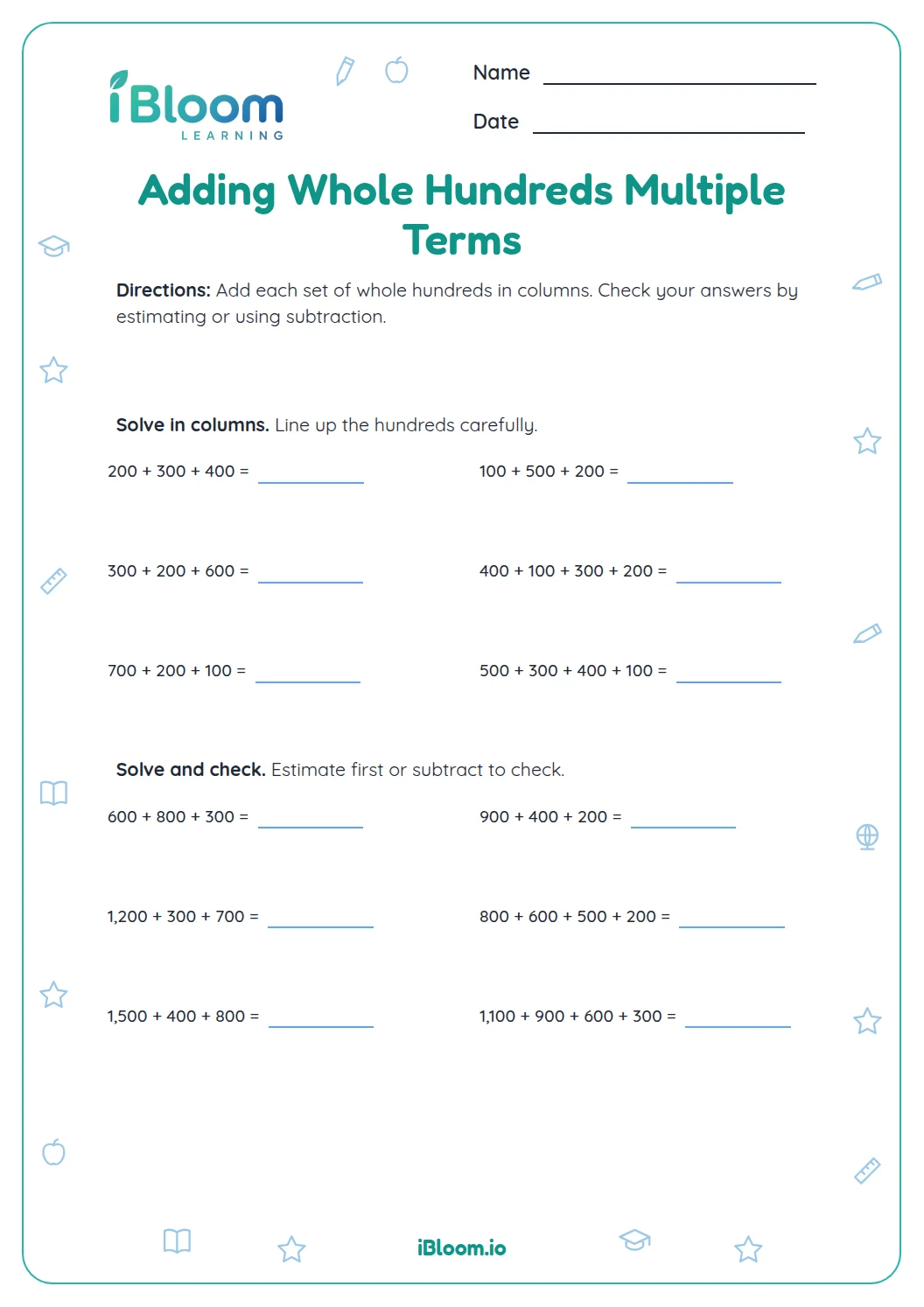
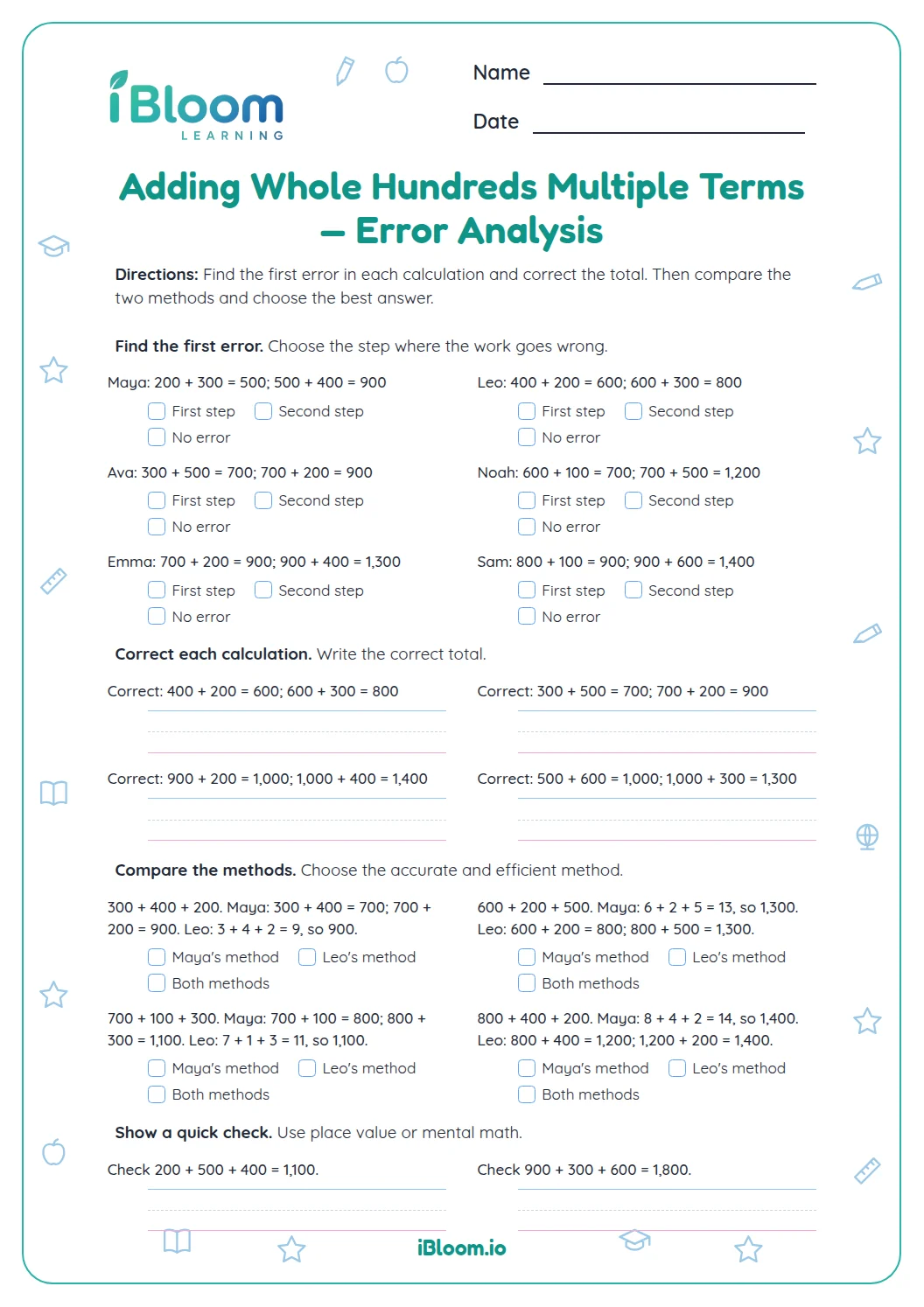
Part A has six sums with three or four whole-hundred addends. Part B asks students to mark five written claims Yes or No; three claims are deliberately false, so each total needs checking. Part C supplies a total and hides one addend.
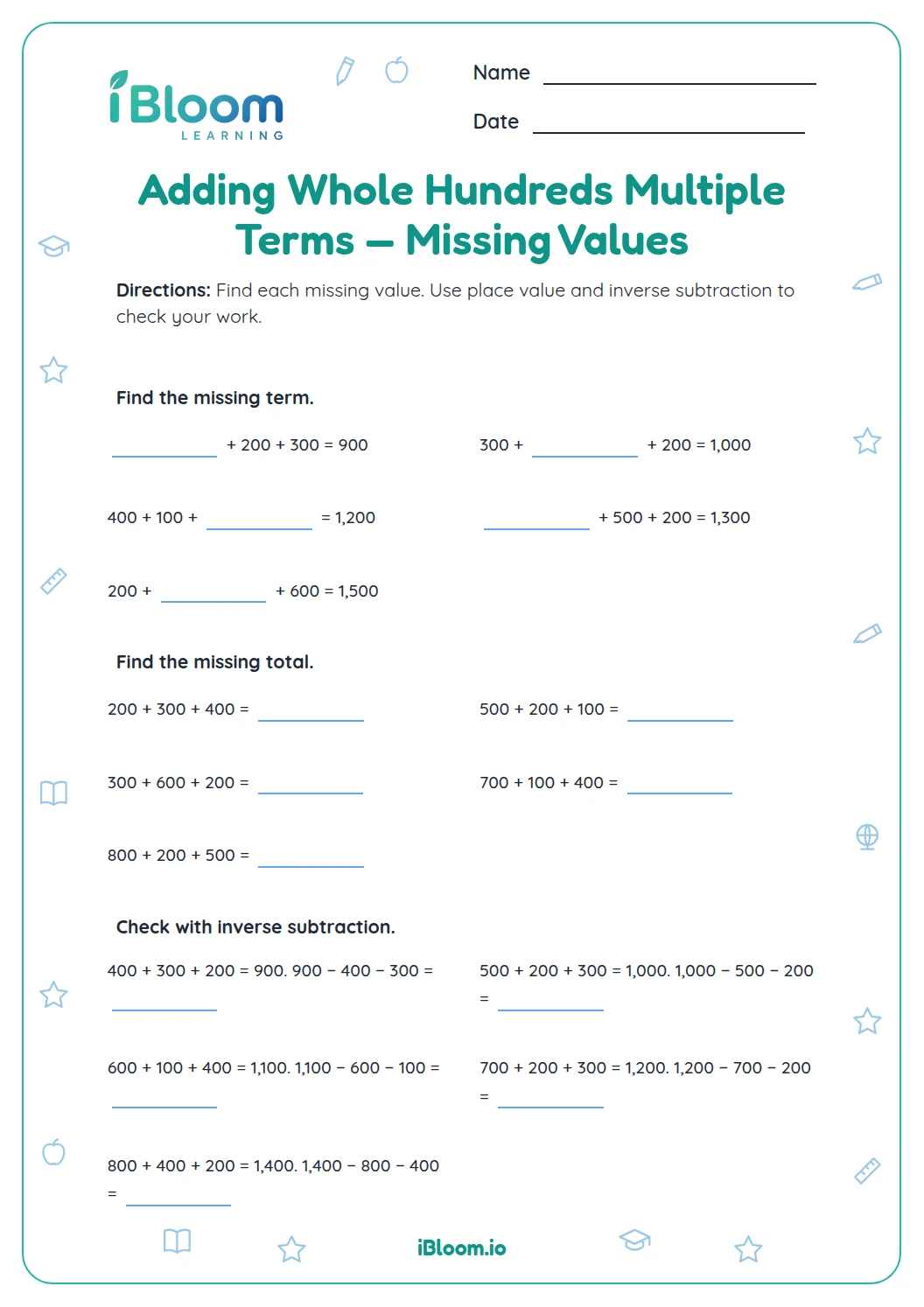
For example, in 4,200 + ___ + 600 + 300 = 6,000, first combine the known terms: 4,200 + 600 + 300 = 5,100. The missing addend is 900.
- Part A: 6 sums
- Part B: 5 check-the-sum choices
- Part C: 5 missing addends
How can you check a sum with several addends?
Keep the place value visible. Since every number is a whole hundred, adding 27 hundreds is the same as adding 2,700. A second check is to regroup the addends in a convenient order and see whether the total stays the same.
- 12,700 + 1,300 + 800 = 4,700
- 22,700 + 1,300 = 4,000
- 34,000 + 800 = 4,800
- 4The claim is No.
How should students use the answer key?
For Part B, ask students to recompute every claim before looking at the key. If a claim is false, naming the actual sum is a useful correction. In Part C, substitute the missing hundred and check that all addends make the printed total.
How to use this worksheet
- 1Add the hundreds in each Part A equation and record the full sum.
- 2For each Part B claim, calculate the left side before choosing Yes or No.
- 3When a claim is false, write the correct total beside it.
- 4For Part C, add the visible terms and subtract that amount from the total.
- 5Substitute each missing addend back into its equation to check.
Common slips and fixes
The mistake
Dropping a zero when adding hundreds.
The fix
Think in hundreds, then restore the two zeros in the final sum.
The mistake
Choosing Yes because a printed total looks close.
The fix
Recompute the left side independently before comparing.
The mistake
Adding the visible terms to the total in Part C.
The fix
Subtract the known addends from the total to find what is missing.
Common Core alignment
Students use multi-digit addition strategies on sums made from whole hundreds.
Add multi-digit whole numbers accurately, including sums made of whole hundreds.
On this sheet: The direct addition items practice accurate addition of multi-digit whole numbers.
Show the official wordingHide the official wording
Fluently add and subtract multi-digit whole numbers using the standard algorithm.
What to practice next
Make more practice
Further reading
Questions parents and teachers ask
How many questions are on this whole-hundreds sheet?
There are 16 questions in three parts: six multi-term sums, five Yes or No checks, and five missing-addend equations. The answer key gives one sum, judgment, or missing hundred for every item. The printable has two worksheet pages and two key pages.
What should students do when a Part B claim is false?
They should choose No after calculating the addends, then write or say the correct total. For example, 2,700 + 1,300 + 800 equals 4,800, so a claim of 4,700 is false. Recomputing is the point of the error-checking section.
How do you find a missing whole-hundred addend?
Add the terms that are visible, then subtract that subtotal from the printed total. If 4,200 + ___ + 600 + 300 equals 6,000, the visible terms total 5,100, leaving 900. Put 900 back in the blank to verify.
What grade is this worksheet for?
The page is labeled Grade 4 and focuses on adding multi-digit whole numbers made of whole hundreds. Students who are comfortable with place value can use the first part as a warm-up, then spend more time checking claims and solving for missing addends.
Is the answer key included?
Yes. A separate answer-key page lists all 16 answers. For the Yes or No section, students can also write the corrected sum for any false claim, then compare their reasoning with the key. That lets them check both their choice and their calculation, and it makes the key useful for reviewing place-value errors.