
About this worksheet
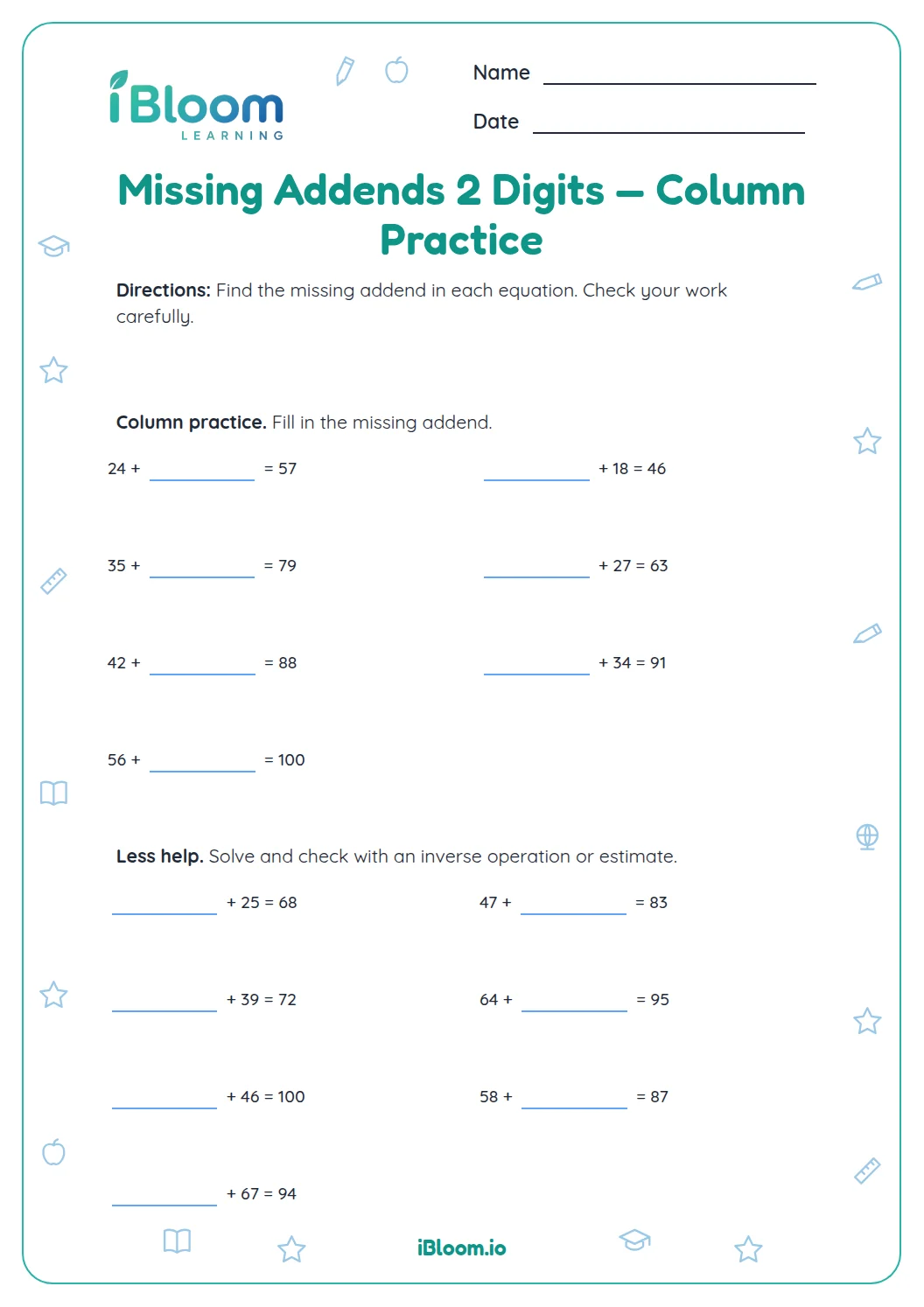
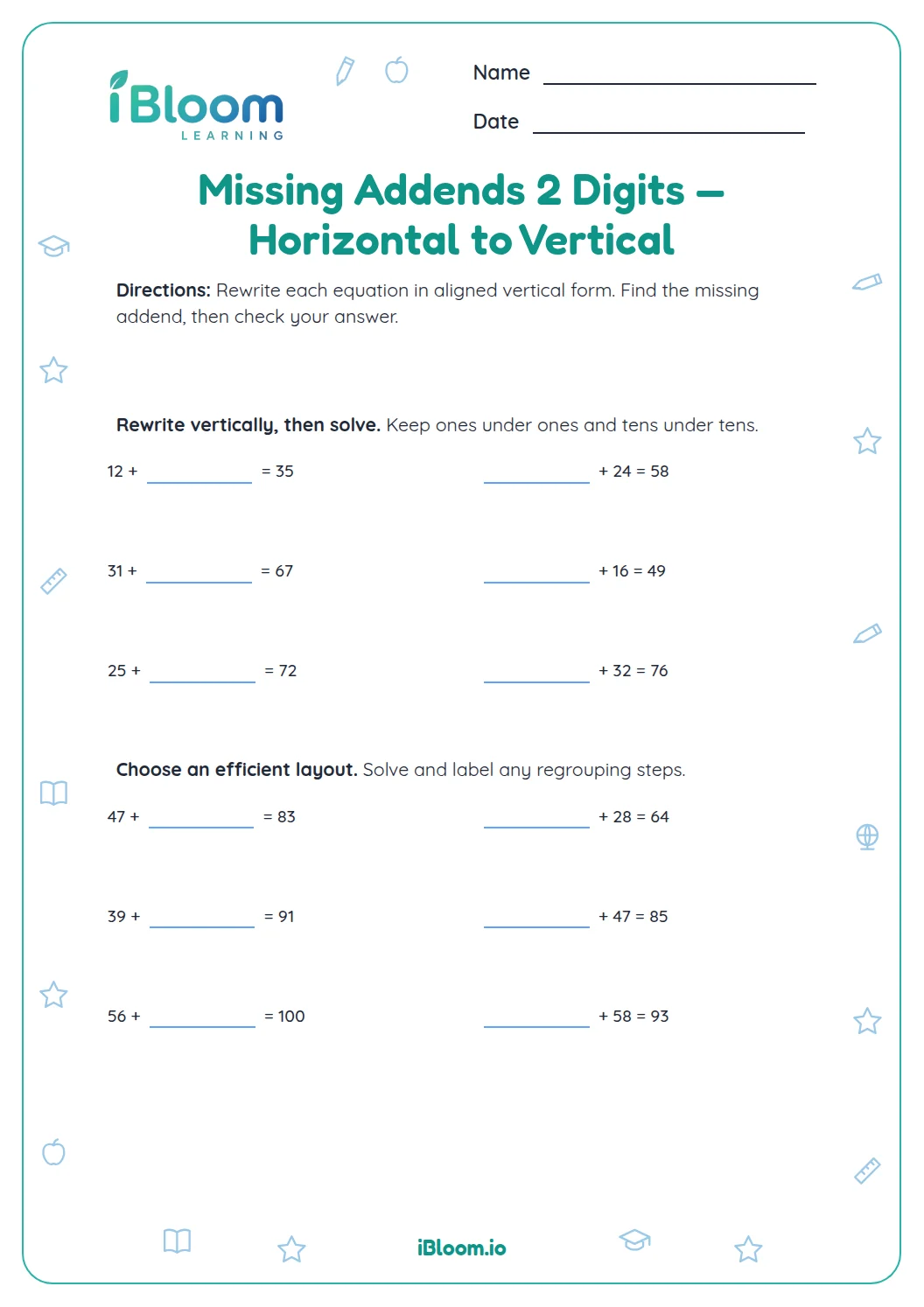
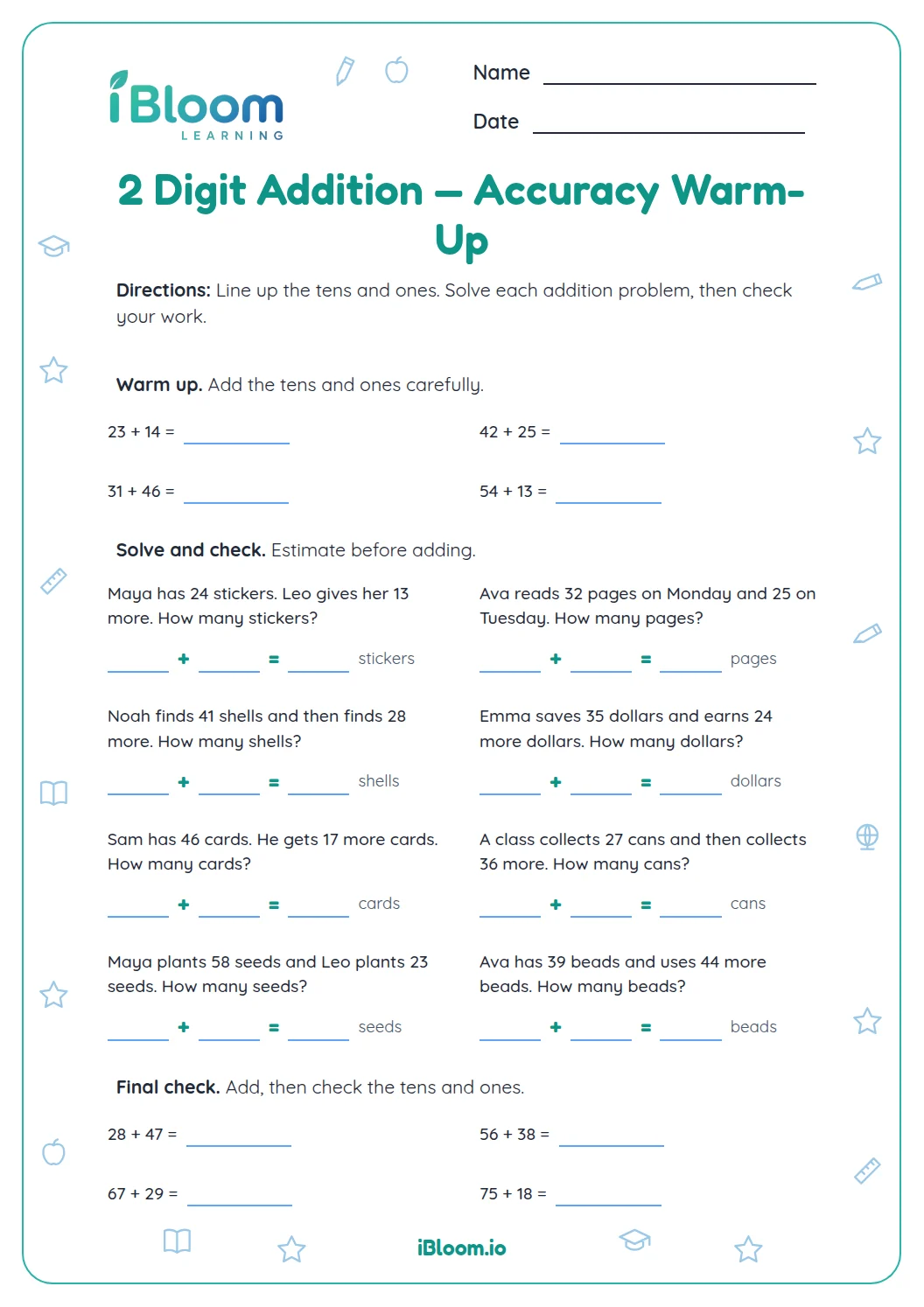
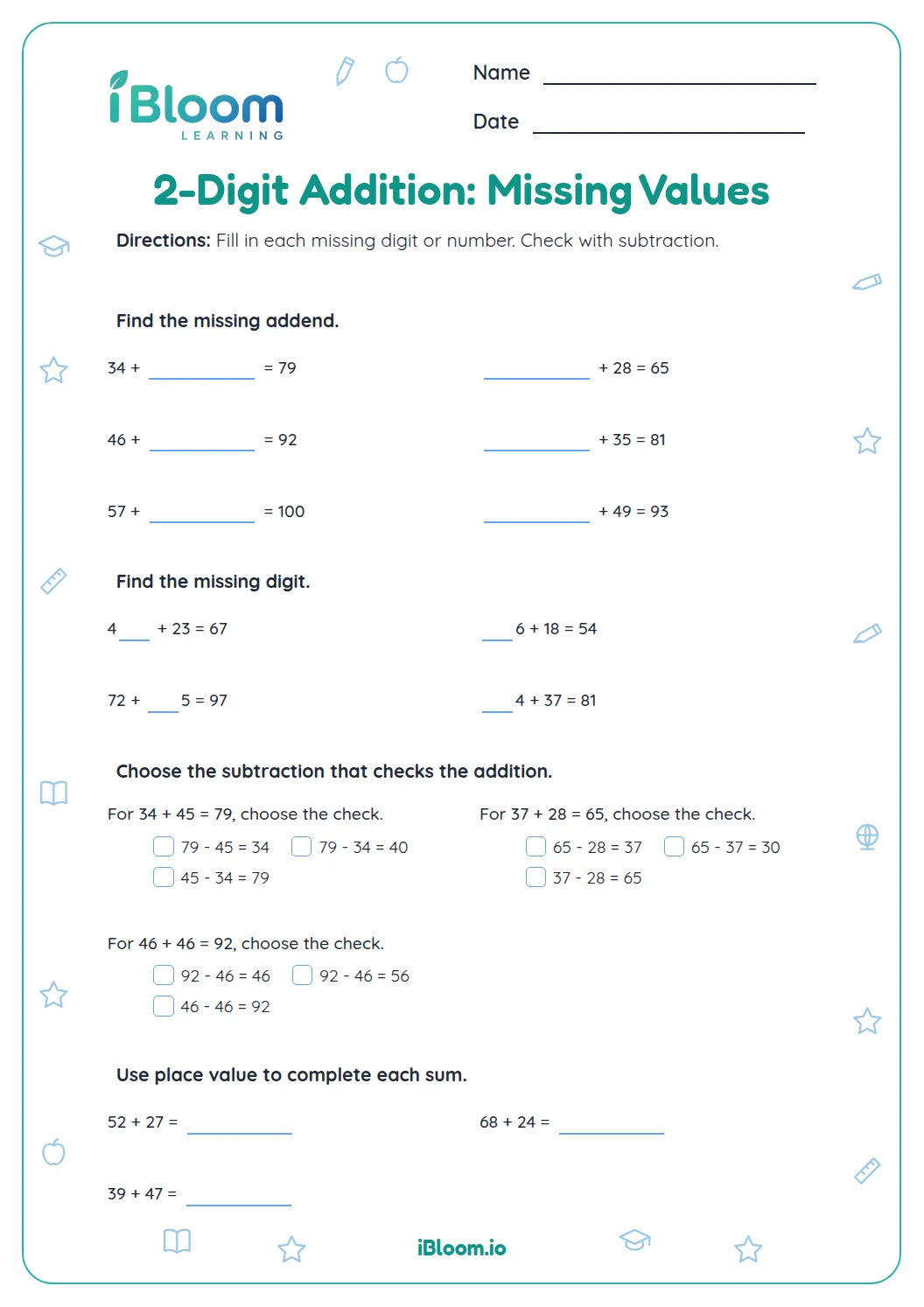
This Grade 2 printable gives students 18 two-digit addition equations with one missing addend. The totals are numerals, including a final set that makes 100. Students can subtract the known addend from the total and check by adding; the separate answer key lists all 18 missing numbers. The page practices addition and subtraction within 100 (CCSS 2.NBT.B.5).
Aligned to 2.NBT.B.5
What kinds of missing addends appear?
All 18 items have two addends and a printed total. Students find the missing part in equations such as 24 + ___ = 50, then check that both addends make the stated sum.
Parts A and B use a range of two-digit totals. Part C focuses on sums of 100, giving students a repeated target while the known addend changes.
- Part A, questions 1–6: find a missing addend in two-digit sums
- Part B, questions 7–12: use subtraction to find the missing part
- Part C, questions 13–18: complete sums of 100
- The key gives all 18 missing addends
How can subtraction find the missing addend?
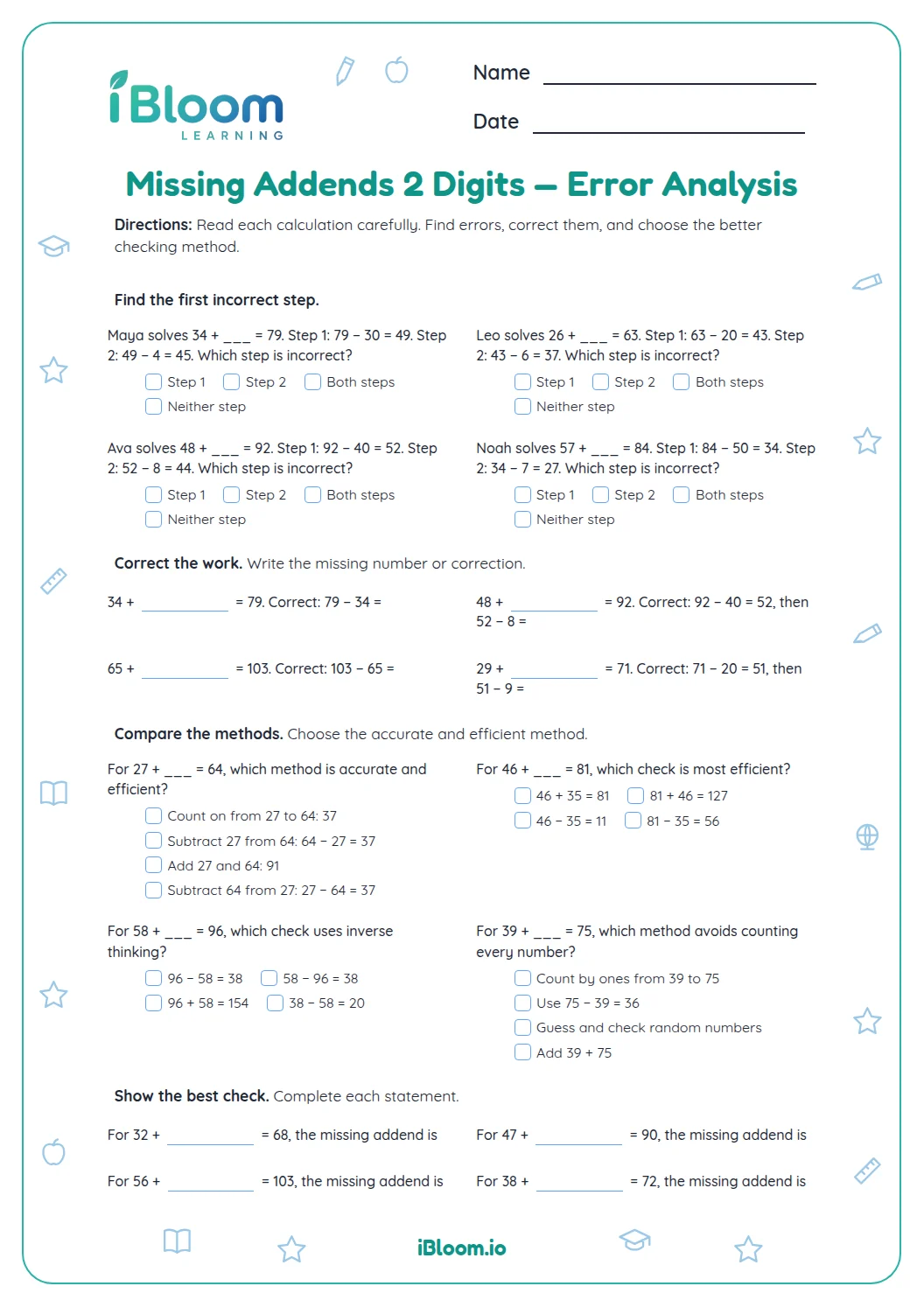
In 24 + ___ = 50, take the known addend away from the total: 50 − 24 = 26. Check with addition: 24 + 26 = 50.
- 124 + ___ = 50
- 250 − 24 = 26; 24 + 26 = 50.
How do you avoid adding the total by mistake?
The blank is one addend, not the answer. For 31 + ___ = 46, calculate 46 − 31 = 15; then verify 31 + 15 = 46.
How to use this worksheet
- 1Find the total and the addend already given.
- 2Subtract the known addend from the total.
- 3Write the difference in the blank.
- 4Add the two addends to check the printed total.
- 5In Part C, use 100 as the total each time, then check with addition.
Common mistakes and quick fixes
The mistake
Adding the known addend to the total instead of finding the missing part.
The fix
Subtract the known addend from the total, then add the two addends to check.
The mistake
Reversing the subtraction in 24 + ___ = 50.
The fix
Start with the total: 50 − 24 = 26.
The mistake
Writing a number that makes a nearby sum instead of the printed total.
The fix
Read the total again and substitute the missing number to confirm the equation.
Common Core alignment
The worksheet practices number operations and place-value reasoning in the Common Core State Standards for Mathematics.
Fluently add and subtract within 100 using strategies based on place value.
On this sheet: Each item uses two-digit addends and a missing addend; sums stay within 100.
Show the official wordingHide the official wording
Fluently add and subtract within 100 using strategies based on place value, properties of operations, and/or the relationship between addition and subtraction.
What to practice next
Make more practice
Further reading
Questions parents and teachers ask
How do you find a missing addend?
Subtract the addend you know from the total. For 24 + ___ = 50, calculate 50 − 24 = 26. Add 24 and 26 to confirm that the result is 50. This works whether the blank is before or after the known addend.
Are the totals printed as numerals?
Yes. Every total is written with digits, including the sums of 100 in Part C. Students can read the equation directly and focus on finding the missing addend. Read the printed total again before checking the completed equation. Then check by adding.
Do the problems involve regrouping?
Some differences require regrouping when subtracting the known addend from the total. Students may use place value or another accurate subtraction strategy, then check by adding the two parts. This keeps both addends and the total in their correct places.
What grade is this worksheet for?
The sheet is designed for Grade 2 practice with two-digit addition and subtraction within 100. It gives students one missing addend per equation and includes a final set with 100 as the target sum. Students can use this two-digit addition skill throughout the page.
Is every answer in the answer key?
Yes. The separate key lists one missing addend for each of the 18 equations. To check a response, add it to the printed addend and see whether the result matches the total. Substitute the missing number to confirm the printed total.