



About this worksheet
This worksheet builds accuracy with addition facts whose addends run from 11 through 20. Students inspect twelve short solution chains, deciding whether each rewrite and final total are sound, then solve six direct facts. The examples include correct mental strategies such as making a friendly ten, alongside a few plausible slips. The key identifies the status of every chain and gives each final sum.
Aligned to 3.OA.A.1
What should students inspect in a worked sum?
Part A presents six solution chains. Some are fully correct, including Leo’s 16 + 13 = 26 + 3 = 29. Students choose whether all steps are correct, the rewrite changes the sum, or the final total is wrong.
Part B adds six more chains with regrouping and friendly-number strategies. A correct chain is still correct even when it looks unusual; the original total and every rewritten total should agree.
- Part A: 6 strategy checks
- Part B: 6 additional checks
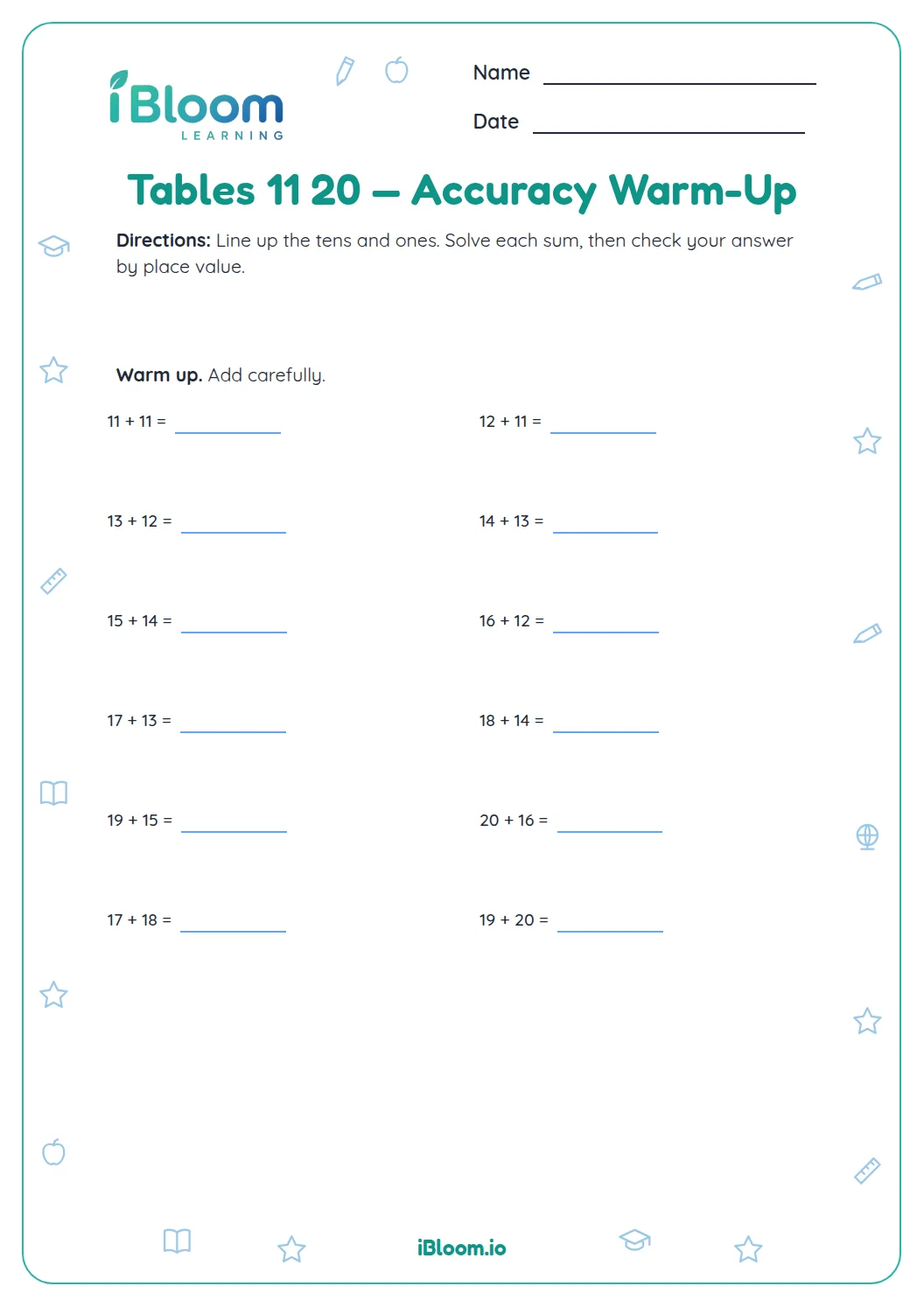
- Part C: 6 direct sums
How do you verify a rewrite?
Evaluate the original expression and the rewritten expression. For 16 + 13, splitting 13 into 10 + 3 gives 16 + 10 + 3 = 29. Rewriting 16 + 13 as 26 + 3 also keeps the total at 29.
- 116 + 13 = 26 + 3 = 29
- 216 + 13 = 29
- 326 + 3 = 29
- 4Both expressions equal 29, so the chain is correct.
Why finish with direct facts?
Part C asks students to solve six facts after analyzing other people’s methods. This gives a short independent check that the sums themselves are familiar, including combinations with teen addends.
How to use this worksheet
- 1Read the original addition sentence first.
- 2Calculate its value independently.
- 3Evaluate each rewritten expression and compare its value with the original.
- 4Check the final total as a separate step.
- 5Choose the option that describes the first issue, or that all steps are correct.
Common slips and fixes
The mistake
Marking every chain as wrong because the directions mention error analysis.
The fix
Some chains are correct; compare the values before choosing.
The mistake
Assuming a regrouping rewrite changes the total.
The fix
Evaluate both expressions. A valid rewrite moves value between addends without changing the sum.
The mistake
Checking only the final answer.
The fix
Inspect intermediate rewrites too, since an invalid step can sometimes land on a correct total by coincidence.
Common Core alignment
Students use addition relationships to interpret and verify worked sums.
Interpret addition through equal values and related multiplication structures.
On this sheet: The sheet uses addition facts and equivalent decompositions, supporting understanding of how number combinations preserve totals.
Show the official wordingHide the official wording
Interpret products of whole numbers, e.g., interpret 5 × 7 as the total number of objects in 5 groups of 7 objects each.
What to practice next
Make more practice
Further reading
Questions parents and teachers ask
Are all the worked solutions on this sheet wrong?
No. Several chains are correct, including Leo’s 16 + 13 = 26 + 3 = 29. Students should calculate the original expression and compare each rewritten expression with it. The answer choices include a choice for all shown steps being correct.
What does it mean for a rewrite to change the sum?
A rewrite changes the sum if it replaces an expression with one that has a different value. For example, 19 + 12 equals 31, while 29 + 2 equals 31 too, so that rewrite is valid. Students can compare both values directly.
How many questions are included?
The worksheet has 18 questions in three parts: twelve multiple-choice checks of worked addition and six direct addition facts. The separate key gives a status for each worked chain and the sums for the final part. The multiple-choice options let students mark a decision directly on the sheet.
What is a useful way to check an addition chain?
Find the value of the original addition first. Then evaluate every expression after an equals sign. If each value matches, the chain is correct; if not, select the choice describing the first faulty rewrite or the wrong final total.
What grade is the sheet for?
It is designed for Grades 3–4 addition practice with addends from 11 through 20. Students use familiar addition facts and equivalent decompositions to explain why a mental strategy works or identify where it stops matching the original sum. The final six equations provide a quick chance to solve without a worked chain.