



About this worksheet
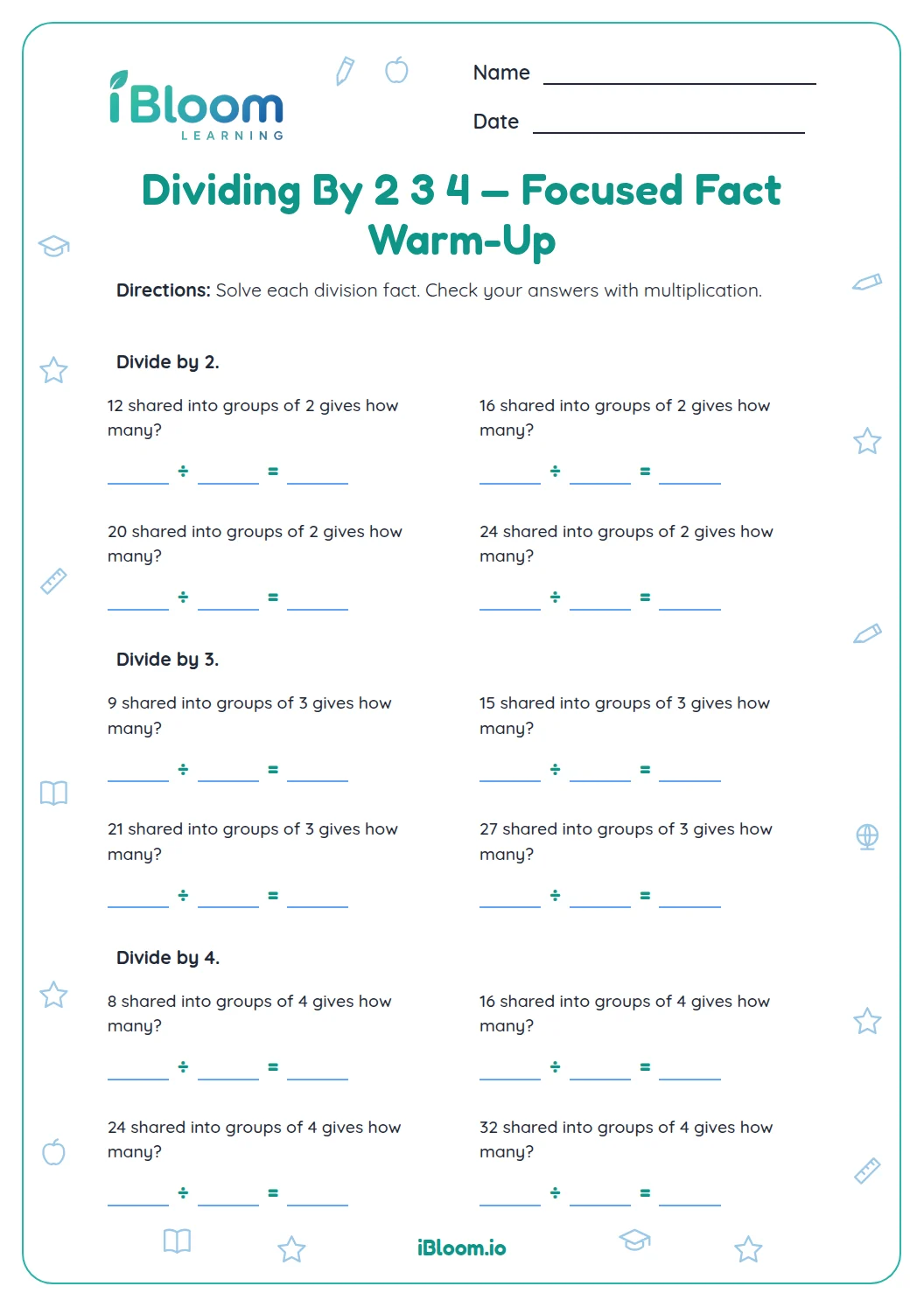
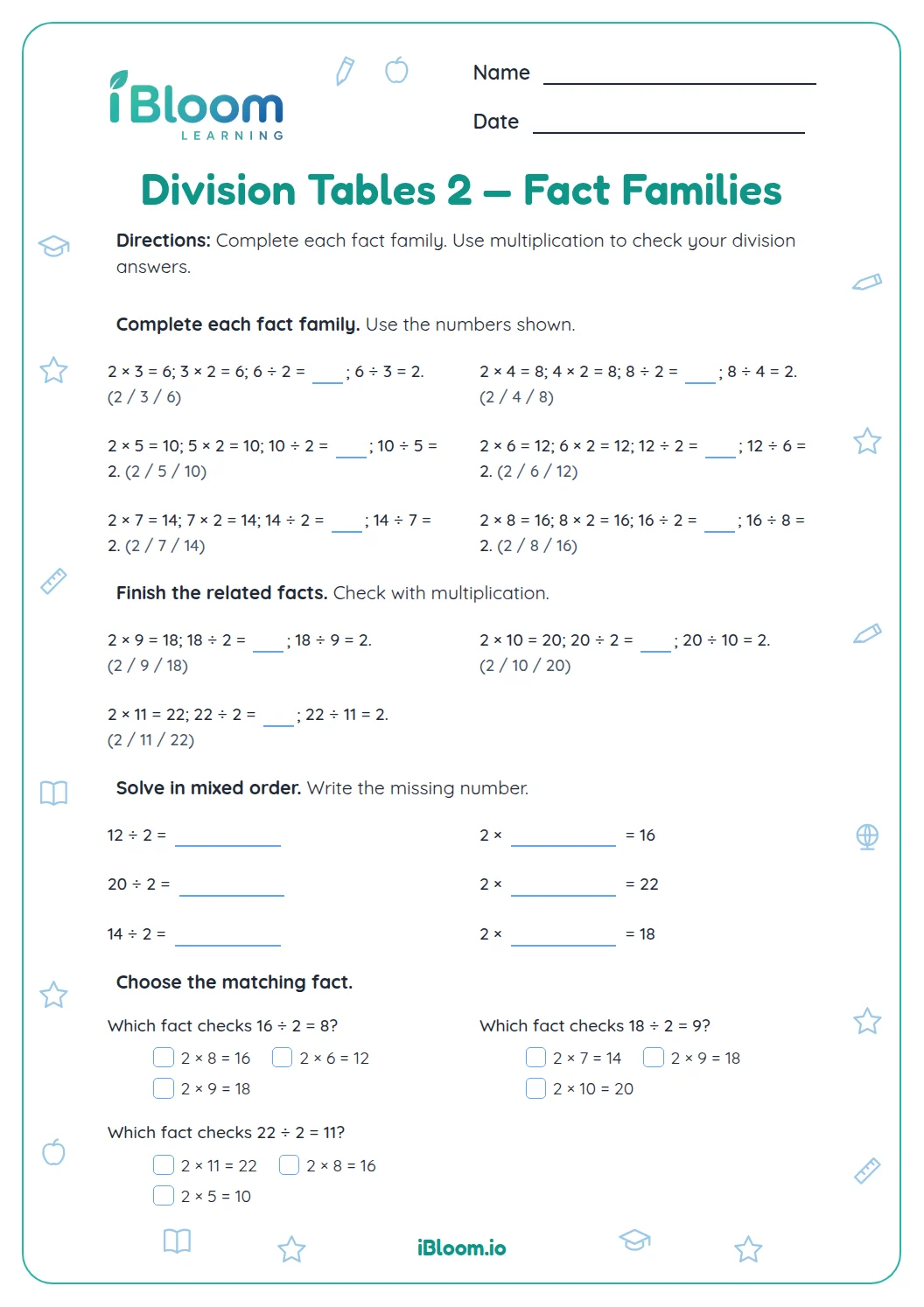
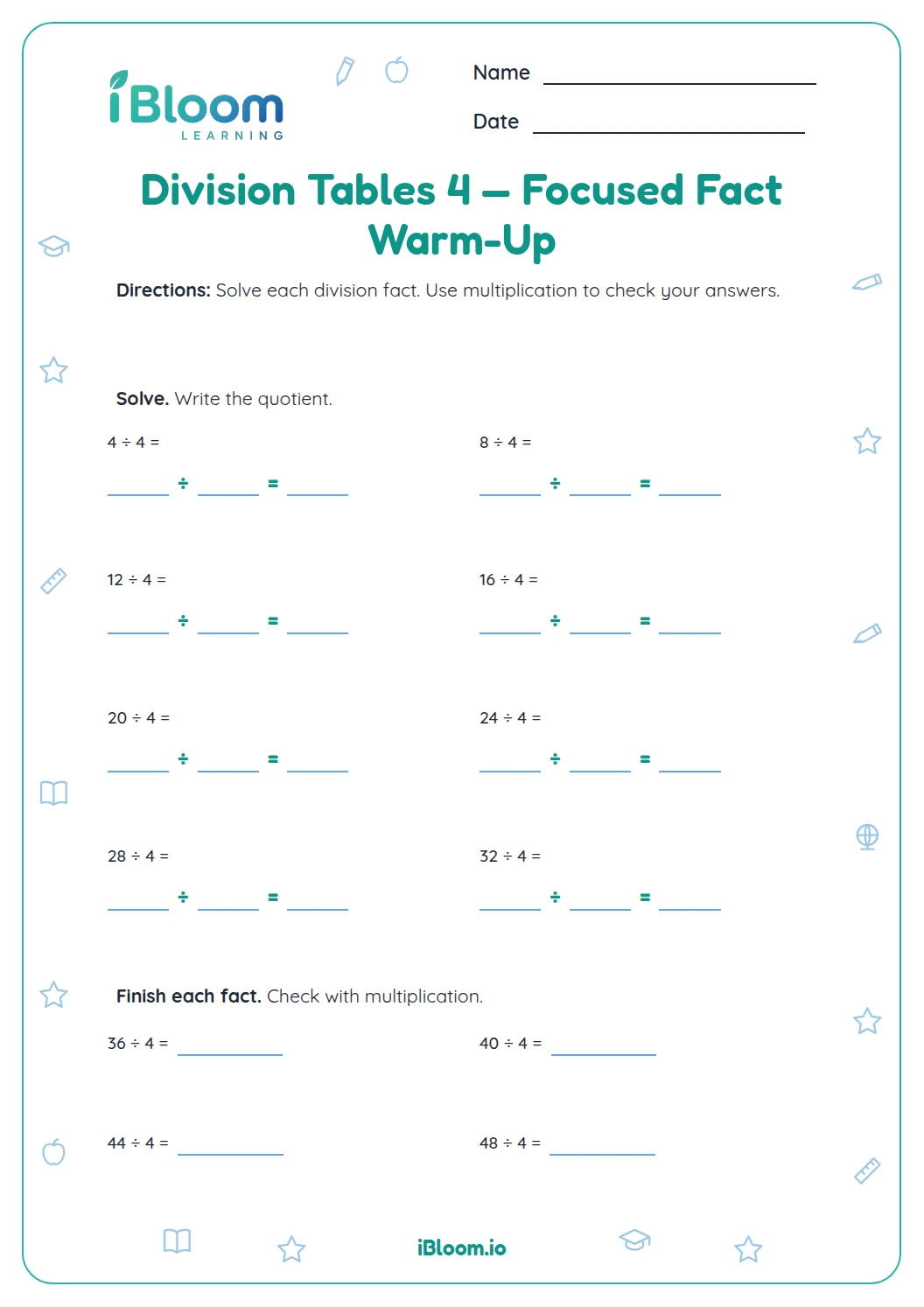
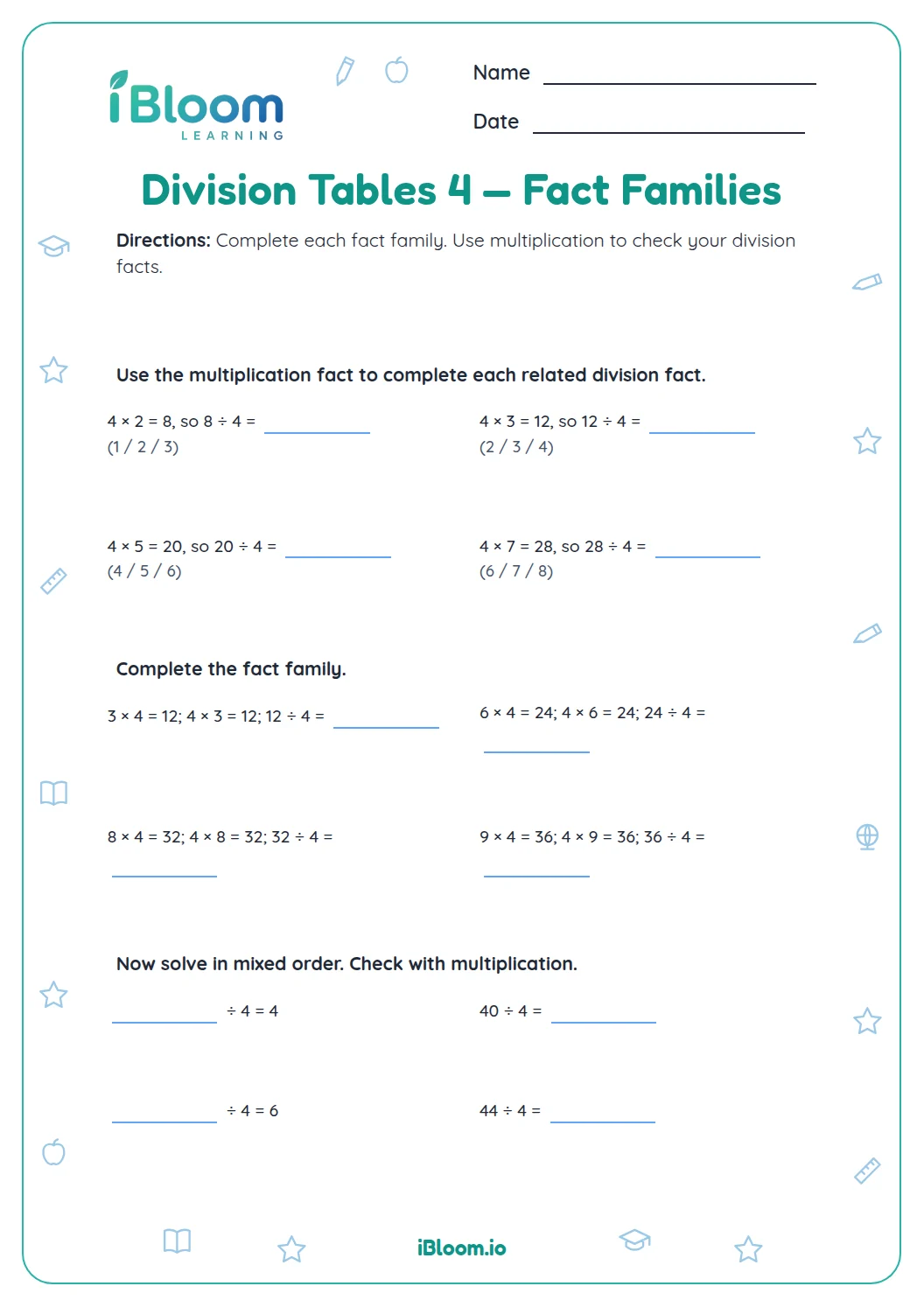
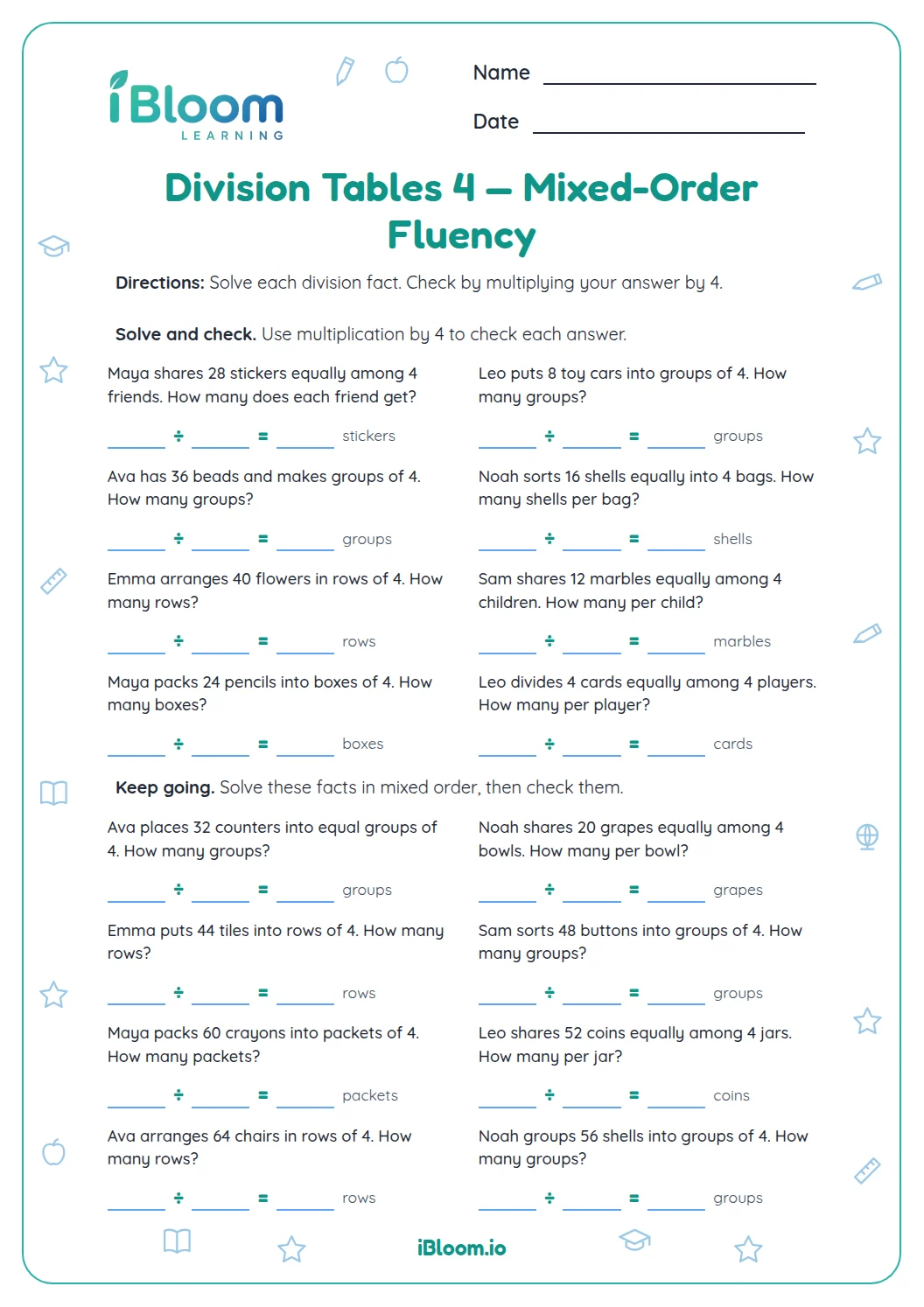
This Grade 3 printable checks division facts with divisors 2, 3, and 4. Students solve six facts, complete six related multiplication equations, and write four division facts with their checks. Every dividend is within 100 and each division is exact. The separate key provides quotients and matching multiplication facts. The sheet practices CCSS 3.OA.B.5.
Aligned to 3.OA.A.3 and 3.OA.B.5
How do students solve the division facts?
Think of division as equal groups or as the unknown factor in multiplication. For example, 36 ÷ 4 asks which number multiplied by 4 gives 36; the answer is 9.
- 136 ÷ 4 = 9
- 24 × 9 = 36
How does multiplication check division?
Multiply the divisor by the quotient. In question 9, 3 × 10 = 30, which confirms that 30 ÷ 3 = 10.
What belongs in a written fact check?
Write a division equation and the matching multiplication equation. The divisor is one factor, and the quotient is the other factor.
How to work through this sheet
- 1Read the divisor and dividend carefully.
- 2Ask which factor times the divisor makes the dividend.
- 3Write the quotient in the division sentence.
- 4Multiply divisor × quotient to check.
Common mistakes and quick fixes
The mistake
Putting the divisor in the quotient blank
The fix
Ask which number multiplied by the divisor gives the dividend.
The mistake
Using a factor that does not make the dividend
The fix
Multiply the proposed quotient by the divisor and compare the product.
The mistake
Writing a different number in the check fact
The fix
Use the quotient from the division sentence as the other multiplication factor.
Common Core alignment
This worksheet practices the number skills named in these standards.
Use equal-group situations to solve division facts.
On this sheet: The sheet frames division as sharing equal groups.
Show the official wordingHide the official wording
Use multiplication and division within 100 to solve word problems in situations involving equal groups, arrays, and measurement quantities.
Use multiplication facts to reason about division.
On this sheet: Students use multiplication facts to check each division quotient.
Show the official wordingHide the official wording
Apply properties of operations as strategies to multiply and divide.
What to practice next
Make more practice
Further reading
Questions parents and teachers ask
How can multiplication check a division fact?
Multiply the divisor by the quotient; the product should equal the dividend. For 36 ÷ 4, the quotient is 9, and 4 × 9 = 36 confirms it. Six questions on this sheet ask students to complete both linked equations.
Which divisors appear on the worksheet?
The division facts use 2, 3, and 4 as divisors. Each dividend is a multiple of its divisor and stays within 100. The final four prompts let students choose a matching fact from a stated number of objects and groups.
What goes in both blanks in 18 ÷ 2 = ___ because 2 × ___ = 18?
Write 9 in both blanks. The quotient in the first equation is the missing factor in the multiplication check, and 2 × 9 equals 18. The directions remind students to use the same number in both places. The repeated quotient makes the inverse relationship visible.
What do students write in the last part?
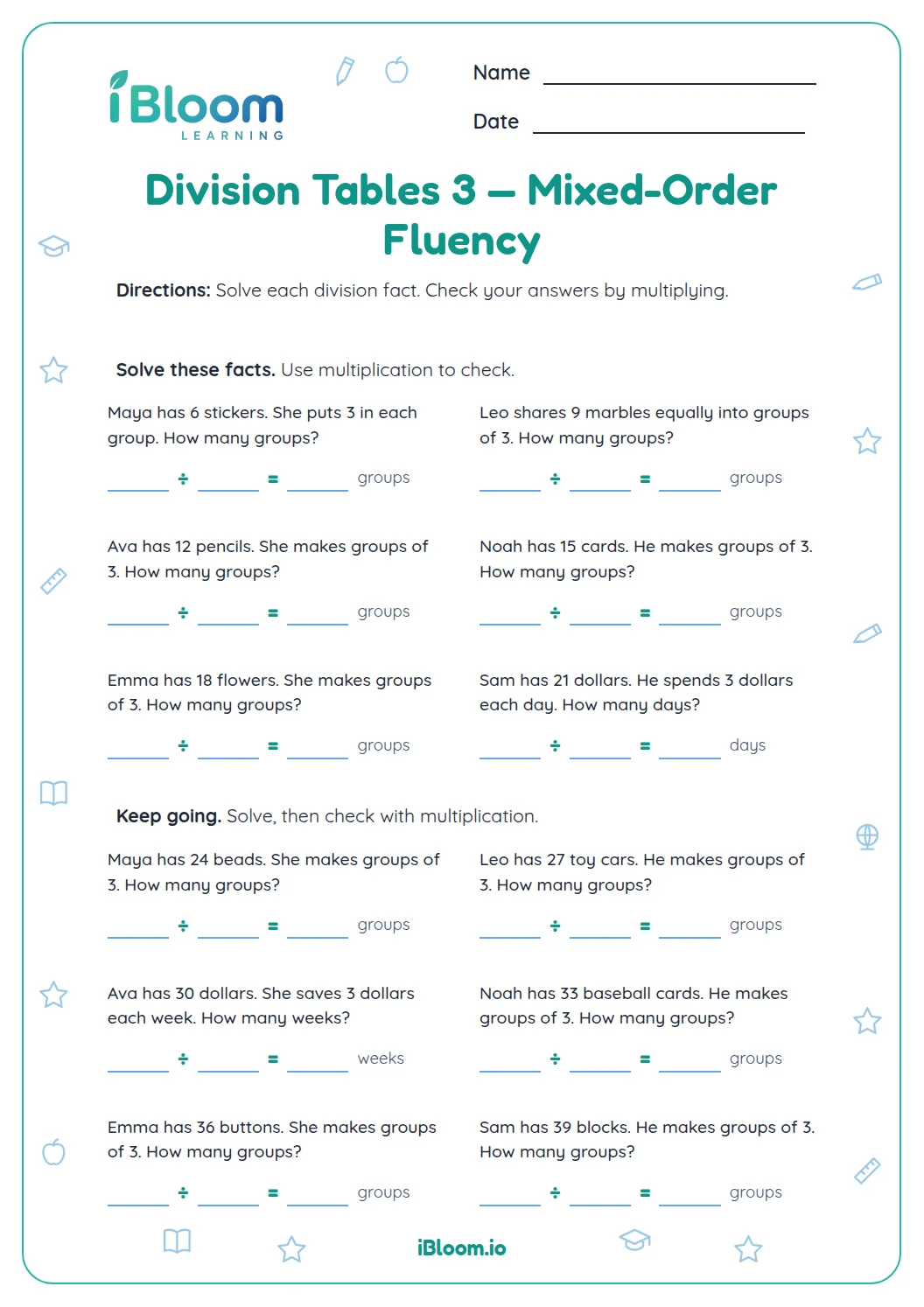
They write one division equation for the equal groups described, followed by its multiplication check. For 21 objects shared among 3 groups, a correct pair is 21 ÷ 3 = 7 and 3 × 7 = 21. The key gives a sample for each item.
How many questions are included?
The printable has 16 questions across three parts: six direct division facts, six prompts with linked division and multiplication blanks, and four written fact pairs. A separate answer key lists the correct quotient or sample pair for each question.
What if a student knows multiplication facts better than division facts?
Use that strength to find the missing factor. For 48 ÷ 3, ask what number multiplied by 3 makes 48; that number is 16. Then write 3 × 16 = 48 to check the division answer. It is a quick way to reason without guessing at the quotient. It is a useful strategy for unfamiliar facts.