





About this worksheet
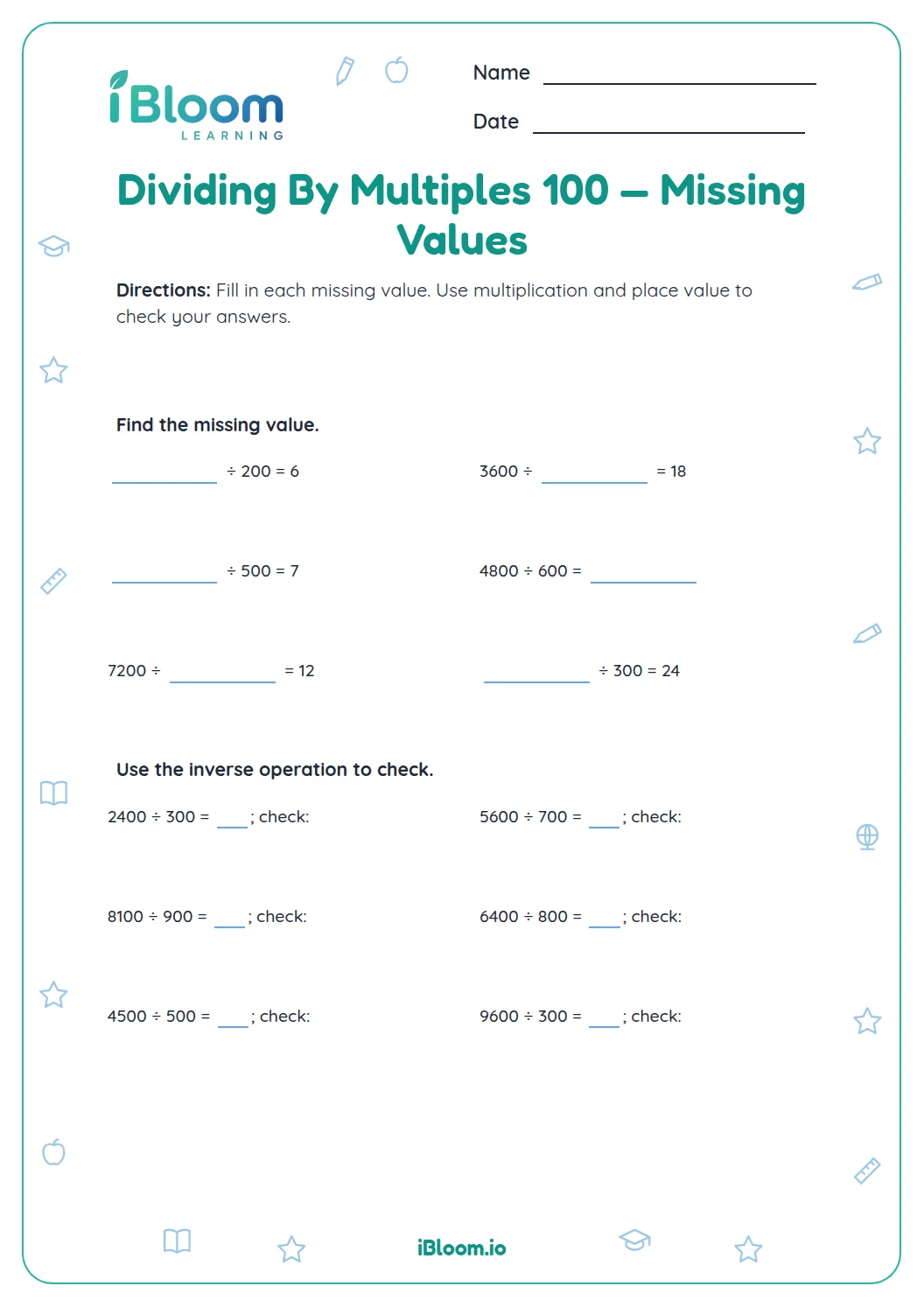
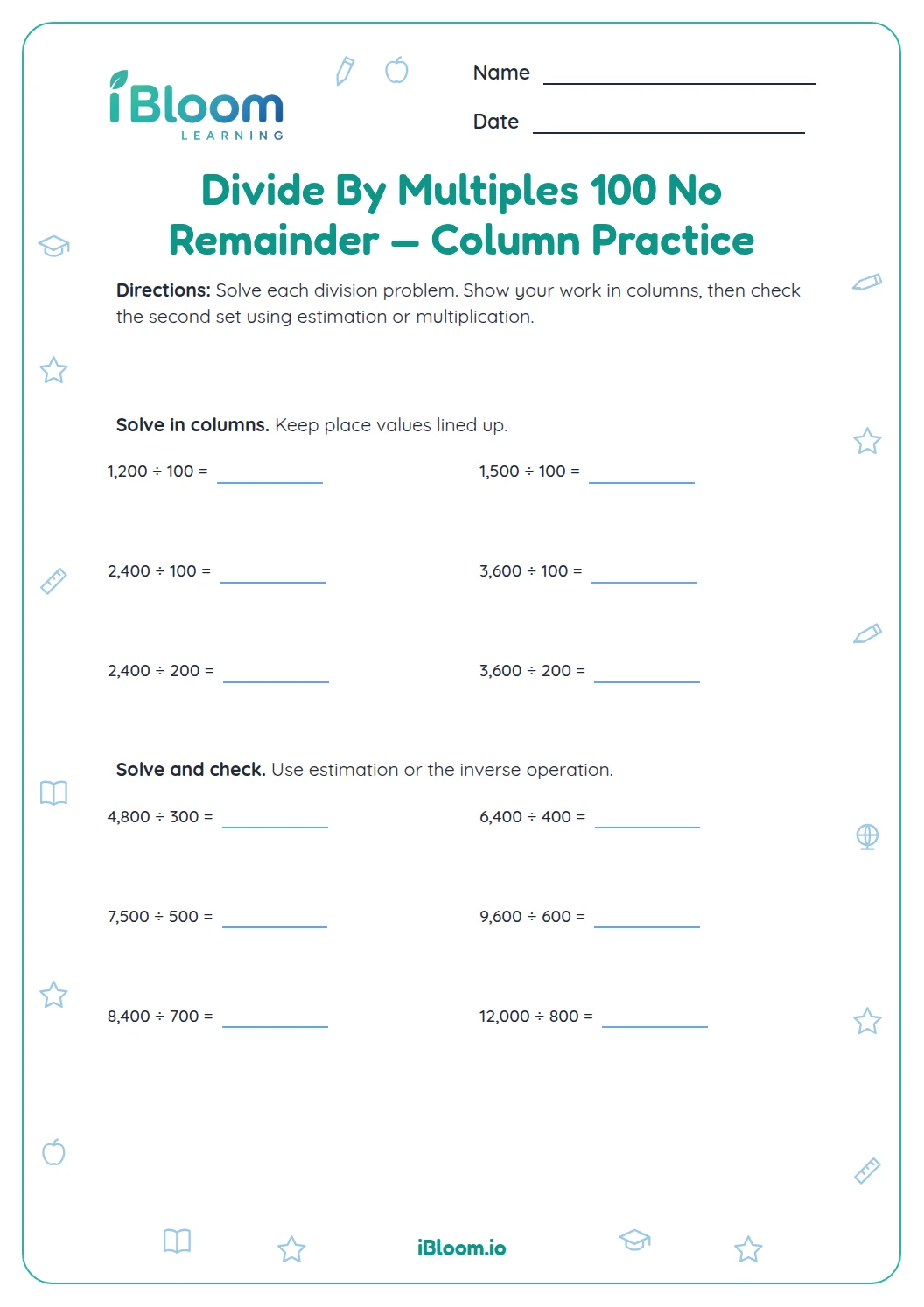
This practice sheet focuses on division by multiples of 100. Students inspect worked calculations, judge method and quotient claims, and solve additional equations independently. The error-analysis items make place-value reasoning visible: dividing by 300 can be viewed as dividing by 3 and then by 100, with the order of those steps kept clear. A separate answer key is included.
Aligned to 5.NBT.B.6
How should students inspect a division method?
Part A shows six calculations, including three correct examples: 8,400 ÷ 200 = 42, 9,600 ÷ 300 = 32, and 7,200 ÷ 6 = 1,200 followed by 1,200 ÷ 100 = 12. Students choose the first incorrect step or the no-error option.
The final chain contains an error because 4,800 ÷ 8 is 600, not 60. The second step is mathematically consistent with 60, but the first value has already changed.
- Part A: 6 step checks
- Part B: 6 quotient judgments
- Part C: 6 independent divisions
How does factoring help with a divisor like 300?
Since 300 = 3 × 100, dividing by 300 is equivalent to dividing by 3 and then by 100. The quotient must be checked after both operations. In 9,000 ÷ 300, divide by 3 to get 3,000, then divide by 100 to get 30.
- 19,000 ÷ 300
- 29,000 ÷ 3 = 3,000
- 33,000 ÷ 100 = 30
- 4So 9,000 ÷ 300 = 30
How can multiplication check a quotient?
Multiply the quotient by the divisor. For 24,000 ÷ 800 = 30, the check is 800 × 30 = 24,000. A matching product confirms the quotient; a product that is ten times too large or small points to a place-value slip.
How to use this worksheet
- 1Read the full divisor and dividend before calculating.
- 2For a shown method, check each step in order.
- 3Factor a multiple of 100 when helpful, and divide by both factors.
- 4For a yes/no item, compute the stated quotient independently.
- 5Check each quotient by multiplying it by the divisor.
Common slips and fixes
The mistake
Changing a zero count incorrectly while dividing by 100.
The fix
Write the quotient after each operation and verify the final product.
The mistake
Marking a correct quotient wrong because an intermediate step looks unfamiliar.
The fix
Calculate the division directly; 8,400 ÷ 200 is 42.
The mistake
Dividing by 3 but forgetting the remaining factor of 100.
The fix
Since 300 = 3 × 100, complete both divisions.
Common Core alignment
Students use place value and the relationship between division and multiplication to solve whole-number quotients.
Use place value and operation relationships to find whole-number quotients.
On this sheet: The worksheet asks students to use place-value reasoning and division-multiplication relationships for whole-number quotients.
Show the official wordingHide the official wording
Find whole-number quotients of whole numbers with up to four-digit dividends and two-digit divisors, using strategies based on place value, the properties of operations, and/or the relationship between multiplication and division.
What to practice next
Make more practice
Further reading
Questions parents and teachers ask
Are the first three division chains incorrect?
No. The first three are correct: 8,400 ÷ 200 = 42, 9,600 ÷ 300 = 32, and 7,200 ÷ 6 = 1,200 followed by 1,200 ÷ 100 = 12. Students should verify the arithmetic instead of assuming every error-analysis example contains an error.
How can 9,000 ÷ 300 be solved?
Since 300 is 3 × 100, divide 9,000 by 3 to get 3,000, then divide 3,000 by 100 to get 30. The answer can be checked because 300 × 30 = 9,000. Both steps are needed, and the quotient is unique.
How many problems are on the page?
There are 18 questions in three parts: six checks of shown work, six judgments about division methods or quotient claims, and six direct division equations. The answer key lists the correct choices and quotients. In the first part, it distinguishes a correct chain from a wrong first or second step, helping students see exactly where the quotient changed.
What is the easiest way to check a quotient?
Multiply the quotient by the divisor and see whether the product equals the dividend. For example, 24,000 ÷ 800 = 30 checks because 800 × 30 equals 24,000. This also reveals answers that are off by a factor of ten.
What grade is this division worksheet for?
It is labeled Grades 4–6 and practices whole-number division using multiples of 100. Students should be comfortable with basic multiplication and division facts so they can focus on place value and checking each step. The independent equations extend the work.