


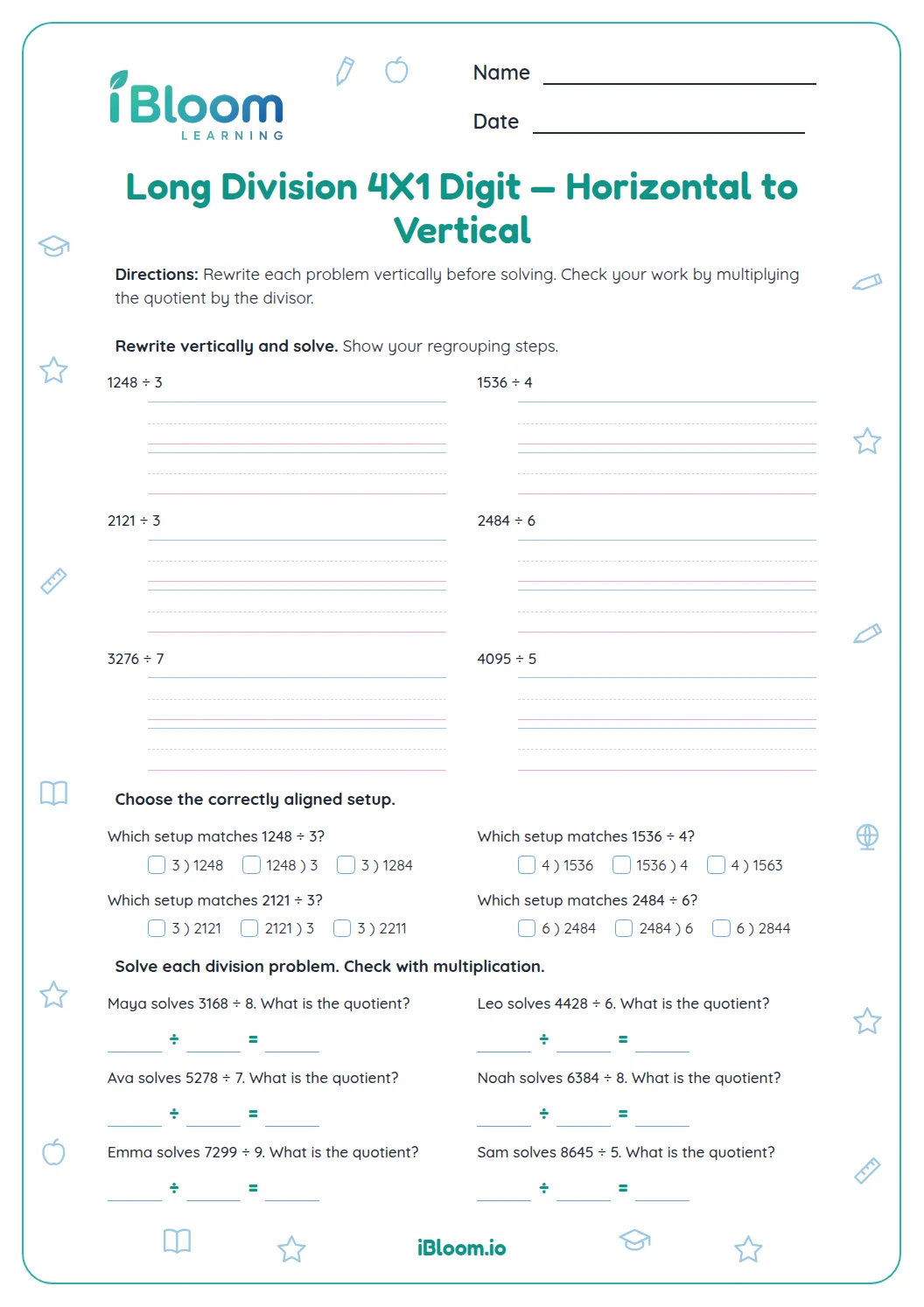
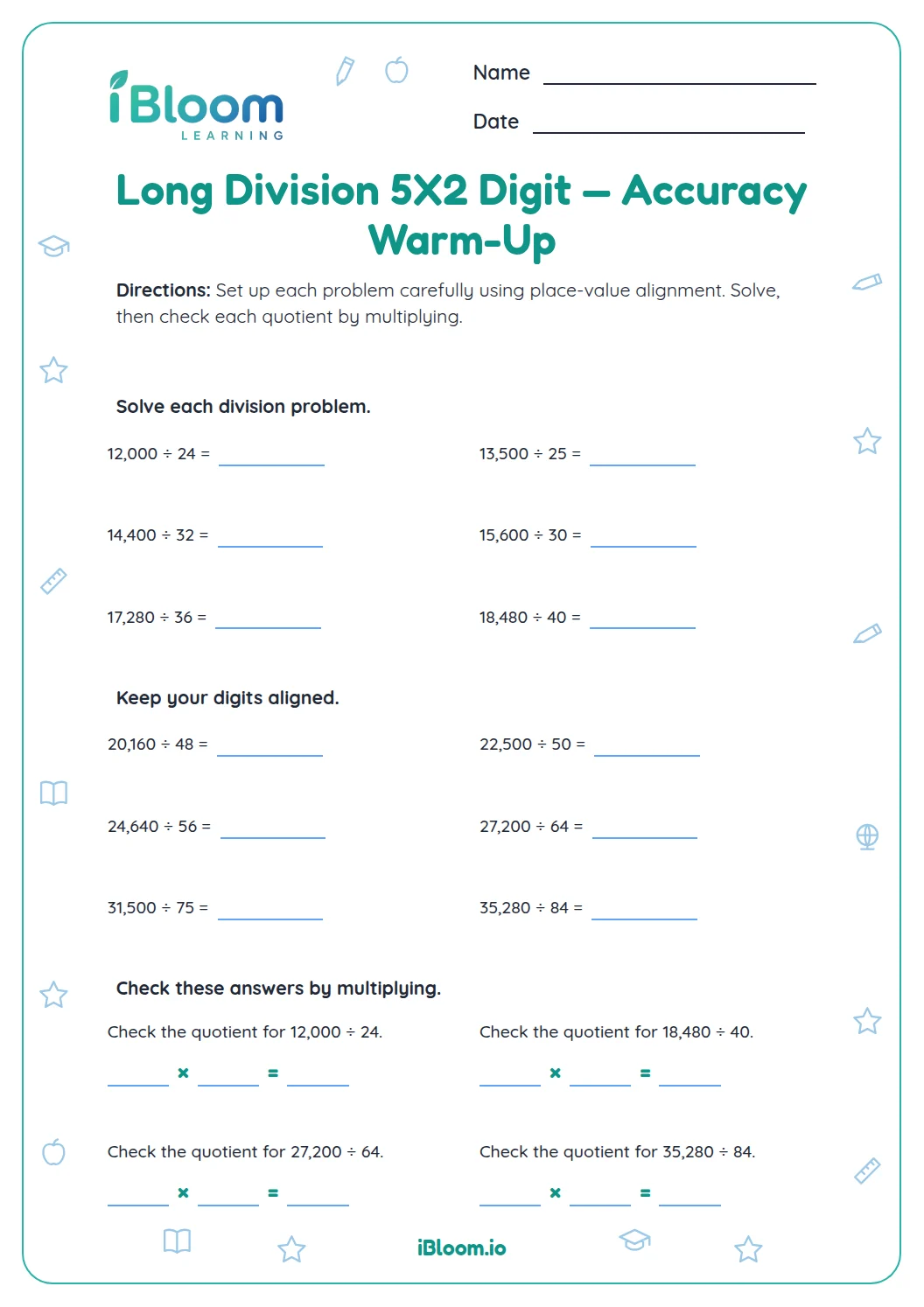
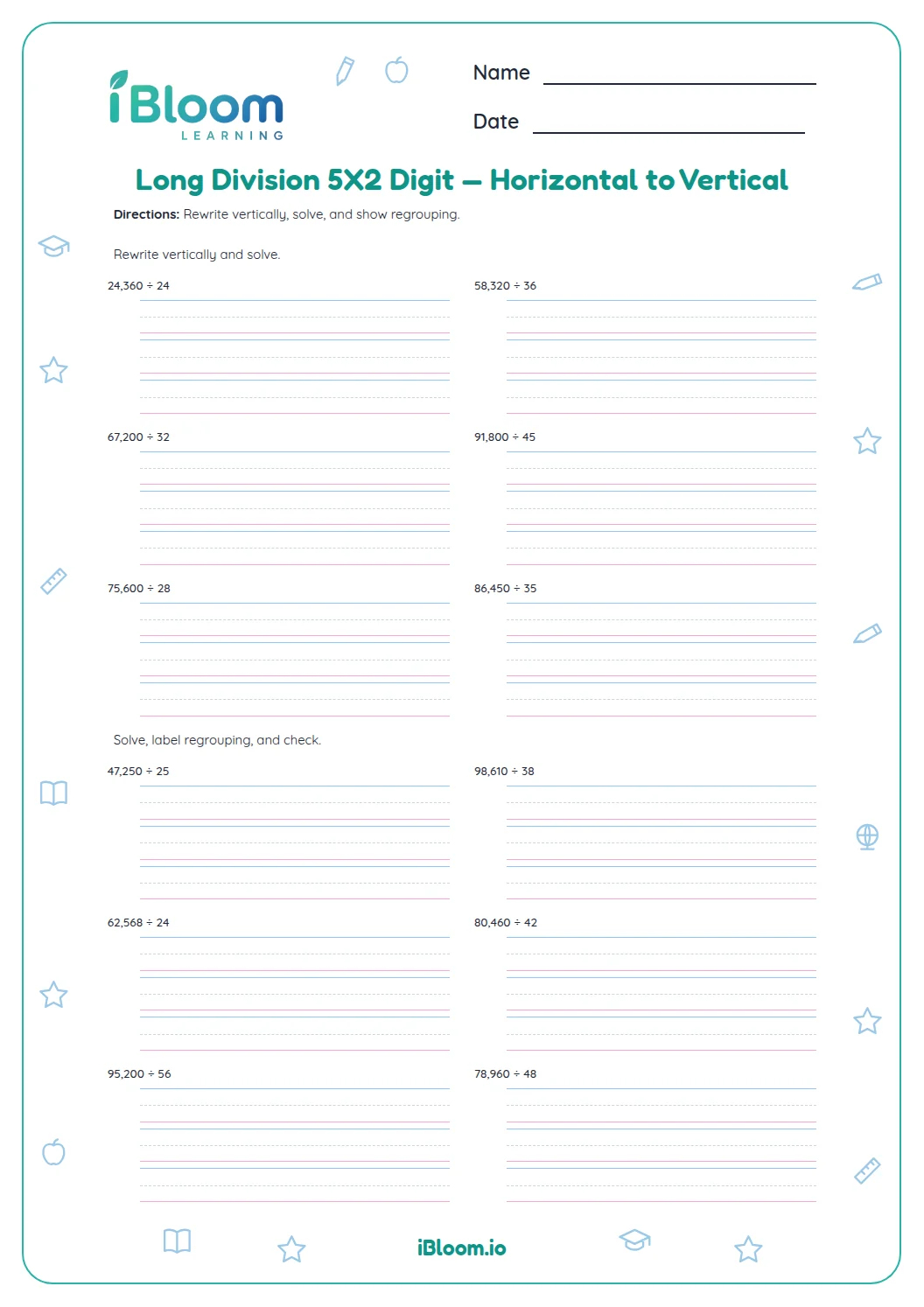
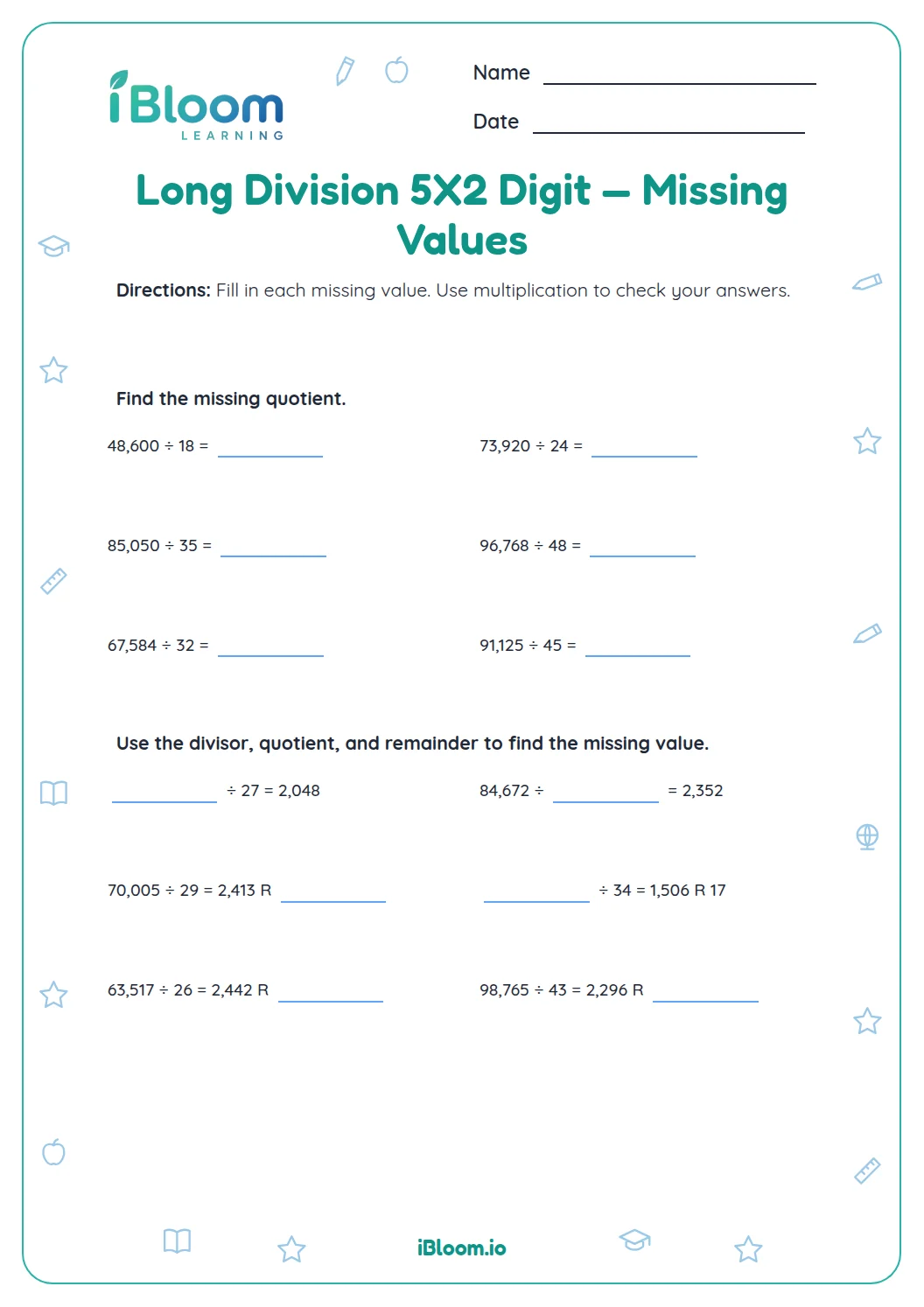
About this worksheet
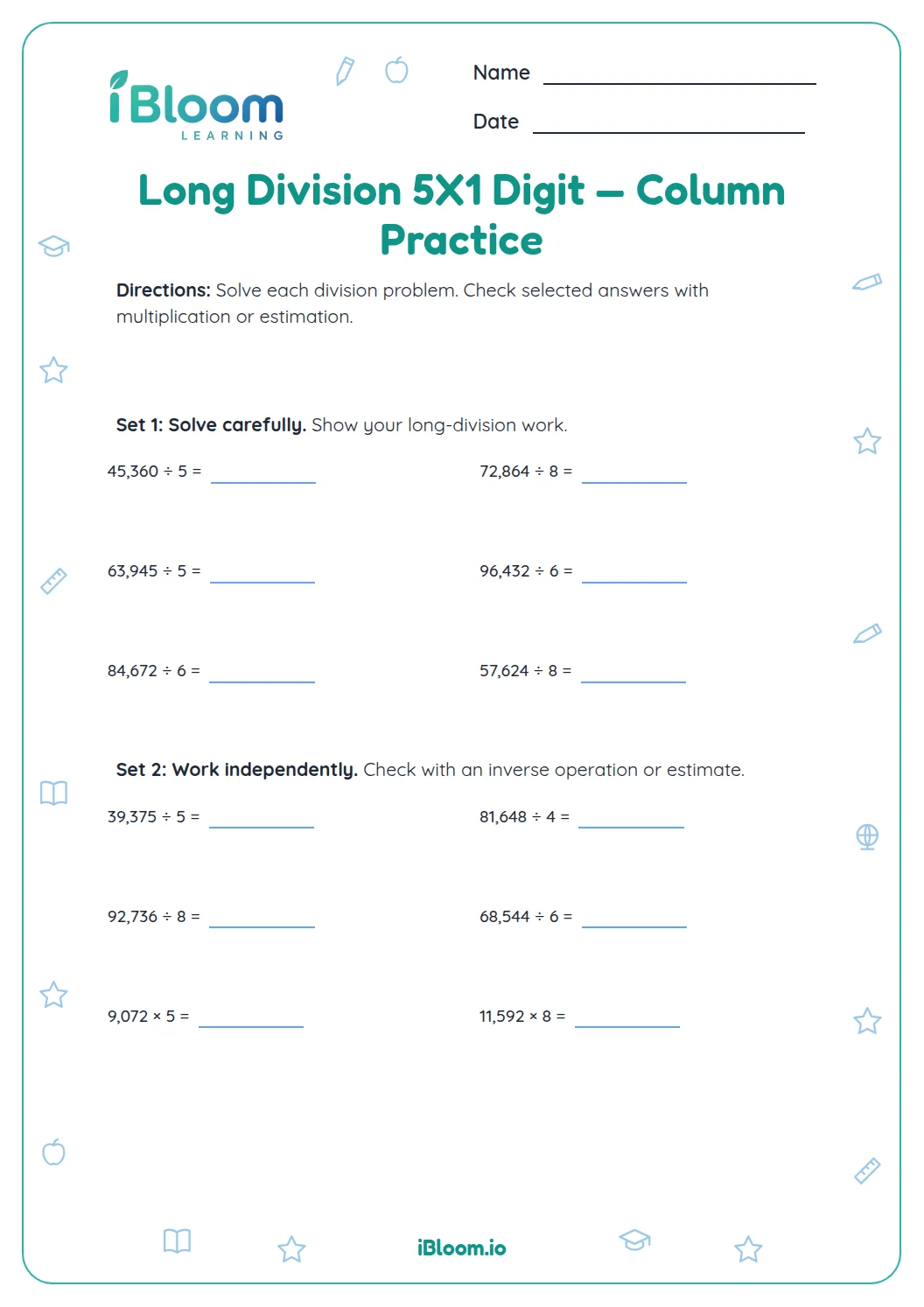
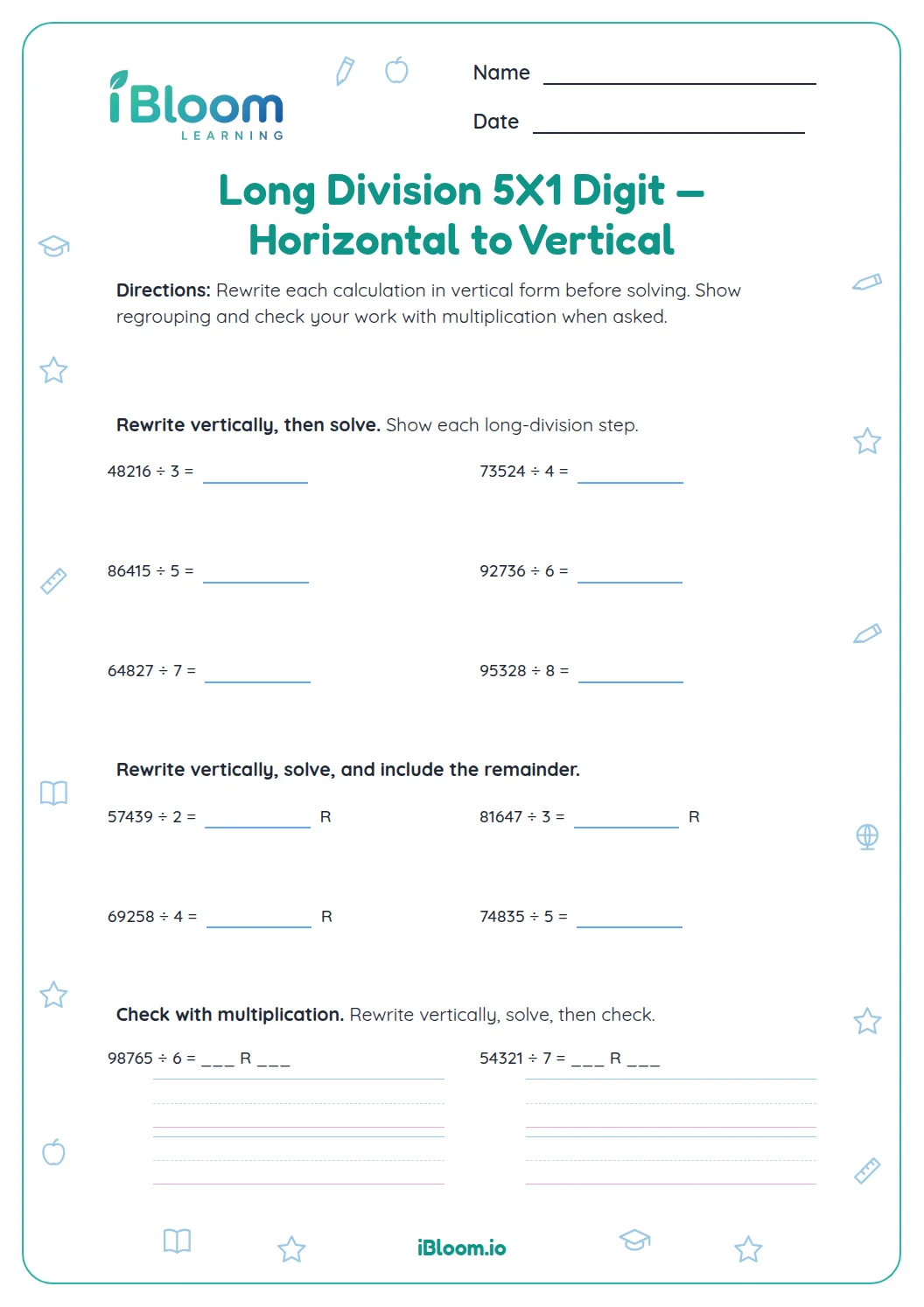
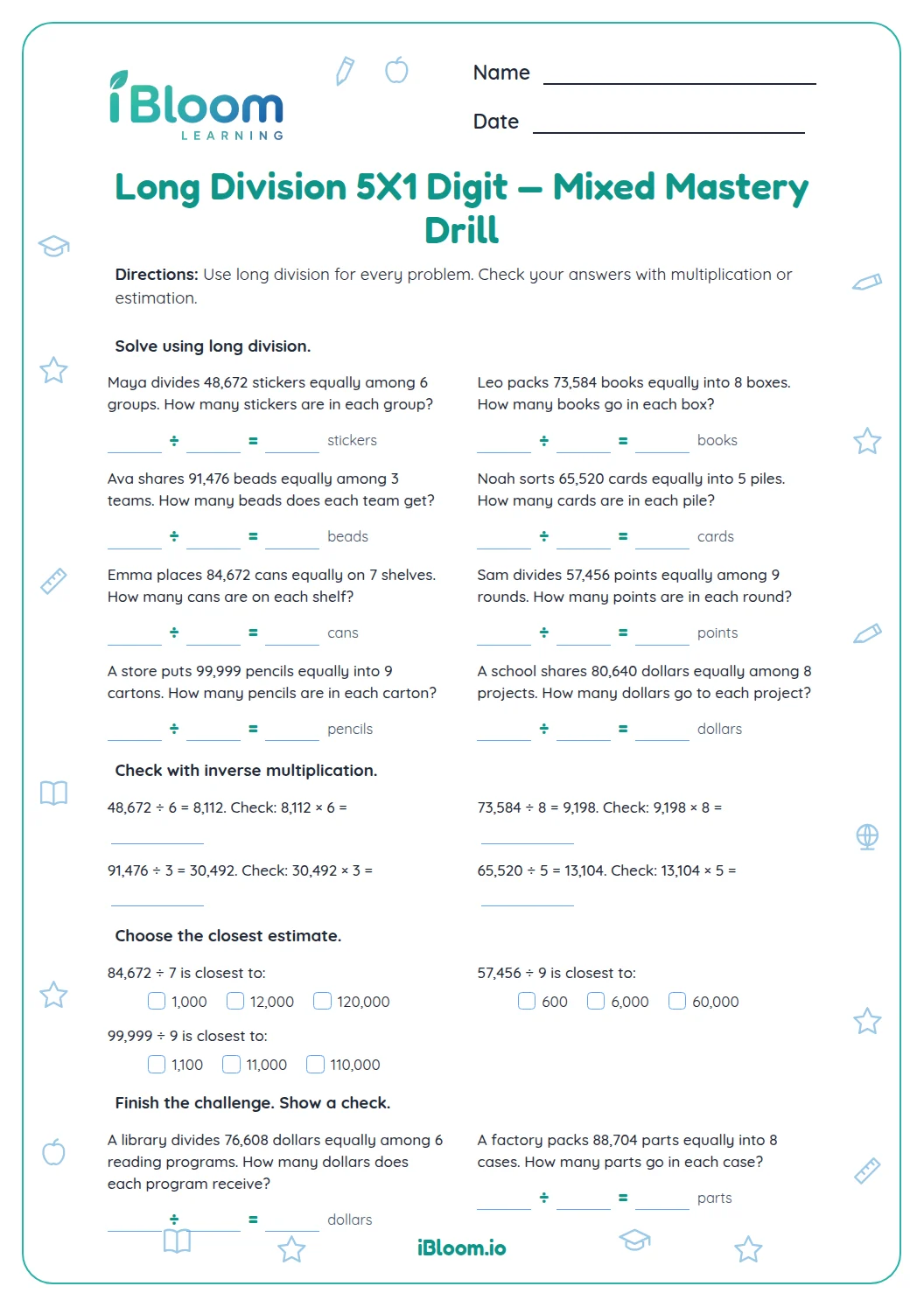
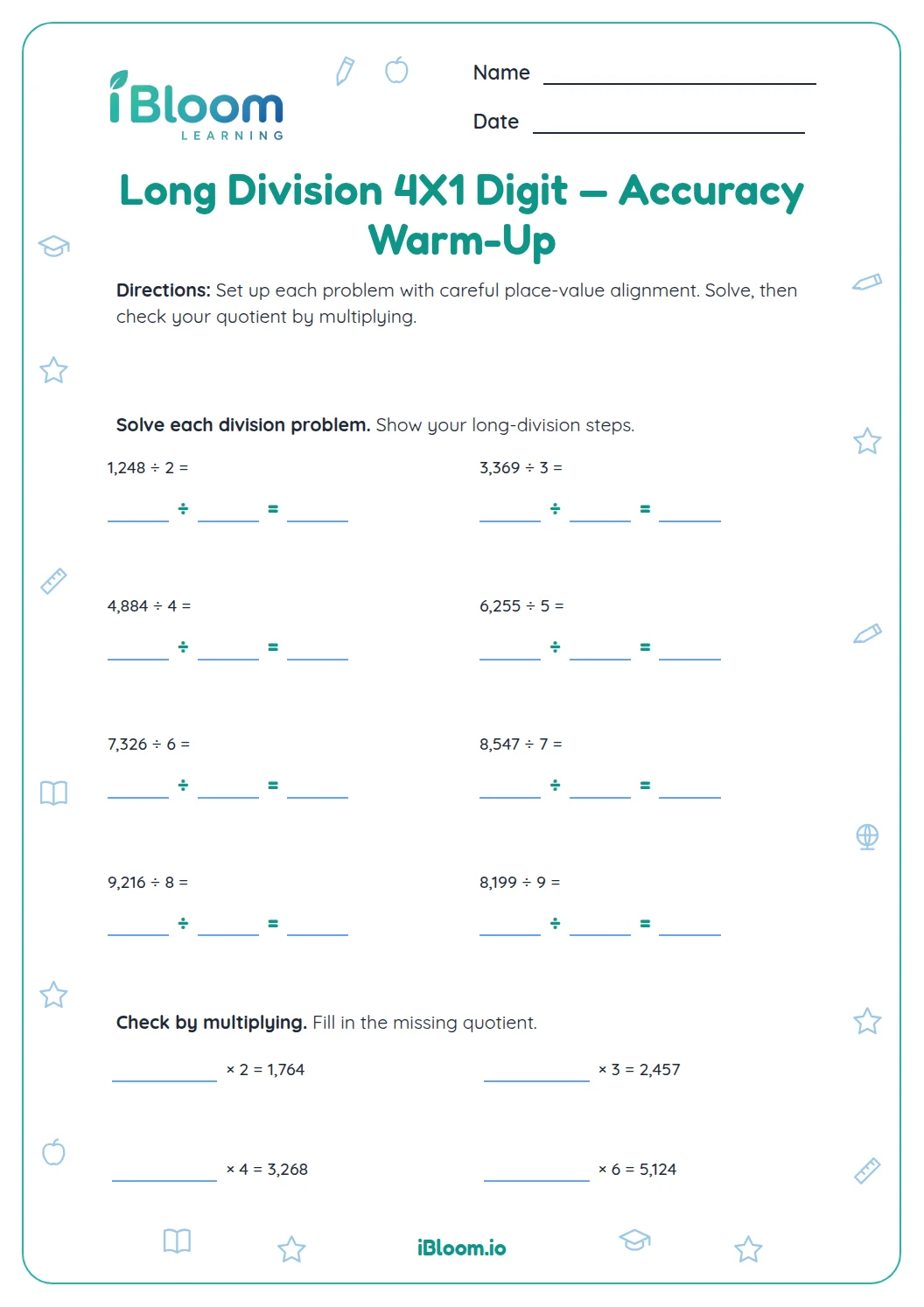
This printable gives students 18 missing-value problems with five-digit dividends and one-digit divisors. Part A supplies a remainder and asks for the quotient. Part B uses the division identity dividend = divisor × quotient + remainder to find a missing remainder. Part C mixes missing quotients and remainders. Every dividend, quotient and remainder forms a true division equation, and the answer key is included.
Aligned to 5.NBT.B.6
What is missing in the first division set?
Part A gives the divisor and remainder, then asks for the quotient. For 84,761 ÷ 9 = ___ R 8, the quotient is 9,417 because 9 × 9,417 = 84,753 and 84,753 + 8 = 84,761.
Part B turns the check into an equation, leaving the remainder blank. Keep the printed equals sign and dividend in view as you calculate.
- Part A: 6 missing quotients
- Part B: 6 missing remainders
- Part C: 6 mixed quotient or remainder blanks
How does the remainder check work?
A division with remainder can be rewritten as dividend = divisor × quotient + remainder. The remainder must be nonnegative and less than the divisor. If either condition fails, the quotient or remainder needs another look.
- 15,709 × 8 + ___ = 45,672
- 25,709 × 8 = 45,672
- 345,672 − 45,672 = 0
- 4The missing remainder is 0.
What should students check before finishing?
In Part C, read the location of the blank: it may ask for a quotient or a remainder. Check the completed equation by multiplying and adding. A zero remainder is valid, and a nonzero remainder must be smaller than the divisor.
How to use this worksheet
- 1Identify the dividend and one-digit divisor.
- 2Use the printed remainder, if given, to determine the missing quotient.
- 3For a missing remainder, subtract divisor × quotient from the dividend.
- 4Check that the remainder is smaller than the divisor.
- 5Multiply the quotient by the divisor and add the remainder to verify the dividend.
Common slips and fixes
The mistake
Copying a quotient that leaves the wrong remainder.
The fix
Multiply it by the divisor and compare the product with the dividend.
The mistake
Writing a remainder as large as the divisor.
The fix
A remainder must be less than the divisor; regroup into the quotient if it is not.
The mistake
Omitting the remainder in the multiplication check.
The fix
Use divisor × quotient + remainder = dividend, including the final addition.
Common Core alignment
Long division connects place value with multiplication and division relationships.
Find whole-number quotients using place value and the division-multiplication relationship.
On this sheet: The sheet practices whole-number quotients through long division and checks the relationship between dividend, divisor, quotient, and remainder.
Show the official wordingHide the official wording
Find whole-number quotients of whole numbers with up to four-digit dividends and two-digit divisors, using strategies based on place value, the properties of operations, and/or the relationship between multiplication and division.
What to practice next
Make more practice
Further reading
Questions parents and teachers ask
What is the division check for a remainder problem?
Multiply the quotient by the divisor, then add the remainder. That total must equal the dividend. Also check that the remainder is smaller than the divisor. For 84,761 ÷ 9 = 9,417 R 8, the check is 9 × 9,417 + 8 = 84,761.
Why does the first problem use remainder 8?
Because 9 × 9,417 is 84,753, which is 8 less than 84,761. Therefore 84,761 ÷ 9 is 9,417 remainder 8. The remainder is smaller than 9, so the division form is valid. The multiplication check confirms both values. Add 8 to the product to verify.
How many questions does this worksheet have?
There are 18 fill-in equations in three parts: six missing quotients, six missing remainders in multiplication checks, and six mixed quotient or remainder items. The key provides one value for each blank. Every item can be checked with the division relationship.
Can a division problem have a remainder of zero?
Yes. A zero remainder means the divisor divides the dividend evenly. Part B includes a check with zero as the missing remainder, and Part C also includes a quotient followed by R 0. Multiplying the divisor by the quotient gives the dividend exactly.
What grade is this long-division worksheet for?
The sheet is labeled Grades 4–6 and practices five-digit dividends divided by one-digit divisors. Students should be comfortable with multiplication facts and multi-digit division so they can focus on accurate quotients, remainders, and checks. The problems also suit review when a learner is strengthening long-division accuracy.