

About this worksheet
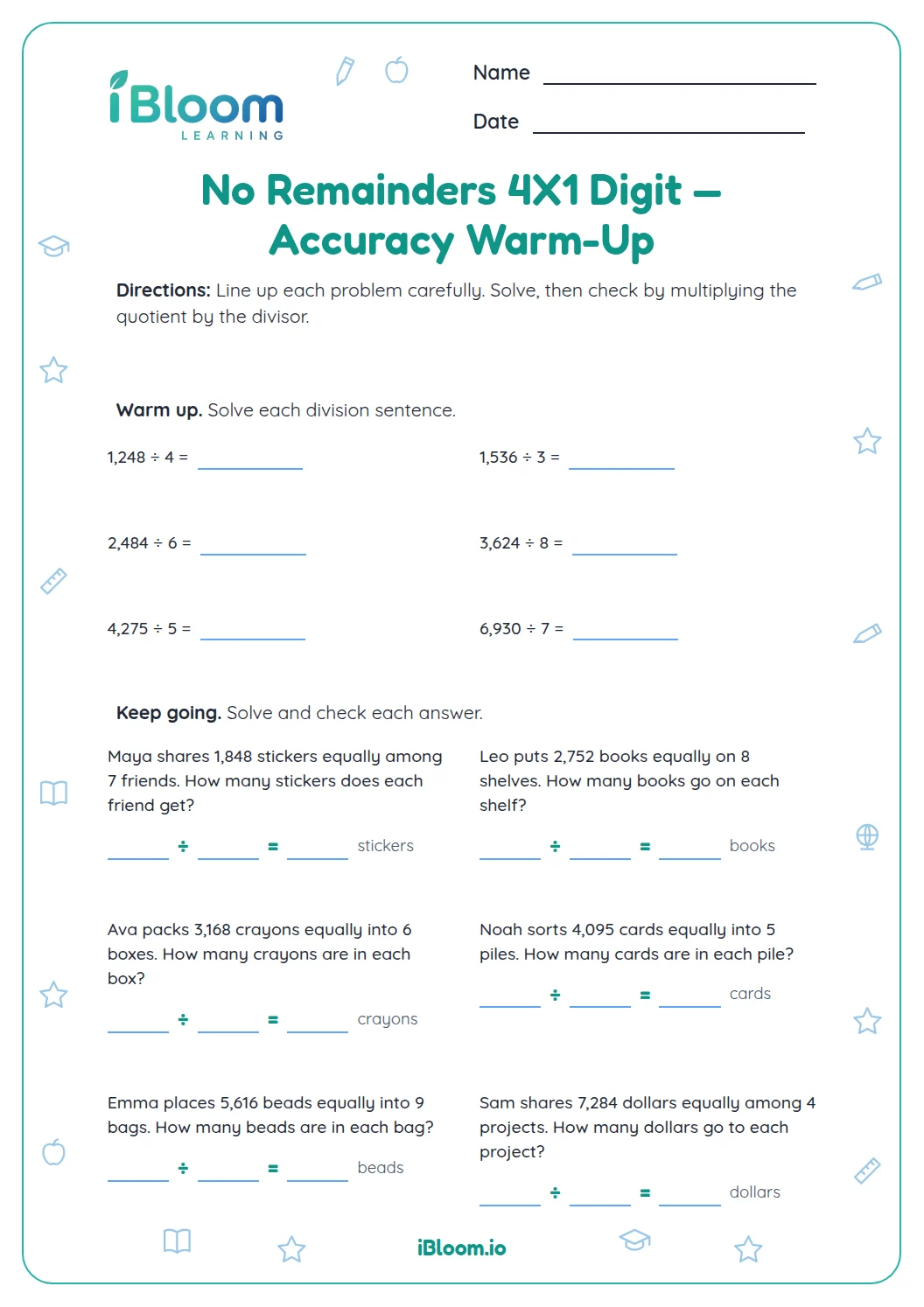
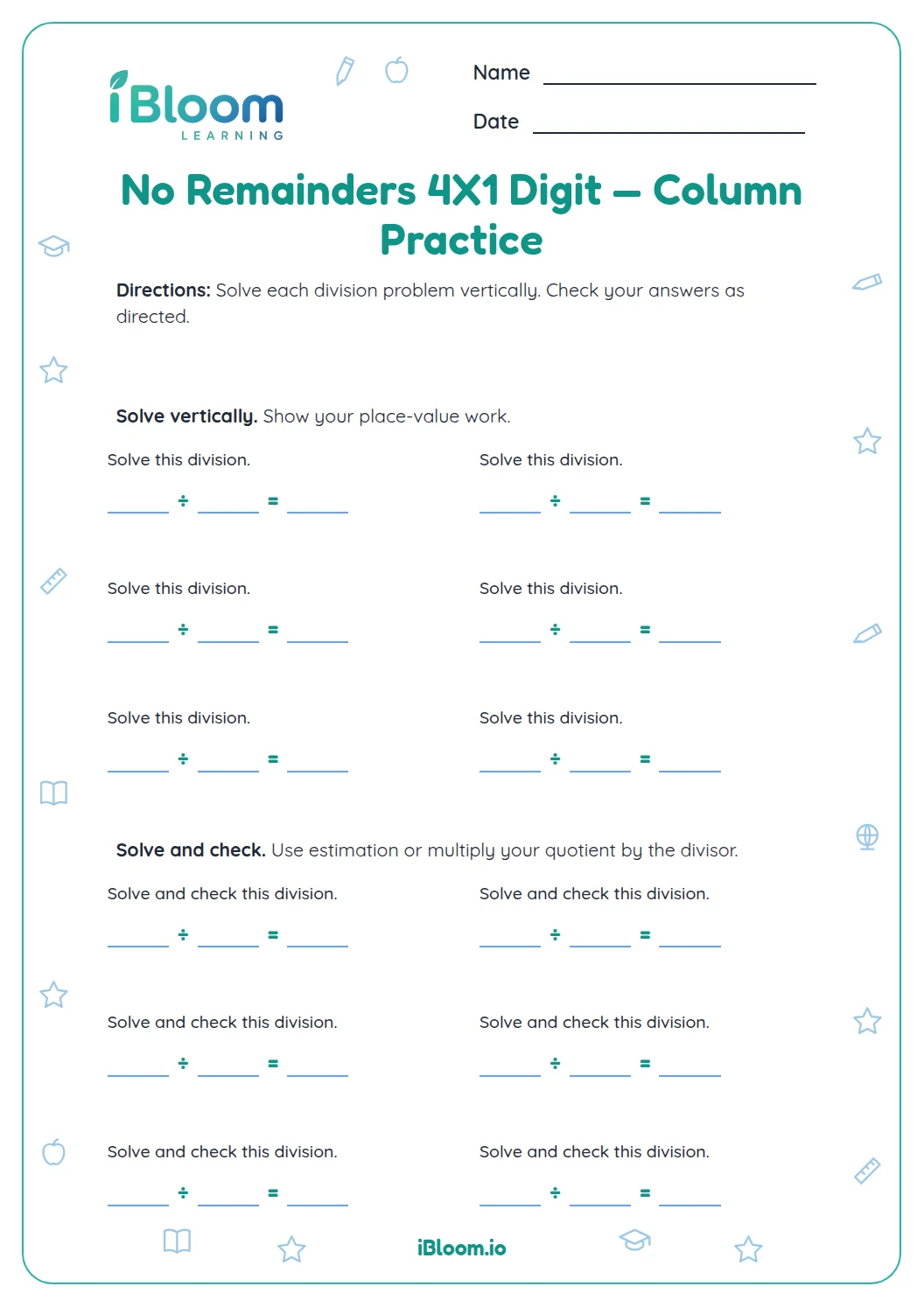
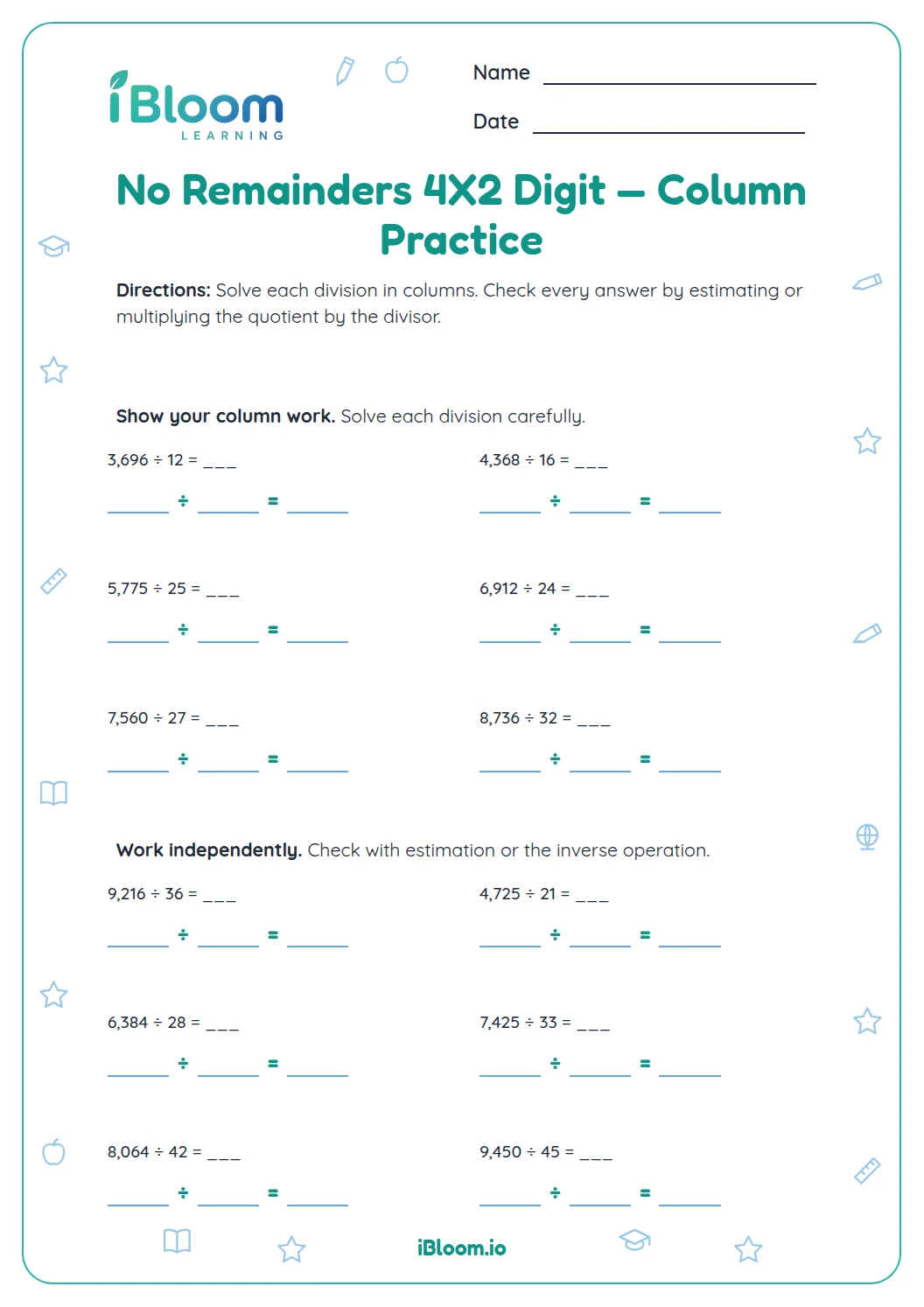
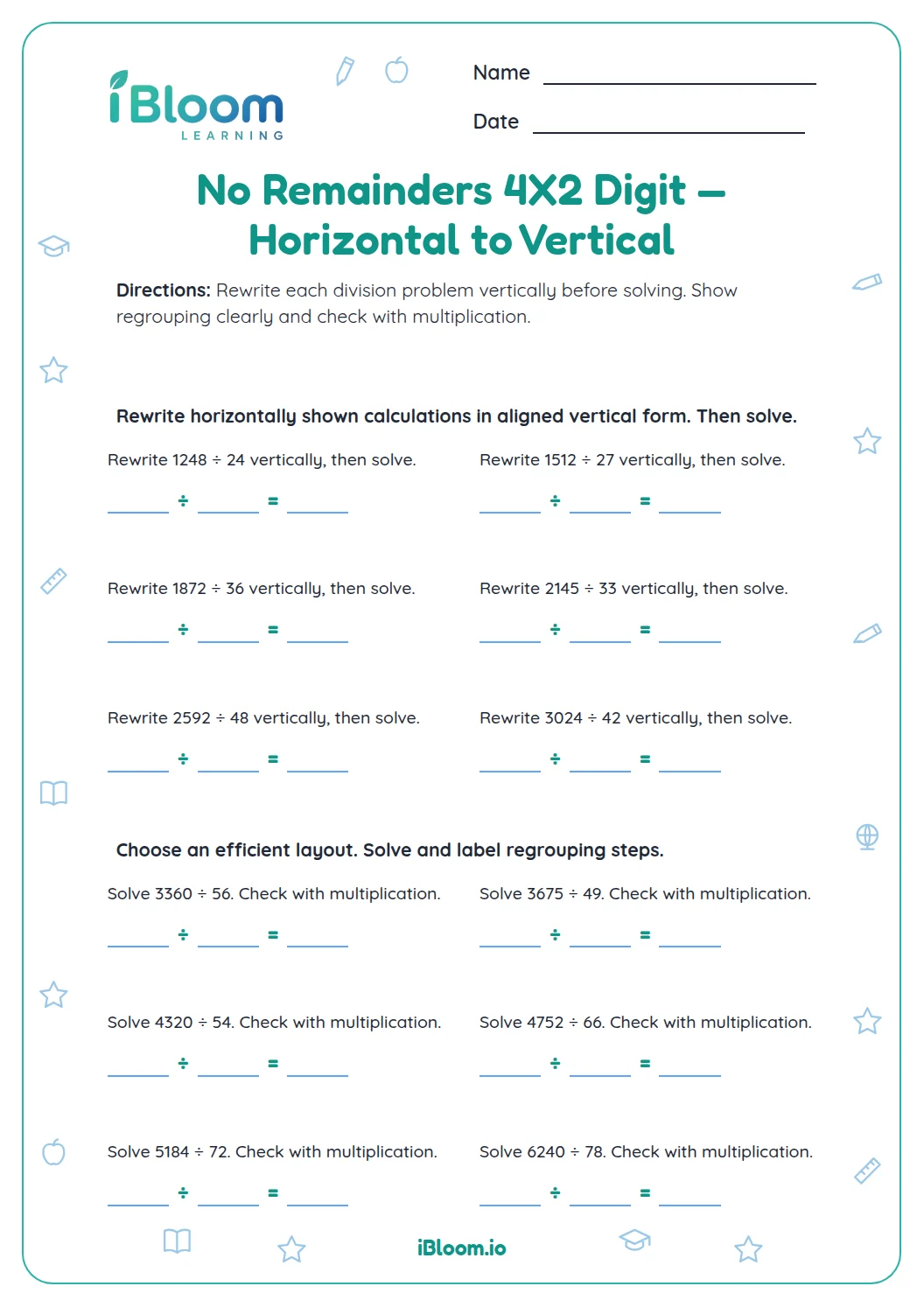
This worksheet helps students in Grades 4–6 move from horizontal division equations to vertical long-division work. All 16 problems use four-digit dividends and one-digit divisors, and each has a whole-number quotient. Students rewrite each equation, solve with place value, and can verify by multiplication. The work practices CCSS 4.NBT.B.6; the answer key is on separate pages.
Aligned to 4.NBT.B.6
What will students practice?
This worksheet helps students in Grades 4–6 move from horizontal division equations to vertical long-division work. All 16 problems use four-digit dividends and one-digit divisors, and each has a whole-number quotient. Students rewrite each equation, solve with place value, and can verify by multiplication. The work practices CCSS 4.NBT.B.6; the answer key is on separate pages.
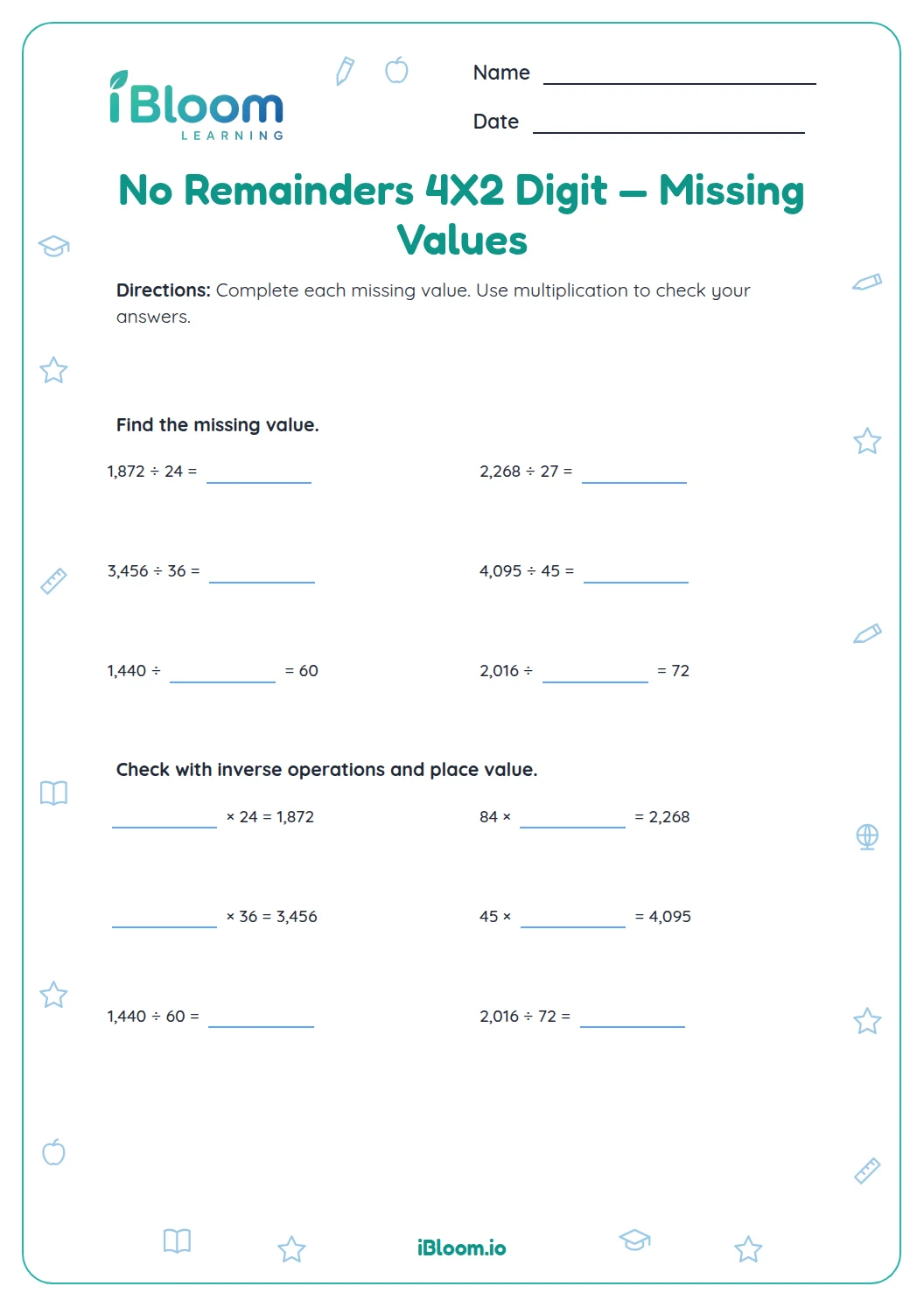
Sixteen exact-quotient problems in two parts, with vertical work space.
How does one problem work?
For 1,248 ÷ 4, place 4 outside the division bracket and 1,248 inside. Divide each partial dividend from left to right to get 312. Check with 312 × 4 = 1,248.
How can families use the answer key?
Have the student finish a part before checking it. For any missed answer, compare the place-value work with the key and redo the calculation. The key makes it easier to find the step that needs attention.
How to work through the sheet
- 1Set up the divisor outside and the dividend inside the bracket.
- 2Divide the leftmost usable digits first.
- 3Bring down the next digit and continue by place value.
- 4Multiply the quotient by the divisor to check.
Common slips to watch for
The mistake
Starting with too few digits
The fix
Use enough leading digits to make a number at least as large as the divisor.
The mistake
Skipping a zero in the quotient
The fix
Keep a placeholder when a partial dividend is smaller than the divisor.
The mistake
Checking only the last digit
The fix
Multiply the entire quotient by the divisor and compare the full product.
The problems build accurate multi-digit computation with the standard algorithm.
Rewrite the equation in long-division form, solve one place at a time, and check the product.
On this sheet:
Show the official wordingHide the official wording
Find whole-number quotients and remainders with up to four-digit dividends and one-digit divisors.
What to practice next
Make more practice
Further reading
Questions parents and teachers ask
Why rewrite the horizontal equation?
The vertical setup keeps each quotient digit aligned with the place value it represents. It also makes each subtract-and-bring-down step easier to track. Keep the original dividend intact as you copy it, then check the completed quotient by multiplication. Write the inverse equation beside the original and confirm that both calculations return the same value.
Do these problems have remainders?
No. Each of the 16 dividends was selected to divide evenly by its one-digit divisor. The quotient is a whole number, and multiplying it by the divisor gives the original four-digit dividend. Write the inverse equation beside the original and confirm that both calculations return the same value.
What should I do when a partial dividend is too small?
Write 0 in that quotient place, then bring down the next digit to make a larger partial dividend. The zero keeps later quotient digits in the correct places. Check the final result by multiplying the full quotient by the divisor.
How many problems are on the sheet?
There are 16 four-digit division questions arranged in two parts. Each asks students to rewrite a horizontal equation vertically and solve it. The separate key gives the quotient for every item so students can check after completing their work. Write the inverse equation beside the original and confirm that both calculations return the same value.
What is a quick way to check an answer?
Multiply the quotient by the divisor. For 1,248 ÷ 4, the proposed quotient 312 checks because 312 × 4 = 1,248. If the product differs from the dividend, review the long-division steps and place-value alignment. Write the inverse equation beside the original and confirm that both calculations return the same value.