




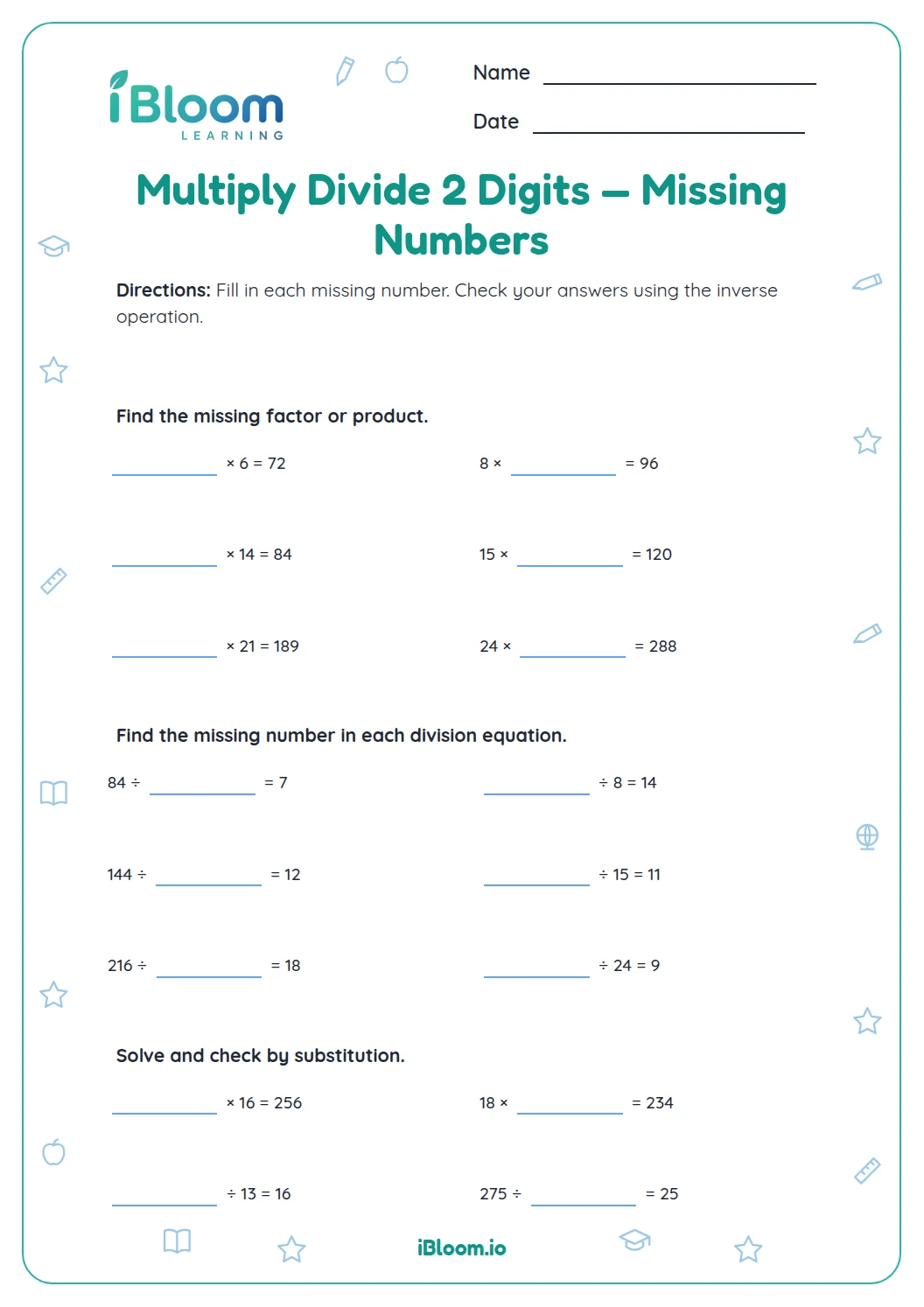

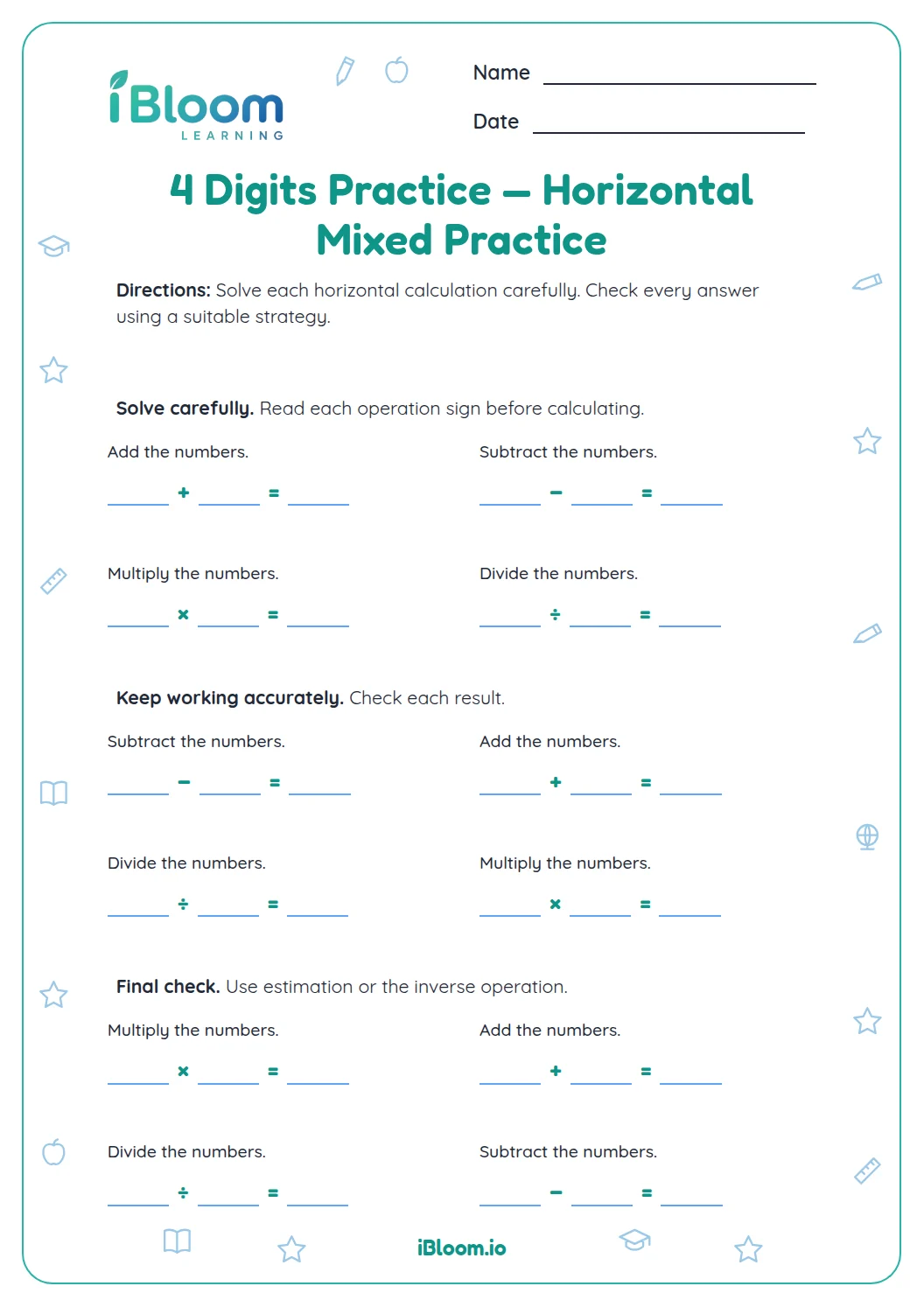
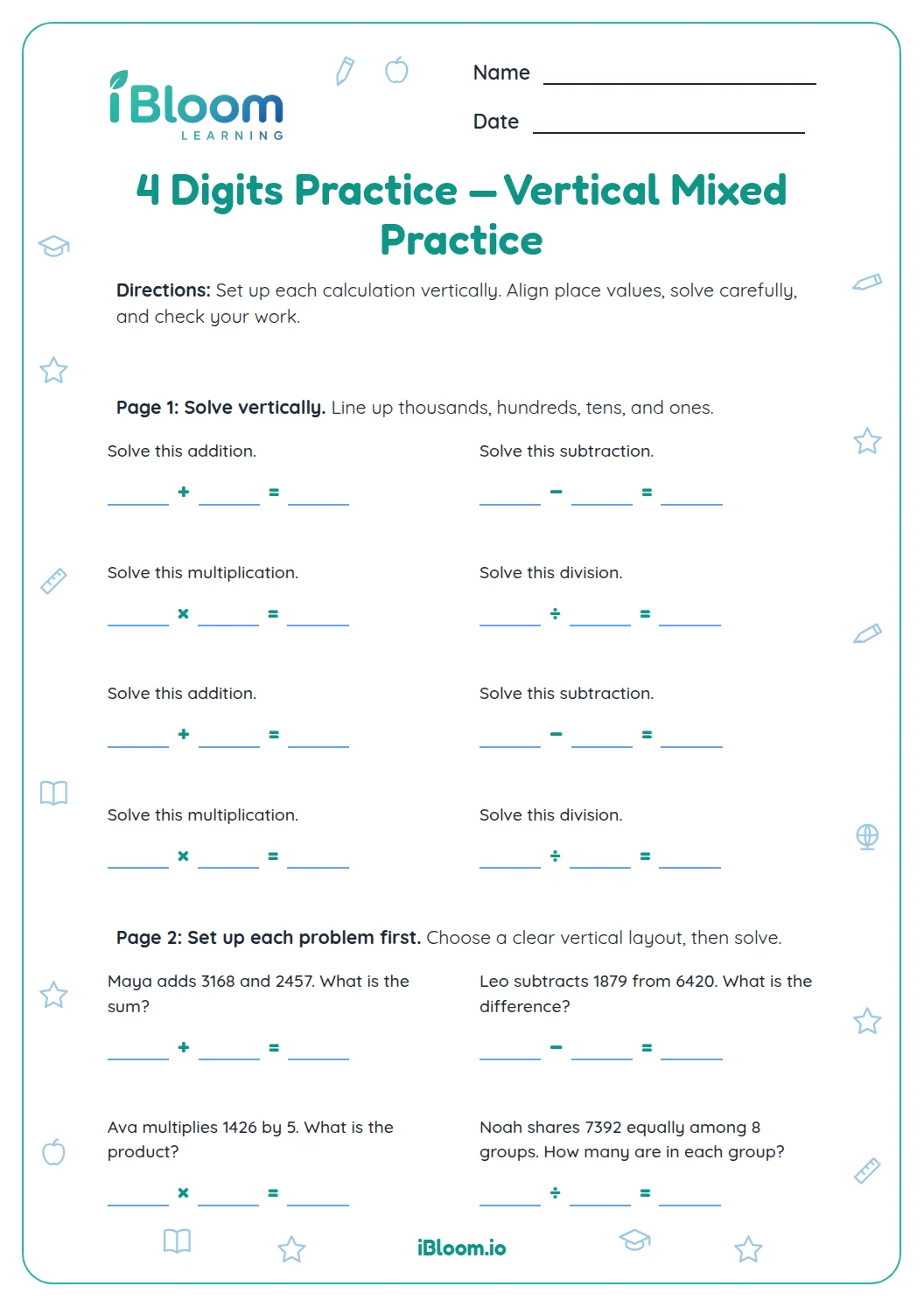
About this worksheet
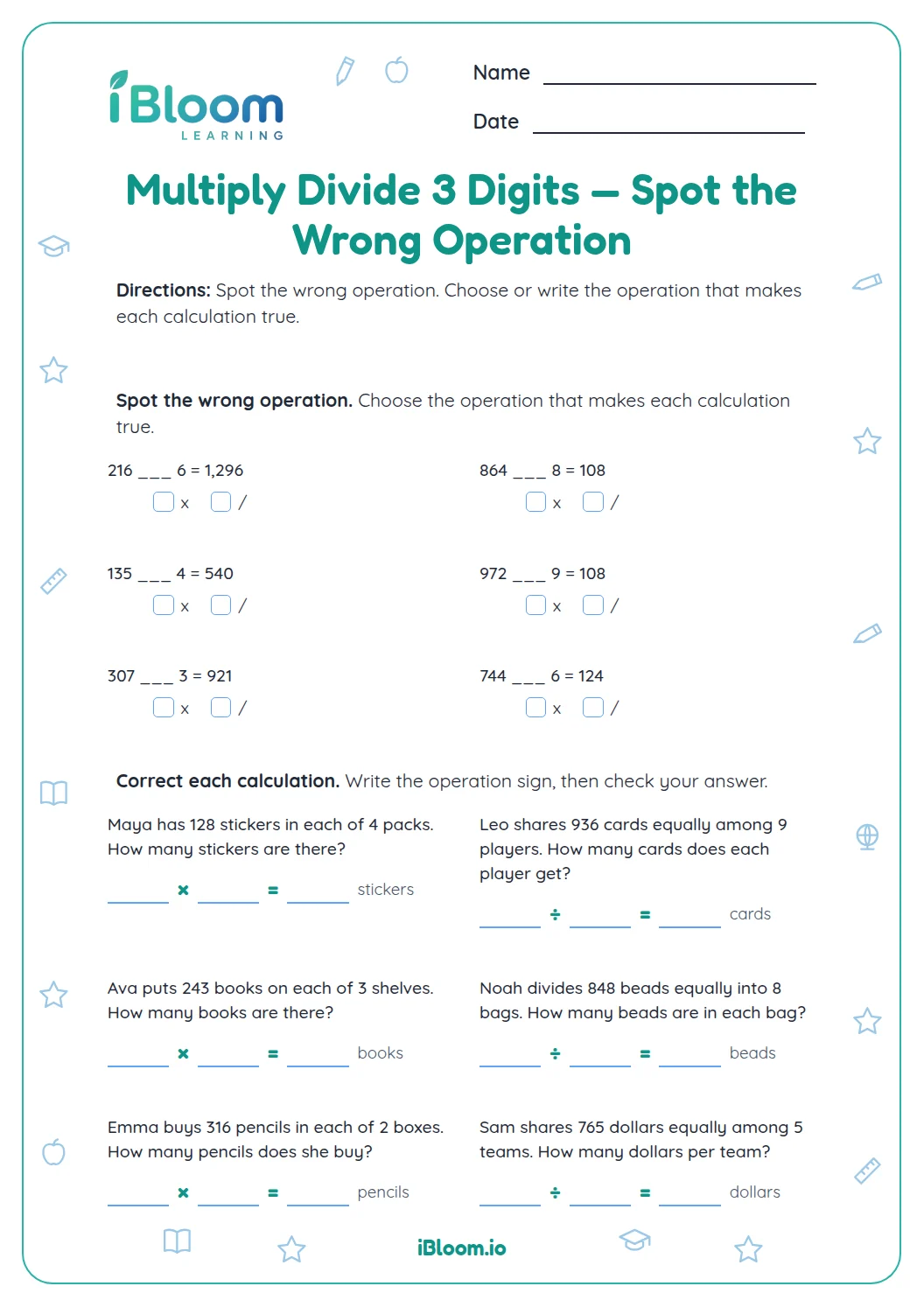
This Grade 6 worksheet gives students 14 complete equal-groups situations. For each, students choose multiplication or division, write a number sentence, and solve using whole numbers. The problems include combining equal groups and sharing totals equally, practicing multi-digit computation described in Common Core 6.NS.B.2.
Aligned to 6.NS.B.2
How do students choose multiplication or division?
Identify whether each situation combines equal groups or shares a total equally. Write the matching multiplication or division equation and calculate.
- 124 trays × 125 muffins = 3,000 muffins
- 2936 books ÷ 6 rooms = 156 books per room
What situations are on the sheet?
Fourteen situations alternate between equal groups and equal sharing. Every prompt includes its quantities and asks for one result.
How can an adult use the answer key?
After the student finishes, compare each result with the key. For a division item, multiply the share by the number of groups to check the total.
How to use this worksheet
- 1Read the situation and identify the quantities.
- 2Decide whether it combines equal groups or shares a total.
- 3Write the matching multiplication or division equation.
- 4Calculate and include the unit in your answer.
- 5Check division with multiplication.
- 6Use the answer key after completing the page.
Common mistakes and quick fixes
The mistake
Losing track of a zero or place value.
The fix
Estimate the size first, then check each digit in the written work.
The mistake
Using a different operation from the printed sign or story.
The fix
Circle the operation clue and say the matching number sentence aloud.
The mistake
Stopping without checking a quotient or product.
The fix
Use the inverse operation to see whether the original numbers are recovered.
Common Core alignment
The questions practice fluently divide multi-digit whole numbers; the situations also use multiplication to model equal groups.
Fluently divide multi-digit whole numbers; the situations also use multiplication to model equal groups.
On this sheet: Fluently divide multi-digit whole numbers; the situations also use multiplication to model equal groups.
Show the official wordingHide the official wording
Fluently divide multi-digit numbers using the standard algorithm.
What to practice next
Make more practice
Further reading
Questions parents and teachers ask
How can a student choose between multiplication and division?
If equal groups are being combined, multiply the number of groups by the amount in each group. If a total is shared equally, divide the total by the number of groups. Check that the equation matches the story before calculating.
How many problems are on this worksheet?
There are 14 situations in two parts. Each question includes all quantities and asks for one total or one equal share, with no missing information. The student sheet contains each value needed to select an operation. This also helps students notice whether their answer makes sense in the original problem.
Do students need to write an equation?
Writing a multiplication or division equation is a useful way to record the operation choice before calculating. The directions ask students to choose and solve. Include the item’s units in the final answer to show what it counts. This also helps students notice whether their answer makes sense in the original problem.
Are the answers whole numbers?
Yes. Every sharing total divides evenly by its number of groups, and every equal-groups situation has whole-number factors and a whole-number result. Students can verify each quotient with multiplication and check its context. This also helps students notice whether their answer makes sense in the original problem.
What does the answer key show?
The separate answer key lists each result. Students can also check division by multiplying the share by the number of groups and comparing with the total. This confirms both the calculation and the meaning of the answer. This also helps students notice whether their answer makes sense in the original problem.