Free printable practice
Input Output Charts Add Subtract Practice Activities
Printable math drills for practicing addition and subtraction rules in input-output charts with clear patterns and mixed fact work.
Free printable worksheet PDFs
Preview every available page, then download the free worksheet PDF for home, homeschool, tutoring, or classroom practice.
Preview the exact activity before downloading it.
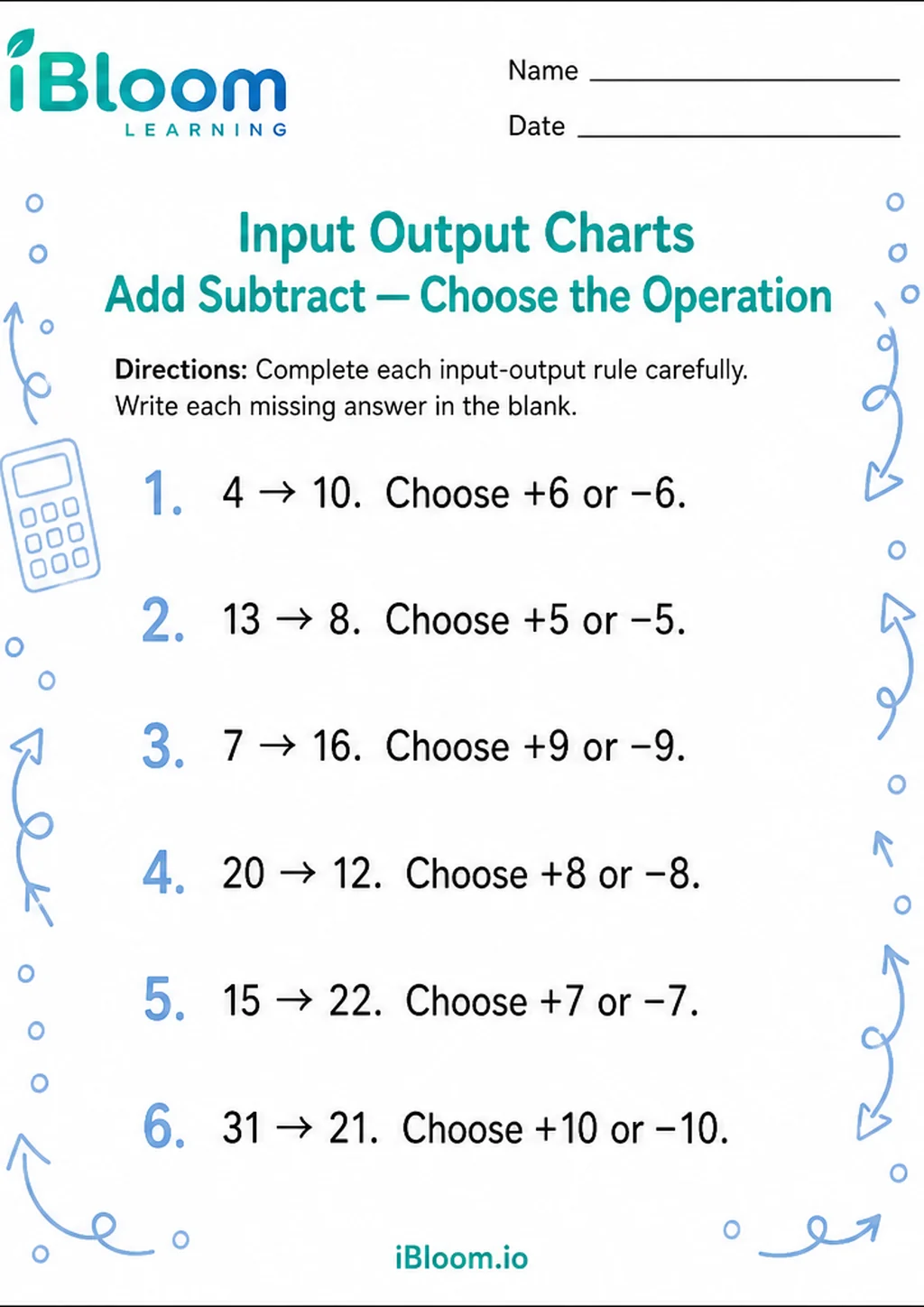 Input Output Charts Add Subtract — Choose the OperationPrintable math drills for practicing addition and subtraction rules in input-output charts with clear patterns and mixed fact work. This choose the operation worksheet provides focused, repeatable practice with clear accuracy checks.Grade 3, Grade 4, Grade 5, Grade 6Free PDF preview
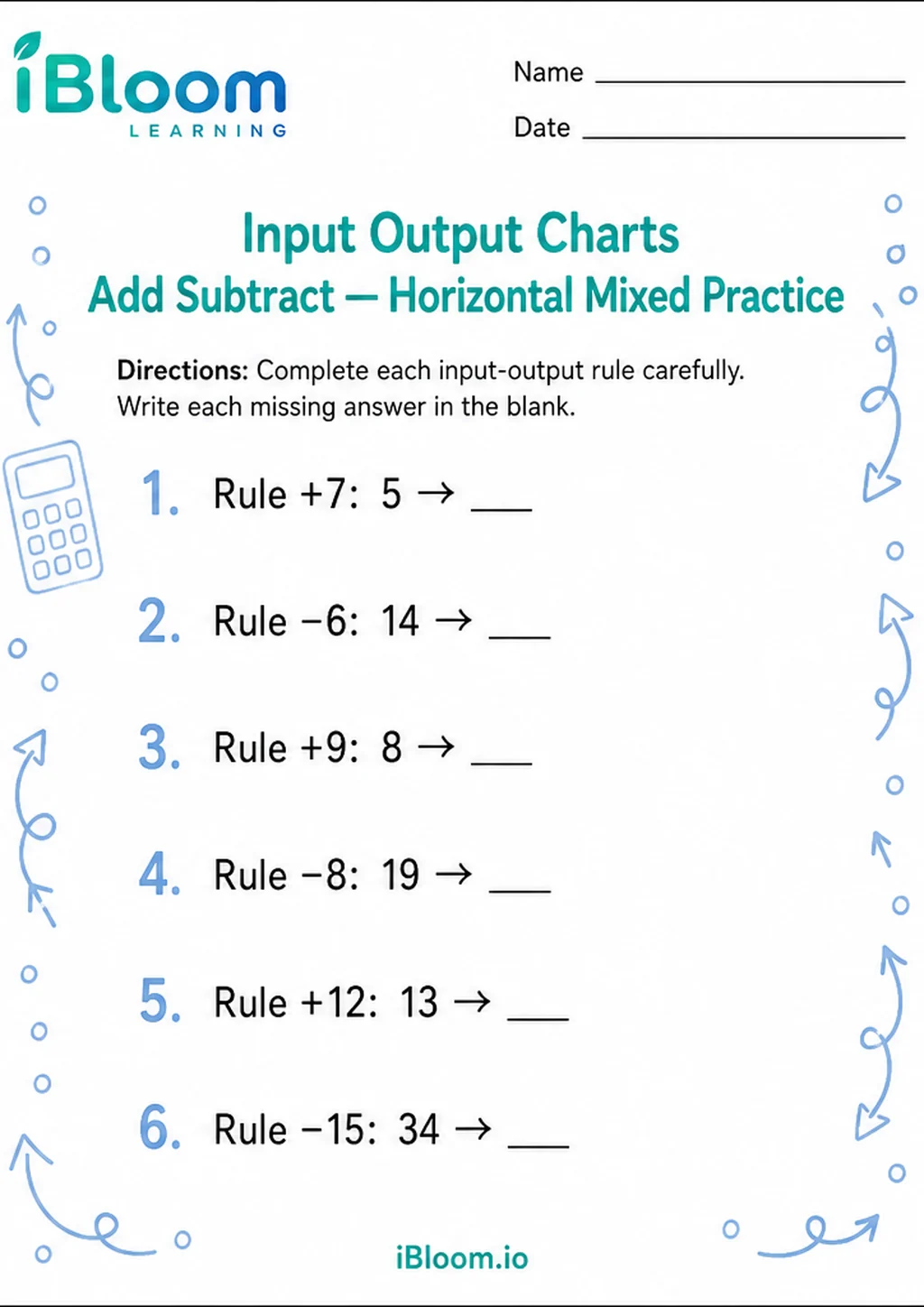 Input Output Charts Add Subtract — Horizontal Mixed PracticePrintable math drills for practicing addition and subtraction rules in input-output charts with clear patterns and mixed fact work. This horizontal mixed practice worksheet provides focused, repeatable practice with clear accuracy checks.Grade 3, Grade 4, Grade 5, Grade 6Free PDF preview
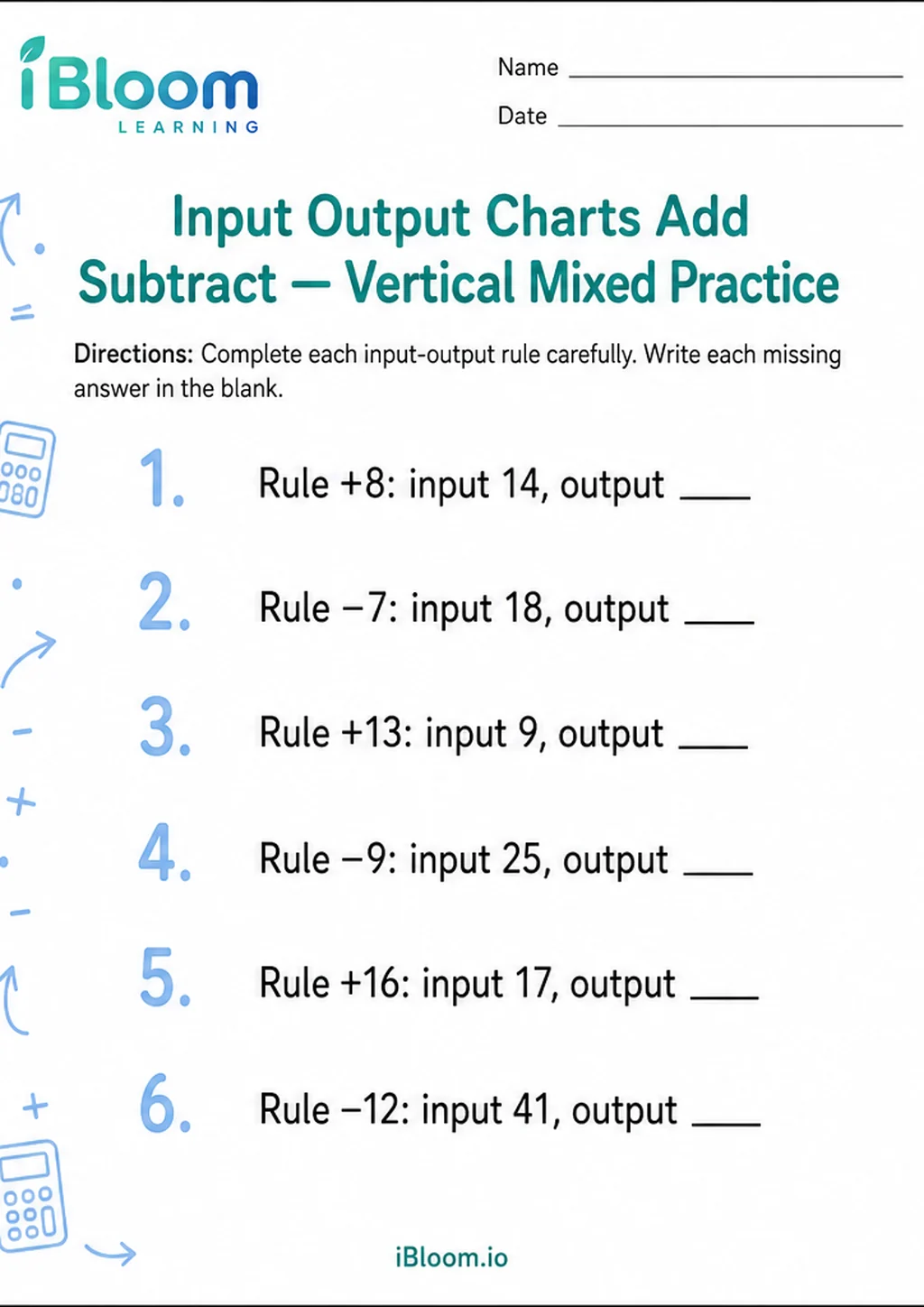 Input Output Charts Add Subtract — Vertical Mixed PracticePrintable math drills for practicing addition and subtraction rules in input-output charts with clear patterns and mixed fact work. This vertical mixed practice worksheet provides focused, repeatable practice with clear accuracy checks.Grade 3, Grade 4, Grade 5, Grade 6Free PDF preview
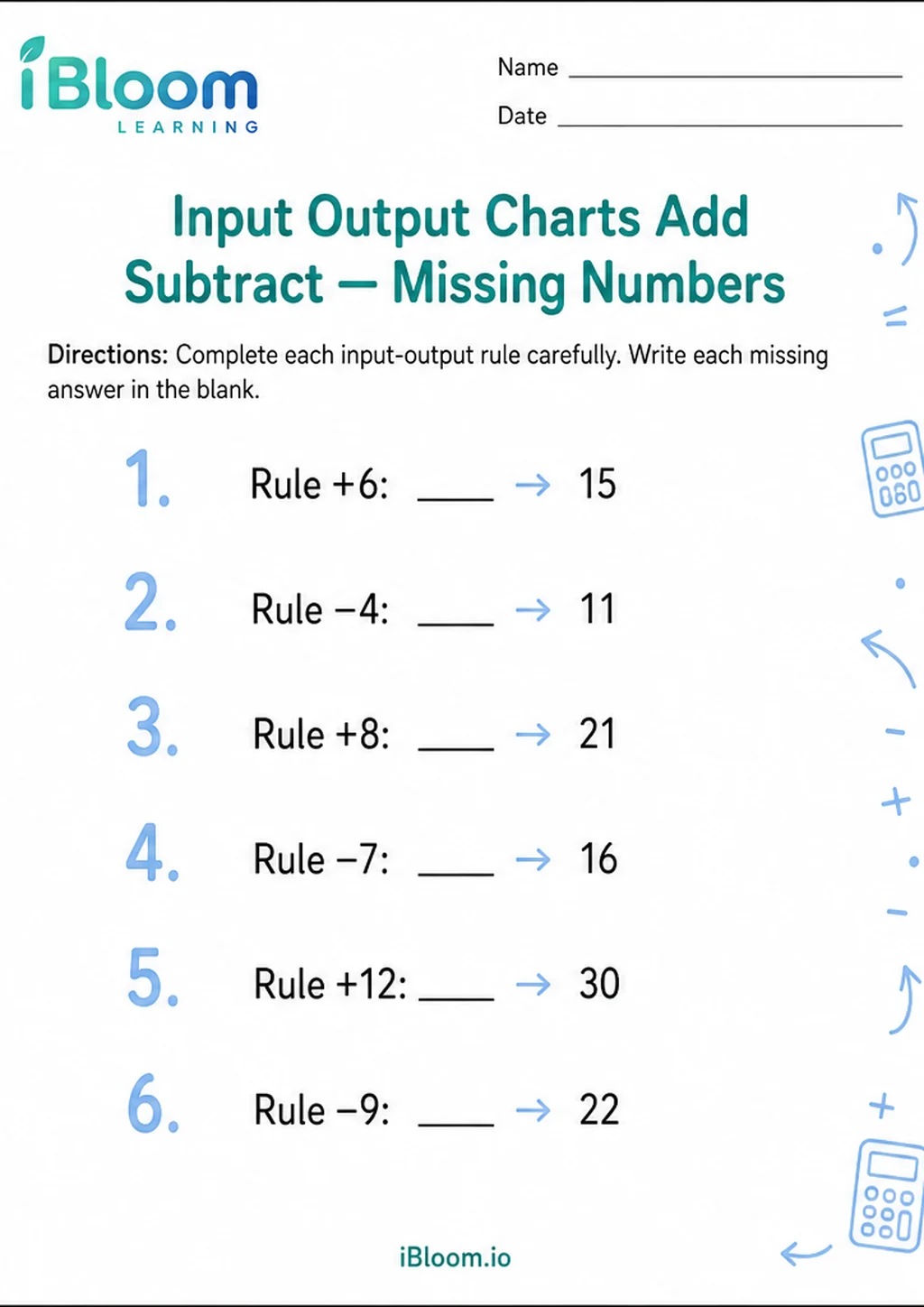 Input Output Charts Add Subtract — Missing NumbersPrintable math drills for practicing addition and subtraction rules in input-output charts with clear patterns and mixed fact work. This missing numbers worksheet provides focused, repeatable practice with clear accuracy checks.Grade 3, Grade 4, Grade 5, Grade 6Free PDF preview
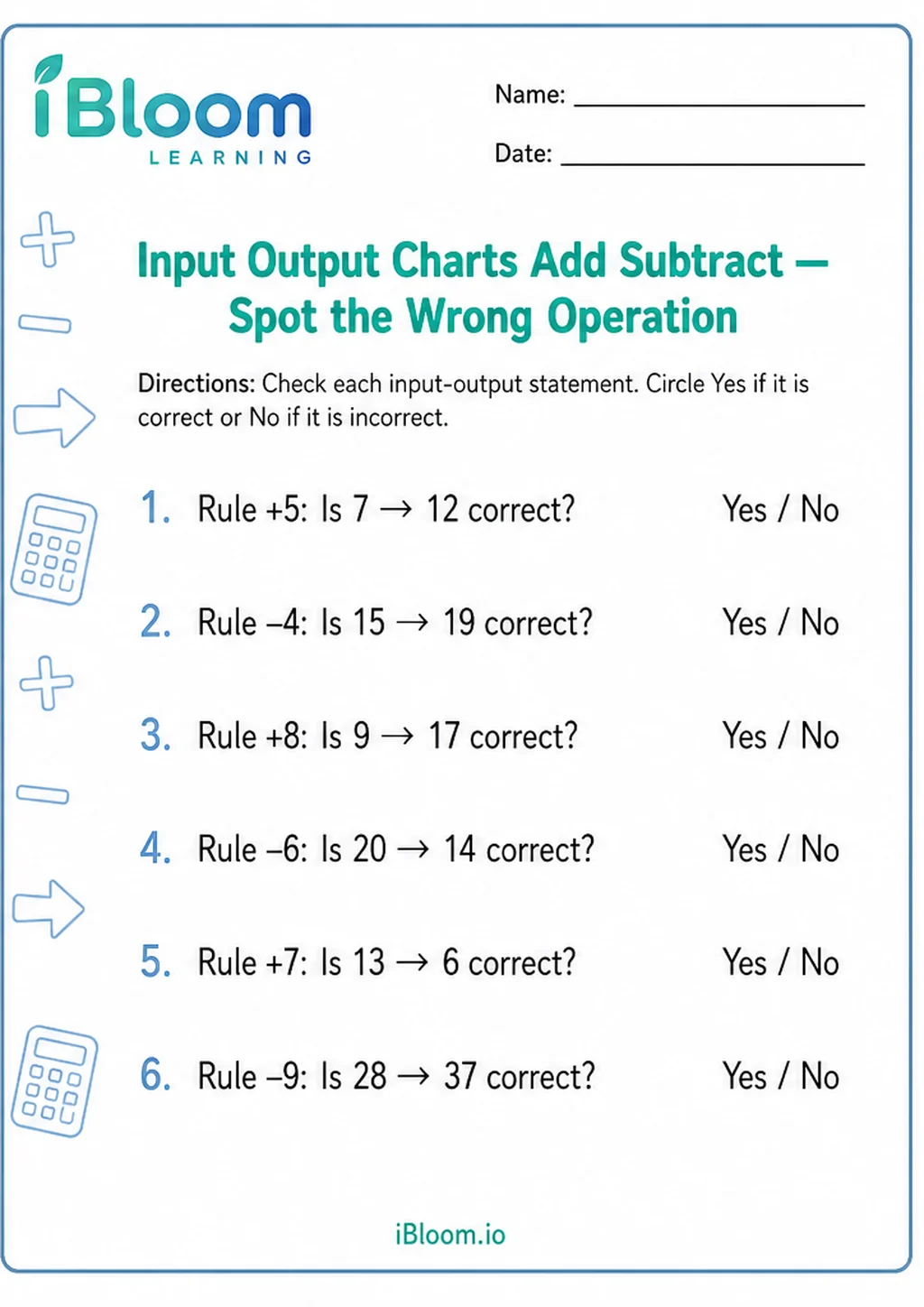 Input Output Charts Add Subtract — Spot the Wrong OperationPrintable math drills for practicing addition and subtraction rules in input-output charts with clear patterns and mixed fact work. This spot the wrong operation worksheet provides focused, repeatable practice with clear accuracy checks.Grade 3, Grade 4, Grade 5, Grade 6Free PDF preview
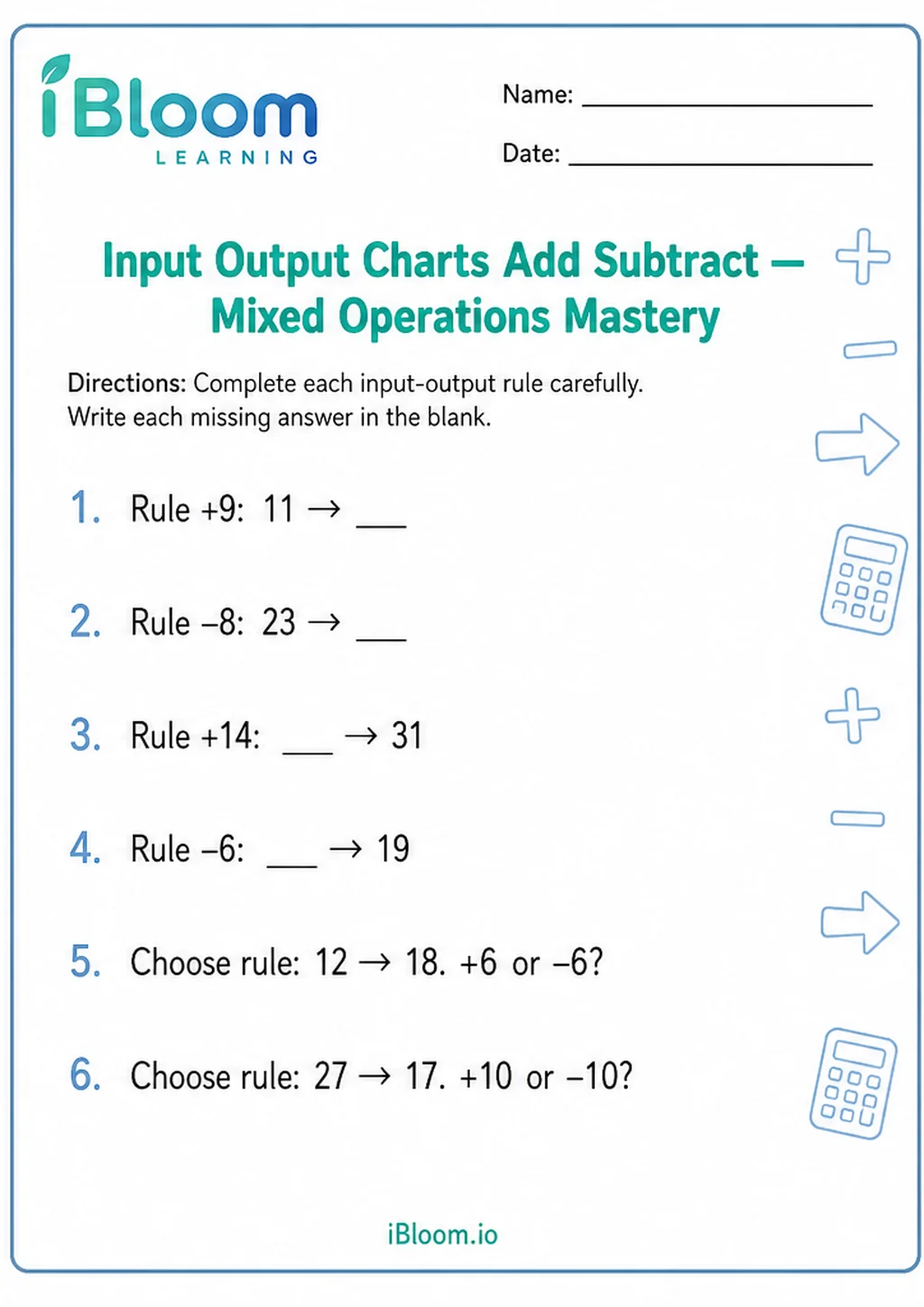 Input Output Charts Add Subtract — Mixed Operations MasteryPrintable math drills for practicing addition and subtraction rules in input-output charts with clear patterns and mixed fact work. This mixed operations mastery worksheet provides focused, repeatable practice with clear accuracy checks.Grade 3, Grade 4, Grade 5, Grade 6Free PDF preview
Practice that builds confidence
How input-output charts work
These worksheets help children read input-output charts and find the rule using addition or subtraction. They practise moving from one number to another, completing missing outputs, and noticing how the same rule works across a row or table.
The printable activities include mixed add-and-subtract function tables, number patterns, and rule-finding practice. Children strengthen fact fluency while also learning to explain a math relationship in a simple, organized way.
An input-output chart shows a starting number, called the input, and a result, called the output. Children compare the two numbers to decide what happened: add a number or subtract a number. For example, if 8 becomes 13, the rule may be “add 5.” If 16 becomes 10, the rule may be “subtract 6.”

Building mixed fact fluency
Because these pages sit inside mixed math facts practice, children do more than memorize isolated equations. They switch between addition and subtraction, read across tables, and apply one rule to several inputs. This supports flexible thinking: 7 + 4, 11 - 4, and “what rule changes 7 to 11?” are connected ideas.
A simple parent routine
At home, ask your child to circle one input-output pair first. Have them say, “The input is __. The output is __. It changed by __.” Then they should test the same rule on the next row before filling the whole chart. After the worksheet, choose two completed rows and ask your child to write the matching equation, such as 9 + 3 = 12 or 14 - 5 = 9.

Classroom uses for teachers
Teachers can use these printables for math drills, warm-ups, small-group review, or centers. They work well after students have practised basic addition and subtraction facts, because the table format asks them to organize those facts visually. For quick assessment, have students shade the rule box, underline the inputs, and check one row aloud with a partner.

Common errors to watch for
Some children find the difference between the first row and then apply it backward. Others add on one row and subtract on the next because they focus only on getting a nearby number. Encourage students to use the same rule for the entire chart unless the directions clearly say otherwise. Also watch for counting errors when crossing 10.
Free printable PDF download
Use this input output charts add subtract worksheet page to preview the activity, print it, or download it as a PDF for quick practice. It works well for homework, homeschool lessons, tutoring, morning work, revision, and classroom centers.
Answers and answer key support
After the child completes the worksheet independently, parents and teachers can use the answer support or answer key information to check the work, review mistakes, and choose the next practice step.
Why iBloom worksheets help
The iBloom pages give repeated practice with a clear structure, so children can focus on the relationship instead of guessing. A child-friendly strategy is: “Look, compare, choose, check.” Look at one row, compare input to output, choose add or subtract, then check the rule on another row before finishing.
Helpful answers
Frequently asked questions
What skill do these input-output chart worksheets teach?
They teach children to compare an input and an output, identify an addition or subtraction rule, and use that rule to complete the rest of a chart.
How are these different from regular math fact worksheets?
Regular fact worksheets usually show one equation at a time. These charts ask children to apply the same add or subtract rule across several numbers, which builds pattern recognition as well as fact fluency.
What should my child do if the rule is not obvious?
Have your child choose one complete row, count or calculate the difference between input and output, decide whether the number increased or decreased, and then test that rule on another row.
Can these worksheets be used for math centers?
Yes. They are useful for centers because students can work independently, check that one rule fits a whole chart, and then compare strategies with a partner.
What mistakes are common with add and subtract input-output tables?
Common mistakes include reversing the rule, changing the rule from row to row, misreading input and output columns, and making small counting errors when adding or subtracting across 10.
Is this input output charts add subtract worksheet free?
Yes. You can preview it for free and use the printable worksheet for home or classroom practice.
Can I download this input output charts add subtract worksheet as a PDF?
Yes. Use the worksheet download option to save a printable PDF, or print the worksheet directly from the page.
Does this input output charts add subtract worksheet include answers or an answer key?
When the activity has fixed answers, iBloom includes answer support so parents and teachers can check the completed worksheet.