


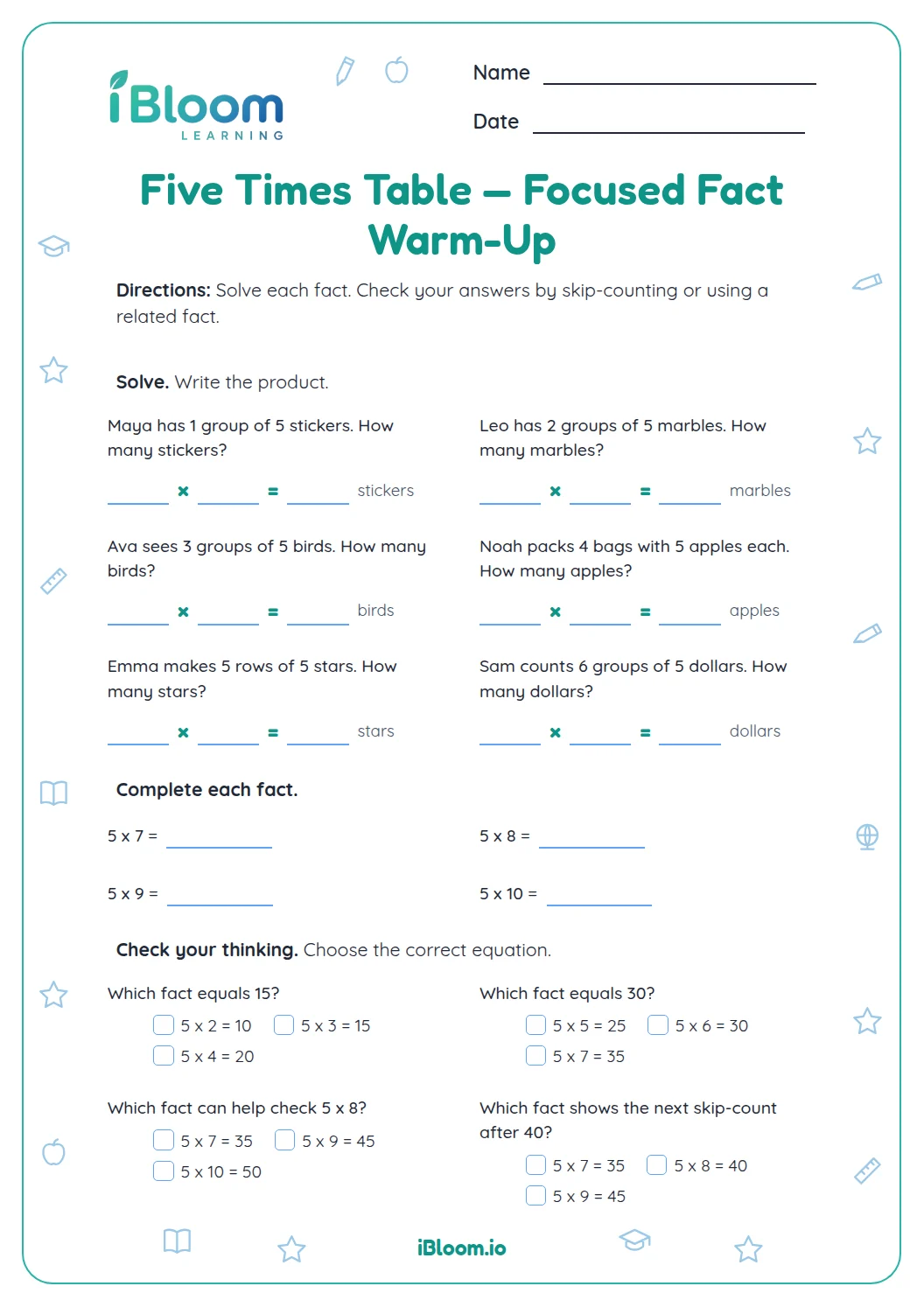
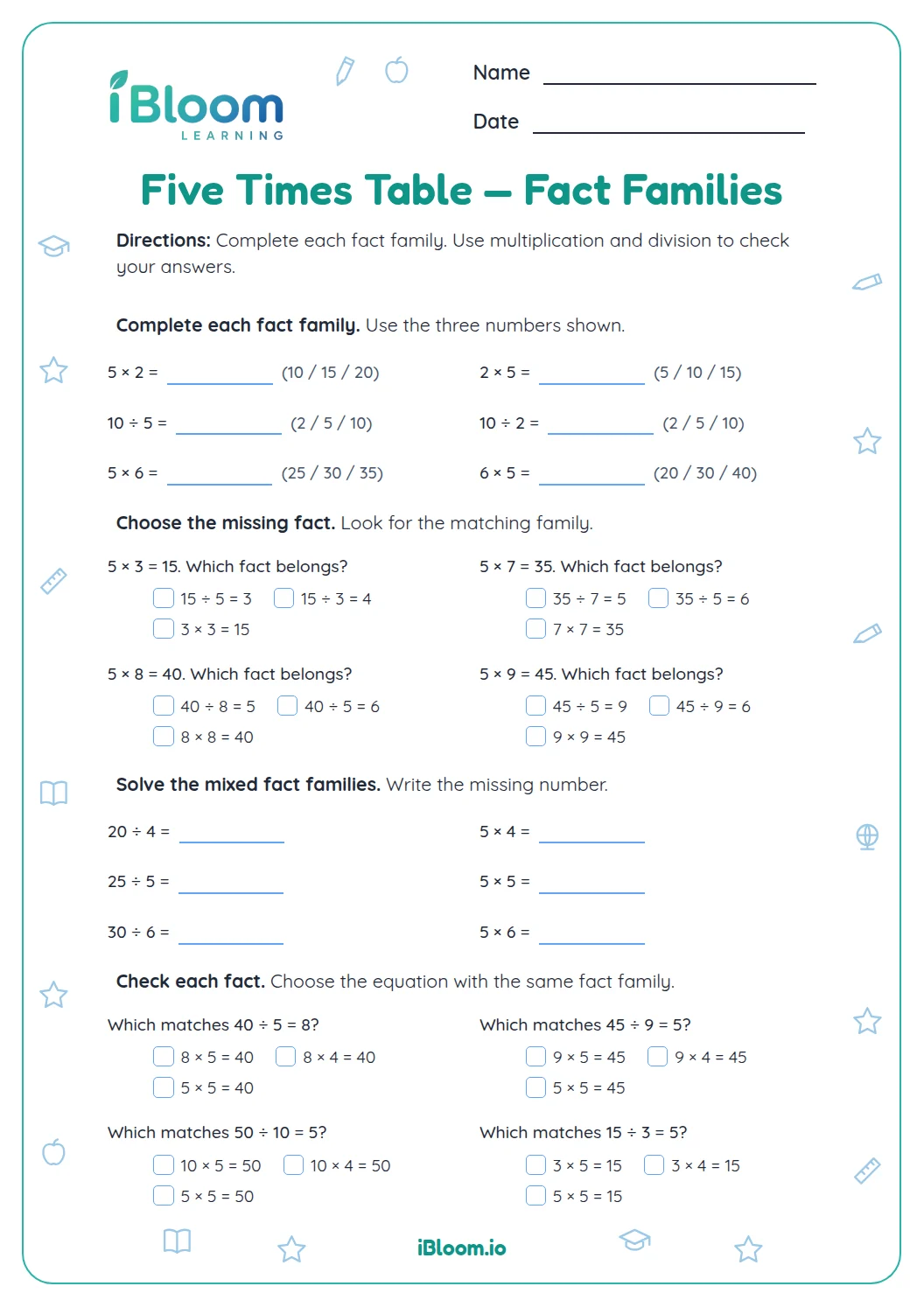
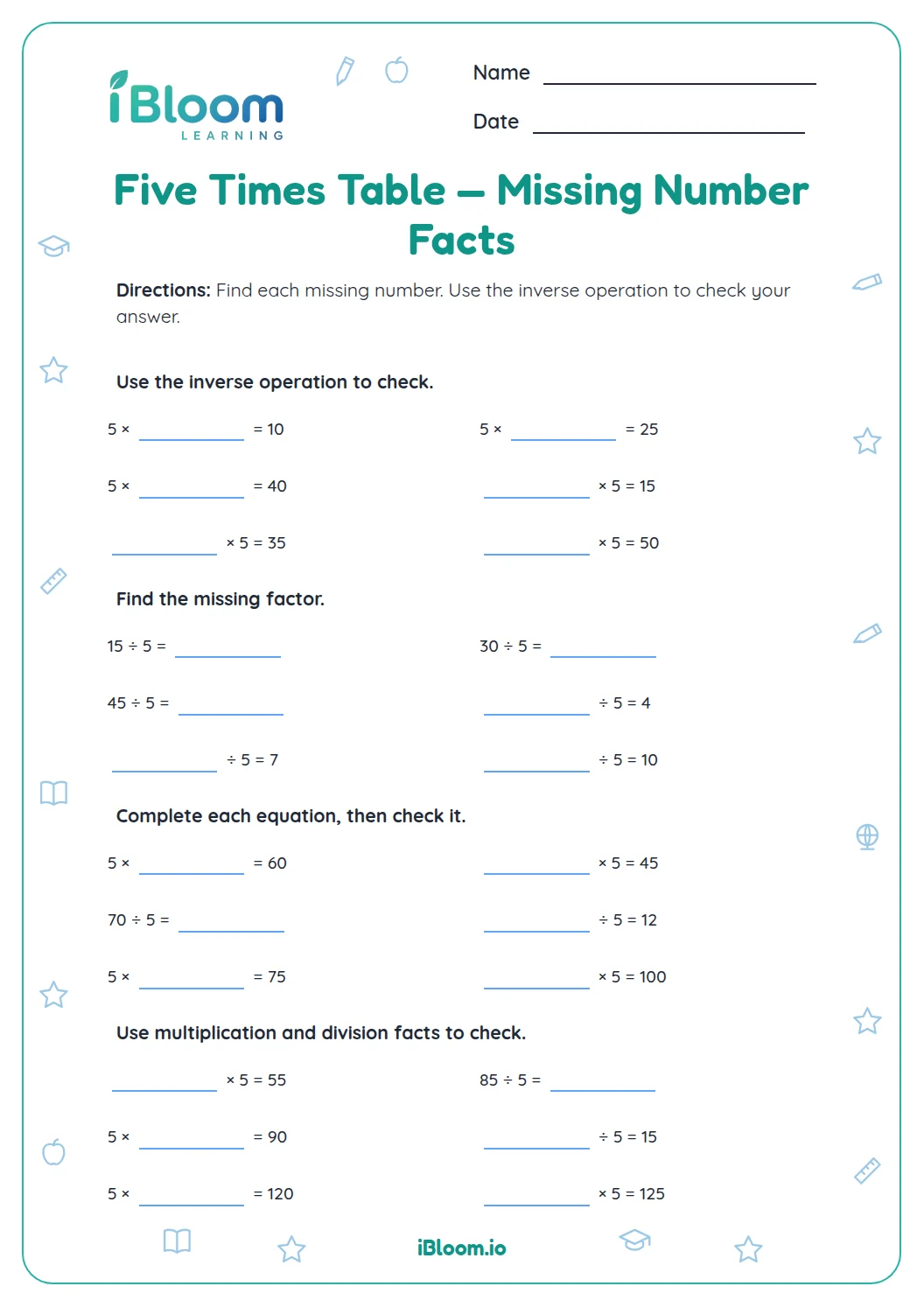
About this worksheet
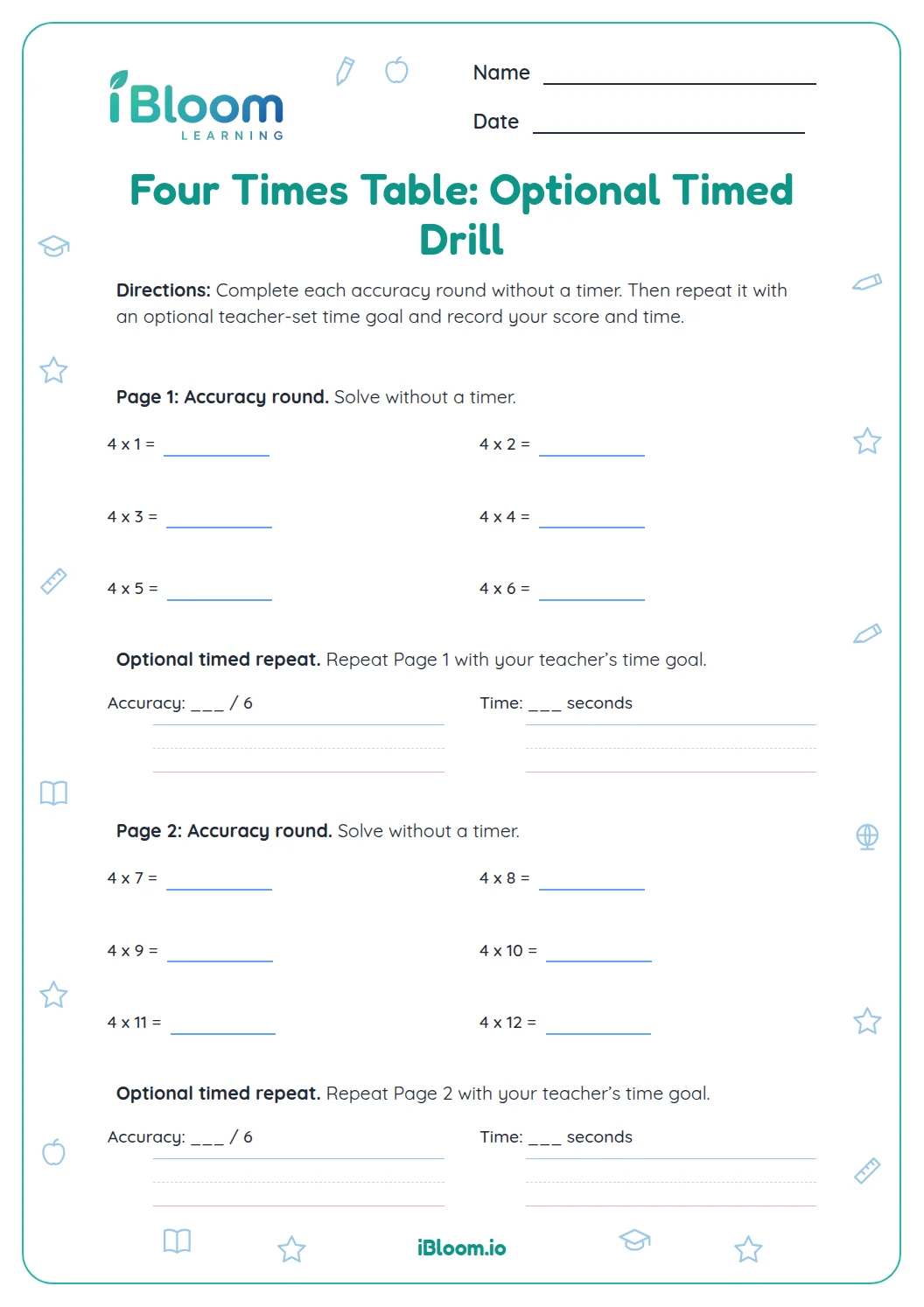
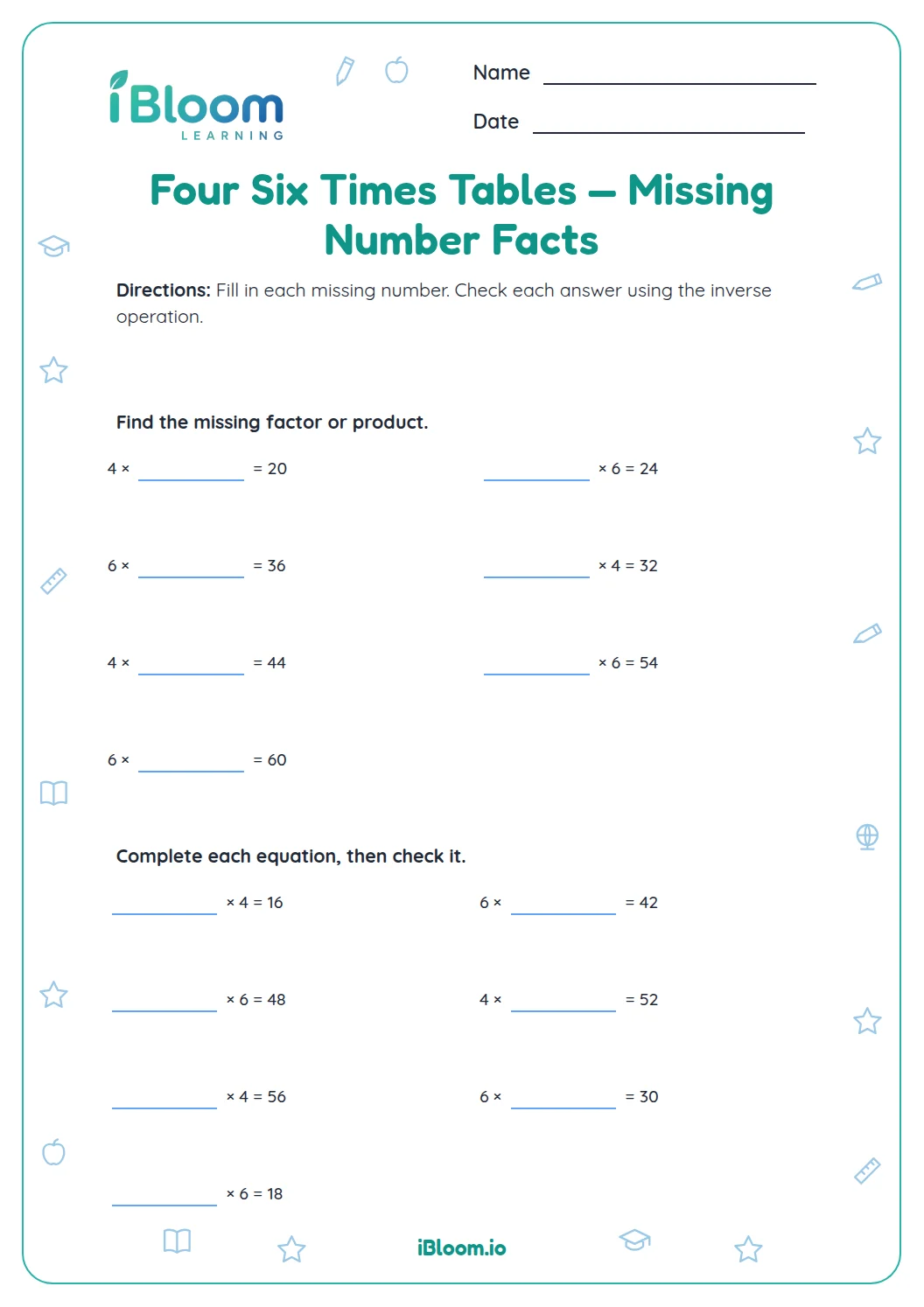
This Grade 3 printable connects the four-times table with related division facts. Students complete 12 multiplication equations and eight division equations, one missing value at a time. Products stay within 100, and each division is exact. The separate key gives one answer for every blank. The skill aligns with CCSS 3.OA.C.7.
Aligned to 3.OA.C.7
How does a four-times fact family work?
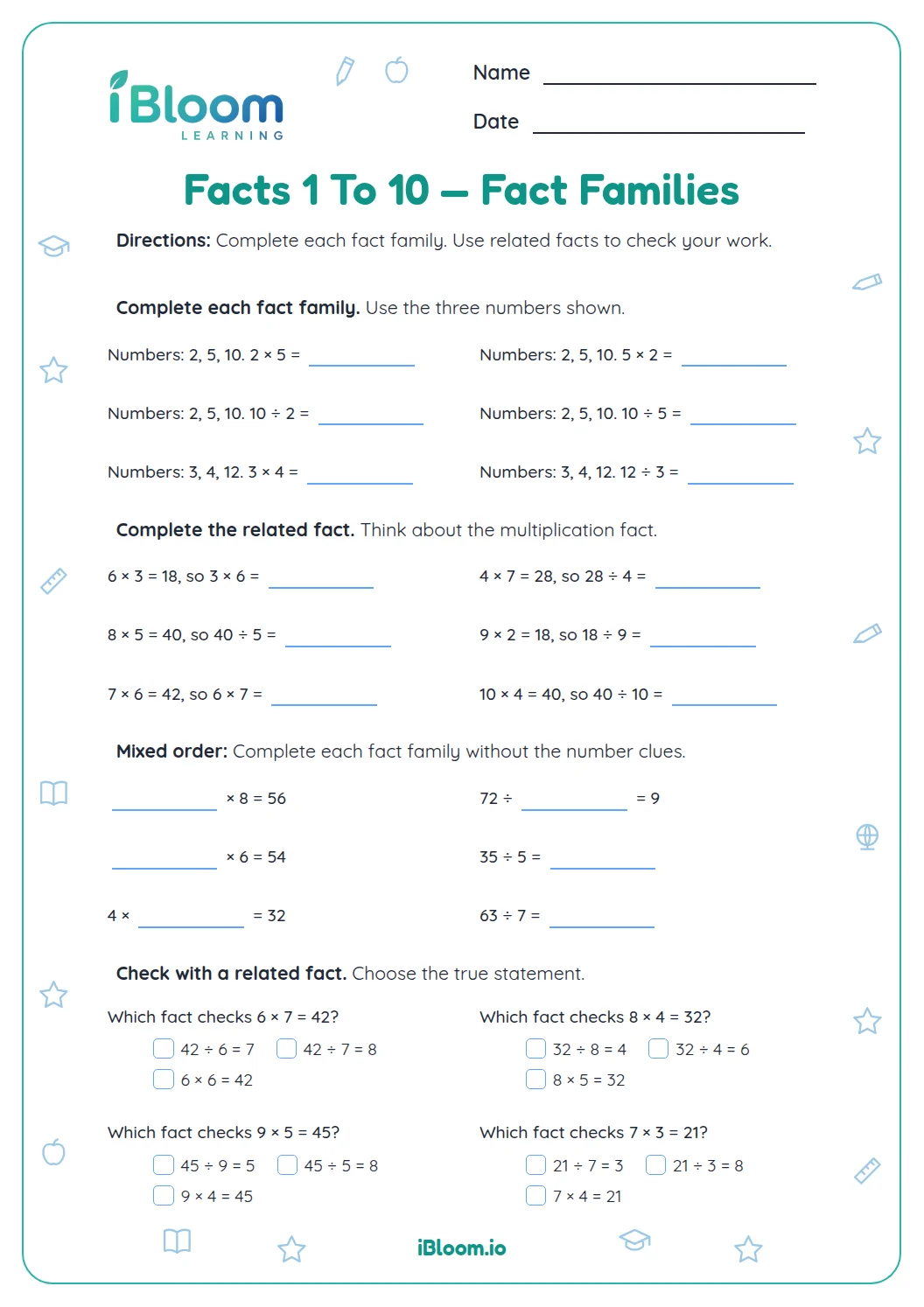
A fact family connects multiplication and division equations made from the same numbers. For question 1, 4 × 2 = 8, so the related facts include 8 ÷ 4 = 2 and 8 ÷ 2 = 4. Each worksheet item asks for just one value.
- 14 × 2 = 8
- 22 × 4 = 8
- 38 ÷ 4 = 2
- 48 ÷ 2 = 4
How can multiplication help solve a division fact?
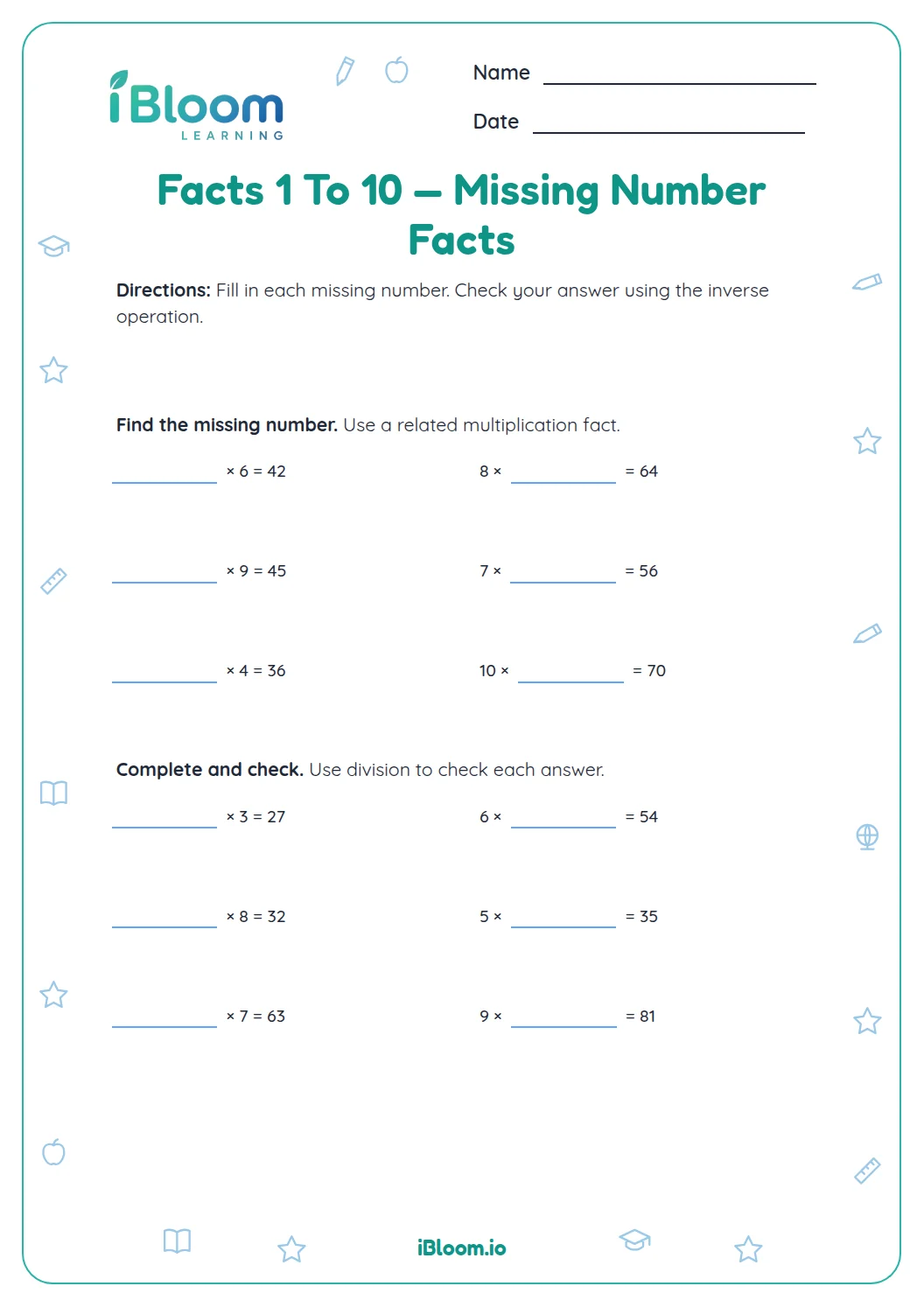
Ask which factor makes the product. For 32 ÷ 4, think 4 × ___ = 32. Since 4 × 8 = 32, the quotient is 8.
What facts are on the sheet?
The sheet mixes multiplication and division equations, so students identify the operation before finding the missing value. Products remain within 100.
How to work through this sheet
- 1Read the operation sign before solving.
- 2For multiplication, count groups of four or recall the product.
- 3For division, use a related four-times multiplication fact.
- 4Check that multiplying divisor and quotient gives the dividend.
Common mistakes and quick fixes
The mistake
Writing the factor instead of the product
The fix
Pause and use the operation relationship to check the value: Multiply the two factors, such as 4 × 6 = 24..
The mistake
Using addition instead of equal groups
The fix
Pause and use the operation relationship to check the value: Think of the number of groups and the size of each group..
The mistake
Reversing the division fact
The fix
Pause and use the operation relationship to check the value: Check divisor × quotient = dividend..
Common Core alignment
This worksheet practices the number skills named in these standards.
Use multiplication and division strategies to solve facts within 100.
On this sheet: Students solve four-times multiplication facts and use related division facts.
Show the official wordingHide the official wording
Fluently multiply and divide within 100, using strategies such as the relationship between multiplication and division (e.g., knowing that 8 × 5 = 40, one knows 40 ÷ 5 = 8) or properties of operations. By the end of Grade 3, know from memory all products of two one-digit numbers.
What to practice next
Make more practice
Further reading
Questions parents and teachers ask
What is a multiplication and division fact family?
It is a set of related equations built from the same three numbers. For 4, 2, and 8, the family includes 4 × 2 = 8, 2 × 4 = 8, 8 ÷ 4 = 2, and 8 ÷ 2 = 4. This sheet practices one missing value per equation.
Does each question ask for all four facts?
No. Each of the 20 questions has one blank, so students write one product or quotient at a time. The equations connect multiplication facts with related division, and the answer key gives one value per blank. This keeps the response space clear and easy to mark.
How can a student solve 32 ÷ 4?
Think of the multiplication fact 4 × 8 = 32. That means 32 ÷ 4 = 8. The worksheet includes exact division facts that can all be checked with a matching multiplication equation. Students can write that check in the work area.
Which factors appear in the four-times facts?
The multiplication equations include 4 multiplied by each whole number from 1 through 12, with products no greater than 48. The division equations use products from this table and 4 as the divisor. This keeps every fact within 100. for each product and quotient.
How many questions and pages are included?
There are 20 single-blank questions: 12 multiplication equations and eight related division equations. The worksheet spans two practice pages, followed by an answer key with the missing product or quotient for every item. Students can complete the pages in one sitting or split the practice.
Can students use skip counting to find a product?
Yes. Counting by fours can help with a fact such as 4 × 7, and a known product can help with division. For 28 ÷ 4, ask which multiple of four equals 28; the answer is 7. Multiplication confirms the quotient.