




About this worksheet
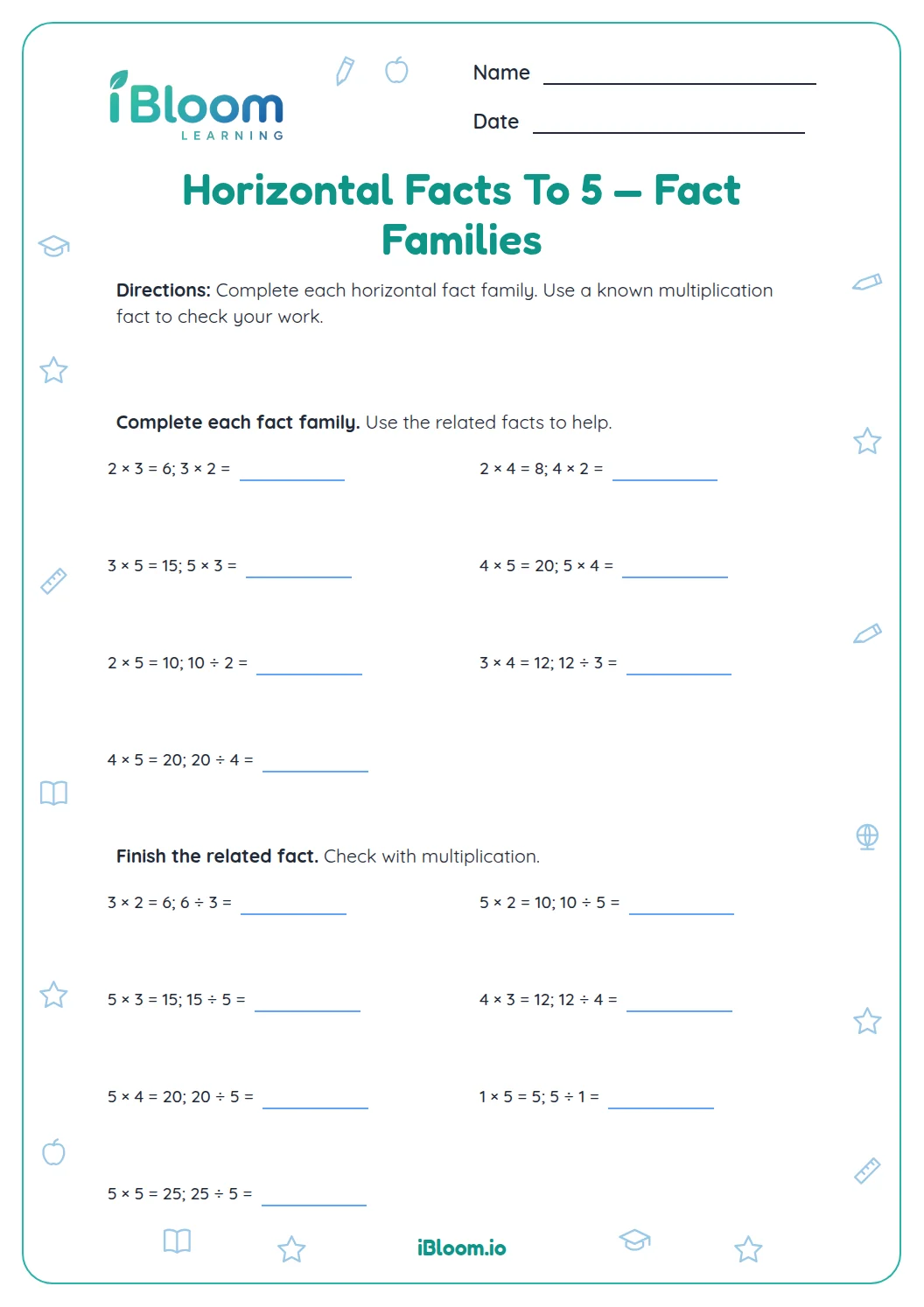
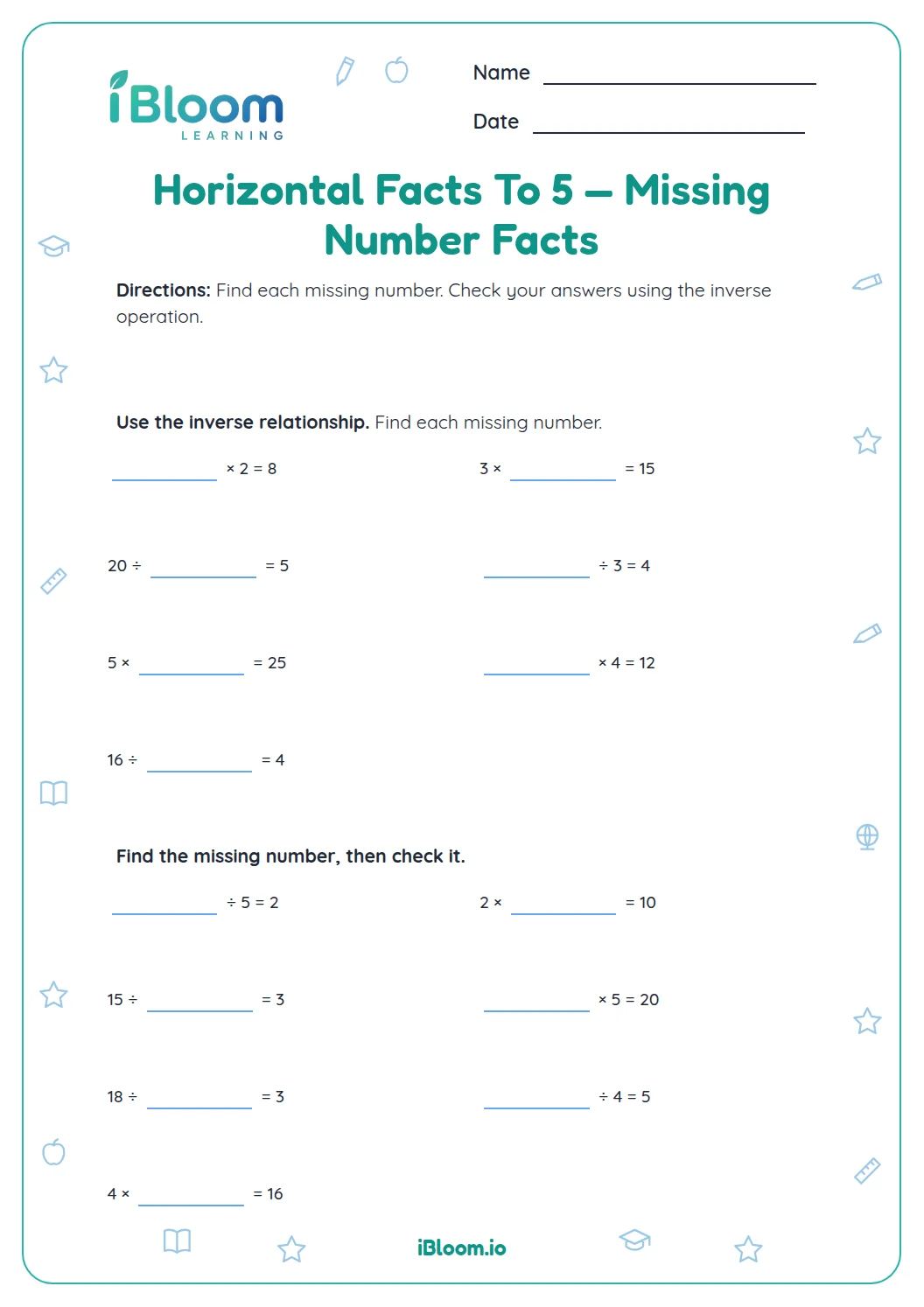
This Grade 3 printable gives students 18 horizontal multiplication facts with factors from 0 through 5. The first two parts ask for products in mixed order; the final part places the unknown in a factor position. A separate key lists all 18 answers. It practices fluent multiplication within 100 (CCSS 3.OA.C.7).
Aligned to 3.OA.C.7
What multiplication facts are included?
The sheet has 18 number sentences in three parts. Part A mixes facts with 0, 1 and 2; Part B mixes factors 3, 4 and 5; Part C asks students to find a missing factor. Every needed number is printed in the prompt.
Products stay at 25 or below. The factor order changes, so students need to read both factors rather than rely on a memorized row.
- Part A, questions 1–6: products with factors 0, 1 and 2
- Part B, questions 7–12: products with factors 3, 4 and 5
- Part C, questions 13–18: missing factors
- The answer key gives one product or factor for every item
How do you find a missing factor?
For 3 × ___ = 15, ask how many groups of 3 make 15. Since 3 × 5 = 15, the missing factor is 5. Check by putting 5 back into the original equation.
- 13 × ___ = 15
- 23 × 5 = 15, so the missing factor is 5.
What should students check before writing an answer?
Keep the product and factor roles straight. In ___ × 4 = 12, 12 is the product and 3 is the missing factor because 3 × 4 = 12.
How to use this worksheet
- 1Read the two factors and identify which number is missing.
- 2Solve questions 1–12 by recalling or rebuilding the product.
- 3For questions 13–18, ask what number times the known factor gives the product.
- 4Check each answer by substituting it into the equation.
- 5Use the separate answer key after completing the page.
Common mistakes and quick fixes
The mistake
Writing the product in a factor blank, such as 12 for ___ × 4 = 12.
The fix
Use the known factor and product to find the other factor: 3 × 4 = 12, so the blank is 3.
The mistake
Treating 0 × 5 like 5 groups of zero objects and answering 5.
The fix
Any factor multiplied by 0 has a product of 0.
The mistake
Reading 4 × 2 as a different fact from 2 × 4.
The fix
Multiplication order can change, but the product stays 8.
Common Core alignment
The worksheet practices number operations and place-value reasoning in the Common Core State Standards for Mathematics.
Fluently multiply and divide within 100.
On this sheet: All facts use factors 0 through 5; the set mixes factor order and unknown products.
Show the official wordingHide the official wording
Fluently multiply and divide within 100, using strategies such as the relationship between multiplication and division (e.g., knowing that 8 × 5 = 40, one knows 40 ÷ 5 = 8) or properties of operations. By the end of Grade 3, know from memory all products of two one-digit numbers.
What to practice next
Make more practice
Further reading
Questions parents and teachers ask
Which factors appear on the worksheet?
Each factor is 0, 1, 2, 3, 4 or 5. The first two parts ask for products, and the last part asks for missing factors. Products range from 0 to 25, so the practice stays focused on the facts named in the title.
How do I solve 3 × ___ = 15?
Find the number of groups of 3 that make 15. Five groups do, because 3 × 5 = 15. Put 5 in the blank and multiply once more to check that the equation remains true. Then verify the original number sentence.
What grade is this worksheet for?
It is written for Grade 3 multiplication practice. The 18 prompts mix factor order and include missing-factor equations, while all products stay within 100 as described in CCSS 3.OA.C.7. Use that check before moving to the next fact. in each equation.
Does the answer key include missing factors?
Yes. The separate key includes the product for every multiplication question and the missing factor for each equation in Part C. Students can check a missing factor by multiplying it by the other factor. Substitute the answer and multiply to check.
Can students use a related fact?
Yes. If a student knows 4 × 3 = 12, that also helps with 3 × 4 = 12. For a missing factor, use the known product and factor to identify the number that completes the fact. Then test the completed equation once more.