

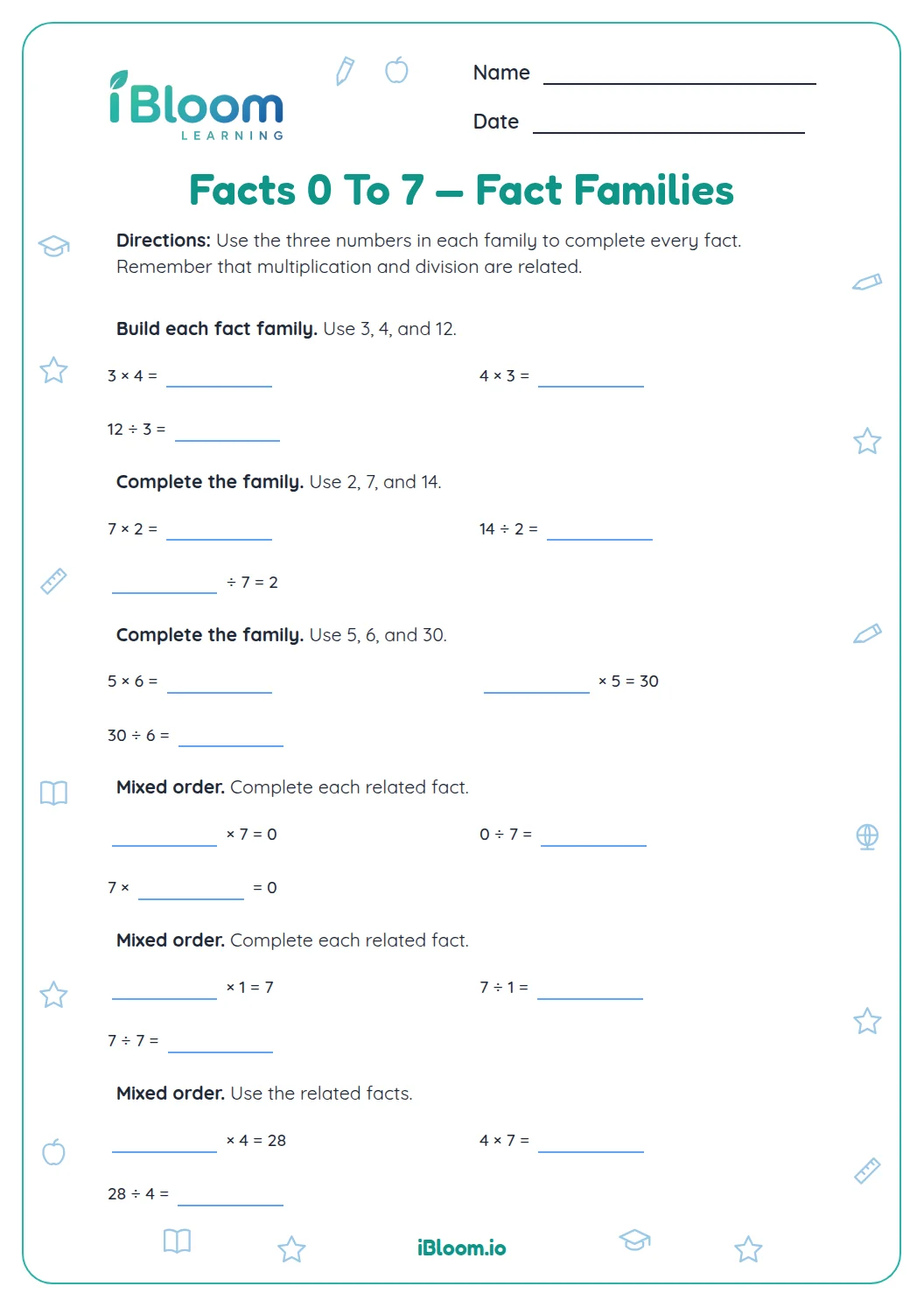
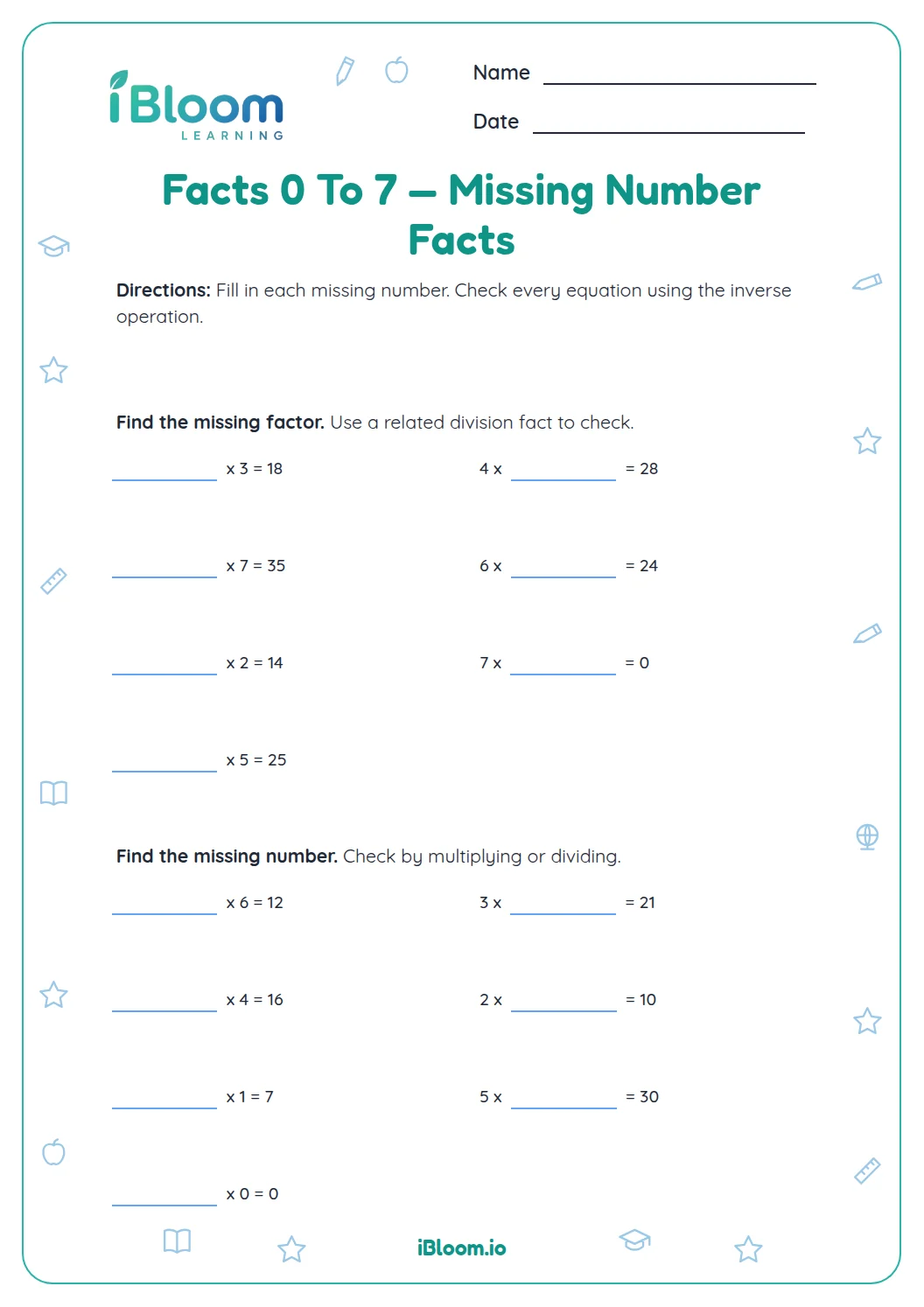
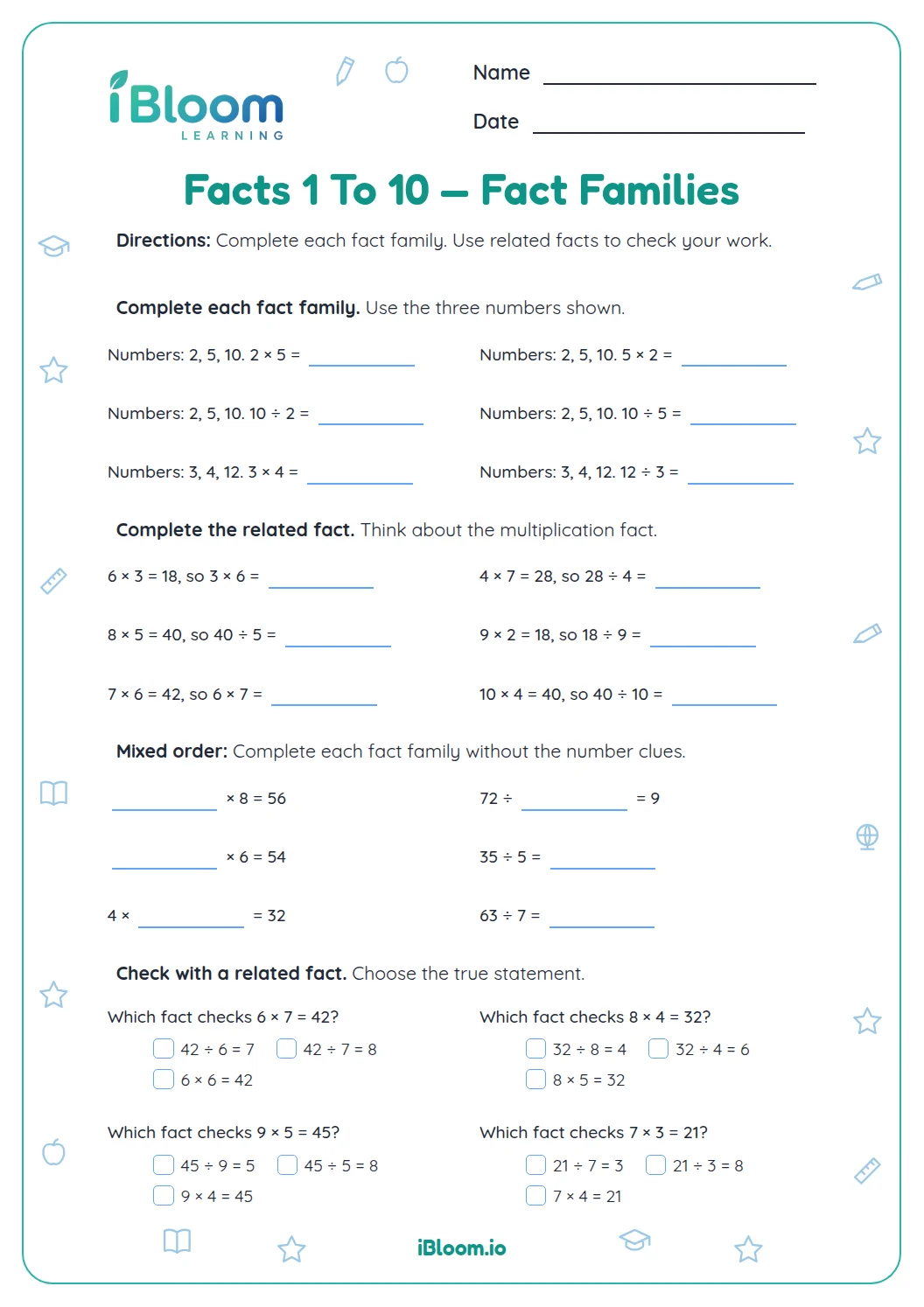
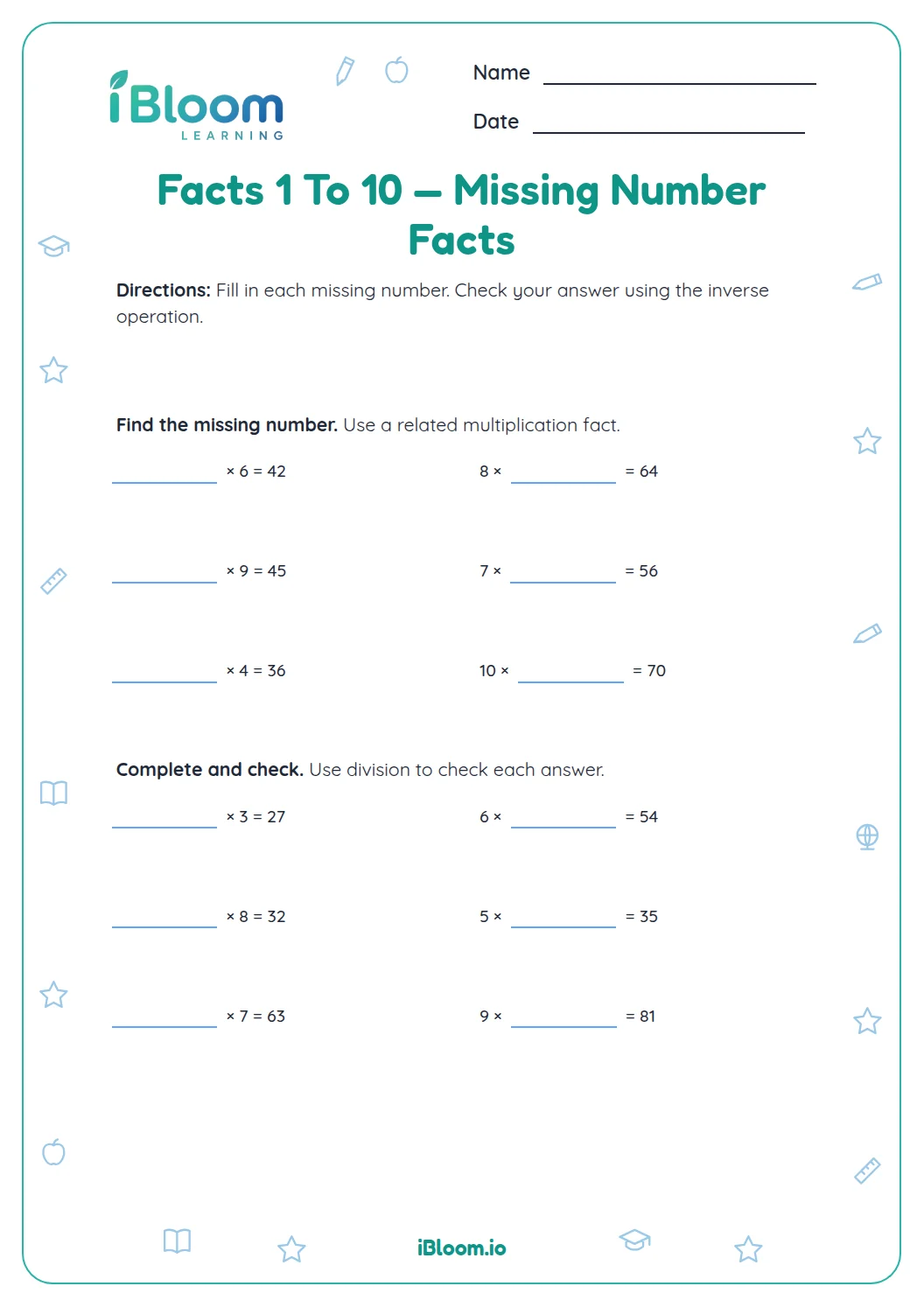
About this worksheet
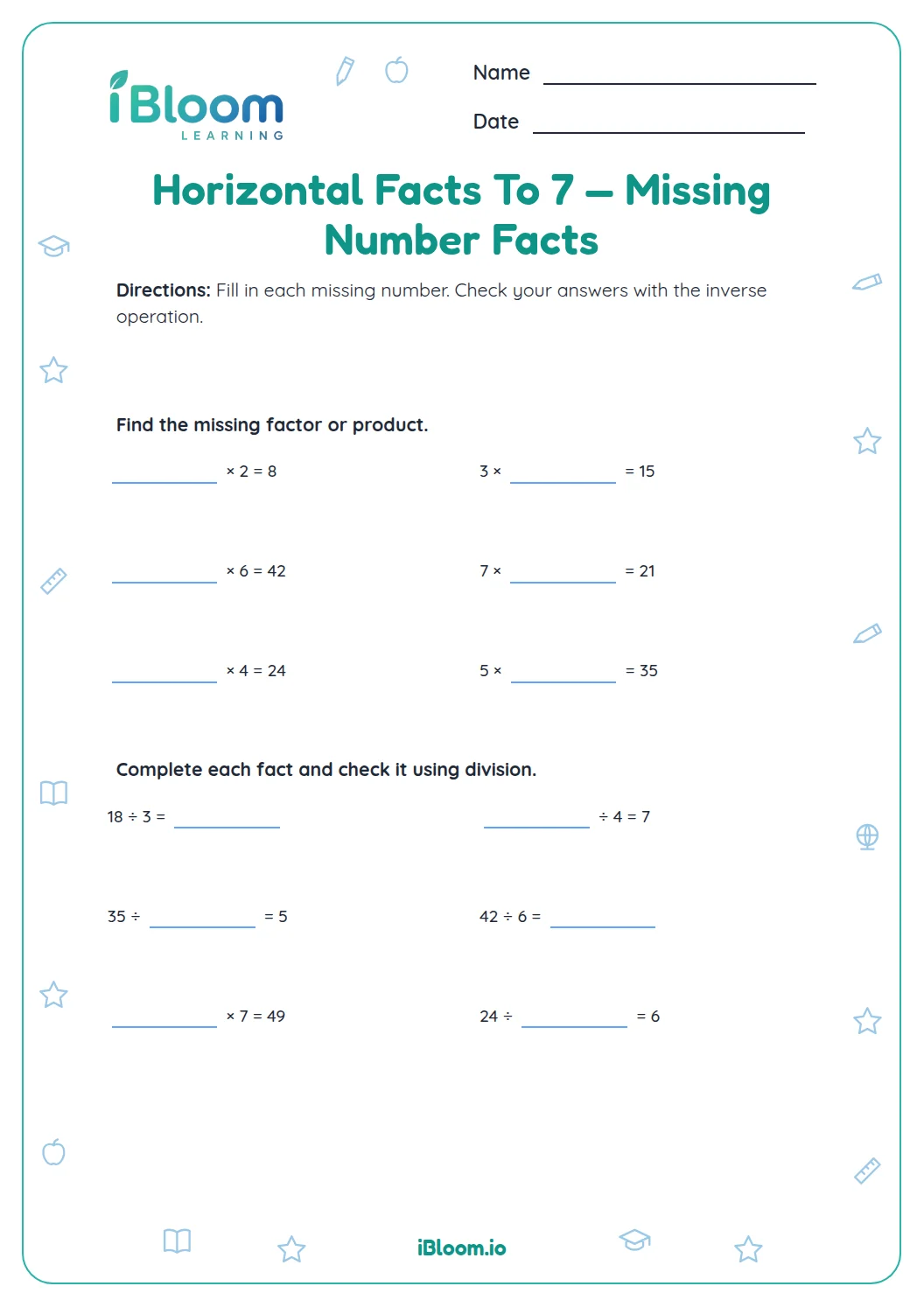
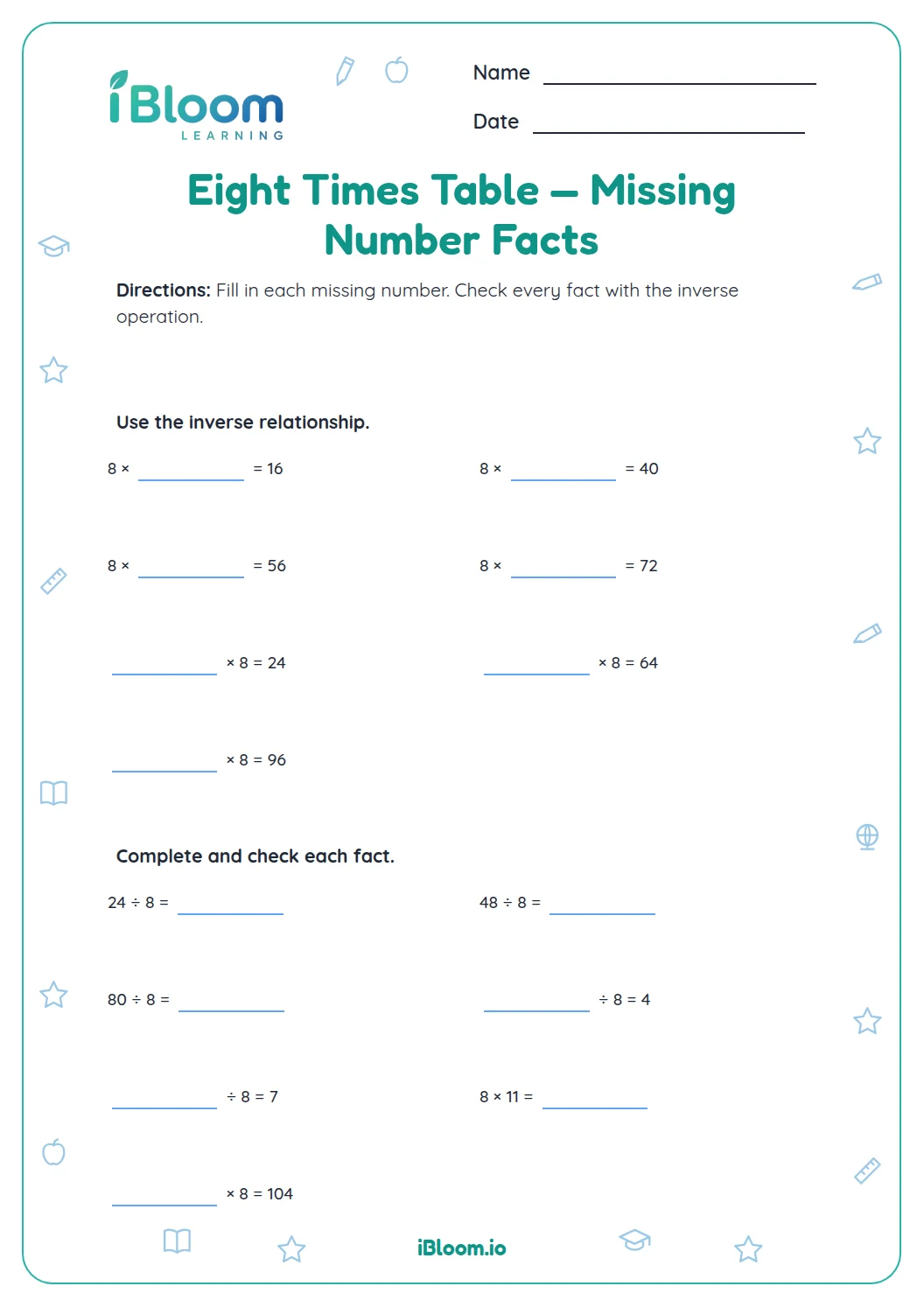
This free two-page worksheet helps Grade 3 students practice facts through 7 multiplication facts with the numbers printed on every item. Students first find products, then use products to recover missing factors, and finally connect facts to equal-groups situations. The sequence moves from quick recall to using multiplication to find a total. It practices Common Core standard 3.OA.C.7, fluently multiplying within 100 and knowing one-digit products from memory. A separate answer key gives the value for all 16 questions.
Aligned to 3.OA.C.7
How can students build accurate multiplication recall?
Begin with the printed equations in Part A. Say the factors in order, then use a known fact or a related fact to find the product. For example, question 1 is 7 × 6; skip-counting by 7 gives the product 42.
- 17 × 6
- 2Count {items[0][0]} groups of {items[0][1]} or skip-count by {items[0][0]}.
- 37 × 6 = 42
What does a missing factor tell us?
A missing factor is the number of equal groups or the number in each group. Use the known factor and product together: ask what number multiplied by the known factor makes the product. The question keeps the product visible so students can focus on the relationship.
How do equal-groups stories use multiplication?
In Part C, identify how many groups there are and how many objects belong in each group. Multiply those two counts to find the total. The answer key shows the total for each situation.
- Part A: 8 printed multiplication equations
- Part B: 4 equations with one factor missing
- Part C: 4 equal-groups situations with working space
How to use this worksheet
- 1Read both factors in Part A before choosing a strategy.
- 2Use skip-counting or a familiar fact to find each product.
- 3In Part B, multiply the known factor by a candidate until it reaches the printed product.
- 4For Part C, mark the number of groups and the number in each group, then multiply.
- 5Check each result with the answer key and revisit facts that took extra effort.
Common mistakes and quick fixes
The mistake
Adding the factors instead of multiplying them.
The fix
Ask how many equal groups there are and how many are in each group.
The mistake
Switching the factor and product in a missing-factor equation.
The fix
Multiply the known factor by the blank value and check that it equals the printed product.
The mistake
Counting one group too many in an equal-groups story.
The fix
Underline the stated number of groups before writing the equation.
Common Core alignment
This worksheet practices multiplication fluency and one-digit products.
Recall one-digit multiplication products and use strategies to multiply fluently within 100.
On this sheet: Students solve one-digit multiplication facts, recover missing factors, and use facts in equal-groups situations.
Show the official wordingHide the official wording
Fluently multiply and divide within 100, using strategies such as the relationship between multiplication and division (e.g., knowing that 8 × 5 = 40, one knows 40 ÷ 5 = 8) or properties of operations. By the end of Grade 3, know from memory all products of two one-digit numbers.
What to practice next
Make more practice
Further reading
Questions parents and teachers ask
What is on this multiplication worksheet?
The worksheet has 16 questions in three parts: 8 multiplication equations, 4 missing-factor equations, and 4 equal-groups problems. The factors and products are printed in every prompt, and a separate answer key makes checking straightforward. The page includes room to write each response beside its equation.
What does mixed order mean on this page?
The facts appear in a varied sequence instead of counting steadily through a table. This asks students to recognize each fact from its factors, rather than rely only on the order of a memorized list. This makes flexible recall more important than reciting a table.
How should a student solve a missing-factor question?
Use the known factor and the printed product to find the factor that completes the equation. For example, if 6 × ___ = 42, think of the number of sixes in 42; the missing factor is 7. Then multiply 6 by 7 once more to confirm that the product matches 42.
How can a family use the answer key?
Have the student complete a small group of questions, then compare those responses with the separate key. If an answer differs, return to the printed factors and check the multiplication instead of simply replacing the answer. This keeps the correction connected to the fact that caused it.
Should students race to finish the facts?
Accuracy is the useful first goal for this worksheet. A student can work at a comfortable pace, use skip-counting or a known fact when needed, and repeat the page later to notice which products have become easier to recall.