
About this worksheet
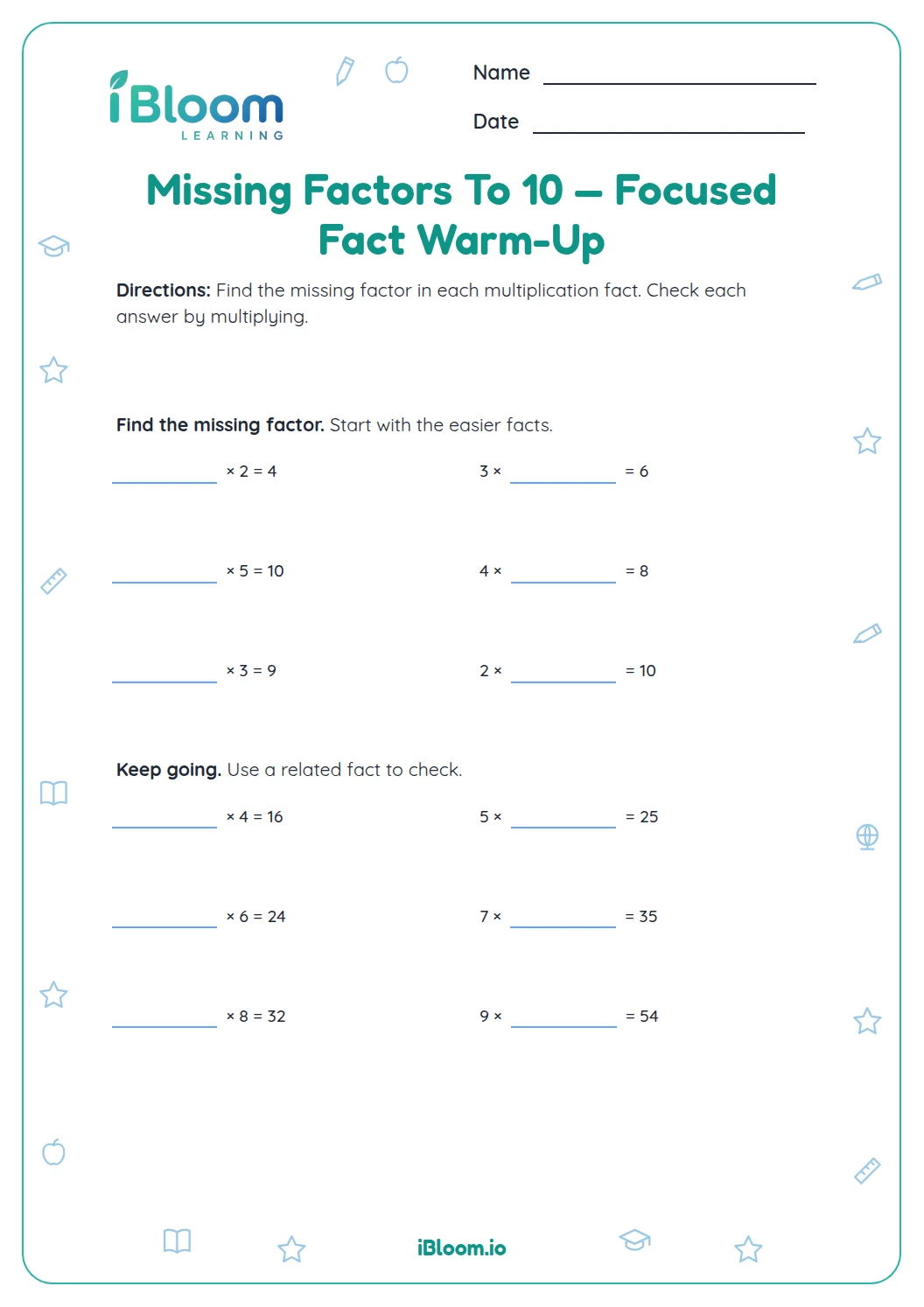
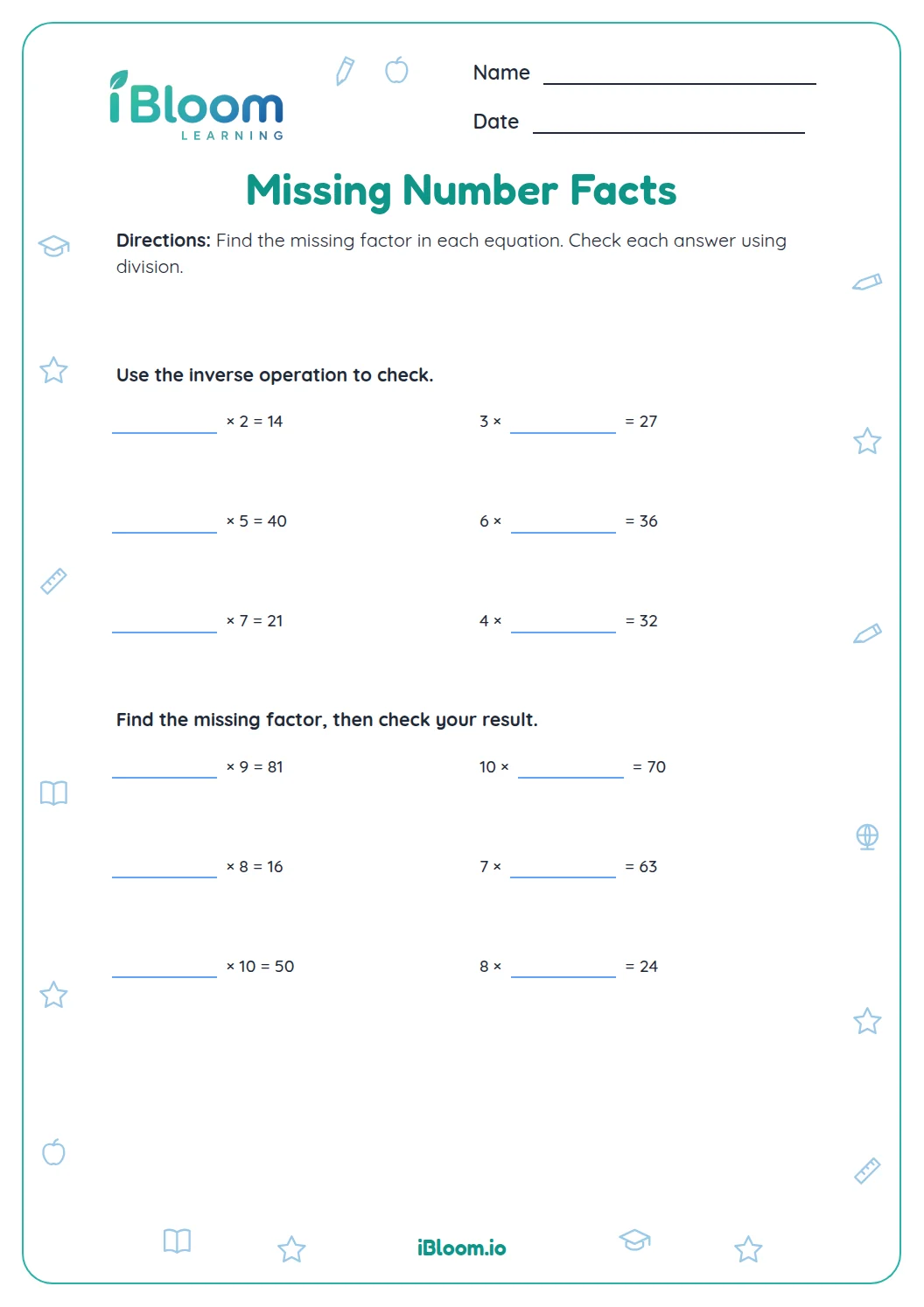
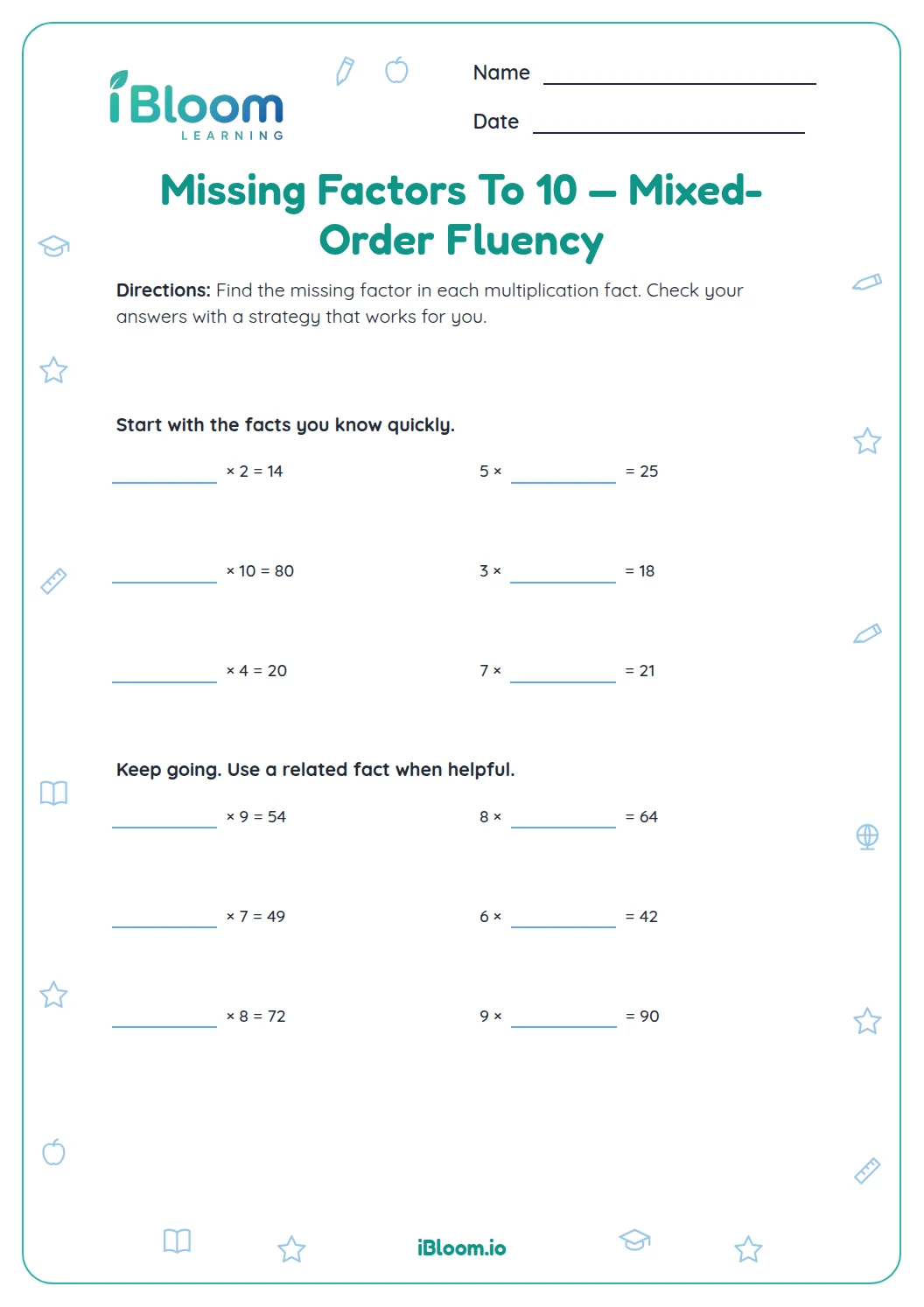
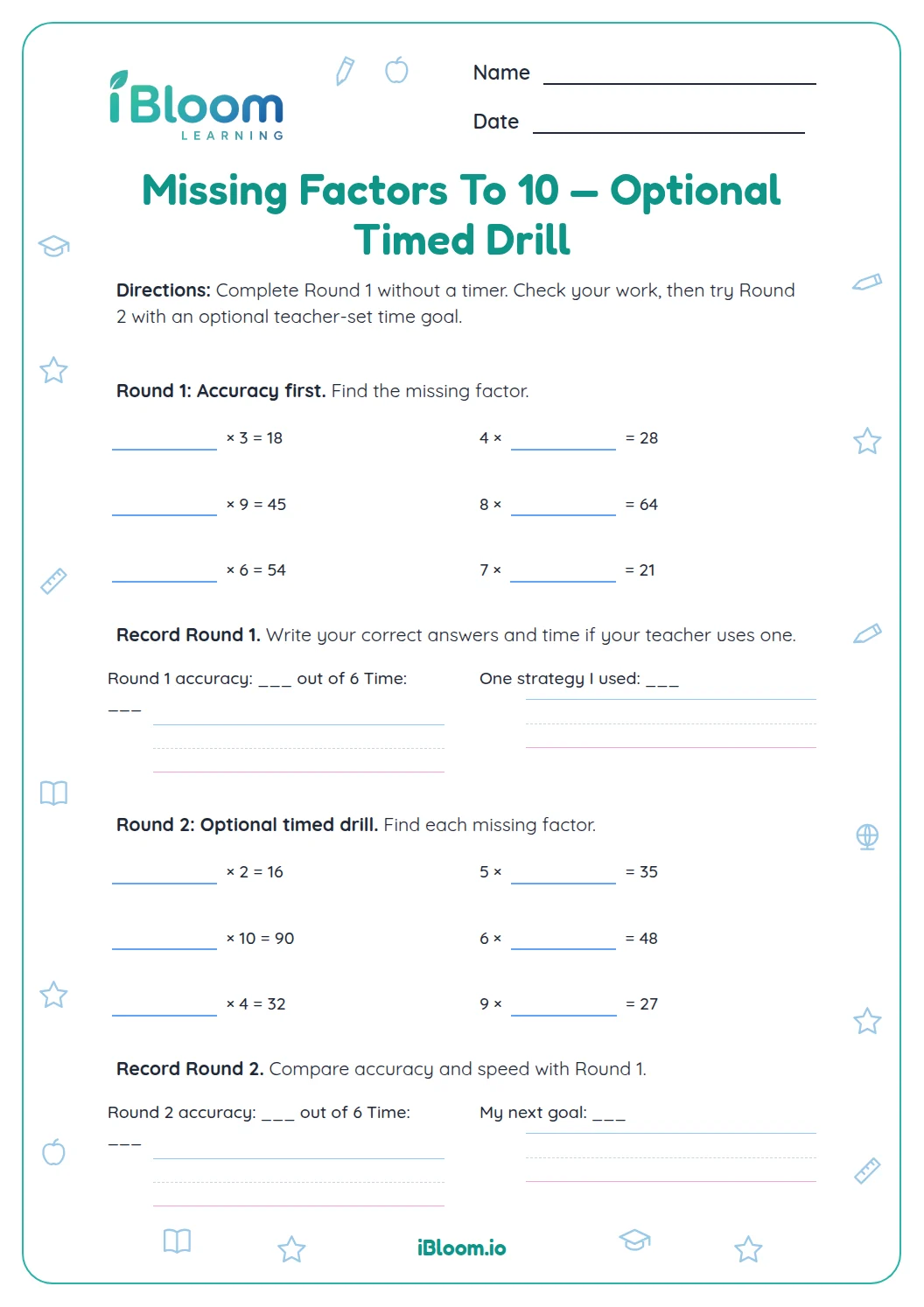
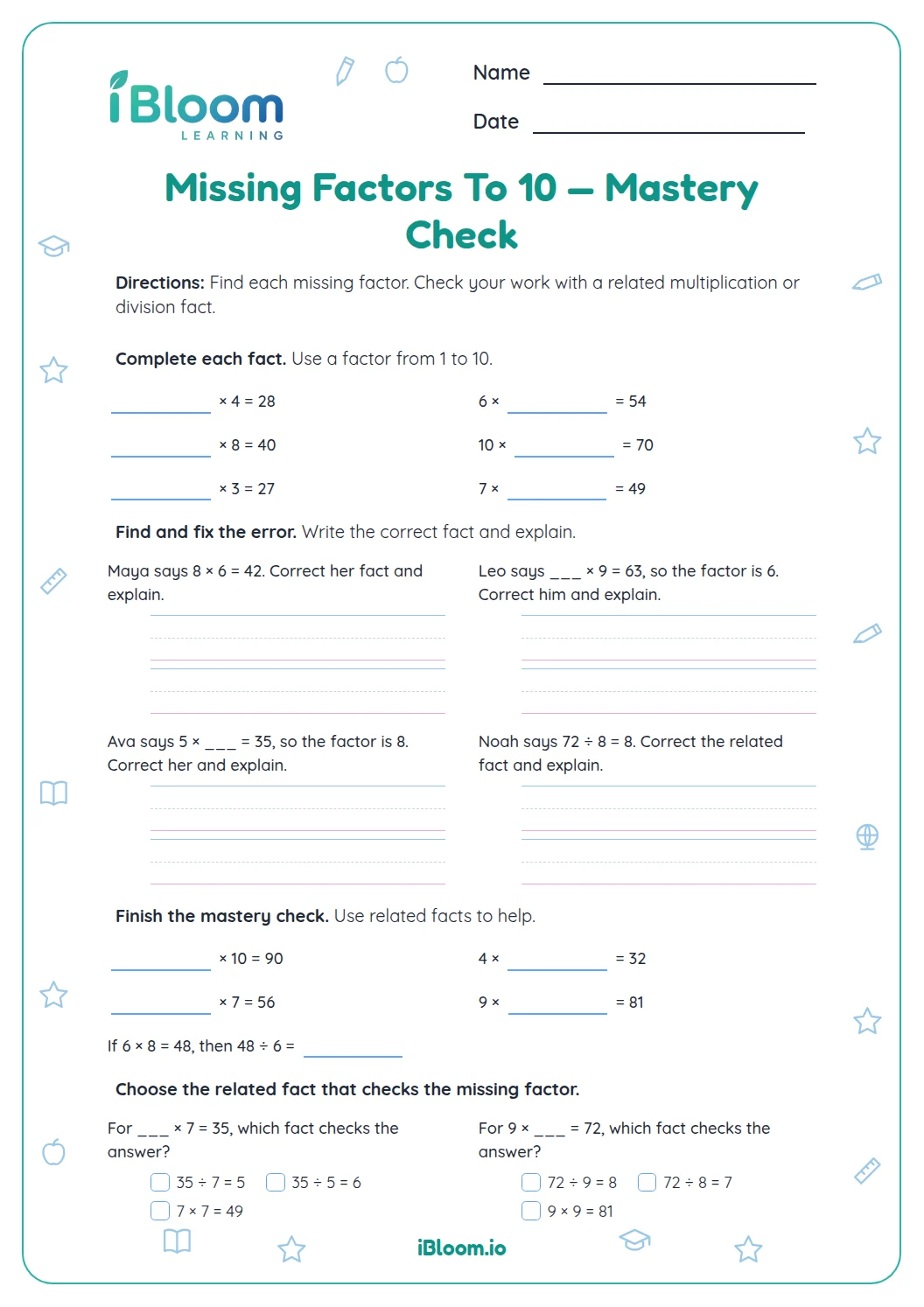
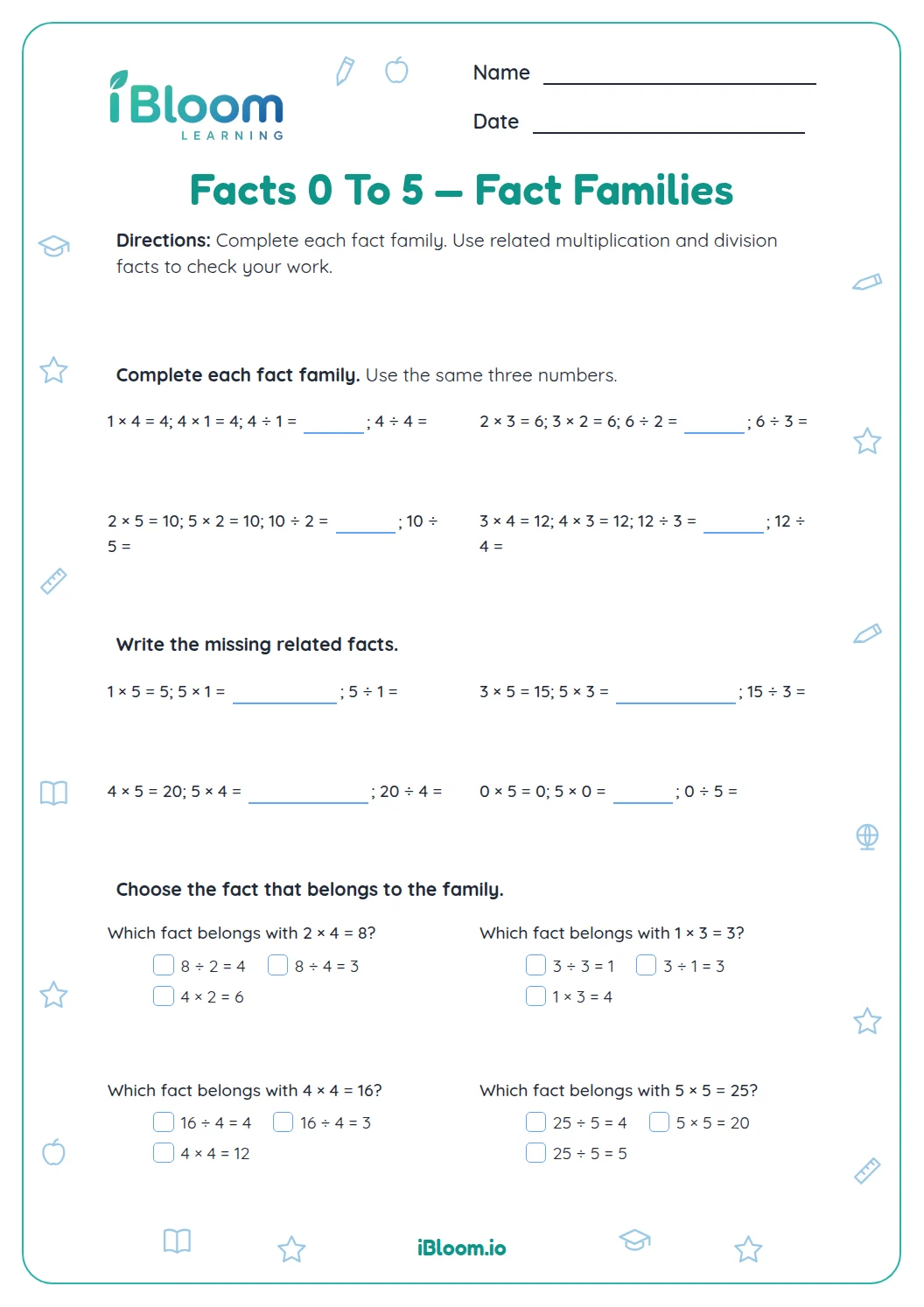
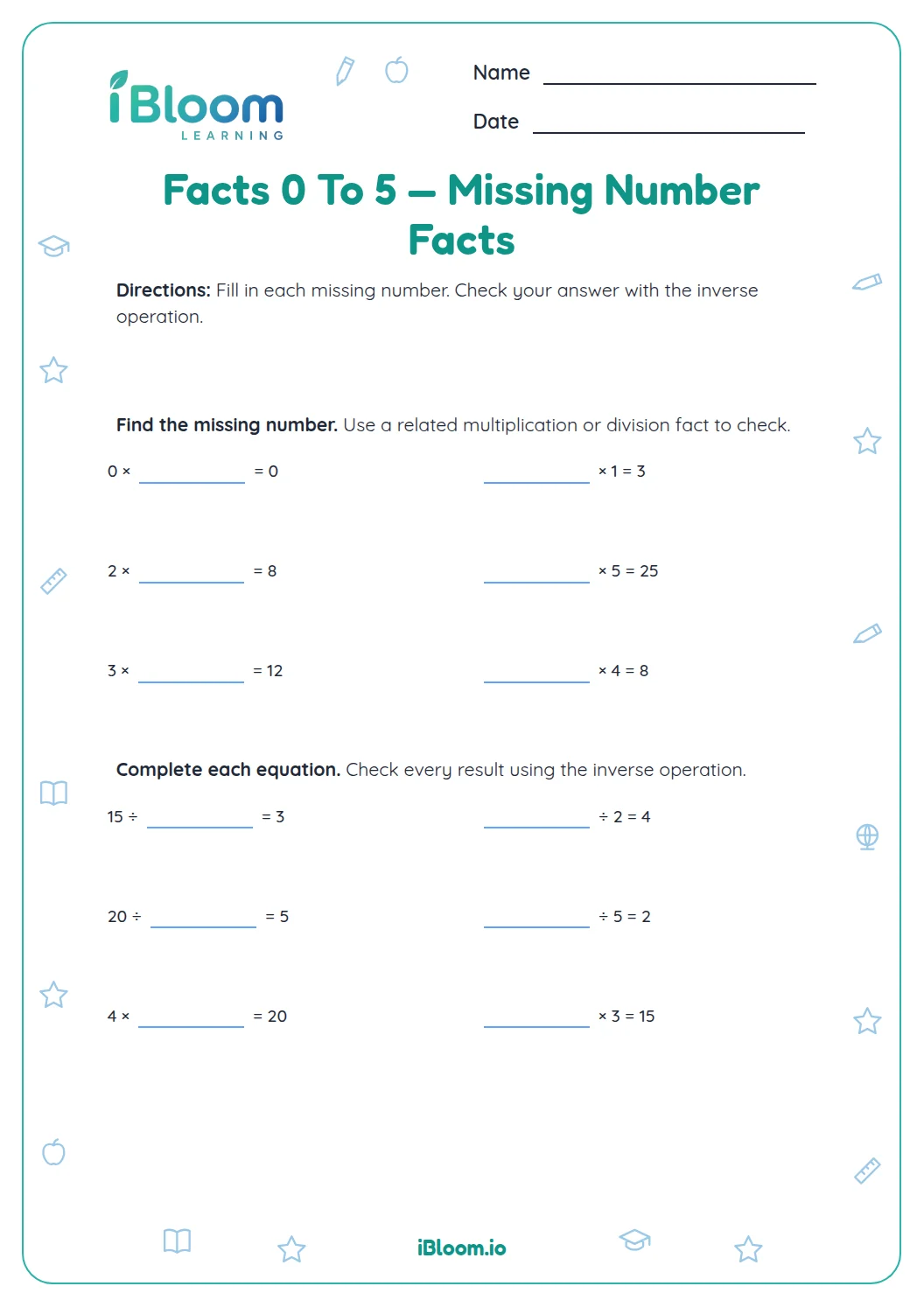
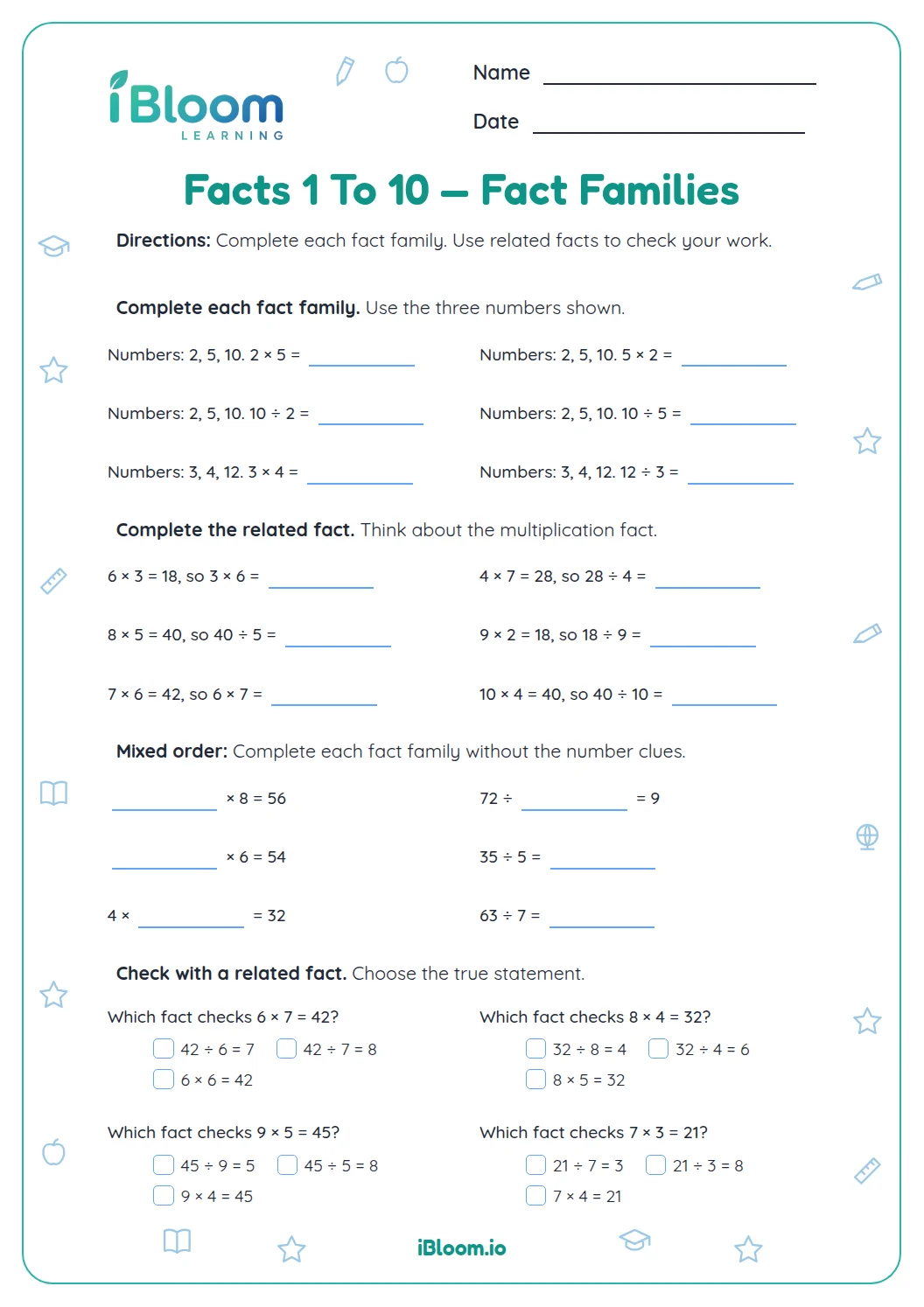
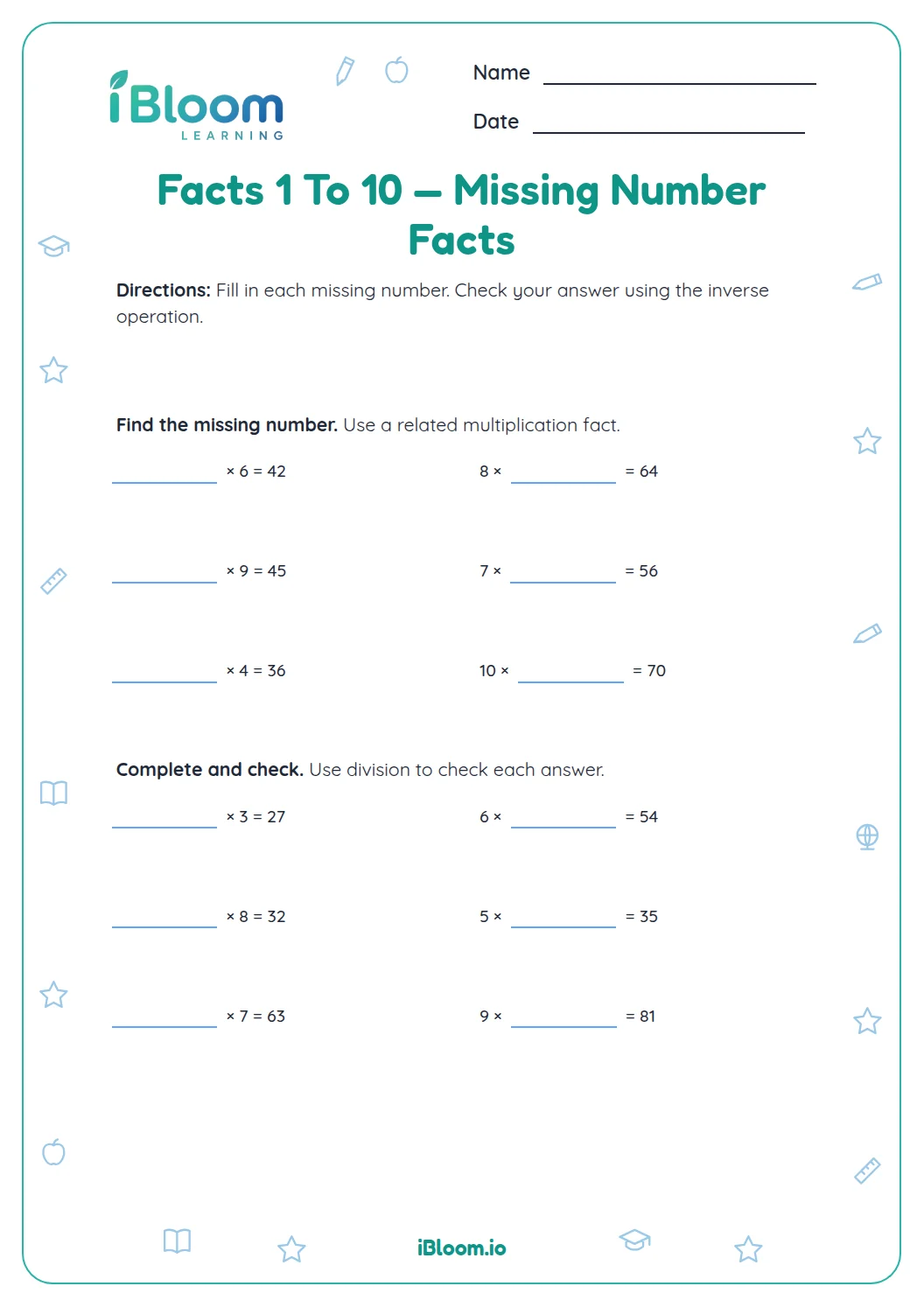
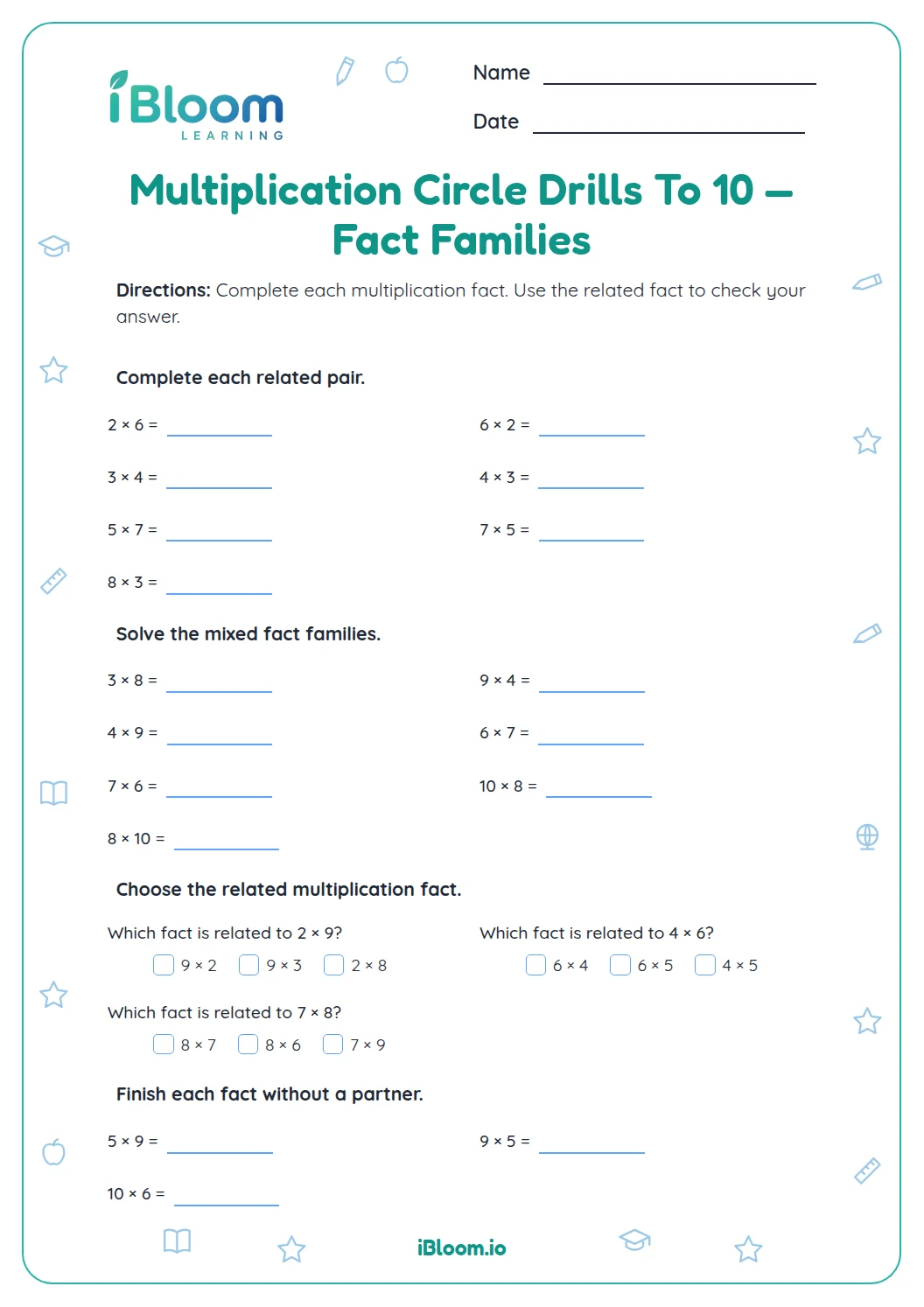
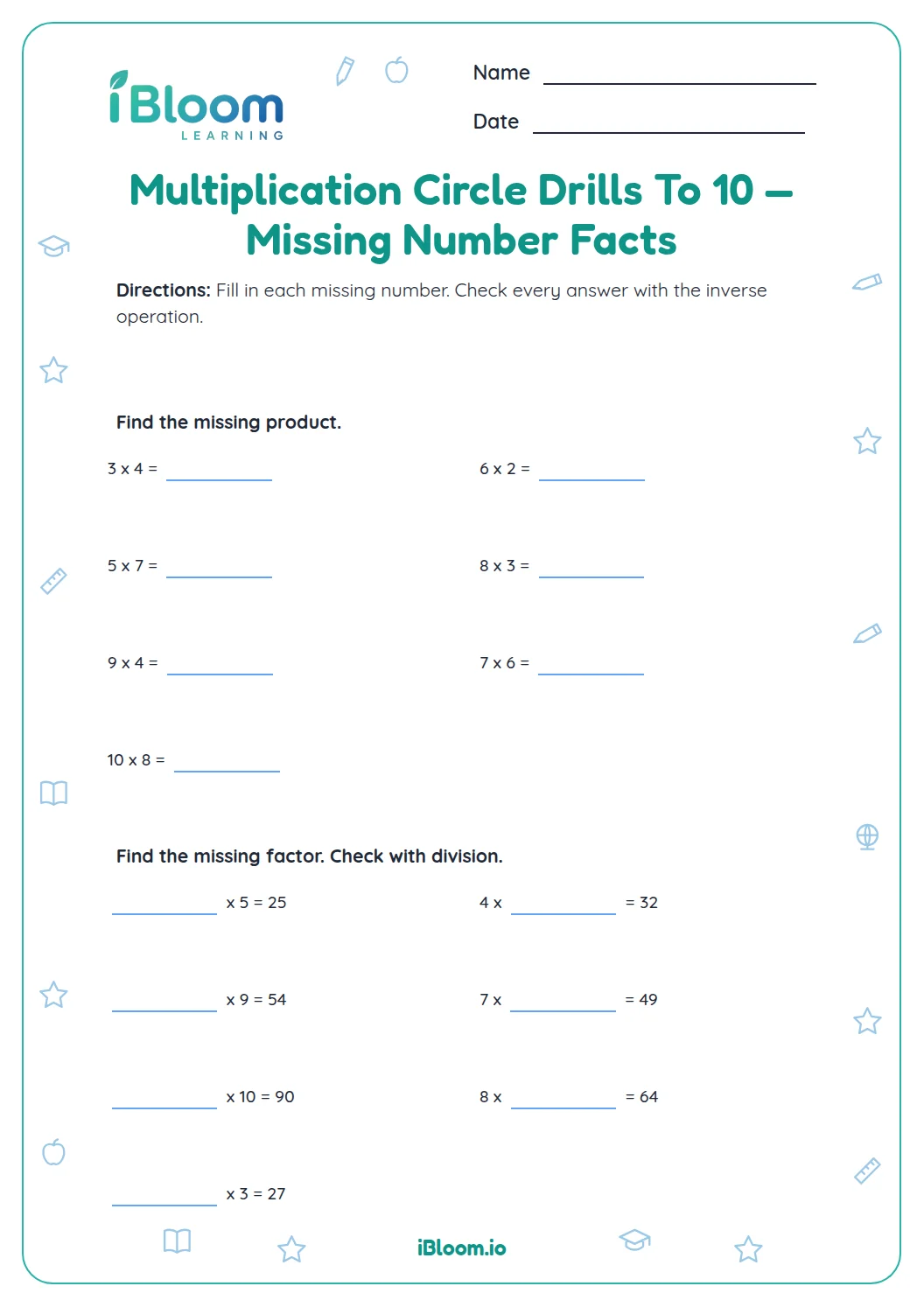
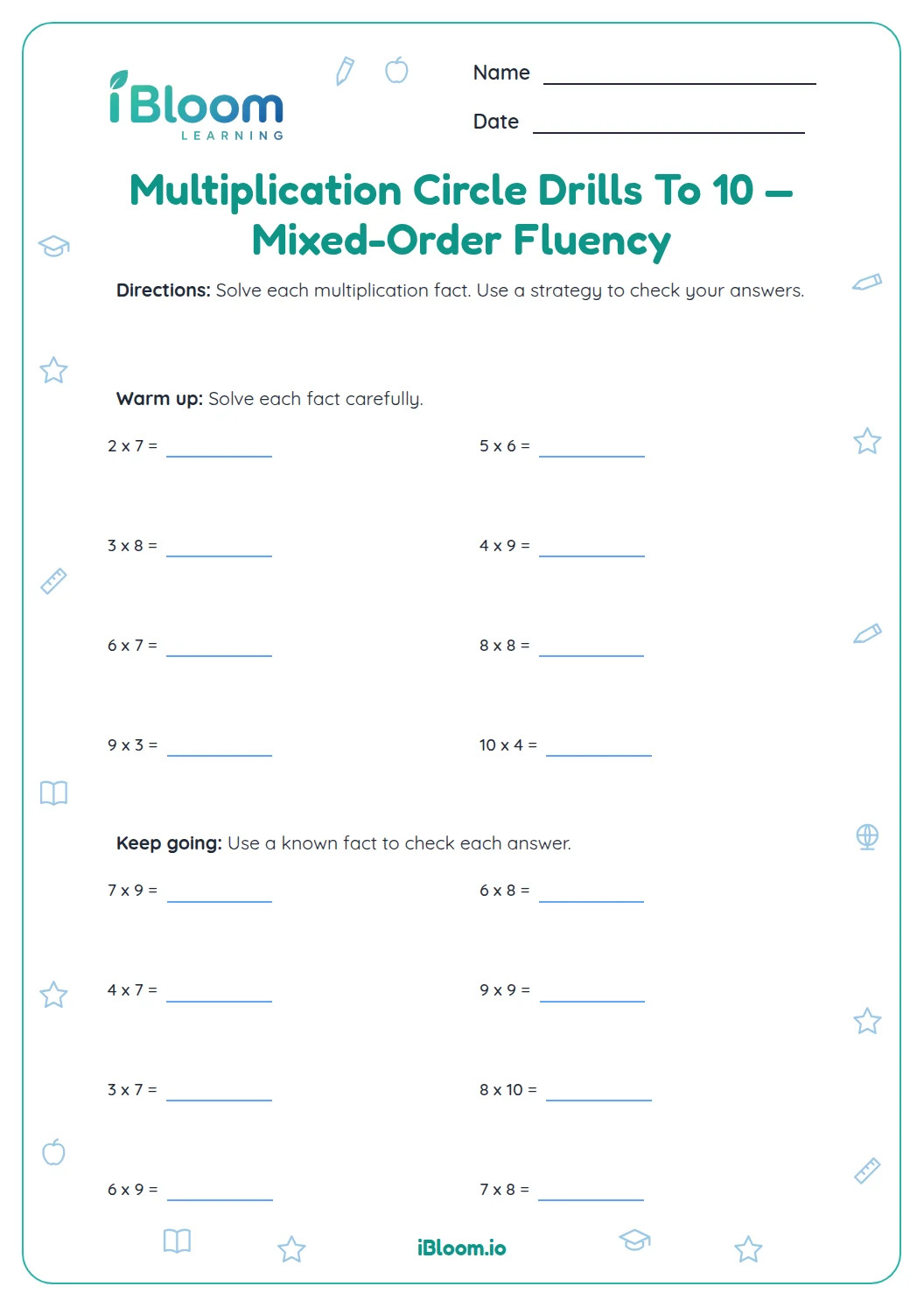
This free printable worksheet helps students use multiplication and division fact families to find missing factors. Sixteen questions move from single missing factors to complete linked facts and mixed multiplication or division equations. Products stay within 100, and a separate answer key lists every missing value.
What is the key idea?
A multiplication fact and its related division facts use the same three numbers. For example, 3 × 8 = 24 connects to 24 ÷ 3 = 8 and 24 ÷ 8 = 3.
How does one problem work?
Question 5 starts with 24 ÷ 3 = 8, so the missing factor in 3 × ___ = 24 is 8. The partner fact is 8 × 3 = 24.
- 124 ÷ 3 = 8
- 23 × ___ = 24
- 38 × 3 = ___
- 4The blanks are 8 and 24.
What is on the worksheet?
The 16 questions are grouped into single missing factors, completed fact-family equations, and mixed multiplication and division facts. Questions 5 and 6 each ask for both multiplication facts linked to a printed division fact.
How can I use the sheet?
- 1Identify the product or quotient in the equation.
- 2For a missing factor, divide the product by the known factor.
- 3Keep the same three numbers when writing a partner fact.
- 4Fill each blank in the order it appears.
- 5Substitute the values to check every equation.
Common mistakes and quick fixes
The mistake
Using the product as the missing factor.
The fix
Divide the product by the known factor.
The mistake
Changing a factor in a partner fact.
The fix
Use the same two factors and product.
The mistake
Answering only the first blank in a linked item.
The fix
Count every blank and check each equation.
What to practice next
Make more practice
Further reading
Questions parents and teachers ask
How do fact families help find a missing factor?
A fact family uses the same two factors and their product in multiplication and division equations. For example, 3 × 8 = 24 helps solve 24 ÷ 3 = 8 and 24 ÷ 8 = 3. The sheet asks students to complete linked facts as well as single equations. The answer key follows the same question order.
Are all the linked equations complete?
Yes. Questions 5 and 6 show a complete division fact and ask for both multiplication facts that use the same three numbers. Each blank has a corresponding answer in the key, listed in the same order as it appears. The worked example connects a division fact to both multiplication facts.
What should a child do if a division fact feels hard?
Use the multiplication fact to check the division fact. For example, if 56 ÷ 8 = 7, then 8 × 7 should equal 56. The questions stay within products of 100, so a known multiplication fact can support the division step. It helps to say the multiplication fact aloud before dividing.
How many problems are on the sheet?
There are 16 numbered questions in three parts. They include single missing factors, connected multiplication and division facts, and mixed equations that ask students to identify the operation and blank. The parts progress from single blanks to linked facts.
What facts does this practice use?
The sheet uses multiplication factors through 10 and products up to 72. It also includes division facts with quotients up to 9, along with partner facts that use the same factor pair and product. Students can use the related fact to check each quotient.