
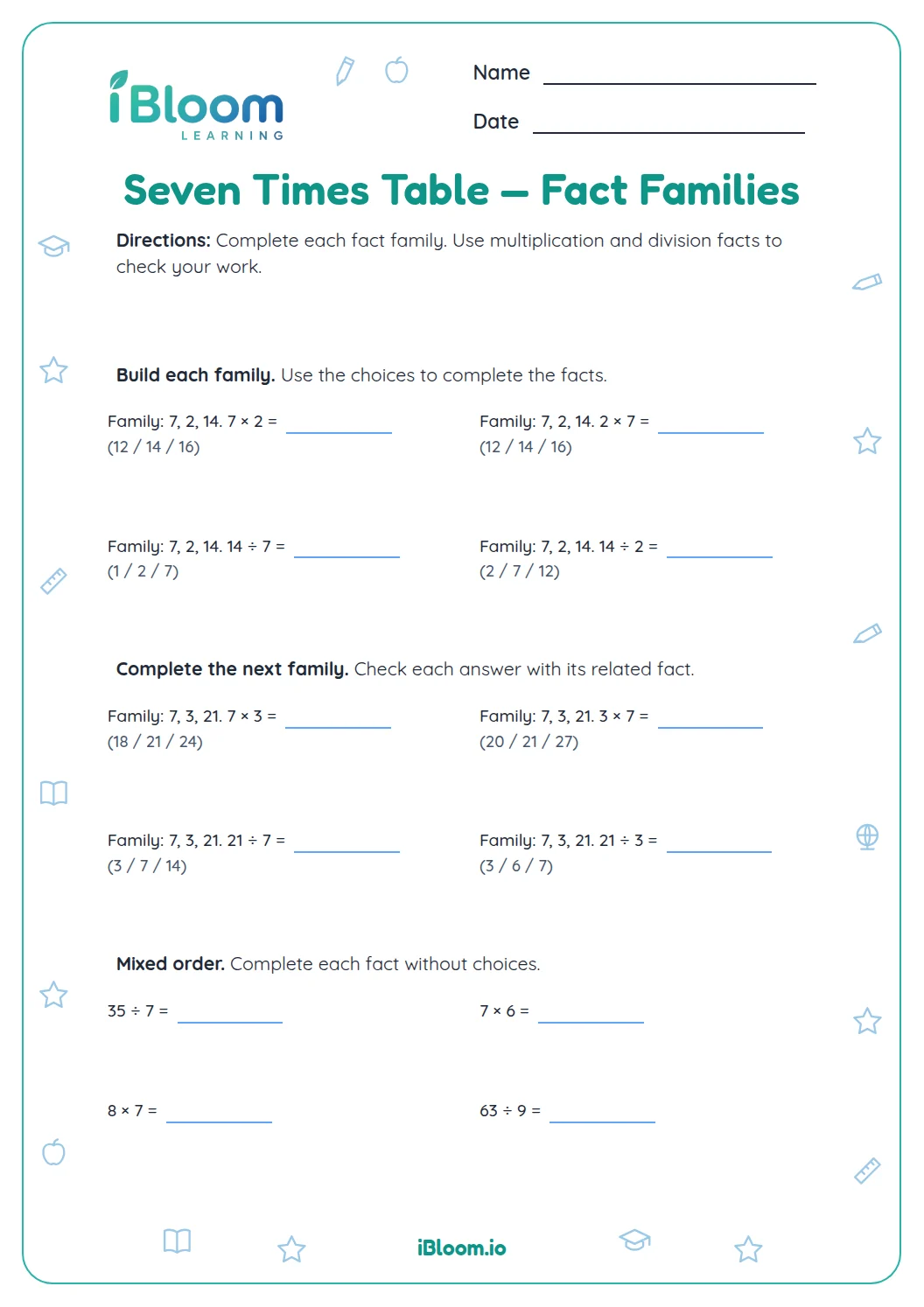


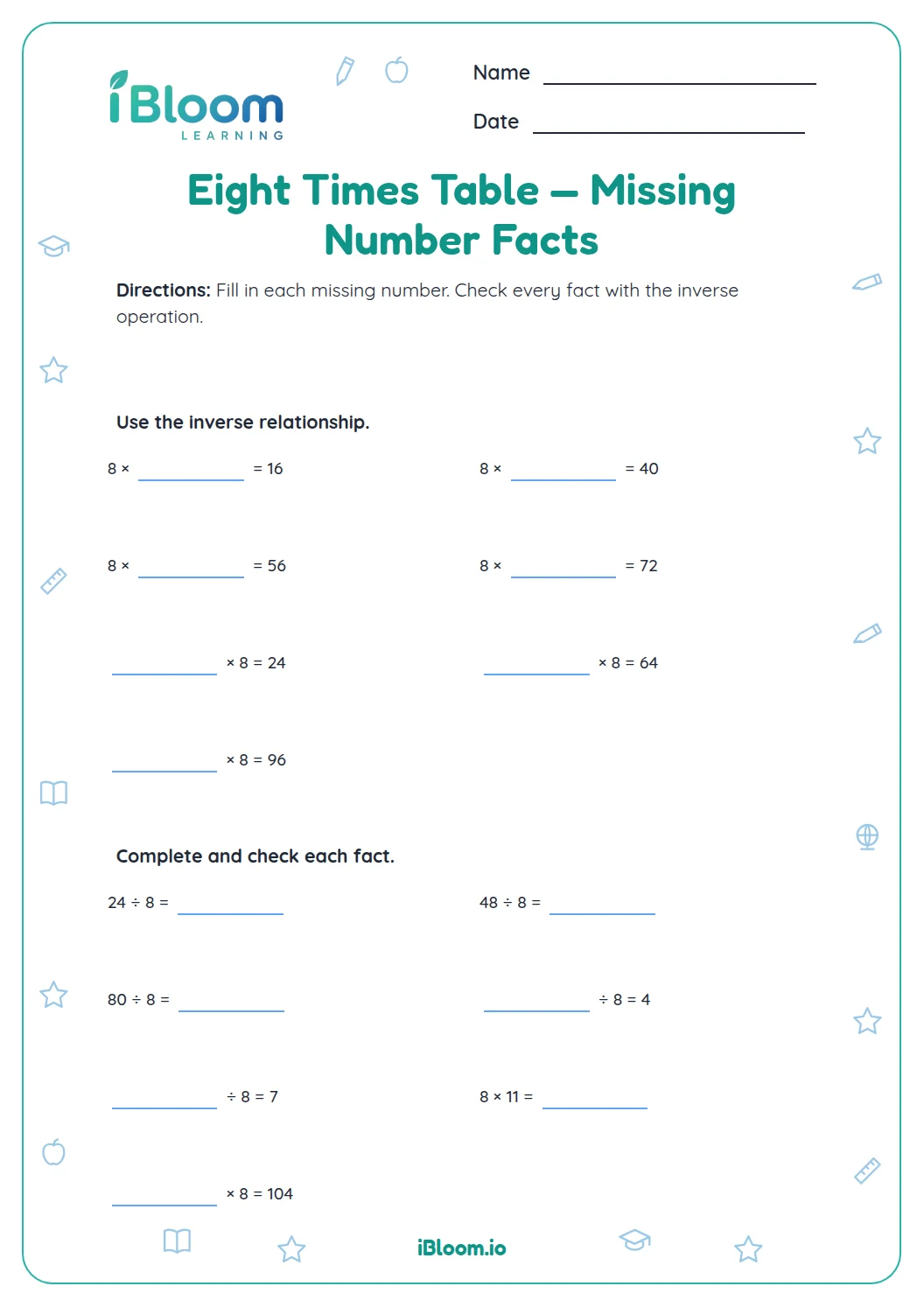
About this worksheet
This printable gives students practice with the seven times table. The first 13 problems include every factor from 0 through 12; seven more prompts ask students to complete skip-counting sequences by seven. Each item shows the numbers needed, and the separate answer key lists all answers.
Aligned to 3.OA.A.1
How can students remember the seven times table?
Skip-counting by seven gives 7, 14, 21, 28, 35, 42, 49, 56, 63, 70, 77, 84. Each number is one more group of seven. Students can say the sequence, then connect each count to a multiplication sentence.
Known facts help too. Since 7 × 4 = 28, doubling 28 gives 56, so 7 × 8 = 56. For 7 × 9, use 7 × 10 − 7: 70 − 7 = 63. Check both factors before writing the product.
- 17 × 8
- 27 × 4 = 28
- 3Double 28
- 47 × 8 = 56
What facts are included?
Part A includes every factor from 0 through 12. Part B asks students to complete seven skip-counting sequences by seven, connecting multiplication facts with repeated addition.
- Part A: 13 facts, factors 0 through 12
- Part B: 7 skip-counting sequences
- Separate answer key lists all 20 answers
How to use this worksheet
- 1Say the factor and operation aloud before solving.
- 2Skip-count by sevens or use a related fact.
- 3Write the product in the blank.
- 4Check by counting the same number of groups or using a nearby product.
Common mistakes and quick fixes
The mistake
Adding 7 to the factor instead of finding equal groups.
The fix
Think of 7 × 6 as six groups of seven, which is 42.
The mistake
Losing a count while skip-counting.
The fix
Point once for each factor as you say the next multiple of seven.
The mistake
Writing a product from a different fact.
The fix
Read both factors again before recording the answer.
Common Core alignment
The seven times table supports Grade 3 multiplication fluency and remains useful review in Grade 4.
Interpret products as equal groups of objects.
On this sheet: All questions practice a one-digit factor multiplied by seven, with products within 100.
Show the official wordingHide the official wording
Interpret products of whole numbers, e.g., interpret 5 × 7 as the total number of objects in 5 groups of 7 objects each.
What to practice next
Make more practice
Further reading
Questions parents and teachers ask
Which factors are included?
The first part includes every factor from 0 through 12, so all 13 basic seven-times facts appear. The second part has seven sequences with one missing multiple in each. Students use the same multiples to complete every sequence.
How can skip-counting help?
Each skip-count adds one more group of seven. The count that matches the other factor gives the product. For example, four counts—7, 14, 21, 28—show that 7 × 4 equals 28. Point once for each count to keep track.
What is one way to check 7 × 8?
Use a nearby fact: 7 × 4 = 28, and doubling 28 gives 56. Students can also skip-count by sevens eight times and check the same product. Both methods connect the answer to the factors printed in the question.
Does it include an answer key?
Yes. A separate answer-key page lists all 20 answers in question order. Students can solve the 13 multiplication facts and seven sequences, then compare each result with its matching prompt. Revisit missed items by skip-counting aloud or using a nearby known product.