



About this worksheet
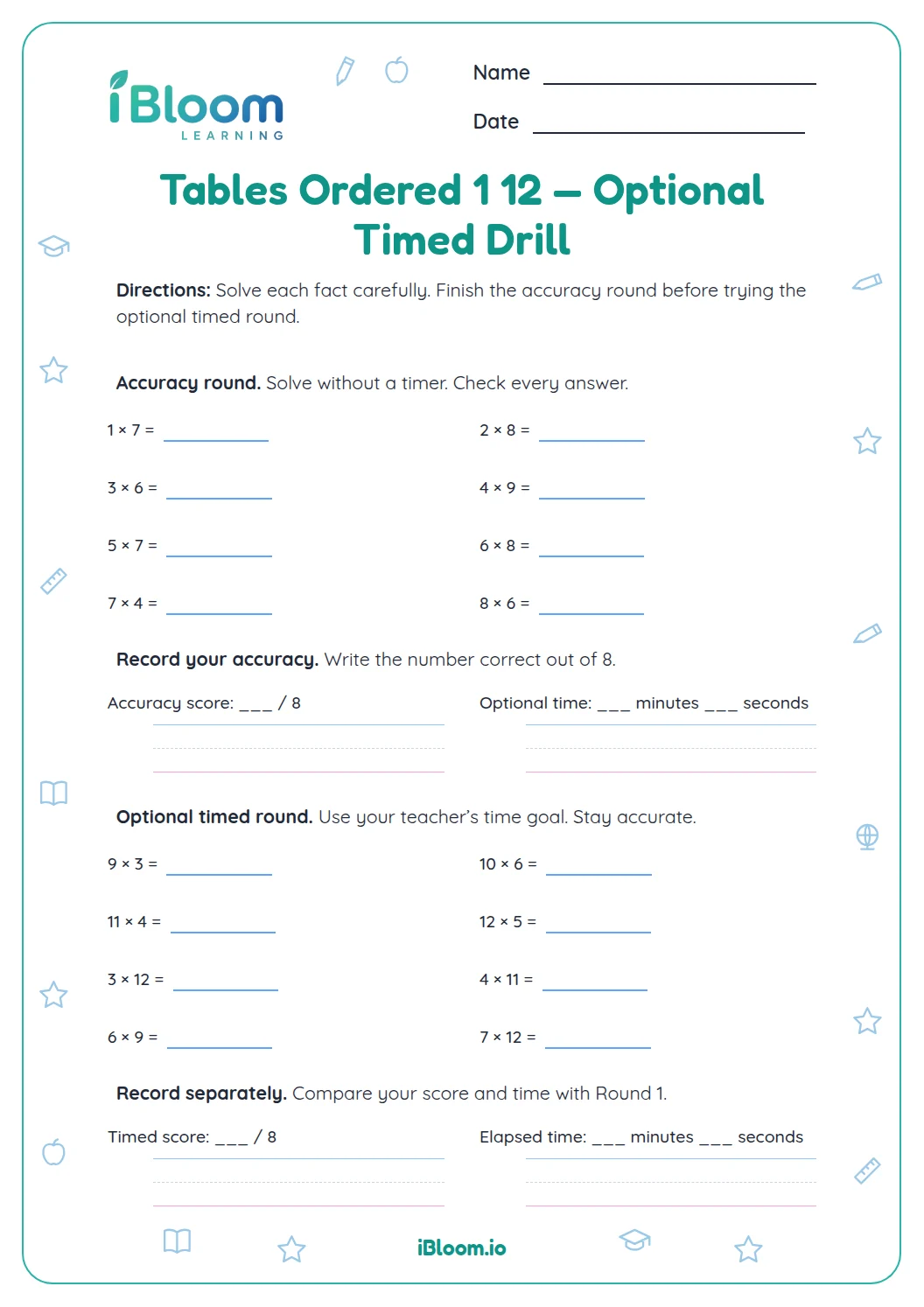
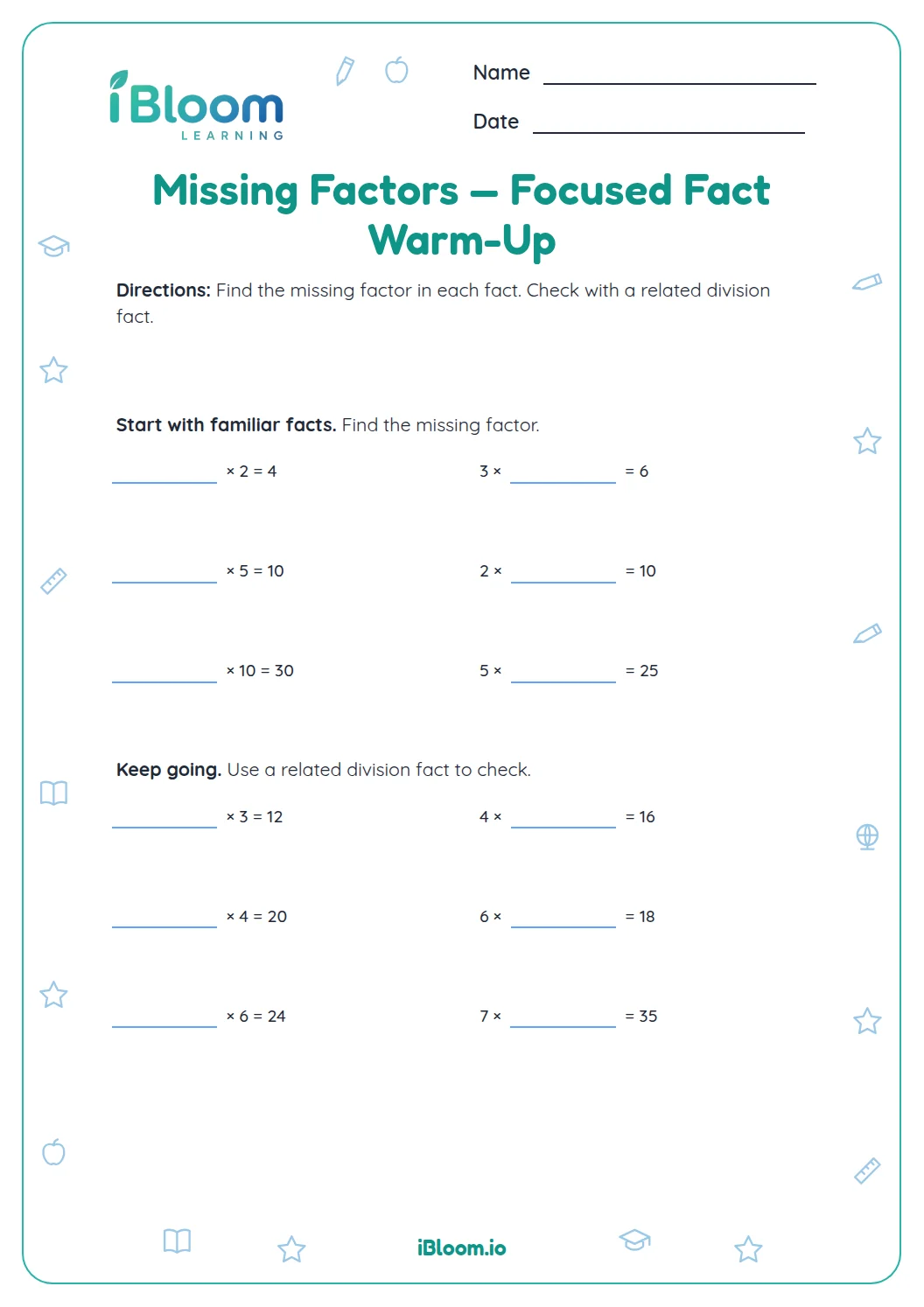
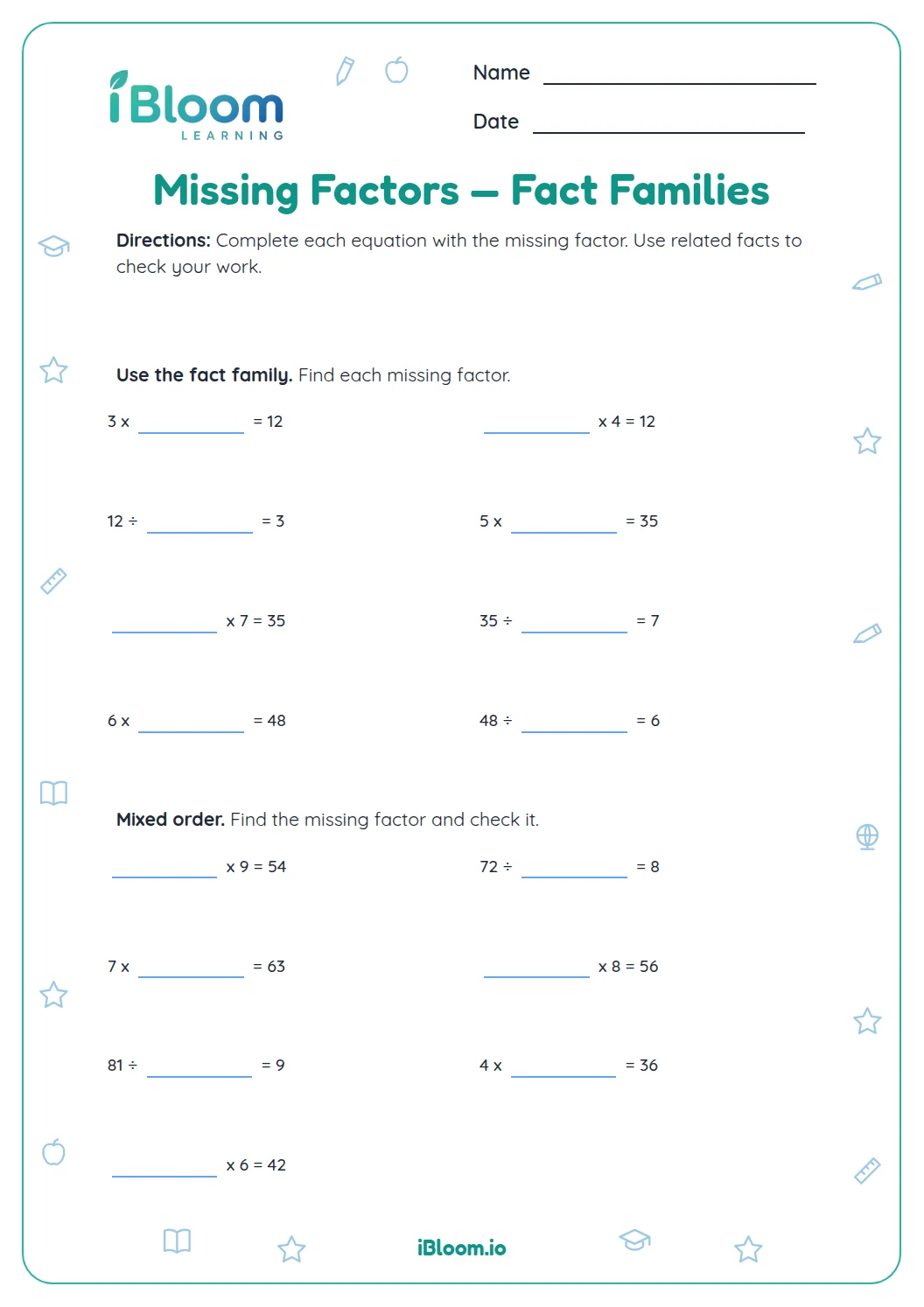
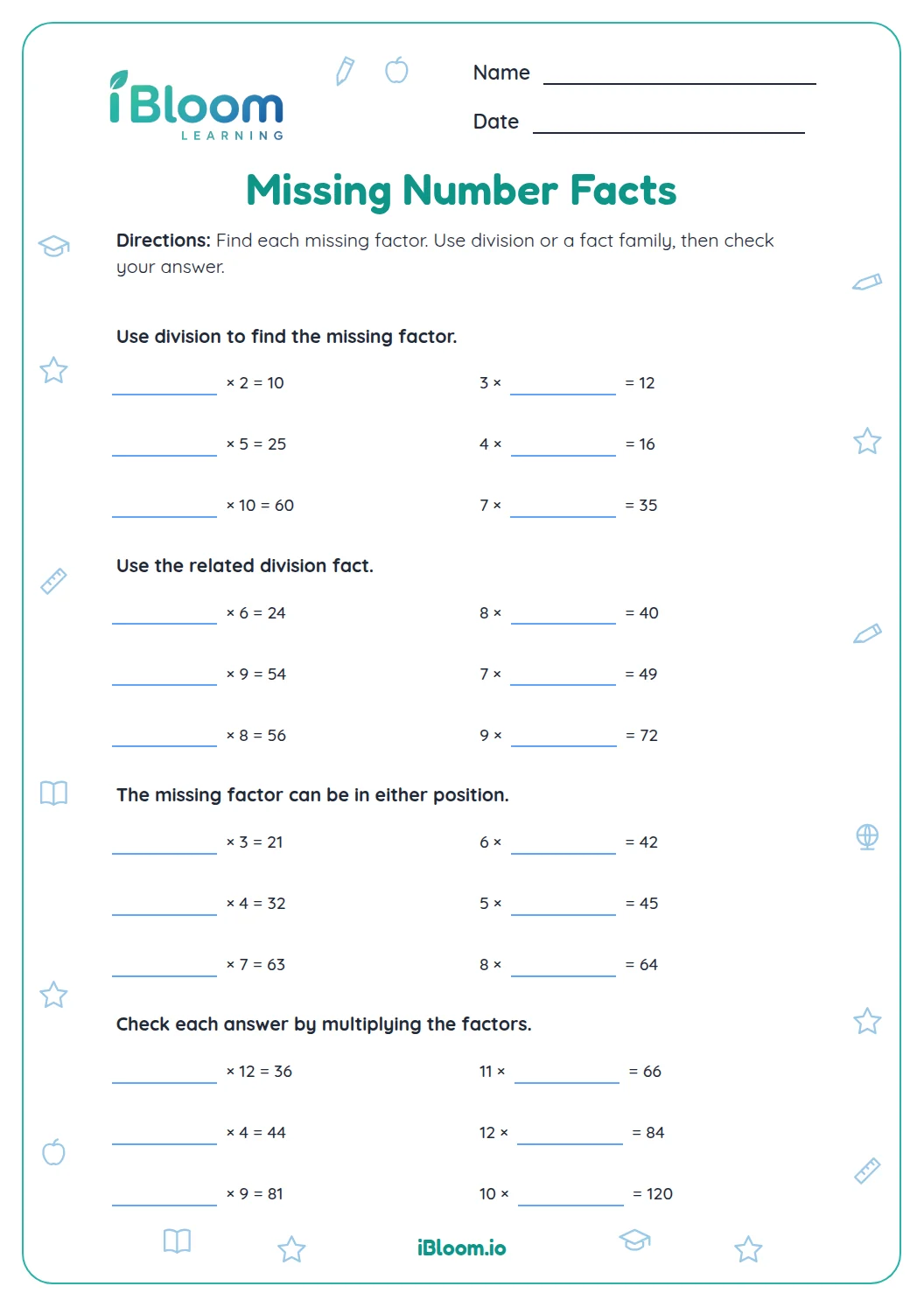
This free printable tables ordered 1 12 — mixed-order fluency gives Grade 3 students 20 multiplication facts to solve on the student page. The problems use printed factors and one blank for each product. Students can use skip-counting, equal groups, or related facts to check their work. The answer key lists all 20 products. The practice supports Common Core 3.OA.C.7: fluently multiplying and dividing within 100.
Aligned to 3.OA.C.7
How should students solve each fact?
Read both factors before calculating. For example, the printed fact 6 × 4 is solved by multiplying its two factors; write the product in the blank. Skip-counting or adding equal groups can help check a result.
Accuracy comes first. When a fact feels difficult, connect it to a nearby known fact and check that the product fits both factors.
- 16 × 4 = ___
- 26 groups of 4
- 36 × 4 = 24
How do known facts help with a harder product?
A known product can help with a related fact. For 6 × 8, double 3 × 8: 24 + 24 = 48. To check 9 × 6, use 10 × 6 and subtract 6: 60 − 6 = 54.
Switching the factors keeps the product the same, so 4 × 7 and 7 × 4 both equal 28.
What practice is on the page?
The student sheet has 20 distinct multiplication facts in two parts. Both factors appear in every question, and the answer key follows the same order.
Solve each blank, then use a related fact or skip-counting to check. On the timed version, the second round is optional; complete it without a timer if that is a better fit.
How can you use the worksheet?
- 1Read the factors in the first part.
- 2Multiply and write one product in each blank.
- 3Use skip-counting, equal groups, or a related fact to check a difficult product.
- 4Continue to the second part and solve its new facts.
- 5Compare each result with the answer key and revisit missed facts.
Common multiplication mistakes
The mistake
Adding the factors instead of finding their product.
The fix
Read the × sign aloud as equal groups, then multiply the two factors.
The mistake
Losing track while skip-counting by a factor.
The fix
Write the count sequence or add one equal group at a time.
The mistake
Changing the product when the factors switch places.
The fix
Use the commutative property: a × b and b × a have the same product.
Common Core alignment
The facts give practice with multiplication fluency within 100.
Recall or derive multiplication facts within 100 and use related strategies to check them.
On this sheet:
Show the official wordingHide the official wording
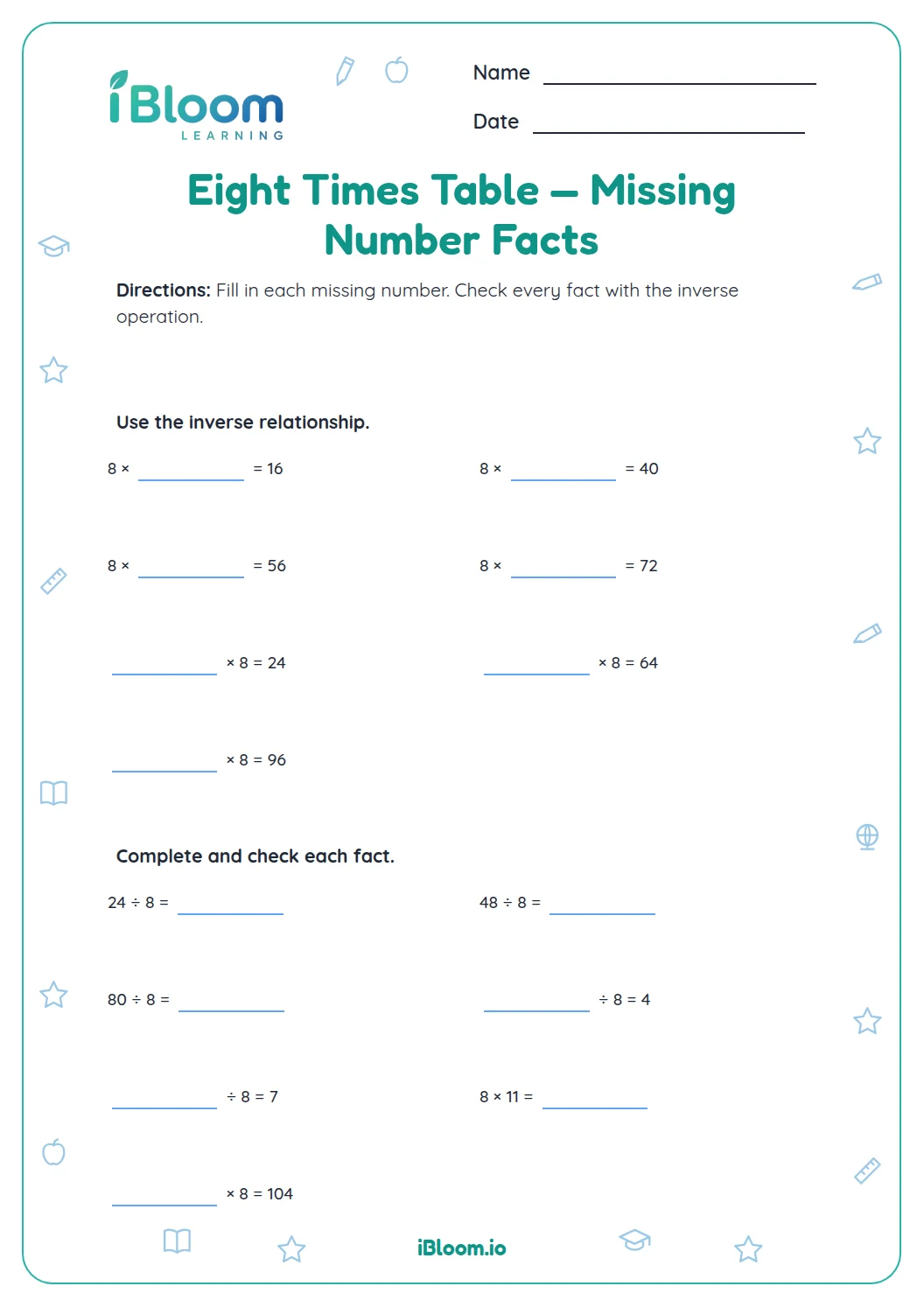
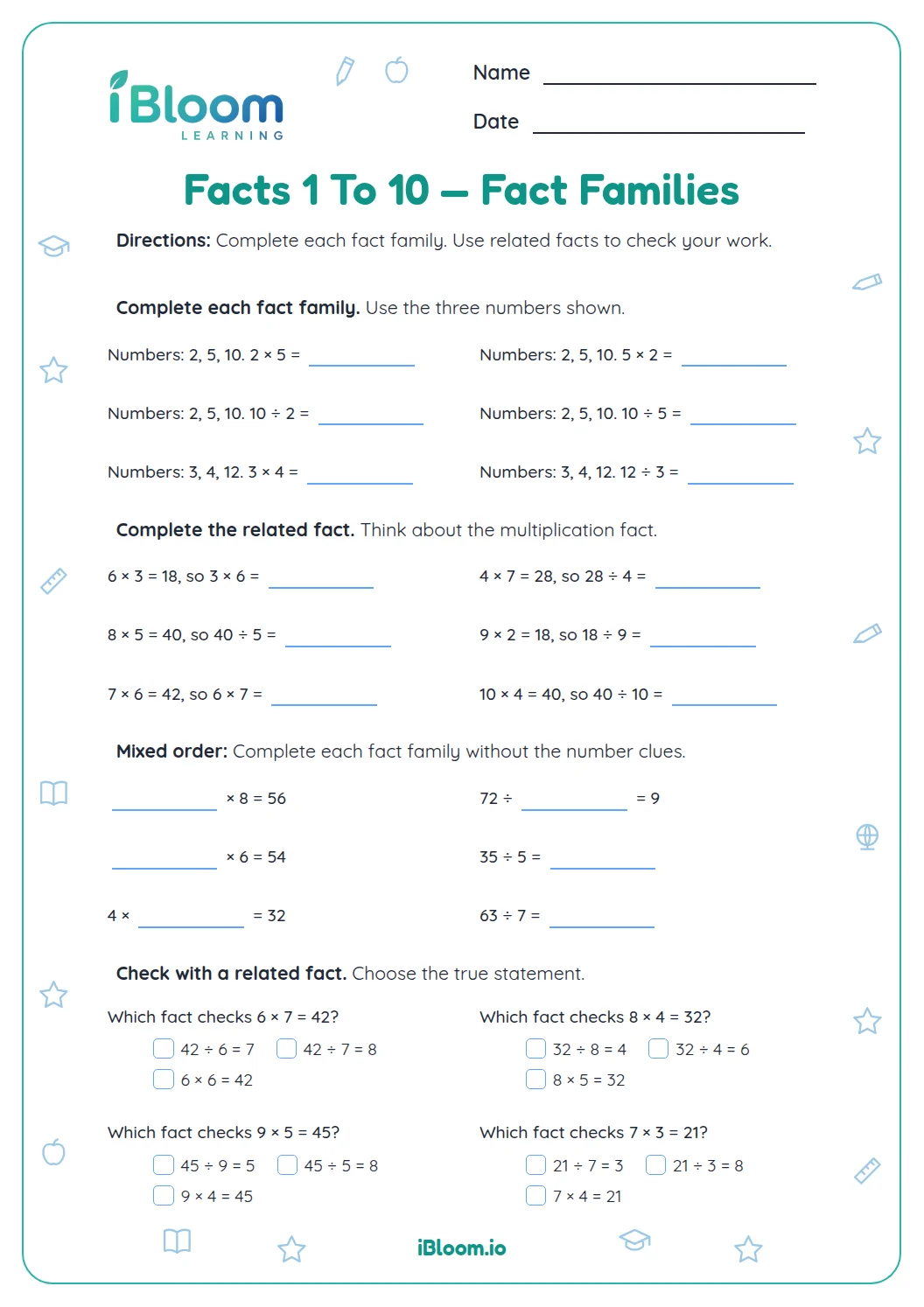
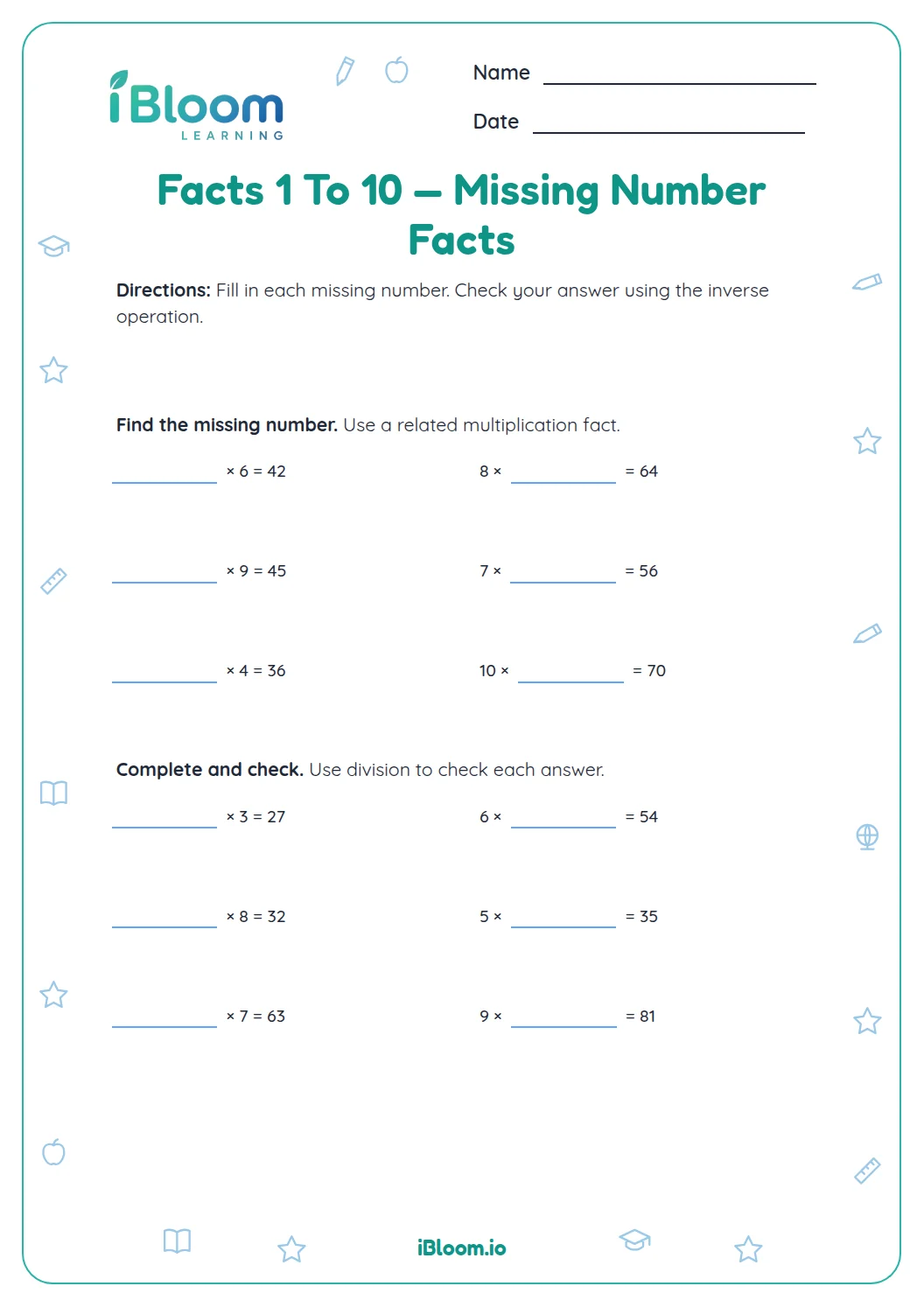
Fluently multiply and divide within 100, using strategies such as the relationship between multiplication and division (e.g., knowing that 8 × 5 = 40, one knows 40 ÷ 5 = 8) or properties of operations. By the end of Grade 3, know from memory all products of two one-digit numbers.
What to practice next
Make more practice
Further reading
Questions parents and teachers ask
How many questions are on the worksheet?
There are 20 multiplication facts in two parts on the student worksheet page. A separate one-page answer key lists each product in the same order. Students can complete the equations directly because every question prints both factors and leaves one blank for the product.
Are the factors printed on the student page?
Yes. Each of the 20 equations shows both factors and a blank for the product, such as 7 × 8 = ___. Students can solve directly on the page without supplying their own factors or copying a problem from the answer key.
What strategy can help with a difficult fact?
Students can skip-count by one factor, add equal groups, or connect the problem to a known product. For example, doubling 3 × 8 helps find 6 × 8. A related fact gives a second way to check the answer.
What strategies can help with a difficult fact?
Students can skip-count by one factor, add equal groups, or connect the problem to a known product. For example, doubling 3 × 8 helps find 6 × 8. A related fact gives a second way to check the answer before looking at the key.
How can I use the answer key?
The one-page answer key follows the 20 questions in order and gives one product for each equation. If a response differs, recompute that fact with a second strategy, such as skip-counting or a known related product, then compare the result with the key.
What math skill does this worksheet practice?
This sheet practices multiplication facts with whole-number factors and products within 100. Students read each printed equation, find its product, and may use a known fact or skip-counting to check. The practice aligns with Grade 3 fluency work in CCSS 3.OA.C.7.