




About this worksheet
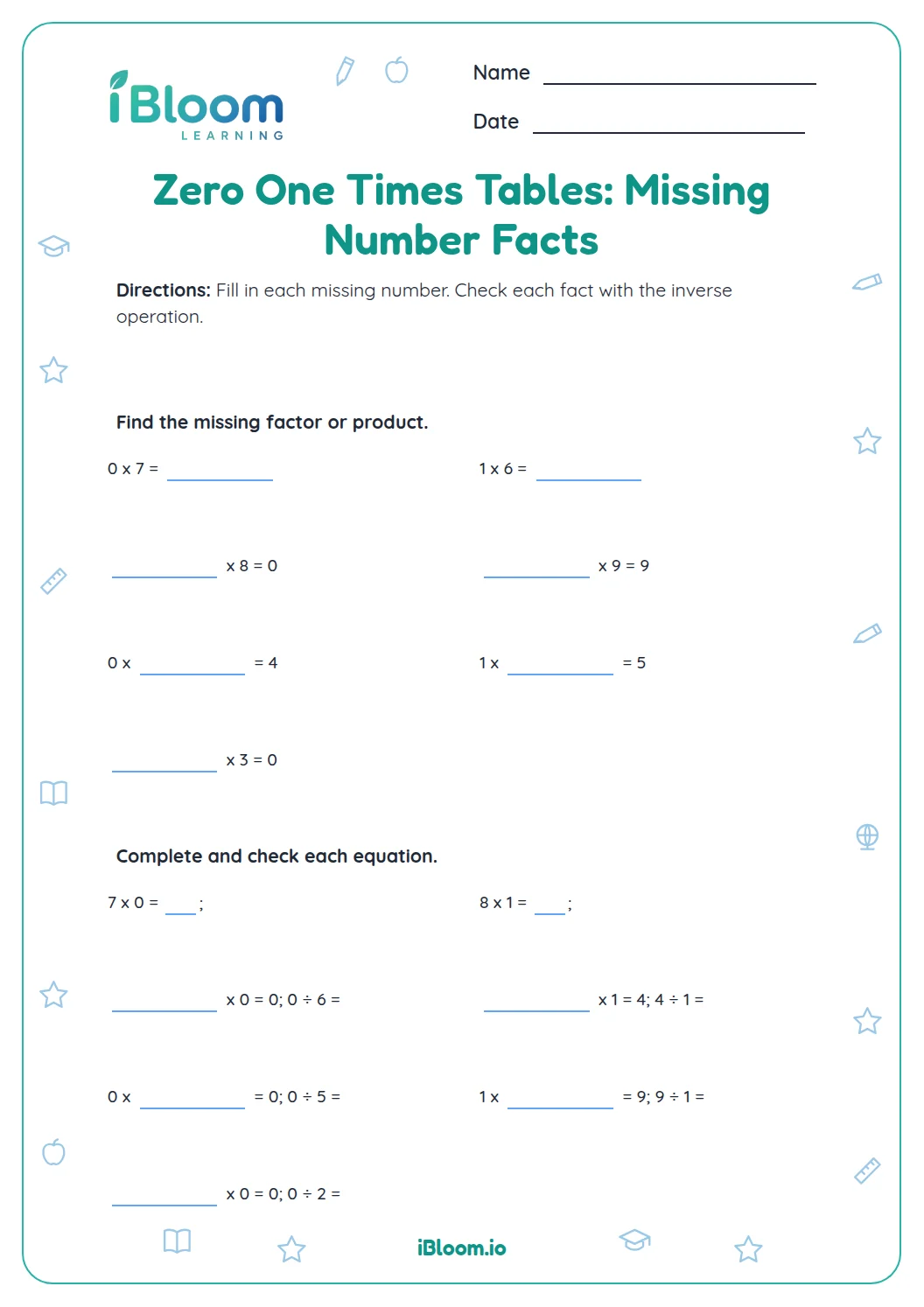
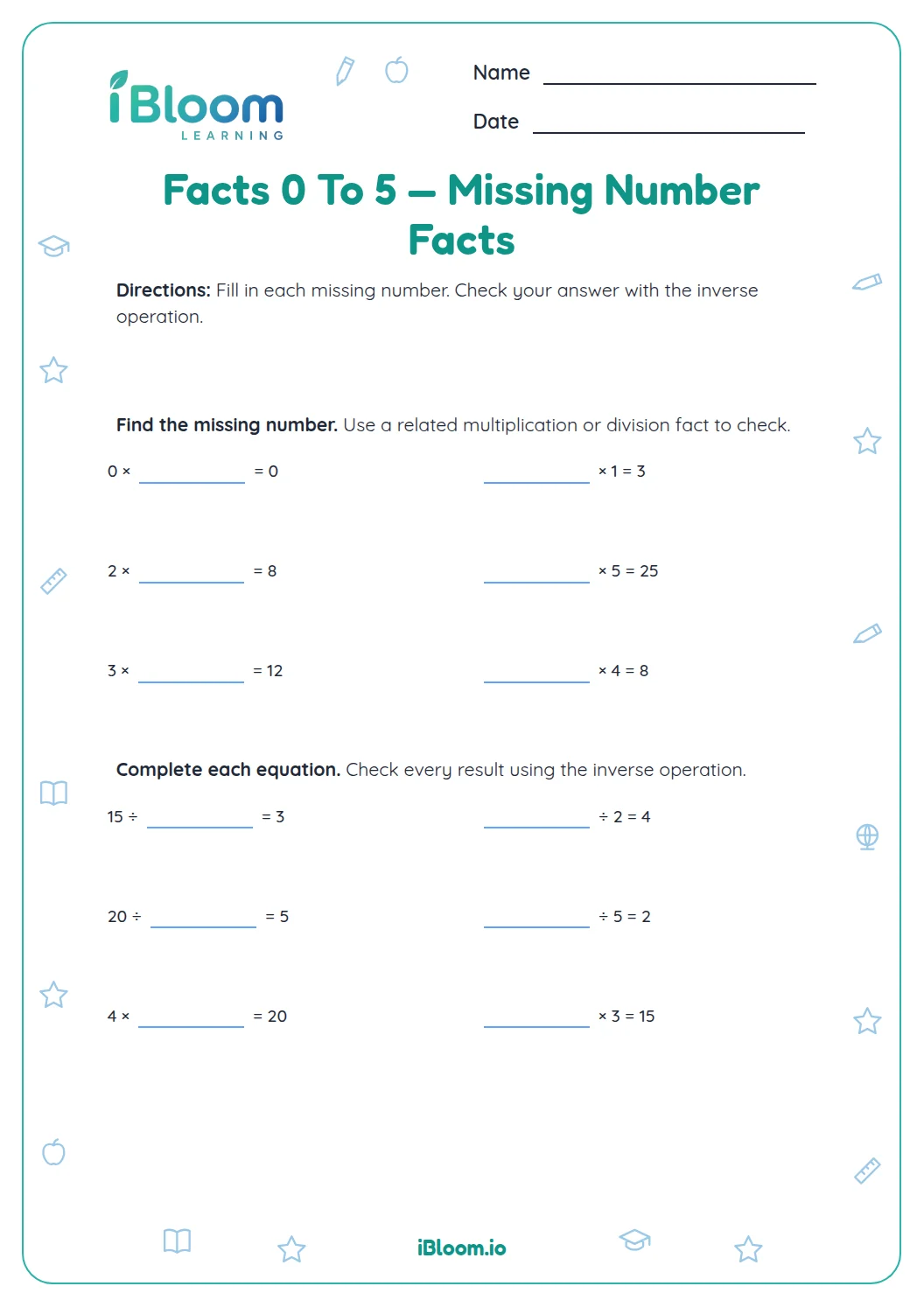
This free Grade 3 worksheet gives students 23 problems on multiplication by 0 and 1. Every equation shows its factors or product clue on the student page. Students find products, fill missing factors, choose products and finish with mixed facts. The separate answer key lists each response for checking.
What happens when a factor is 0 or 1?
A zero factor means zero equal groups, so the product is 0. A factor of 1 means one group, so the product is the other factor. Question 2, 1 × 9, has product 9.
- 11 × 9 = 9
- 2One group of nine is nine.
What practice is on the worksheet?
The problems move from direct products to missing factors and product choices, then mix the facts. Both the zero and one rules appear in each format.
- Direct products
- Missing factors and product choices
- Mixed zero and one facts
How can the answer key be used?
After solving, check each equation against its numbered key entry. A zero product should have a zero factor; with a factor of one, the product matches the other factor.
How to use this worksheet
- 1Read the factors and sign before calculating.
- 2Use skip counting or a known fact to find the product.
- 3For a missing factor, ask how many equal groups make the product.
- 4Finish a part before checking those answers in the key.
Common mistakes and quick fixes
The mistake
Multiplying by zero does not change the other factor.
The fix
A zero factor makes zero groups, so the product is zero.
The mistake
Treating the product as the missing factor.
The fix
Count how many groups of the known factor reach the product.
The mistake
Reading a printed factor incorrectly.
The fix
Point to each factor and the sign, then say the equation before solving.
What to practice next
Make more practice
Further reading
Questions parents and teachers ask
What does this worksheet practice?
The 23 problems focus on multiplication by zero and one. Students solve direct products, find missing factors, choose a product and complete mixed facts. Every question includes the numbers needed, and a separate key lists answers by question number for checking.
Why does any number times zero equal zero?
Multiplying represents equal groups. With zero groups, there are no objects to count, so the total is zero. For example, 0 × 7 means zero groups of seven and has a product of 0. Check the result by counting the groups.
What happens when a number is multiplied by one?
A factor of one represents one group of the other number, so the product stays that number. For example, 1 × 9 is one group of nine, which totals 9. This rule makes the missing factor questions easy to check.
How do missing factors work in this set?
Use the product and known factor to find the blank. In 1 × ___ = 12, the other factor must be 12. Each missing-factor problem in this set has a unique answer, so students can check by multiplying the two factors.
When should a student check the key?
Complete a group of problems before checking the matching numbered answers. For a result that differs, reread the factors: a zero factor gives zero, while a factor of one leaves the other number unchanged. Then recalculate and correct the work.