Free printable practice
Missing Addend Sum Under 20 Practice Activities
Printable Class 1 maths worksheets that help children find the missing number in addition facts with sums under 20.
Free printable worksheet PDFs
Preview every available page, then download the free worksheet PDF for home, homeschool, tutoring, or classroom practice.
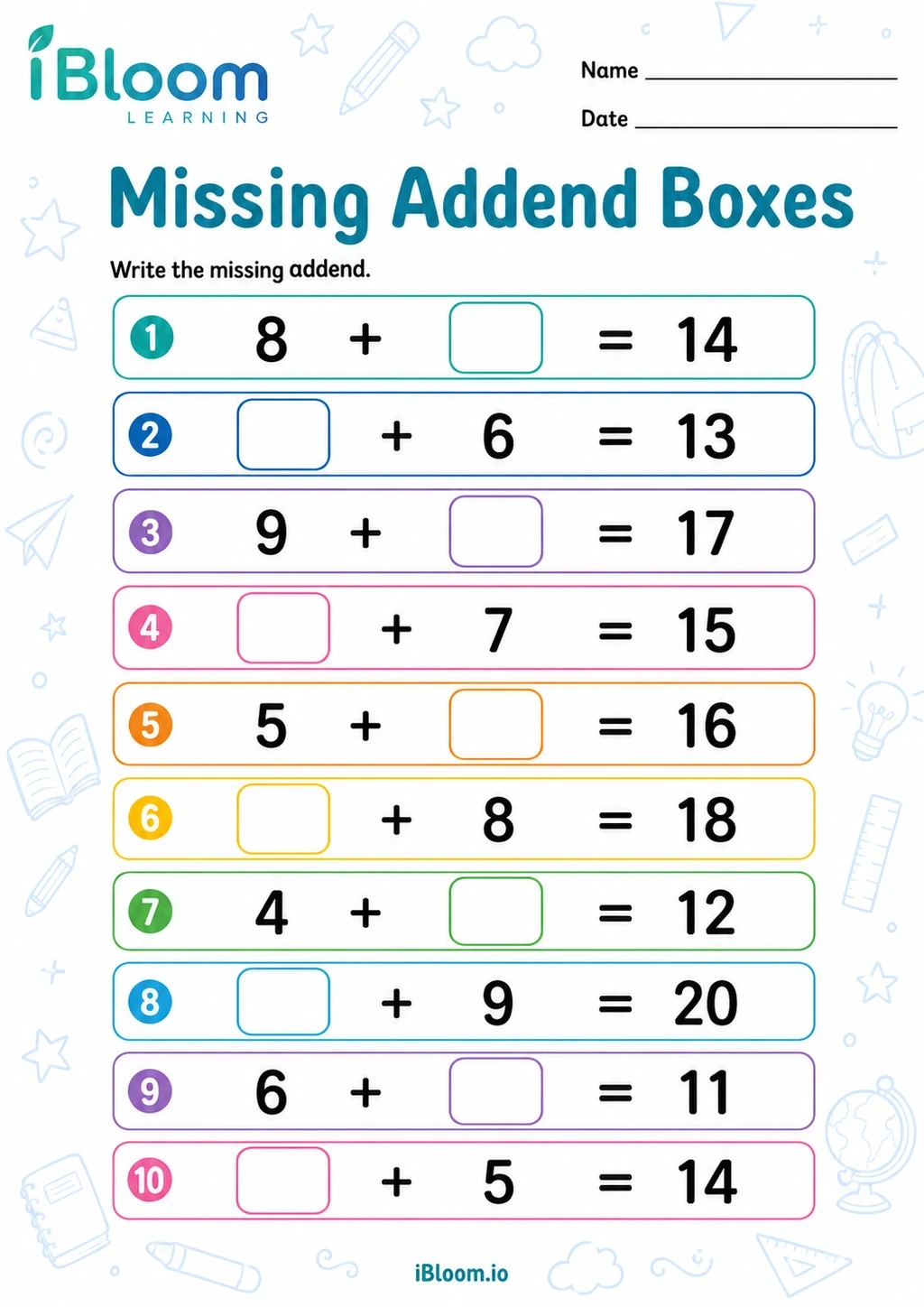
Preview the exact activity before downloading it.
Practice that builds confidence
What children learn
These Class 1 Mathematics worksheets focus on missing addends in addition, such as 7 + __ = 12 or __ + 5 = 14. Children practise finding the unknown part when the total is less than 20, building confidence with early addition facts.
The printable activities use clear number sentences, simple layouts, and repeated practice so children can connect counting, number bonds, and subtraction thinking. They are useful for home revision, classroom practice, and extra support in the Addition unit.
A missing addend is the hidden part in an addition sentence. Instead of only solving 6 + 3, children learn to complete 6 + __ = 9. This helps them see addition as “parts making a whole”, not just counting two groups. In Class 1 maths, this is an important step towards stronger number sense within 20.

Progression within sums under 20
The worksheets move children from familiar facts to slightly less obvious ones. A child may start by counting on from the known addend, then begin to recall number bonds such as 8 and 2 make 10, or 9 and 6 make 15. Problems may place the blank first, middle, or last, so children understand that __ + 4 = 11 and 4 + __ = 11 both ask for the missing part.
Parent routine for home practice
Sit with your child and read each number sentence aloud: “Five plus what makes thirteen?” Ask them to show 5 fingers or counters, then count on until they reach 13. The number of counts gives the missing addend. After a few examples, encourage a quicker method: “If 5 and 5 make 10, how many more to reach 13?” Keep the focus on explaining the thinking, not rushing.

Classroom uses for teachers
Teachers can use these pages after introducing addition facts, as maths notebook practice, or in small-group support. They also work well in centres with counters, ten-frames, or number lines. For quick assessment, ask pupils to complete a row independently and circle one question they can explain to a partner.

Common errors to watch for
Some children add all visible numbers and write the total again, for example answering 7 + __ = 12 with 19. Others count from 1 every time and lose track before 20. Watch for confusion when the blank comes before the plus sign. Remind children that the blank is a missing part, not a sign to add something extra.
Free printable PDF download
Use this missing addend sum under 20 worksheets class 1 page to preview the activity, print it, or download it as a PDF for quick practice. It works well for homework, homeschool lessons, tutoring, morning work, revision, and classroom centers.
Answers and answer key support
After the child completes the worksheet independently, parents and teachers can use the answer support or answer key information to check the work, review mistakes, and choose the next practice step.
Why iBloom worksheets help
iBloom worksheets give focused practice on one clear skill: finding the missing addend when the sum is under 20. The uncluttered format helps young learners concentrate on the number relationship. A child-friendly strategy is: read the total, start with the known part, count on to the total, and write how many steps you counted.
Helpful answers
Frequently asked questions
What is a missing addend in Class 1 addition?
A missing addend is the number that is left blank in an addition sentence, such as 6 + __ = 13. The child has to find the number that joins with 6 to make the total 13.
How can my child solve missing addend sums under 20?
A simple method is to start from the known number and count on to the total. For 8 + __ = 15, count 9, 10, 11, 12, 13, 14, 15. Seven counts means the missing addend is 7.
Why are these worksheets limited to sums under 20?
Totals under 20 are suitable for Class 1 learners because children can still use fingers, counters, number lines, and early number bonds while building fluency with addition facts.
Should children use subtraction for missing addends?
They may begin with counting on, but subtraction thinking is also helpful. For 14 + __ = 19, children can think 19 minus 14 equals 5. Both approaches build understanding of the same relationship.
What mistake should I look for while checking the worksheet?
A common mistake is adding the known number and the total together. If the question is 5 + __ = 12, the answer is not 17; the child must find the part that makes 12.
Is this missing addend sum under 20 worksheets class 1 free?
Yes. You can preview it for free and use the printable worksheet for home or classroom practice.
Can I download this missing addend sum under 20 worksheets class 1 as a PDF?
Yes. Use the worksheet download option to save a printable PDF, or print the worksheet directly from the page.
Does this missing addend sum under 20 worksheets class 1 include answers or an answer key?
When the activity has fixed answers, iBloom includes answer support so parents and teachers can check the completed worksheet.