Free printable practice
Base Ten Blocks Practice Activities
Printable Class 1 maths worksheets for counting, adding, regrouping, and decomposing numbers with base ten blocks.
Explore Base Ten Blocks
Free printable worksheet PDFs
Preview every available page, then download the free worksheet PDF for home, homeschool, tutoring, or classroom practice.
Preview the exact activity before downloading it.
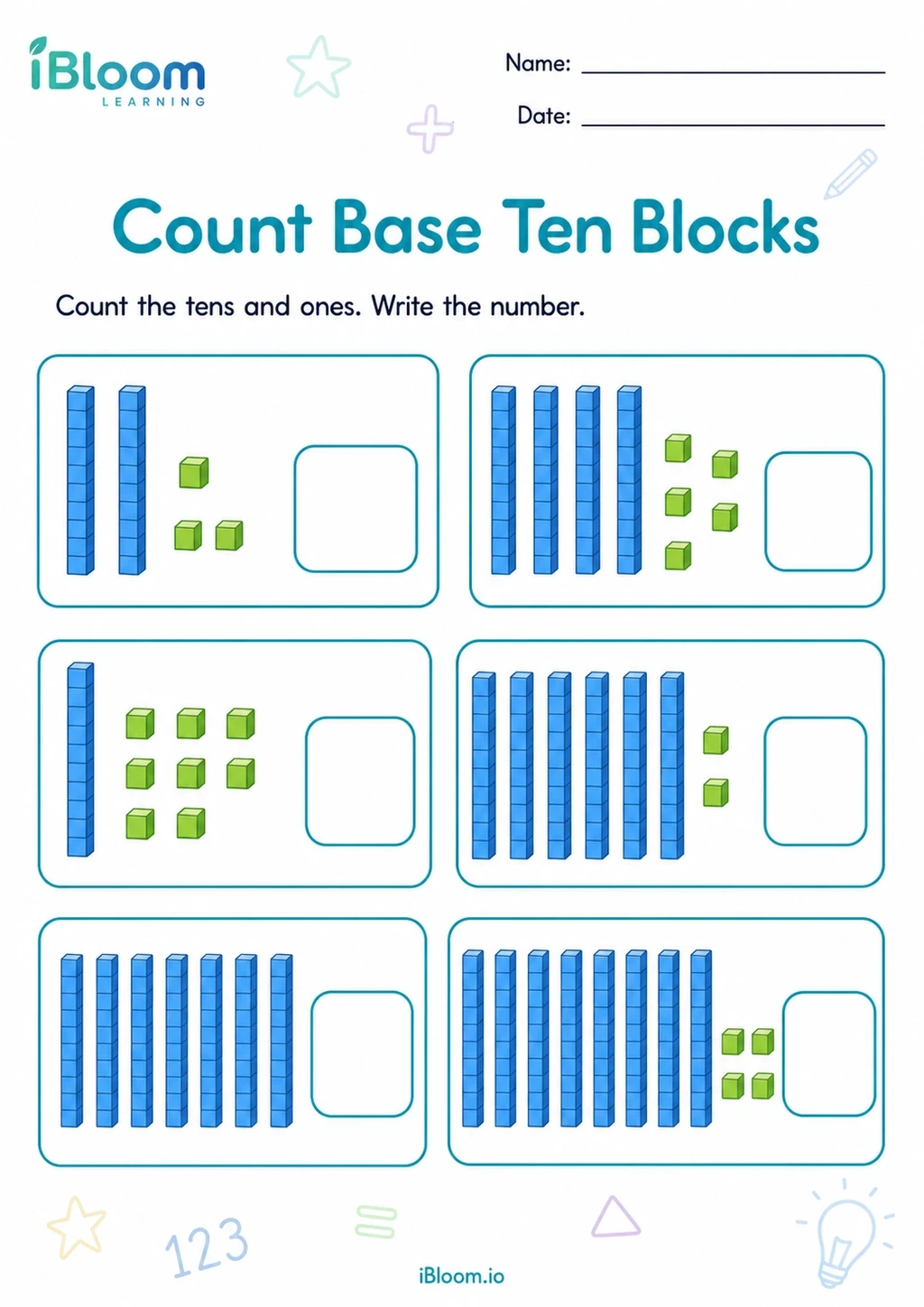 Count Base Ten BlocksA Class 1 base-ten blocks worksheet where children count tens rods and ones cubes, then write the two-digit number.Class 1Free PDF preview
 Base Ten Blocks: Adding — Concept FoundationsConcept Foundations for base ten blocks: adding in Class 1. Read tens rods and ones cubes, combine them, and solve addition facts without regrouping.Class 1Free PDF preview
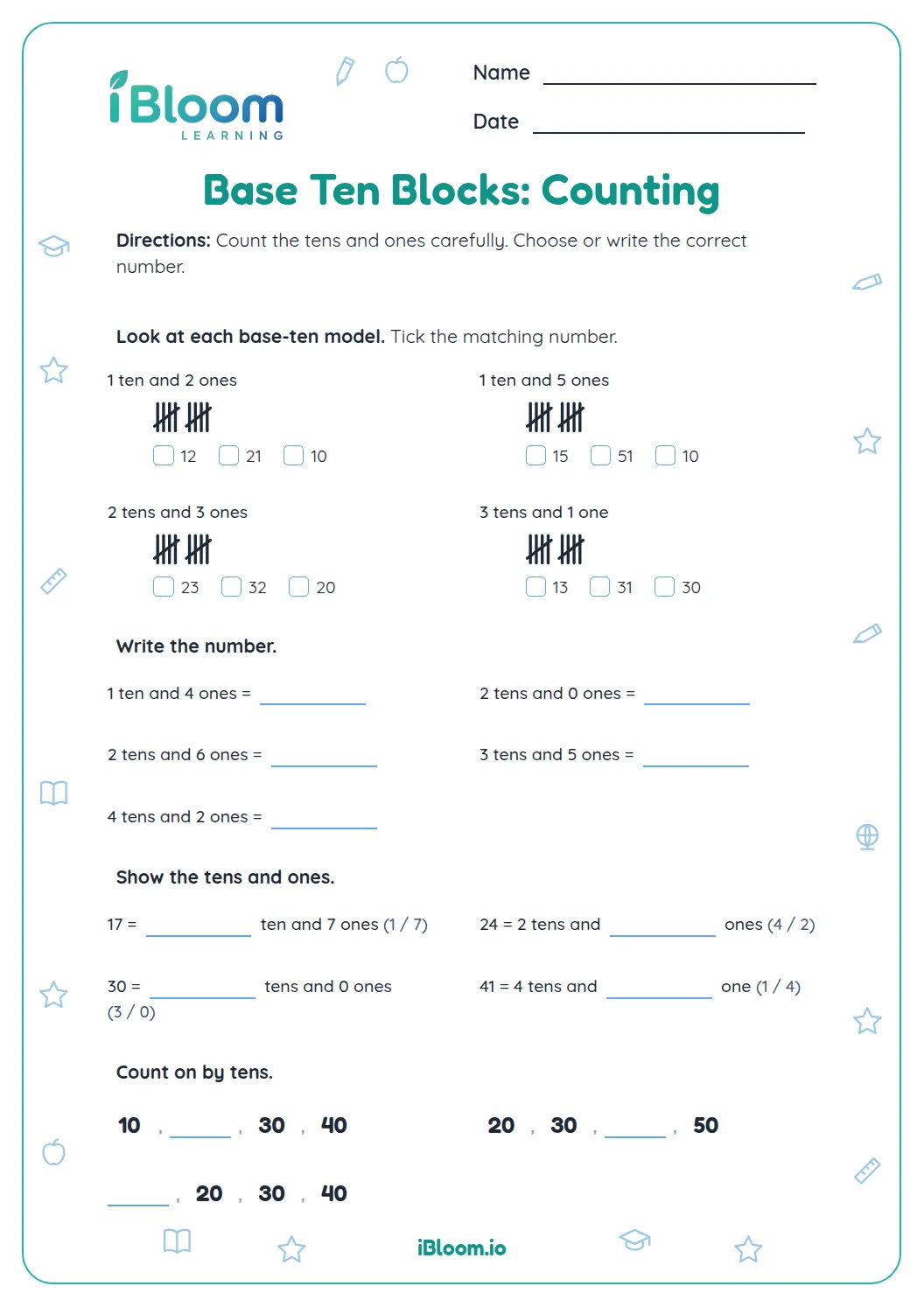 Base Ten Blocks: Counting — Concept FoundationsConcept Foundations for base ten blocks: counting in Class 1. Count tens and ones, match base-ten groups to numbers, and complete simple counting patterns.Class 1Free PDF preview
 Base Ten Blocks: Decomposing — Concept FoundationsConcept Foundations for base ten blocks: decomposing in Class 1. Identify a ten as 10 ones, then complete decompositions of numbers into tens and ones.Class 1Free PDF preview
 Base Ten Blocks: Regrouping — Concept FoundationsConcept Foundations for base ten blocks: regrouping in Class 1. Identify ten ones as one ten, trade between ones and tens, and solve simple regrouping sums.Class 1Free PDF preview
 Base Ten Blocks: Adding — Visual ModelsVisual Models for base ten blocks: adding in Class 1. Count the tens rods and ones cubes in each visual model, then add and write the total.Class 1Free PDF preview
 Base Ten Blocks: Counting — Visual ModelsVisual Models for base ten blocks: counting in Class 1. Count the tens rods and ones cubes in each visual model, then write the matching number.Class 1Free PDF preview
 Base Ten Blocks: Decomposing — Visual ModelsVisual Models for base ten blocks: decomposing in Class 1. Read each base-ten model, count the tens and ones, and complete or choose the matching decomposition.Class 1Free PDF preview
 Base Ten Blocks: Regrouping — Visual ModelsVisual Models for base ten blocks: regrouping in Class 1. Look at each base-ten model, regroup ten ones into one ten, and complete or choose the matching number sentence.Class 1Free PDF preview
 Base Ten Blocks: Adding — Guided PracticeGuided Practice for base ten blocks: adding in Class 1. Combine the tens rods and ones cubes in each model, then write the addition answer.Class 1Free PDF preview
 Base Ten Blocks: Counting — Guided PracticeGuided Practice for base ten blocks: counting in Class 1. Count tens and ones in each base ten block model, then write or choose the matching number.Class 1Free PDF preview
 Base Ten Blocks: Decomposing — Guided PracticeGuided Practice for base ten blocks: decomposing in Class 1. Identify tens and ones, split two-digit numbers into tens plus ones, and exchange one ten for ten ones.Class 1Free PDF preview
 Base Ten Blocks: Regrouping — Guided PracticeGuided Practice for base ten blocks: regrouping in Class 1. Choose correct tens-and-ones models, complete regrouping facts, and solve addition and subtraction with base ten blocks.Class 1Free PDF preview
 Base Ten Blocks: Adding — Independent PracticeIndependent Practice for base ten blocks: adding in Class 1. Use ten-frame pictures first, then add tens and ones in number sentences, moving from easy sums to sums that make a new ten.Class 1Free PDF preview
 Base Ten Blocks: Counting — Independent PracticeIndependent Practice for base ten blocks: counting in Class 1. Count tens and ones in base ten block groups, then write or choose the matching number.Class 1Free PDF preview
 Base Ten Blocks: Decomposing — Independent PracticeIndependent Practice for base ten blocks: decomposing in Class 1. Decompose numbers into tens and ones, then use exchanges to show that one ten equals ten ones.Class 1Free PDF preview
 Base Ten Blocks: Regrouping — Independent PracticeIndependent Practice for base ten blocks: regrouping in Class 1. Practise making a new ten from 10 ones and solving addition problems that need regrouping.Class 1Free PDF preview
 Base Ten Blocks: Adding — Real-World ProblemsReal-World Problems for base ten blocks: adding in Class 1. Solve 12 real-world addition stories by modelling each number with tens rods and ones cubes, then add and write the answer.Class 1Free PDF preview
 Base Ten Blocks: Counting — Real-World ProblemsReal-World Problems for base ten blocks: counting in Class 1. Count the tens and ones in real-world stories, then write or choose the matching number.Class 1Free PDF preview
 Base Ten Blocks: Decomposing — Real-World ProblemsReal-World Problems for base ten blocks: decomposing in Class 1. Read each real-world problem and complete or choose the correct tens-and-ones decomposition.Class 1Free PDF preview
Practice that builds confidence
Building the idea of tens and ones
Base ten blocks help Class 1 children see numbers as tens and ones instead of only counting by ones. These worksheets give practice with counting rods and cubes, building two-digit numbers, and reading simple place value pictures.
The printable activities include matching, drawing, counting, adding, regrouping, and decomposing tasks. Children move from looking at concrete block models to writing number sentences and explaining how a number is made.
Children begin by counting ones cubes, then learn that 10 ones can be grouped as 1 ten rod. The worksheets use clear base ten pictures so learners can connect a number such as 34 with 3 tens and 4 ones. This supports the Class 1 place value habit of looking at a number in parts, not as a string of digits.
Counting, adding, and decomposing
The practice progresses from simple counting to adding groups of rods and cubes. Children may count tens first, then ones, and record the total. Decomposing tasks ask them to break a number into tens and ones, such as 42 = 4 tens and 2 ones. This prepares them to understand addition more deeply because they can see what is being combined.
Regrouping with meaning
Regrouping is introduced visually, not as a rule to memorise. When there are 10 ones, children learn to trade them for 1 ten. This helps them understand why ones can be exchanged while the total stays the same. The focus is on noticing groups of ten, circling them, and then writing the new tens-and-ones form.
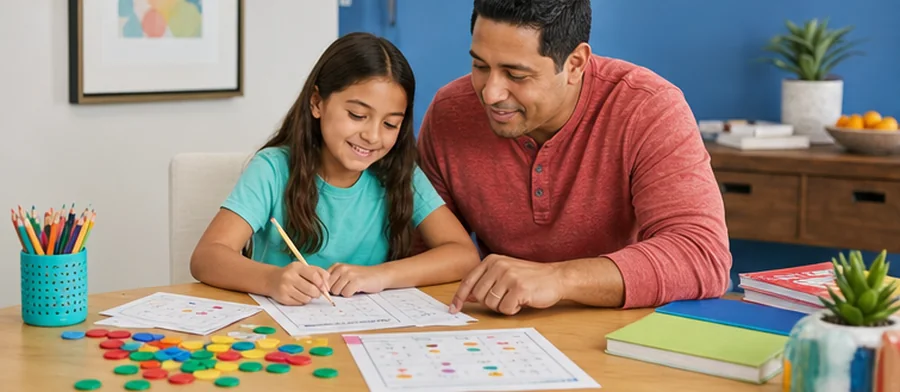
A simple parent routine
At home, ask your child to point to the tens rods first and count 10, 20, 30 before counting the ones. Then say, “How many tens? How many ones? What number is it?” For adding, cover the answer space and let the child build or draw both addends, combine the blocks, and check whether any 10 ones should be regrouped.
Classroom uses for teachers
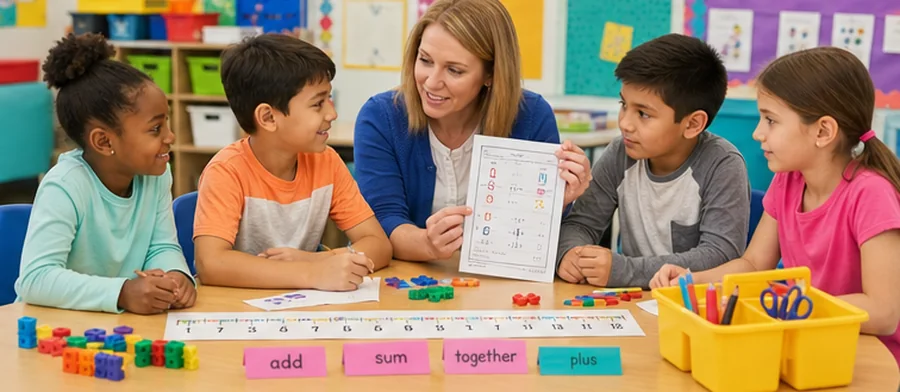
Teachers can use these sheets for maths centres, small-group place value practice, quick revision, or follow-up after using real blocks. They also work well for partner talk: one child reads the blocks while another writes the number. Drawing tasks make it easier to see which children understand tens and which are still counting every cube one by one.
Free printable PDF download
Use this class 1 base ten blocks worksheet page to preview the activity, print it, or download it as a PDF for quick practice. It works well for homework, homeschool lessons, tutoring, morning work, revision, and classroom centers.
Answers and answer key support
After the child completes the worksheet independently, parents and teachers can use the answer support or answer key information to check the work, review mistakes, and choose the next practice step.
Why iBloom worksheets help
Each page keeps the representation consistent: tens rods, ones cubes, digits, and number forms are linked step by step. Watch for common errors such as counting a ten rod as 1, reversing tens and ones, or regrouping before there are 10 ones. A child-friendly strategy is: “Count tens first, count ones next, then check for a new ten.”
Helpful answers
Frequently asked questions
What do Class 1 children learn from base ten blocks?
They learn that numbers can be made from tens and ones. For example, a number can be shown with tens rods and ones cubes, helping children understand place value before using only digits.
Do these worksheets include regrouping?
Yes. Regrouping is shown with blocks so children can see that 10 ones can be traded for 1 ten while the total remains the same.
How should my child count base ten blocks?
Encourage your child to count the tens rods first as 10, 20, 30 and then count the ones. This builds faster and more accurate place value thinking.
Can these sheets be used without physical base ten blocks?
Yes. The worksheets include pictures of rods and cubes, so children can practise visually. If you have straws, sticks, buttons, or bundled pencils, they can also be used alongside the printables.
What mistakes should I watch for?
Common mistakes include treating a ten rod as 1, mixing up tens and ones, counting all blocks by ones, or regrouping when there are fewer than 10 ones.
Is this class 1 base ten blocks worksheet free?
Yes. You can preview it for free and use the printable worksheet for home or classroom practice.
Can I download this class 1 base ten blocks worksheet as a PDF?
Yes. Use the worksheet download option to save a printable PDF, or print the worksheet directly from the page.
Does this class 1 base ten blocks worksheet include answers or an answer key?
When the activity has fixed answers, iBloom includes answer support so parents and teachers can check the completed worksheet.