Free printable practice
Ordering Numbers 0 100 Practice Activities
Class 1 maths worksheets for ordering numbers from 0 to 100 using place value, number lines, and ascending or descending order.
Free printable worksheet PDFs
Preview every available page, then download the free worksheet PDF for home, homeschool, tutoring, or classroom practice.
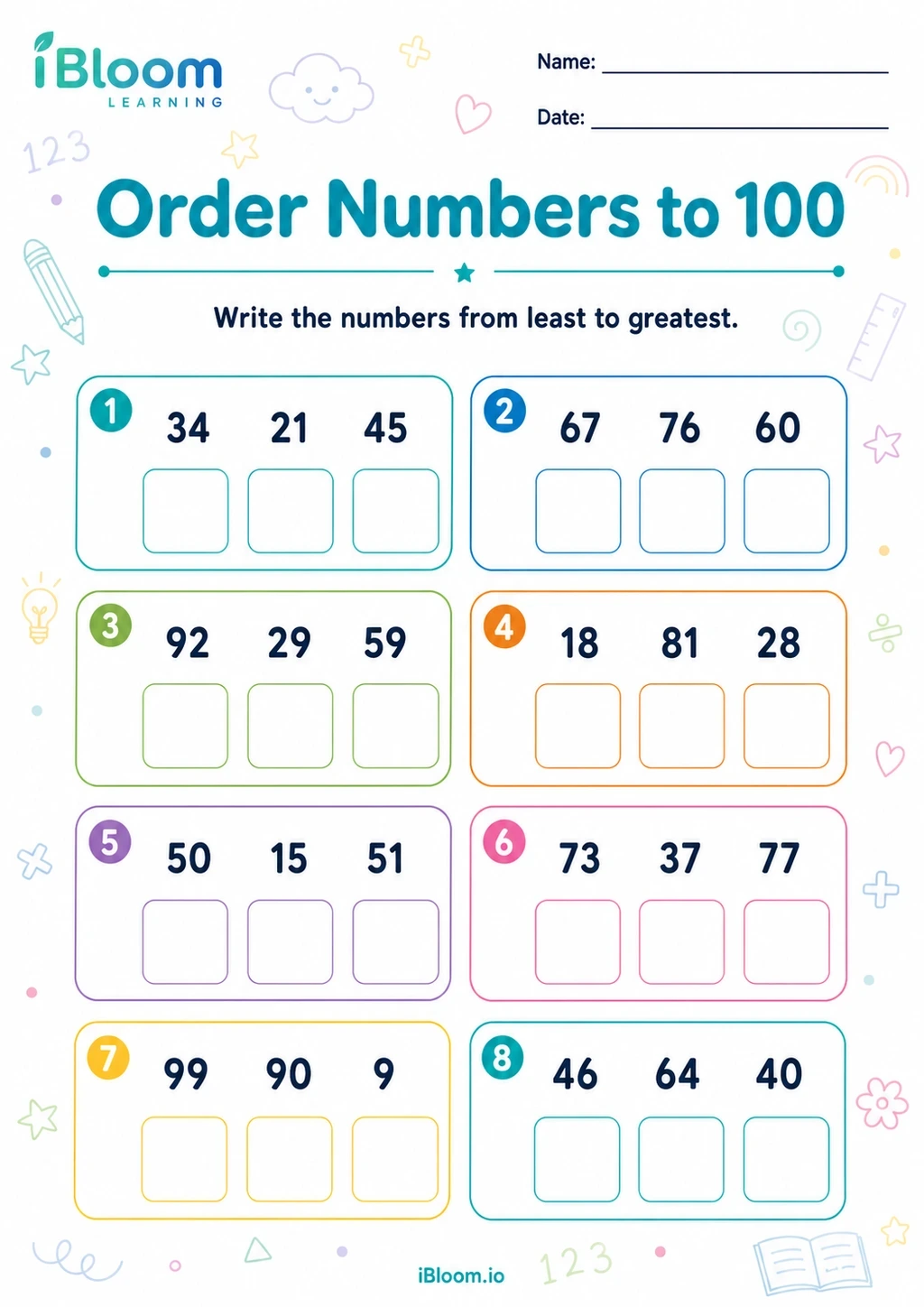
Preview the exact activity before downloading it.
Practice that builds confidence
What children learn about order
These Class 1 comparing numbers worksheets help children order numbers from 0 to 100 with confidence. Learners practise deciding which number comes before, after, between, and how to arrange groups of numbers.
The printable activities include number lines, mixed number sets, ascending order, descending order, and tens-and-ones comparisons. They support early maths fluency and a stronger understanding of the 0–100 number sequence.
Ordering numbers from 0 to 100 helps children understand that numbers have size and position. They learn that 47 comes after 46, that 80 is greater than 18, and that numbers can be arranged from smallest to greatest or greatest to smallest. This is an important step after counting and comparing single numbers.

Using place value from 0 to 100
Class 1 children begin to look at tens and ones when numbers are not next to each other. For example, 52 is greater than 48 because 5 tens is more than 4 tens. If the tens are the same, they compare the ones: 63 comes before 68 because 3 ones is less than 8 ones.
Progression in the worksheets
Activities may start with missing numbers on a number line, then move to ordering three or more numbers. Children practise ascending order, such as 12, 25, 39, and descending order, such as 91, 76, 60. Mixed sets help them avoid simply counting forward and encourage real comparison.
A parent routine for home
Choose four numbers between 0 and 100 and write them on small slips of paper. Ask your child to place them from smallest to greatest. Then ask, “How did you know?” Encourage answers using tens and ones, not only guessing. You can repeat the same numbers in descending order to strengthen flexibility.

Classroom uses for teachers
Teachers can use these worksheets during comparing numbers lessons, maths centres, morning practice, or small-group support. Number-line questions work well for visual learners, while ordering lists help prepare pupils for word problems and data activities where numbers must be ranked.

Free printable PDF download
Use this ordering numbers 0 to 100 worksheet page to preview the activity, print it, or download it as a PDF for quick practice. It works well for homework, homeschool lessons, tutoring, morning work, revision, and classroom centers.
Answers and answer key support
After the child completes the worksheet independently, parents and teachers can use the answer support or answer key information to check the work, review mistakes, and choose the next practice step.
Common errors and why iBloom helps
Children may compare only the first digit incorrectly when reading two-digit numbers, or think 100 is smaller because it starts with 1. Some also confuse ascending and descending order. iBloom worksheets provide varied representations so children connect number names, place value, and position. A simple strategy is: compare tens first, then ones; check the direction last.
Helpful answers
Frequently asked questions
What does ordering numbers from 0 to 100 involve?
It involves arranging numbers by size, either from smallest to greatest in ascending order or from greatest to smallest in descending order.
How should Class 1 children compare two-digit numbers?
They should compare the tens first. If the tens are the same, they compare the ones to decide which number is greater or smaller.
Why do children confuse ascending and descending order?
The words can be new and abstract. Linking ascending with counting up and descending with counting down helps children remember the direction.
Are number lines helpful for this topic?
Yes. A number line shows the position of each number, helping children see that numbers farther to the right are greater.
How can I practise this skill at home?
Write a few numbers between 0 and 100 on slips of paper and ask your child to arrange them. Then ask them to explain using tens and ones.
Is this ordering numbers 0 to 100 worksheet free?
Yes. You can preview it for free and use the printable worksheet for home or classroom practice.
Can I download this ordering numbers 0 to 100 worksheet as a PDF?
Yes. Use the worksheet download option to save a printable PDF, or print the worksheet directly from the page.
Does this ordering numbers 0 to 100 worksheet include answers or an answer key?
When the activity has fixed answers, iBloom includes answer support so parents and teachers can check the completed worksheet.