Free printable practice
Reading Bar Charts Practice Activities
Class 1 children practise reading simple bar charts, comparing quantities, and answering questions using clear data displays.
Free printable worksheet PDFs
Preview every available page, then download the free worksheet PDF for home, homeschool, tutoring, or classroom practice.
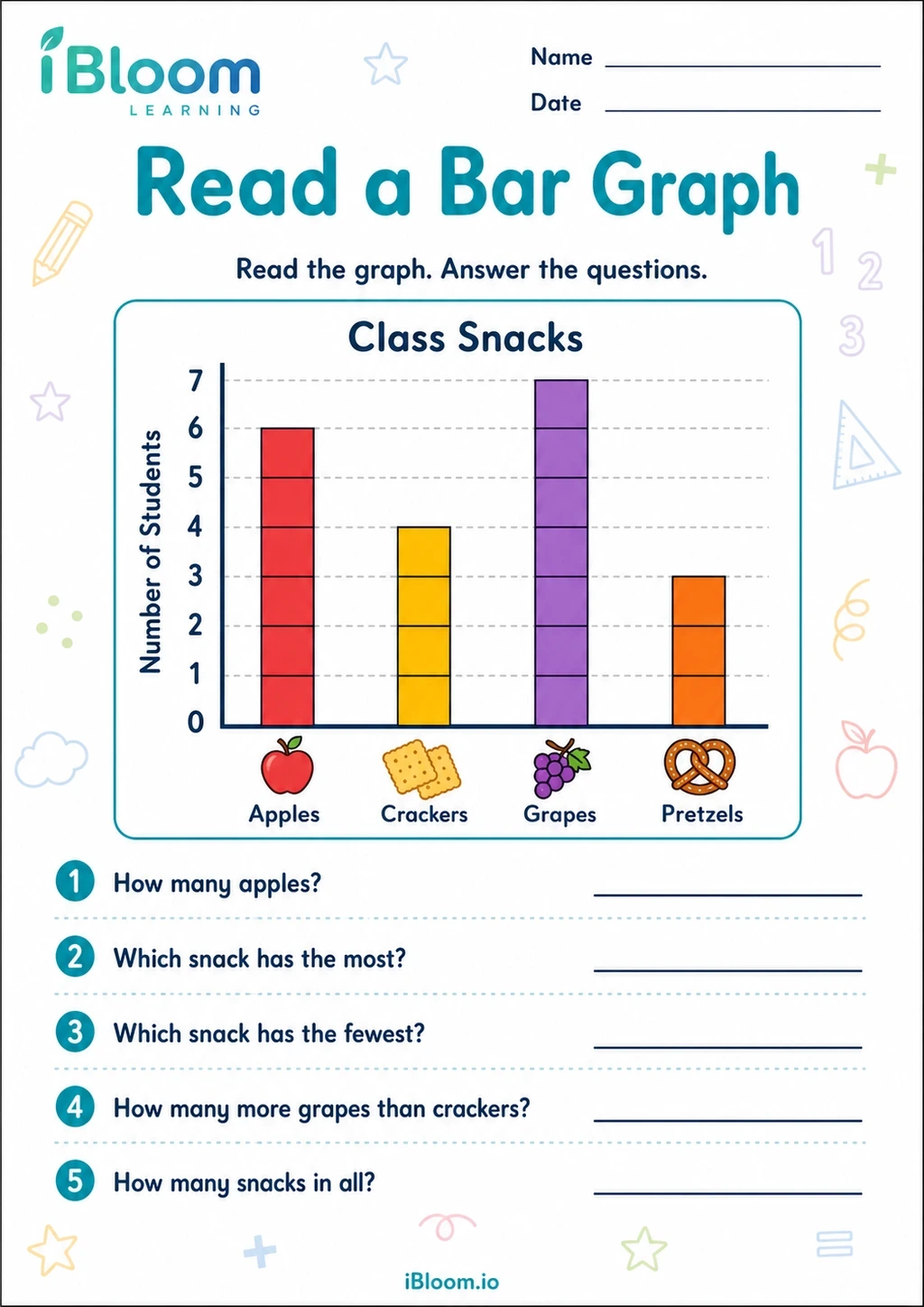
Preview the exact activity before downloading it.
Practice that builds confidence
What children learn
These Class 1 maths worksheets help children read simple bar charts with confidence. Children practise looking at labels, counting the height or length of bars, and using the chart to answer questions such as “how many”, “which has more”, and “which has fewer”.
The printable activities use clear, child-friendly data displays with familiar categories. Each worksheet encourages careful observation, comparison, and early data vocabulary so children learn that a bar chart is a way to organise and understand information.
Reading bar charts is an early data handling skill. In these activities, children learn that each bar stands for a category, and the size of the bar shows how many. They practise reading the title, checking the category names, and matching a bar to its value before answering.

From counting to comparing
Class 1 children often begin by counting squares or units in a bar. They then move to comparison questions: which fruit was chosen by most children, which colour has the least votes, or how many more are in one group than another. This progression helps them connect numbers with visual information.
A simple parent routine
At home, sit with your child and read the chart title first. Ask, “What is this chart about?” Then point to one bar at a time and ask your child to say the category and number. After that, ask one comparison question, such as “Which bar is tallest?” or “How many fewer cats than dogs?” Encourage your child to show the answer on the chart before writing it.

Classroom uses for teachers
Teachers can use these worksheets during maths practice, data graphing lessons, or small-group support. They also work well after a class survey, such as favourite snacks or transport to school. Children can compare their real class data with the printed charts and discuss words like more, fewer, most, least, same, category, and bar.

Common errors to watch for
Some children read the wrong bar because they skip the label. Others count the spaces around a bar instead of the filled units, or answer from memory rather than from the chart. Remind children to use a “label, bar, number” check: read the label, trace the bar with a finger, then count or read the value.
Free printable PDF download
Use this Class 1 reading bar charts worksheet page to preview the activity, print it, or download it as a PDF for quick practice. It works well for homework, homeschool lessons, tutoring, morning work, revision, and classroom centers.
Answers and answer key support
After the child completes the worksheet independently, parents and teachers can use the answer support or answer key information to check the work, review mistakes, and choose the next practice step.
Why iBloom worksheets help
iBloom worksheets keep the charts clean and focused so young learners are not distracted by too much information. The questions move from direct reading to simple comparisons, giving children repeated practice in using evidence from the chart. This builds accuracy, maths vocabulary, and confidence with data in a gentle Class 1-friendly way.
Helpful answers
Frequently asked questions
What do children practise in these reading bar charts worksheets?
Children practise reading category labels, finding the value shown by each bar, and answering simple questions about more, fewer, most, least, and same.
Are these worksheets suitable for Class 1 maths?
Yes. The charts are kept simple and visual, with familiar categories and questions designed for early data graphing practice in Class 1.
How can I help my child if they read the wrong bar?
Ask your child to slow down and use the label, bar, number routine: read the label, follow the matching bar with a finger, then count or read the value.
Do children need to draw bar charts in this set?
This page focuses on reading bar charts. Children mainly interpret given charts and answer questions, which prepares them for creating charts later.
What vocabulary should I revise before using the worksheets?
Useful words include bar, chart, data, category, more, fewer, most, least, equal, tallest, shortest, and how many.
Is this Class 1 reading bar charts worksheet free?
Yes. You can preview it for free and use the printable worksheet for home or classroom practice.
Can I download this Class 1 reading bar charts worksheet as a PDF?
Yes. Use the worksheet download option to save a printable PDF, or print the worksheet directly from the page.
Does this Class 1 reading bar charts worksheet include answers or an answer key?
When the activity has fixed answers, iBloom includes answer support so parents and teachers can check the completed worksheet.