Free printable practice
Equal Parts Practice Activities
Class 1 maths worksheets that help children recognise equal and unequal parts of shapes and everyday objects before formal fraction writing.
Free printable worksheet PDFs
Preview every available page, then download the free worksheet PDF for home, homeschool, tutoring, or classroom practice.
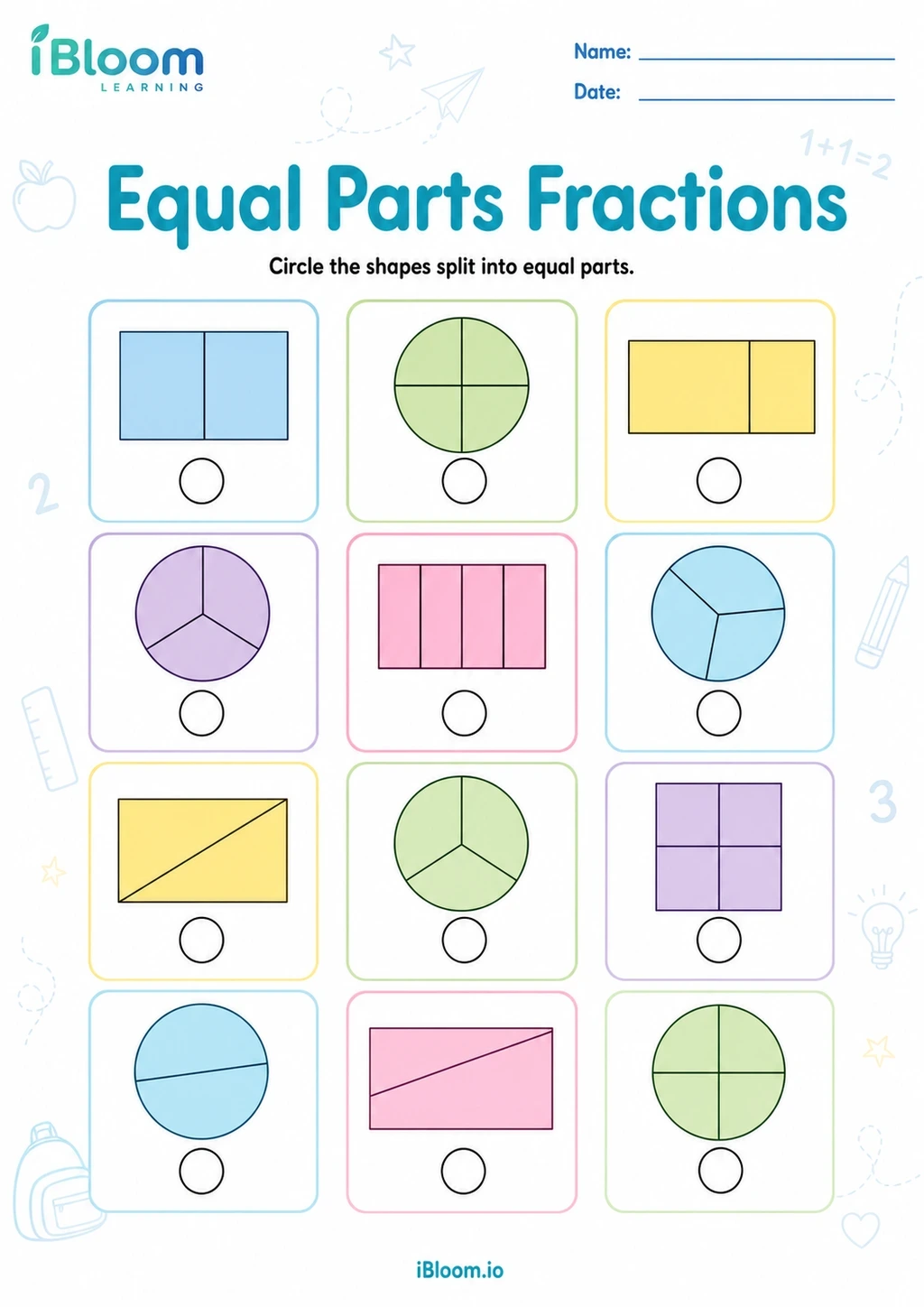
Preview the exact activity before downloading it.
Practice that builds confidence
What children learn first
These Class 1 maths worksheets help children see what “equal parts” really means: each part must be the same size, not just the same shape or colour. Children compare divided shapes, identify fair shares, and begin the early thinking needed for fractions.
The printable activities include simple pictures such as circles, rectangles, strips, food items, and objects split into parts. Children mark equal parts, spot unequal divisions, and practise using words like whole, part, equal, unequal, share, and same size.
Equal parts are the foundation of fractions. At this stage, children do not need to write fraction symbols. They need to look carefully and decide whether a whole has been shared fairly. A rectangle cut into two same-size pieces shows equal parts; a circle split into one large and one small piece does not. The worksheets build this visual judgement through clear, age-appropriate pictures.

From seeing to explaining
The practice moves from simple recognition to simple reasoning. Children may circle shapes divided into equal parts, cross out unequal ones, or choose the picture that shows a fair share. Encourage them to say, “These parts are equal because they are the same size,” or “This is not equal because one part is bigger.” This oral explanation is important in Class 1 maths.
A parent routine for home
Use a quick sharing routine before or after the worksheet. Fold a paper strip into two equal parts, then fold another strip unevenly. Ask, “Which one is fair?” You can also use a roti, slice of bread, chocolate bar drawing, or fruit picture. Let the child point, compare, and explain before colouring the equal parts on the worksheet.

Classroom uses for teachers
Teachers can use these printables during a fractions introduction, maths centres, small-group support, or revision. They also work well after a hands-on activity with folding paper shapes. Ask pupils to sort worksheet pictures into “equal” and “not equal” groups, then discuss their choices with a partner.

Common errors to watch for
Some children think parts are equal if there are the same number of pieces, even when one piece is much larger. Others focus on colour or position instead of size. If a shape is divided diagonally, they may think it is unequal because it looks different. Remind them to compare the amount of space each part takes up.
Free printable PDF download
Use this Class 1 equal parts worksheet page to preview the activity, print it, or download it as a PDF for quick practice. It works well for homework, homeschool lessons, tutoring, morning work, revision, and classroom centers.
Answers and answer key support
After the child completes the worksheet independently, parents and teachers can use the answer support or answer key information to check the work, review mistakes, and choose the next practice step.
Why iBloom worksheets help
iBloom worksheets keep the focus on one skill: recognising equal parts. The pages use familiar objects, uncluttered drawings, and repeated comparison so children can build confidence before moving to halves, quarters, or written fractions. A child-friendly strategy is: “Look at the whole, compare each part, then ask: is every share the same size?”
Helpful answers
Frequently asked questions
What does equal parts mean for a Class 1 child?
Equal parts means a whole is divided so every part is the same size. Children learn this by comparing pictures rather than by writing fraction symbols.
Do these worksheets teach halves and quarters?
They prepare children for halves and quarters by focusing on the idea of fair, same-size parts. Formal fraction names can be introduced after this concept is secure.
How can I explain unequal parts at home?
Show two paper strips or food drawings: one shared evenly and one with a bigger piece and a smaller piece. Ask your child which sharing is fair and why.
Why might my child mark an unequal shape as equal?
Many children count the number of pieces and forget to compare size. Prompt them to look at how much space each part covers, not only how many parts there are.
Can teachers use these for a fractions lesson introduction?
Yes. The worksheets are useful before written fractions because they build the visual understanding that fractions must come from equal parts of a whole.
Is this Class 1 equal parts worksheet free?
Yes. You can preview it for free and use the printable worksheet for home or classroom practice.
Can I download this Class 1 equal parts worksheet as a PDF?
Yes. Use the worksheet download option to save a printable PDF, or print the worksheet directly from the page.
Does this Class 1 equal parts worksheet include answers or an answer key?
When the activity has fixed answers, iBloom includes answer support so parents and teachers can check the completed worksheet.