Free printable practice
Place Value Practice Activities
Class 1 place value worksheets for reading, building, expanding, rounding, and adding two-digit numbers using tens and ones.
Explore Place Value
Free printable worksheet PDFs
Preview every available page, then download the free worksheet PDF for home, homeschool, tutoring, or classroom practice.
Preview the exact activity before downloading it.
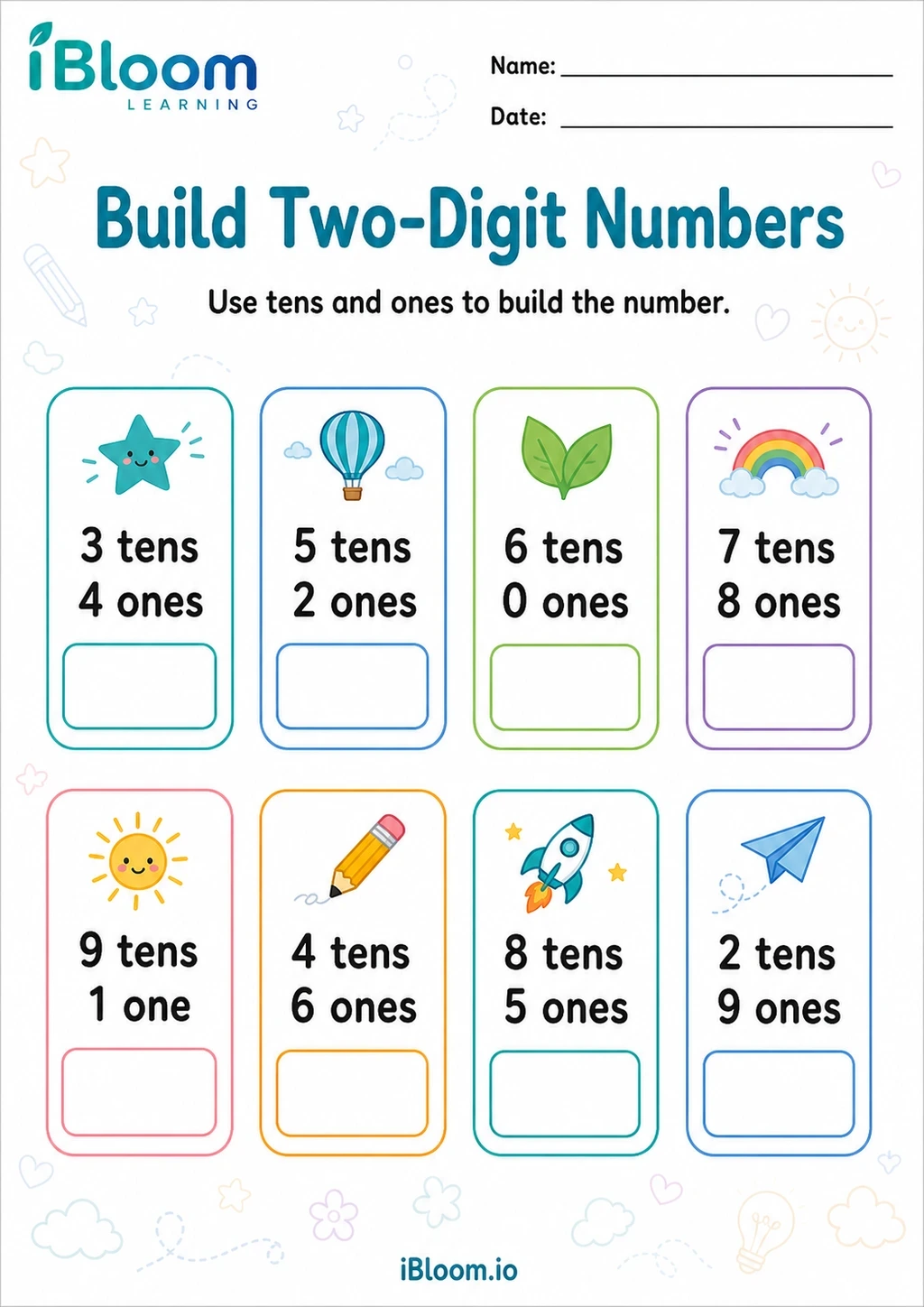 Build Two-Digit NumbersA Class 1 place-value worksheet where children combine tens and ones to build two-digit numbers.Class 1Free PDF preview
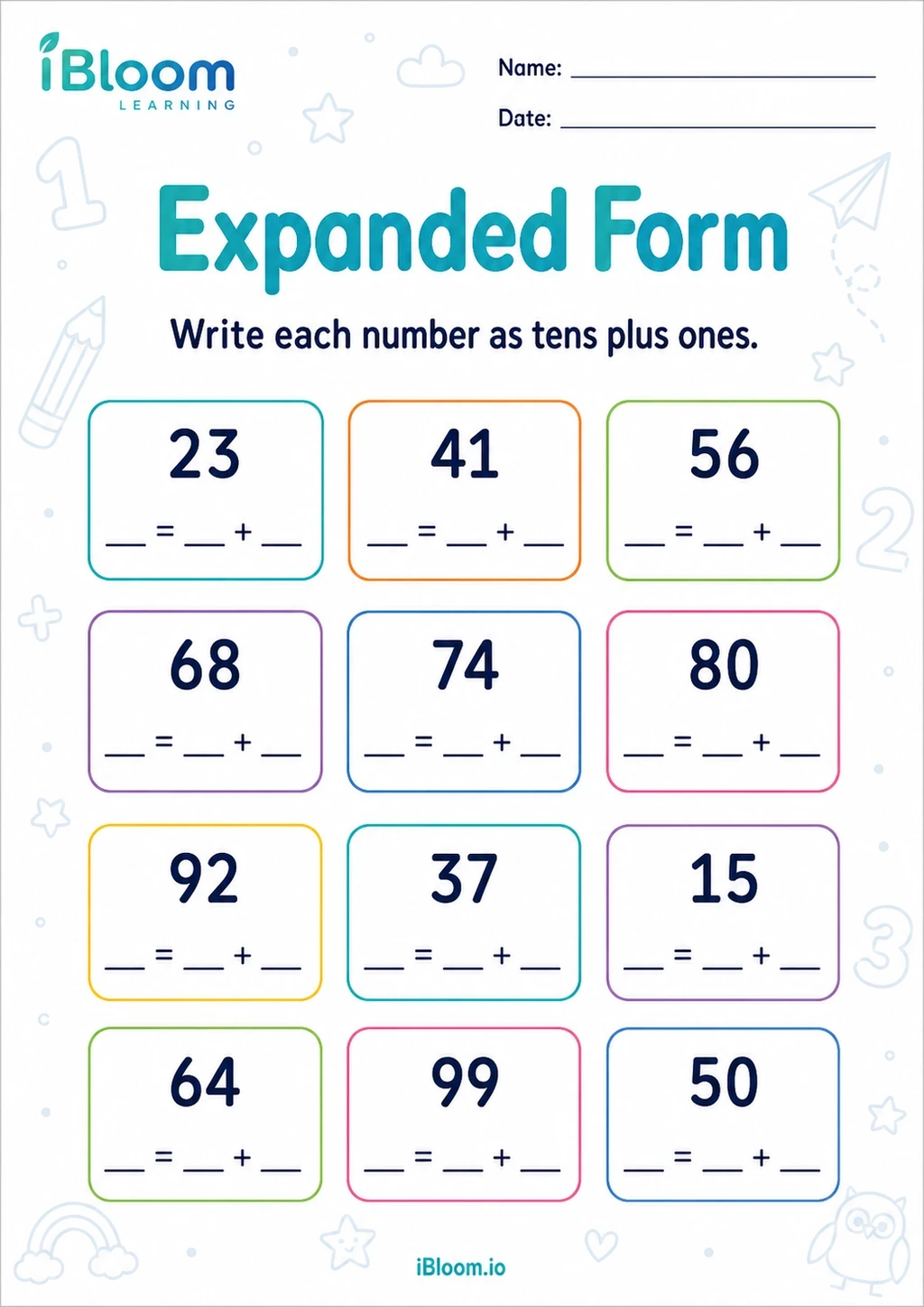 Expanded FormA Class 1 place-value worksheet for writing two-digit numbers as tens and ones in expanded form.Class 1Free PDF preview
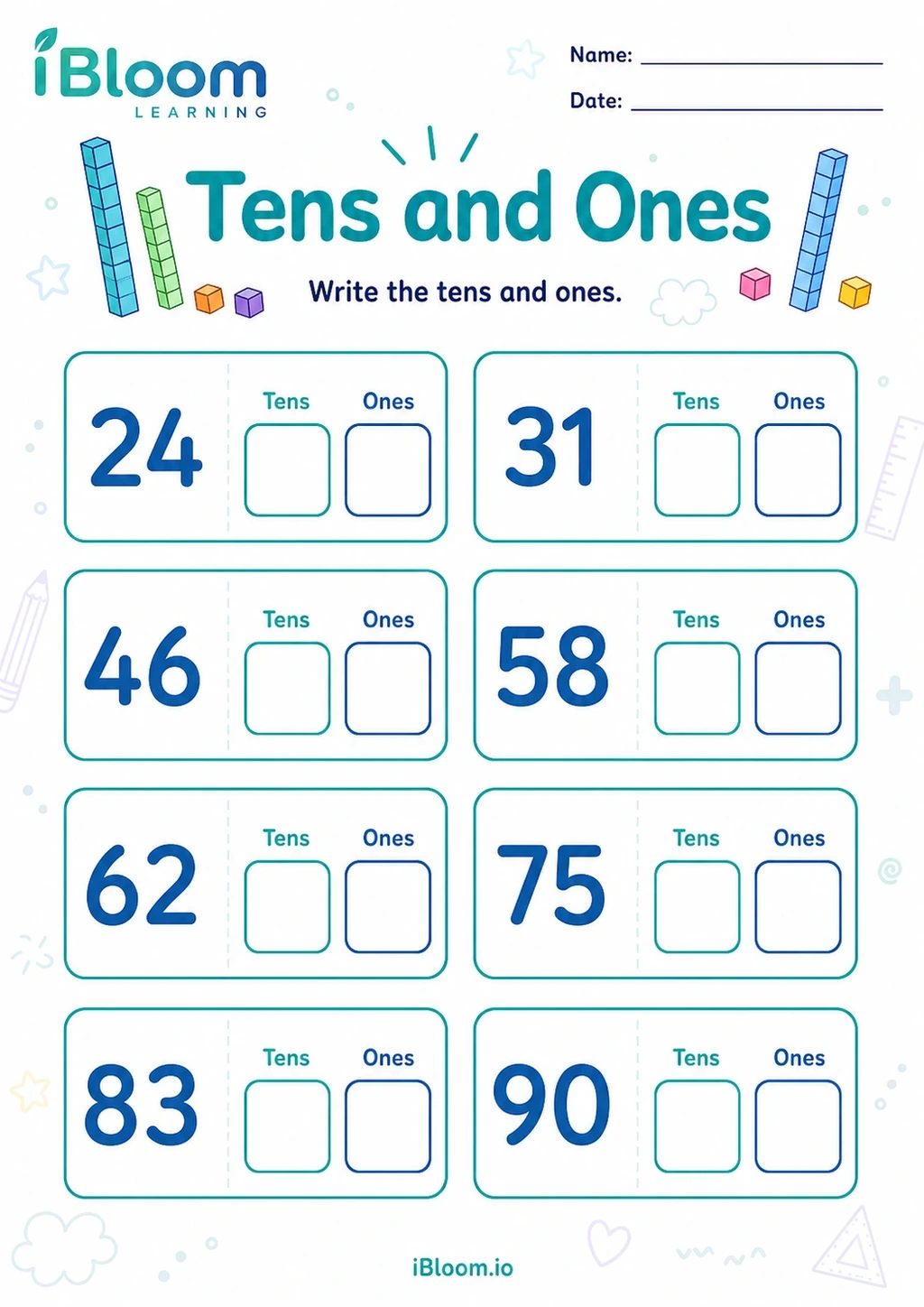 Tens and OnesA Class 1 place value worksheet where children break two-digit numbers into tens and ones.Class 1Free PDF preview
Practice that builds confidence
Building two-digit number sense
These Class 1 place value practice activities help children understand that two-digit numbers are made from tens and ones. Learners practise writing numbers in normal form, expanded form, identifying tens and ones, and combining them to make a number.
The printable worksheets include tasks on adding whole tens and ones, finding missing addends, and rounding numbers to the nearest 10. Activities move from visual understanding to number sentences, so children can build confidence with early maths notation.
Place value is one of the most important Class 1 maths skills because it explains how numbers are organised. A child learns that 34 is not just “3 and 4”; it means 3 tens and 4 ones. These worksheets give repeated practice with tens, ones, normal form such as 47, and expanded form such as 40 + 7.

Skills covered in this collection
The activities connect the listed skills in a clear sequence: identify the tens and ones, combine tens and ones, write numbers in normal form, and then write them in expanded form. Children also practise adding whole tens and ones, such as 30 + 6, and solving missing addend questions like 40 + __ = 48. Rounding to the nearest 10 is introduced through nearby tens, helping children see which ten a number is closer to.
A simple parent routine
At home, use small objects such as pencils, beads, or rajma beans. Bundle 10 together with a rubber band and keep loose ones separately. Say a number, for example 52, and ask your child to show 5 bundles and 2 loose ones, then write 50 + 2 and 52. For rounding, place numbers like 21, 25, and 29 between 20 and 30 and ask, “Which ten is nearer?”

Classroom uses for teachers
Teachers can use these printables for maths centres, morning revision, small-group support, or quick checks after a place value lesson. Pair a worksheet with base-ten blocks, straws, number cards, or a tens-ones mat. Mixed questions are useful for spotting whether a child can move between pictures, words, expanded form, and standard numerals.

Common errors to watch for
Some children reverse digits, reading 42 as 24, or write 4 + 2 instead of 40 + 2. Others count all objects one by one instead of recognising groups of ten. In rounding, children may choose the ten they like rather than the nearest ten. Encourage them to circle the tens digit, underline the ones digit, and say the number as “tens and ones”.
Free printable PDF download
Use this Class 1 place value worksheet page to preview the activity, print it, or download it as a PDF for quick practice. It works well for homework, homeschool lessons, tutoring, morning work, revision, and classroom centers.
Answers and answer key support
After the child completes the worksheet independently, parents and teachers can use the answer support or answer key information to check the work, review mistakes, and choose the next practice step.
Why iBloom worksheets help
The pages are designed to progress from concrete understanding to written number work. Children first identify and combine tens and ones, then use that idea in addition, missing addends, expanded form, and rounding. A helpful child-friendly strategy is: “Build it, say it, split it, write it.” Build the number, say the tens and ones, split it into expanded form, and write the final number clearly.
Helpful answers
Frequently asked questions
What place value skills are practised in these Class 1 worksheets?
Children practise identifying tens and ones, combining tens and ones, writing numbers in normal form and expanded form, adding whole tens and ones, finding missing addends, and rounding to the nearest 10.
How can I explain tens and ones to a Class 1 child?
Use bundles of 10 objects and loose ones. For 36, show 3 bundles and 6 loose objects, then say “3 tens and 6 ones” before writing 30 + 6 and 36.
When should children start expanded form?
Expanded form is best introduced after children can identify the tens and ones in a two-digit number. For example, once they know 58 has 5 tens and 8 ones, they can write it as 50 + 8.
What is a common mistake in adding whole tens and ones?
A common mistake is adding the digits only, such as treating 40 + 7 as 4 + 7. Remind children that 40 means 4 tens, so 40 + 7 makes 47.
How do these worksheets introduce rounding to the nearest 10?
They help children compare a number with the two nearby tens. For example, 28 lies between 20 and 30 and is closer to 30, so it rounds to 30.
Is this Class 1 place value worksheet free?
Yes. You can preview it for free and use the printable worksheet for home or classroom practice.
Can I download this Class 1 place value worksheet as a PDF?
Yes. Use the worksheet download option to save a printable PDF, or print the worksheet directly from the page.
Does this Class 1 place value worksheet include answers or an answer key?
When the activity has fixed answers, iBloom includes answer support so parents and teachers can check the completed worksheet.