Free printable practice
Meaning Division Sentences Practice Activities
Printable Class 3 maths worksheets that help children understand, read, write, and match division sentences using equal groups and sharing situations.
Free printable worksheet PDFs
Preview every available page, then download the free worksheet PDF for home, homeschool, tutoring, or classroom practice.
Preview the exact activity before downloading it.
 Meaning Division Sentences — Concept FoundationsConcept Foundations for meaning division sentences in Class 3. Read equal-group and sharing stories, choose the meaning, and complete division sentences.Class 3Free PDF preview
 Meaning Division Sentences — Visual ModelsVisual Models for meaning division sentences in Class 3. Look at each equal-group visual model, choose the matching division sentence, then solve short sharing stories.Class 3Free PDF preview
 Meaning Division Sentences — Guided PracticeGuided Practice for meaning division sentences in Class 3. Read equal-group and sharing stories, choose or write the matching division sentence, then solve guided division facts.Class 3Free PDF preview
 Meaning Division Sentences — Independent PracticeIndependent Practice for meaning division sentences in Class 3. Solve equal-sharing and equal-group stories, complete division sentences, and match each division sentence to its meaning.Class 3Free PDF preview
 Meaning Division Sentences — Real-World ProblemsReal-World Problems for meaning division sentences in Class 3. Solve real-world equal-group and sharing stories by writing and reading division sentences.Class 3Free PDF preview
 Meaning Division Sentences — Reasoning ChallengeReasoning Challenge for meaning division sentences in Class 3. Solve and explain meaning division sentences by finding missing parts, matching equal-group stories, and checking reasoning.Class 3Free PDF preview
Practice that builds confidence
Understanding the division sentence
These Class 3 maths worksheets build the meaning of division sentences before children move on to faster calculation. Learners practise seeing division as equal sharing and equal grouping, then connect a picture or word situation to a number sentence such as 12 ÷ 3 = 4.
The printable activities include simple visual models, matching tasks, fill-in division sentences, and short story-based questions. Children learn what each number in a division sentence represents, so the symbol ÷ becomes connected to real quantities rather than memorised as a rule.
A division sentence tells how a quantity is split into equal parts. In 12 ÷ 3 = 4, 12 is the total, 3 may be the number of equal groups or the number in each group, and 4 is the result. These worksheets help children say the meaning aloud: “12 things shared into 3 equal groups gives 4 in each group” or “12 things put in groups of 3 makes 4 groups.”
From pictures to numbers
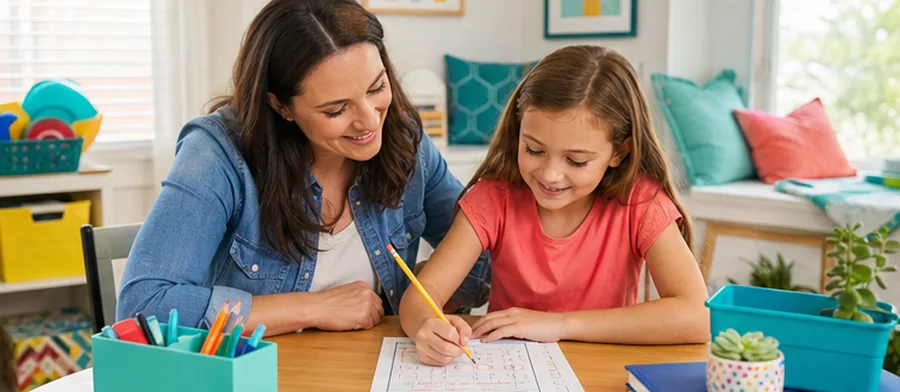
The practice moves from visible groups of objects to completed number sentences and then to missing-number formats. Children may count items in equal sets, match a picture to a division sentence, or complete a statement using ÷ and = correctly. This progression is important because many Class 3 learners can count the objects but need support translating the model into maths language.
A parent routine for home
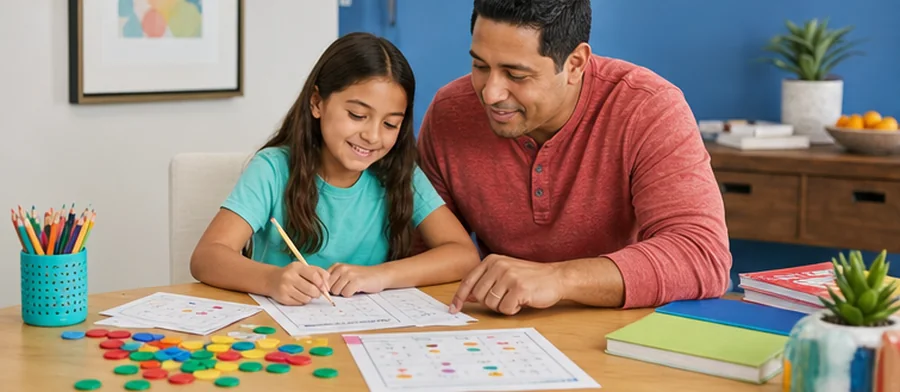
Use small objects such as rajma beans, buttons, or crayons. Make 15 objects and ask your child to share them equally among 5 plates, then write 15 ÷ 5 = 3. Next, regroup the same 15 objects into groups of 3 and write 15 ÷ 3 = 5. Ask, “What does the first number show? What does the answer show?” This short routine makes the two meanings of division clear.
Classroom uses for teachers
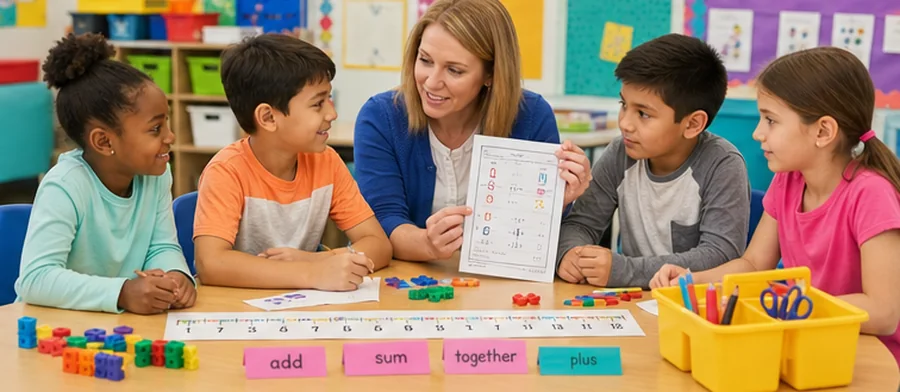
Teachers can use these sheets after a concrete activity with counters, during maths centres, or as independent practice after introducing the ÷ symbol. The matching and fill-in formats are useful for checking whether pupils understand the situation, not just the answer. They also work well for pair talk: one child explains the picture while the other writes the division sentence.
Common errors to watch for
Children may reverse the numbers, write 3 ÷ 12 instead of 12 ÷ 3, or count unequal groups as if they were division. Some may confuse the divisor and quotient when the context changes from sharing to grouping. Encourage them to circle the total first, check that all groups are equal, and read the sentence in words before solving.
Free printable PDF download
Use this Class 3 division sentences worksheet page to preview the activity, print it, or download it as a PDF for quick practice. It works well for homework, homeschool lessons, tutoring, morning work, revision, and classroom centers.
Answers and answer key support
After the child completes the worksheet independently, parents and teachers can use the answer support or answer key information to check the work, review mistakes, and choose the next practice step.
Why iBloom worksheets help
iBloom worksheets focus on meaning, representation, and vocabulary together. A child-friendly strategy is: total first, equal groups next, answer last. By repeating this habit across pictures, words, and number sentences, children develop a stronger foundation for later division facts and problem solving.
Helpful answers
Frequently asked questions
What does a division sentence mean in Class 3 maths?
A division sentence shows a total being split into equal groups. For example, 12 ÷ 3 = 4 can mean 12 items shared equally among 3 groups gives 4 in each group.
Do these worksheets teach both sharing and grouping?
Yes. The activities help children understand division as sharing equally and as making equal groups, then connect both ideas to division sentences.
What should my child know before using these worksheets?
Your child should be able to count objects, recognise equal groups, and write basic number sentences. It helps if they have seen repeated addition or simple multiplication arrays.
How can I help if my child writes the numbers in the wrong order?
Ask your child to find the total first and place it before the division sign. Then identify the number of groups or the number in each group before writing the answer.
Are these worksheets suitable for classroom revision?
Yes. Teachers can use them for guided practice, maths centres, partner explanation, or quick checks after introducing the division symbol and equal-group models.
Is this Class 3 division sentences worksheet free?
Yes. You can preview it for free and use the printable worksheet for home or classroom practice.
Can I download this Class 3 division sentences worksheet as a PDF?
Yes. Use the worksheet download option to save a printable PDF, or print the worksheet directly from the page.
Does this Class 3 division sentences worksheet include answers or an answer key?
When the activity has fixed answers, iBloom includes answer support so parents and teachers can check the completed worksheet.