Free printable practice
Geometry Practice Activities
Class 3 geometry worksheets for practising shapes, angles, symmetry, area, perimeter, lines, circles, polygons and quadrilaterals.
Explore Geometry
Free printable worksheet PDFs
Preview every available page, then download the free worksheet PDF for home, homeschool, tutoring, or classroom practice.
Preview the exact activity before downloading it.
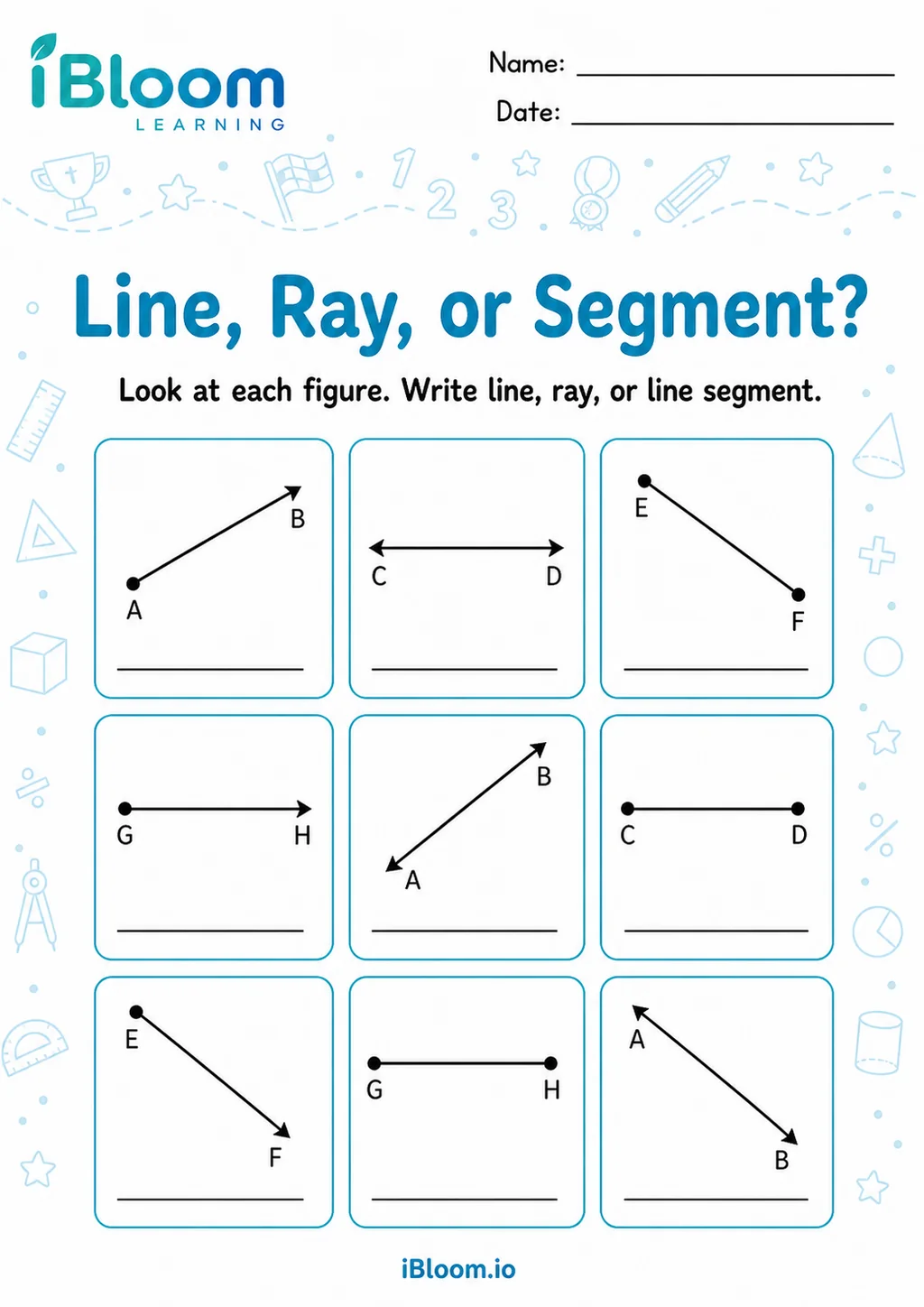 Line, Ray, or Segment?Classify labelled figures by checking their endpoints and arrowheads.Class 3Free PDF preview
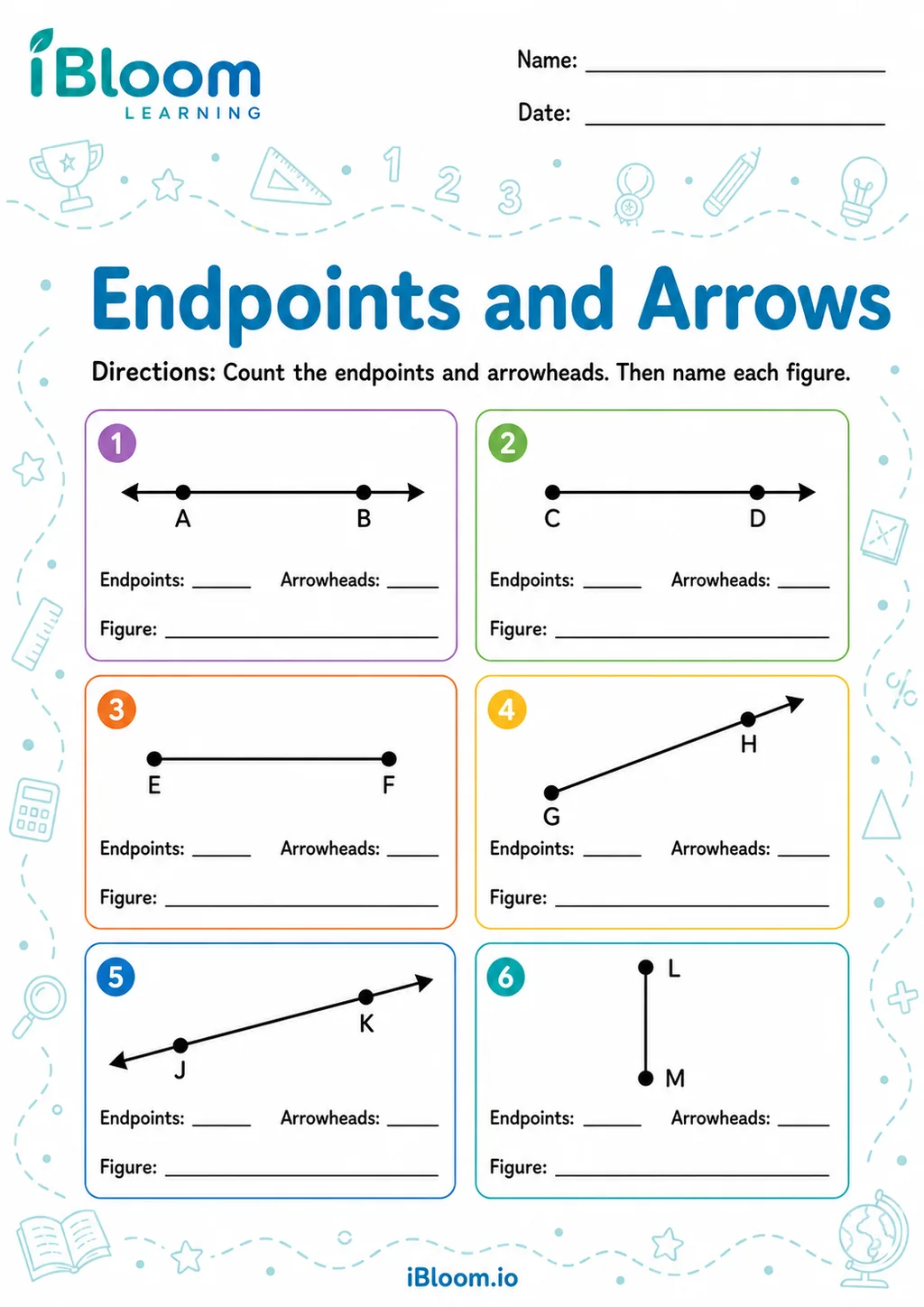 Endpoints and ArrowsCount the defining marks on six figures and name each one.Class 3Free PDF preview
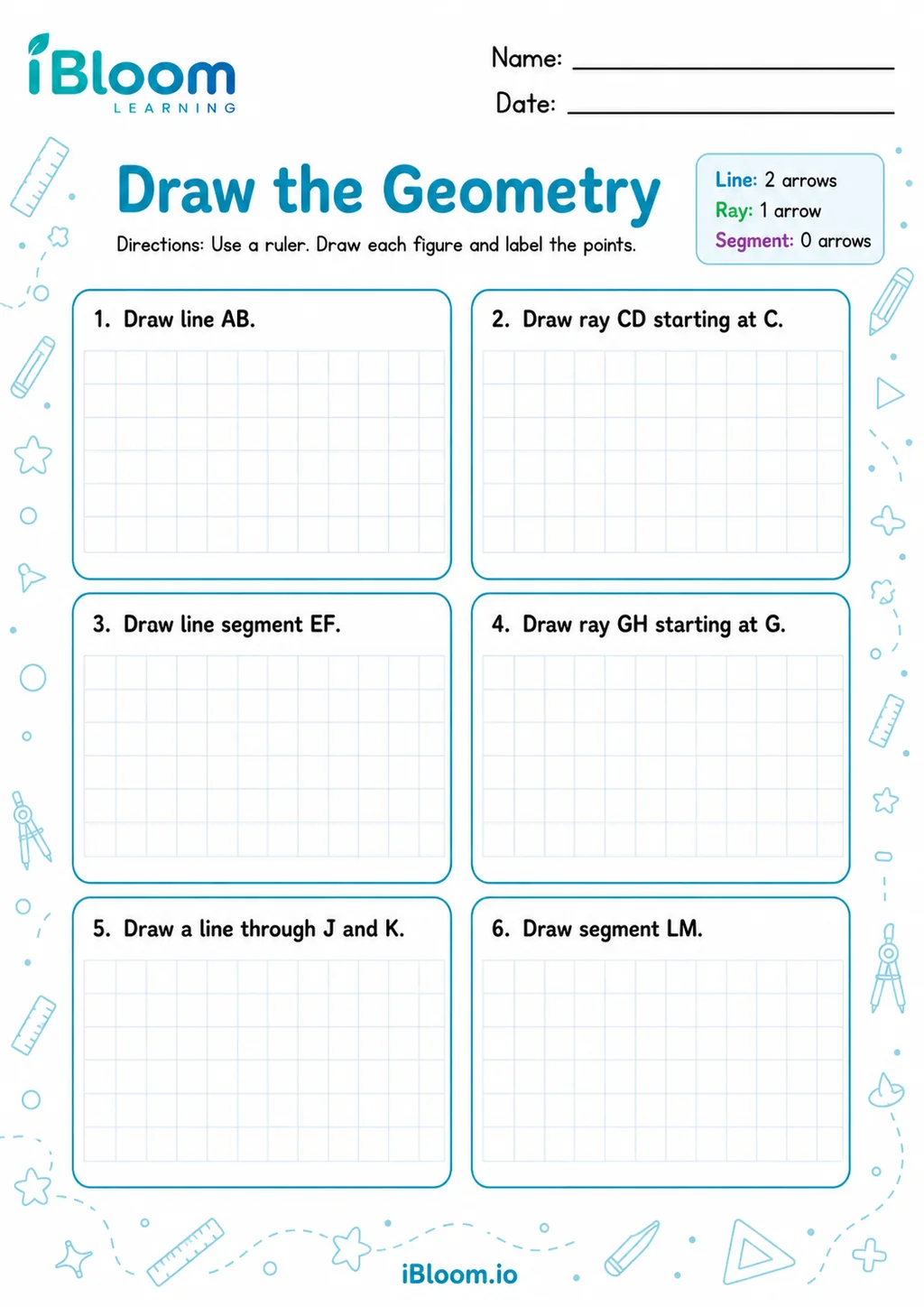 Draw the GeometryUse a ruler and grid space to draw labelled lines, rays, and segments.Class 3Free PDF preview
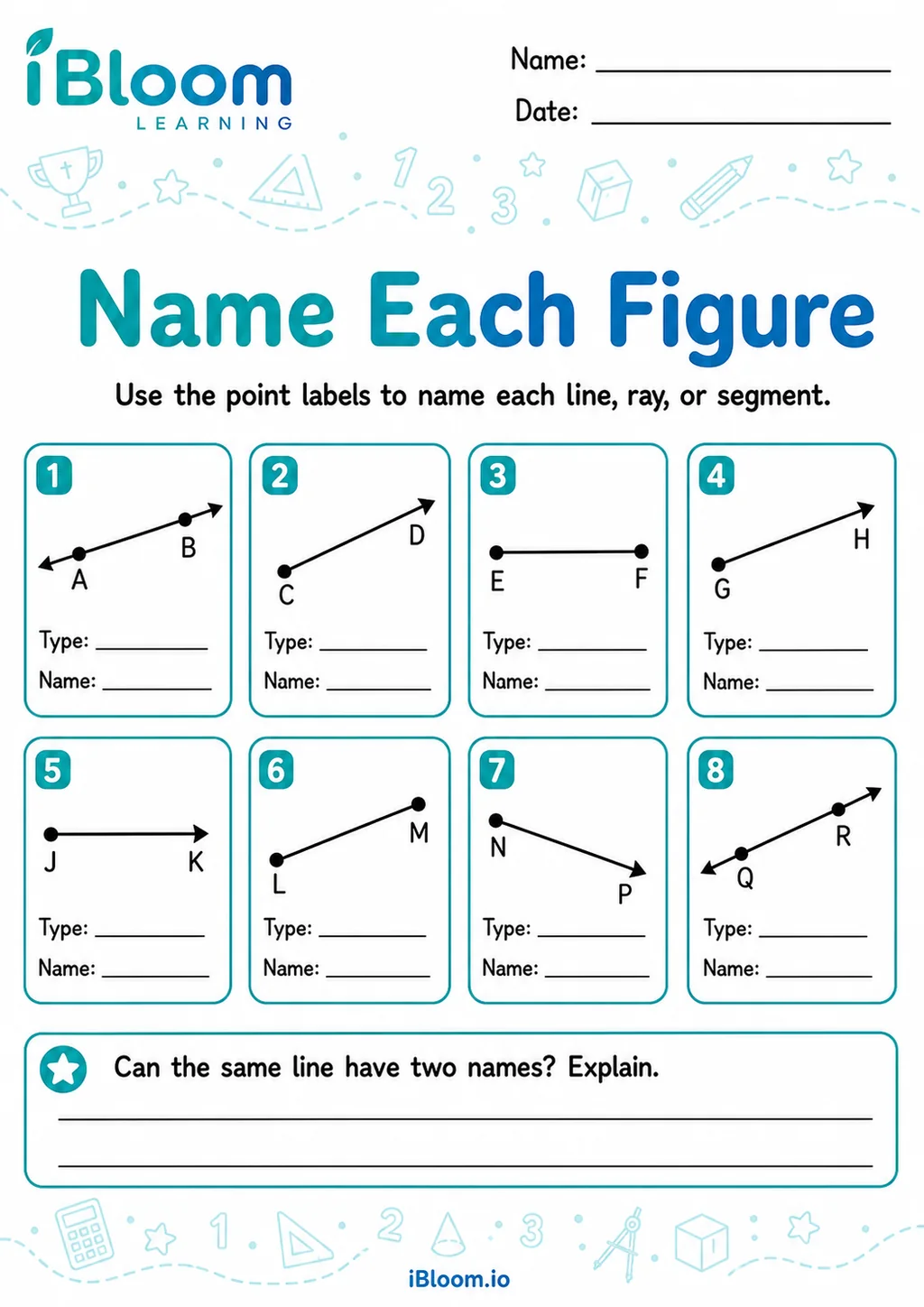 Name Each FigureName eight labelled figures and explain how order can name a line.Class 3Free PDF preview
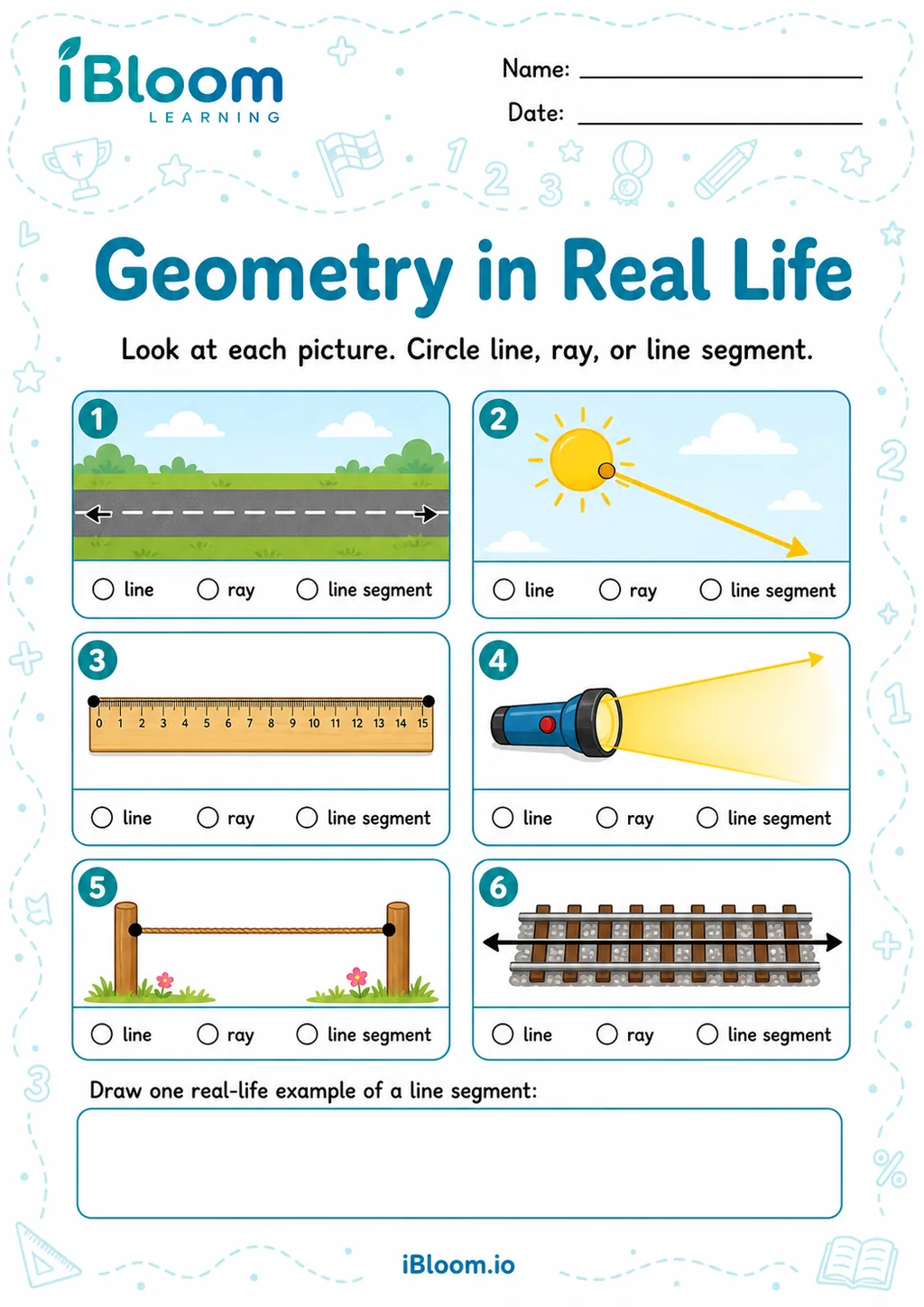 Geometry in Real LifeClassify roads, beams, edges, string, and tracks as lines, rays, or segments.Class 3Free PDF preview
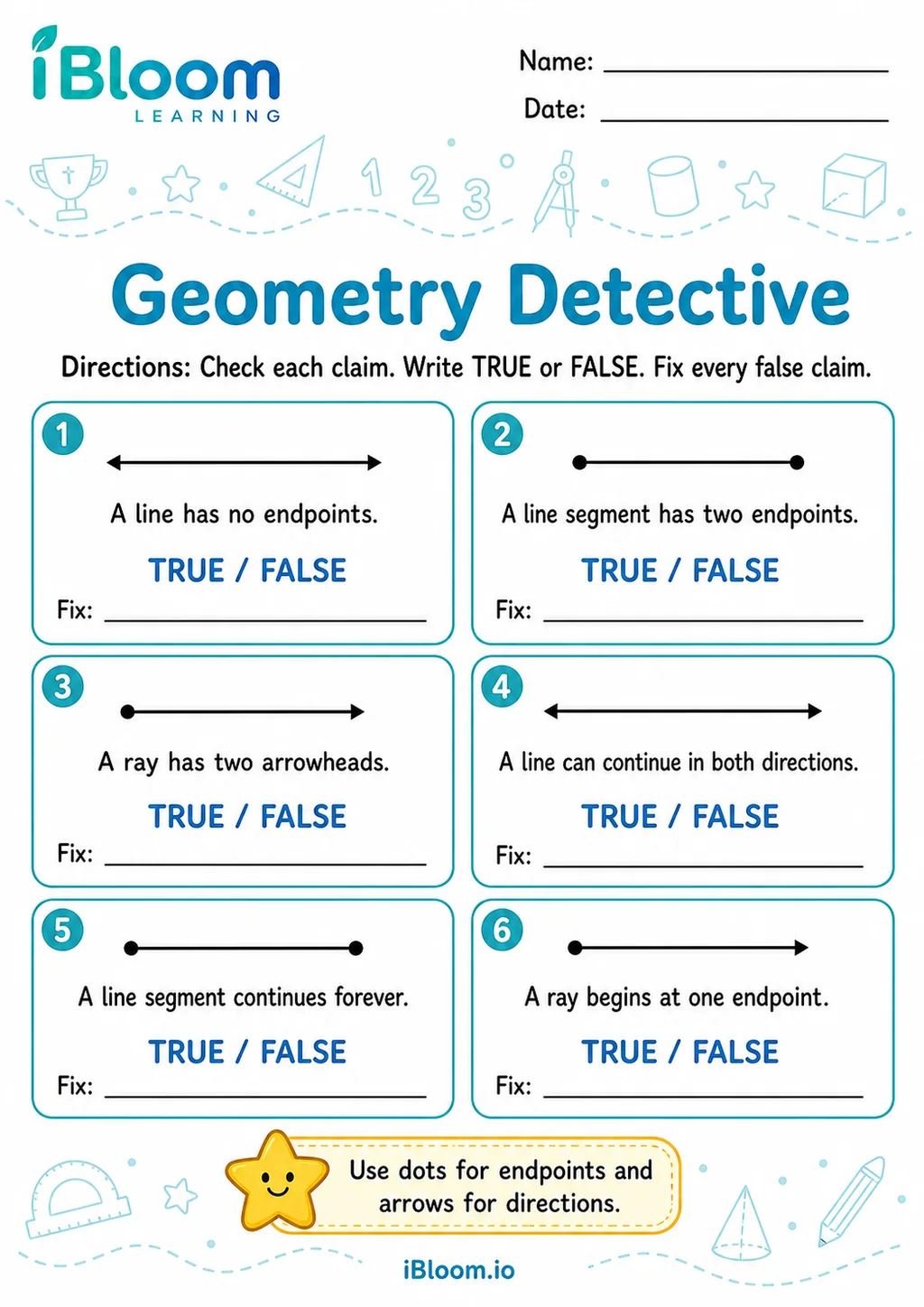 Geometry DetectiveDecide whether six claims are true or false and repair every misconception.Class 3Free PDF preview
Practice that builds confidence
Geometry ideas build step by step
These Class 3 maths geometry worksheets help children move from recognising shapes to describing them with correct vocabulary. They practise line segments, rays, parallel and perpendicular lines, right angles, measuring angles with a protractor, circles, triangles, polygons, quadrilaterals, congruent shapes and lines of symmetry.
The printable activities include identifying and classifying shapes, drawing and measuring angles, finding area and perimeter on rectangular grids, and solving rectangle area-perimeter tasks. Children also compare parallelograms, spot symmetrical shapes, and build confidence with perimeter rectangle questions.
Class 3 geometry becomes easier when children connect pictures, words and measurements. These worksheets move from naming basic figures to using terms such as line segment, ray, angle, right angle, parallel, perpendicular, polygon, circle, triangle, quadrilateral, parallelogram and congruent shapes. Children learn that a shape is not defined by its position on the page, but by its sides, corners and properties.

Shapes, angles, area and perimeter
The practice covers identifying quadrilaterals, sorting types of polygons, checking lines of symmetry, and classifying angles. Grid-based questions help children count unit squares for area rectangular grid tasks and count boundary units for perimeter rectangular grid tasks. Rectangle area, rectangle area-perimeter and perimeter rectangle work then connect the grid model to length and breadth. Protractor pages support measuring angles carefully instead of guessing.
A simple parent routine
At home, choose one sheet and one real object. Ask your child to trace a rectangle on a book cover, count its sides and corners, point to right angles, then measure or compare lengths if the task allows. For symmetry, fold a paper shape and check whether both sides match. For perimeter, let your child run a finger around the outside edge before adding side lengths.

Classroom uses for teachers
Teachers can use these printables for revision, maths centres, board follow-up, or small-group support. One group can sort polygons and quadrilaterals, another can work on parallel and perpendicular lines, while a third practises measuring angles. Completed sheets are useful for spotting whether a learner needs help with vocabulary, spatial reasoning or calculation.

Common errors to watch for
Children may count inside squares instead of boundary units for perimeter, or add only two sides of a rectangle. Some confuse area with perimeter, rays with line segments, and parallel lines with lines that simply look neat. While measuring angles, the most common slips are placing the protractor away from the vertex or reading the wrong scale.
Child-friendly strategy
Use the rule: name it, mark it, check it. Name the shape or line, mark sides, corners or equal parts, then check the property asked in the question.
Free printable PDF download
Use this class 3 geometry worksheet page to preview the activity, print it, or download it as a PDF for quick practice. It works well for homework, homeschool lessons, tutoring, morning work, revision, and classroom centers.
Answers and answer key support
After the child completes the worksheet independently, parents and teachers can use the answer support or answer key information to check the work, review mistakes, and choose the next practice step.
Why iBloom worksheets help
Each worksheet focuses on a clear geometry action: identify, classify, draw, measure, compare or calculate. The mix of visual diagrams, grids and short questions gives children repeated practice without making the page feel crowded.
Helpful answers
Frequently asked questions
What geometry skills are included in these Class 3 worksheets?
They cover shapes, polygons, triangles, quadrilaterals, parallelograms, circles, line segments, rays, parallel and perpendicular lines, right angles, angle classification, protractor use, symmetry, congruent shapes, area and perimeter.
Do these worksheets include area and perimeter practice?
Yes. Children practise counting unit squares for area on rectangular grids, counting boundary units for perimeter on grids, and solving rectangle area and perimeter questions using side lengths.
How can my child avoid mixing up area and perimeter?
Use a finger to trace the outside edge for perimeter, then shade the inside space for area. This physical difference helps children remember that perimeter is around and area is inside.
Are protractor activities suitable for Class 3 learners?
Yes, the worksheets introduce measuring angles in a supported way. Children practise placing the protractor at the vertex, aligning the baseline, and reading the correct scale.
Can these geometry worksheets be used for revision before tests?
Yes. The collection is useful for revising shape properties, angle vocabulary, symmetry, lines, and area-perimeter concepts because it combines identification, drawing, measuring and calculation.
Is this class 3 geometry worksheet free?
Yes. You can preview it for free and use the printable worksheet for home or classroom practice.
Can I download this class 3 geometry worksheet as a PDF?
Yes. Use the worksheet download option to save a printable PDF, or print the worksheet directly from the page.
Does this class 3 geometry worksheet include answers or an answer key?
When the activity has fixed answers, iBloom includes answer support so parents and teachers can check the completed worksheet.