Free printable practice
Improper Fractions To Mixed Numbers Practice Activities
Class 5 maths worksheets that help children convert improper fractions into mixed numbers using division, remainders, and fraction notation.
Free printable worksheet PDFs
Preview every available page, then download the free worksheet PDF for home, homeschool, tutoring, or classroom practice.
Preview the exact activity before downloading it.
 Improper Fractions To Mixed Numbers — Concept FoundationsConcept Foundations for improper fractions to mixed numbers in Class 5. Use division to find the whole number and remainder, then write each improper fraction as a mixed number.Class 5Free PDF preview
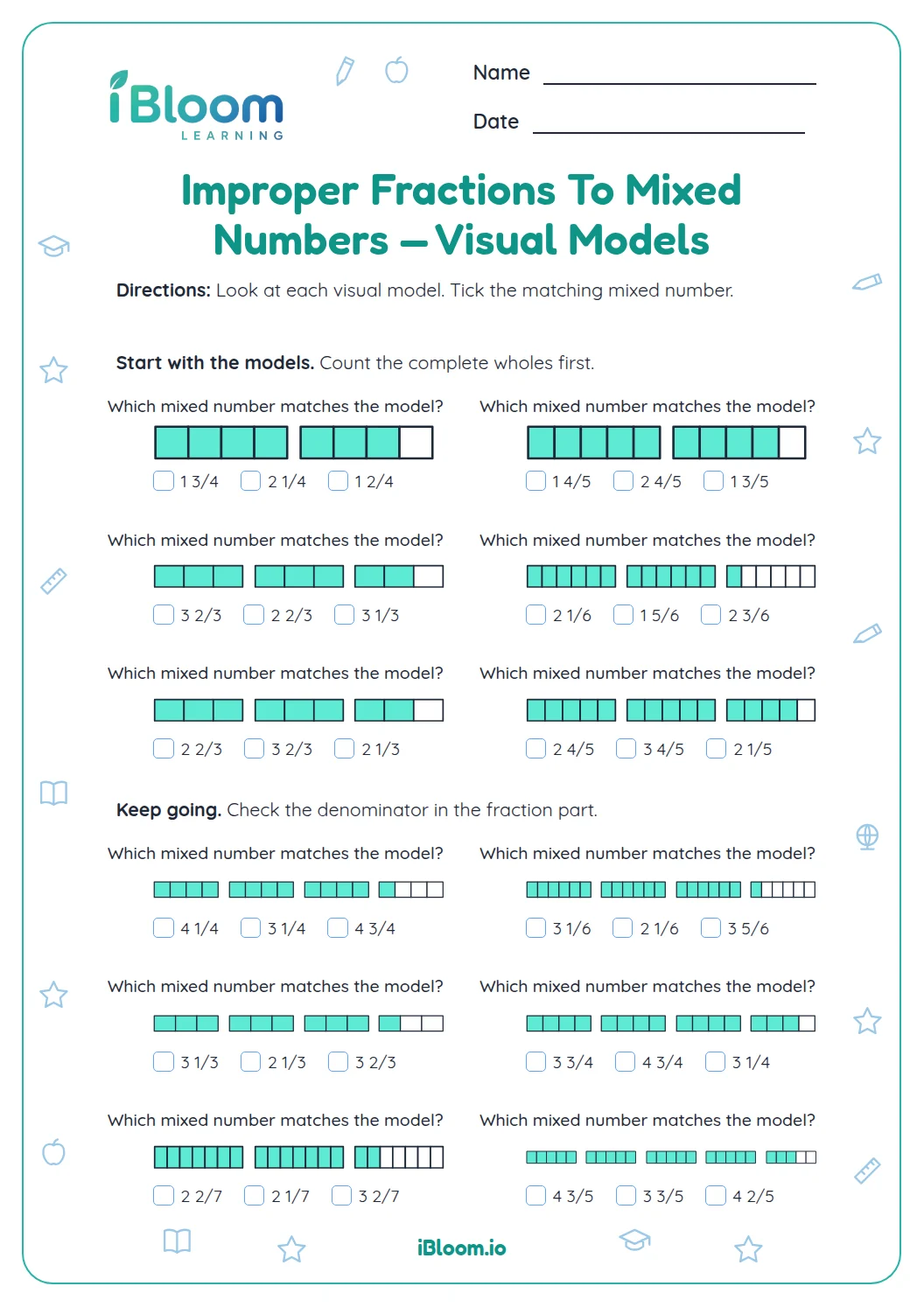 Improper Fractions To Mixed Numbers — Visual ModelsVisual Models for improper fractions to mixed numbers in Class 5. Look at each improper-fraction model and choose its matching mixed number.Class 5Free PDF preview
 Improper Fractions To Mixed Numbers — Guided PracticeGuided Practice for improper fractions to mixed numbers in Class 5. Use division facts, remainders, and fraction notation to complete guided steps for converting improper fractions into mixed numbers.Class 5Free PDF preview
 Improper Fractions To Mixed Numbers — Independent PracticeIndependent Practice for improper fractions to mixed numbers in Class 5. Convert each improper fraction into a mixed number by dividing the numerator by the denominator and using the remainder as the fraction numerator.Class 5Free PDF preview
 Improper Fractions To Mixed Numbers — Real-World ProblemsReal-World Problems for improper fractions to mixed numbers in Class 5. Convert each improper fraction in a real-world story into a mixed number using division and a remainder.Class 5Free PDF preview
 Improper Fractions To Mixed Numbers — Reasoning ChallengeReasoning Challenge for improper fractions to mixed numbers in Class 5. Solve division-based fraction conversions, explain remainders, and spot correct mixed-number reasoning.Class 5Free PDF preview
Practice that builds confidence
Understanding the conversion
These Class 5 maths practice activities focus on converting improper fractions to mixed numbers, a key skill in the Converting Fractions unit. Children practise seeing a fraction such as 17/5 as whole groups plus a remaining fractional part.
The printable worksheets include clear fraction problems where learners divide the numerator by the denominator, write the quotient as the whole number, and use the remainder as the new numerator. They build accuracy with notation, simplification awareness, and mathematical vocabulary.
An improper fraction has a numerator greater than or equal to its denominator, such as 9/4 or 12/5. To change it into a mixed number, children divide the numerator by the denominator. The quotient becomes the whole number, the remainder becomes the numerator, and the denominator stays the same: 17/5 = 3 remainder 2, so 17/5 = 3 2/5.

How the practice progresses
These worksheets support a steady movement from recognising improper fractions to completing independent conversions. Early questions may use friendly numbers where the whole part is easy to spot. Later items require careful division and correct placement of the remainder. Children also learn that a fraction like 15/5 becomes the whole number 3, with no leftover fractional part.
Parent routine at home
Ask your child to read each fraction aloud first: “seventeen fifths.” Then have them write a short division statement, such as 17 ÷ 5 = 3 r 2. Finally, they should say the mixed number aloud: “three and two-fifths.” This simple routine connects language, division, and fraction notation. If your child rushes, cover the answer space and ask, “How many full groups of the denominator fit into the numerator?”

Classroom uses for teachers
Teachers can use these pages for maths centres, morning revision, small-group support, or independent practice after modelling on the board. They also work well for quick checks before teaching the reverse skill of converting mixed numbers to improper fractions. Encourage pupils to annotate each problem with quotient and remainder so their thinking is visible.

Common errors to watch for
A frequent mistake is changing the denominator after division. In 22/6, the denominator remains 6, so the mixed number is 3 4/6, which may later be simplified to 3 2/3 if simplification is expected. Some children write the remainder as the denominator or forget that a zero remainder means a whole number only. Others confuse “greater than 1” with “wrong”; reinforce that improper fractions are valid and useful.
Free printable PDF download
Use this improper fractions to mixed numbers worksheets class 5 page to preview the activity, print it, or download it as a PDF for quick practice. It works well for homework, homeschool lessons, tutoring, morning work, revision, and classroom centers.
Answers and answer key support
After the child completes the worksheet independently, parents and teachers can use the answer support or answer key information to check the work, review mistakes, and choose the next practice step.
Why iBloom worksheets help
The activities give repeated, focused practice without distracting contexts, helping children concentrate on the structure of the conversion. A child-friendly strategy is: “Divide, keep, write” — divide the top by the bottom, keep the bottom number, and write the remainder on top of it. This supports both accuracy and confidence with mixed numbers.
Helpful answers
Frequently asked questions
What skill do these worksheets practise?
They practise converting improper fractions, such as 14/3 or 19/6, into mixed numbers by dividing the numerator by the denominator and using the remainder as the fractional part.
How should a Class 5 child convert an improper fraction to a mixed number?
They should divide the numerator by the denominator. The quotient is the whole number, the remainder is written as the new numerator, and the original denominator stays the same.
What happens if there is no remainder?
If the division has no remainder, the improper fraction converts to a whole number. For example, 20/5 becomes 4, not 4 0/5.
Do children need to simplify the mixed numbers?
The main focus is conversion. If a fractional part can be simplified, such as 4/6 to 2/3, teachers or parents can add that step depending on what the child is currently learning.
What common mistake should I look for while checking answers?
Watch that the denominator does not change. In 23/5, the answer is 4 3/5 because 23 ÷ 5 = 4 remainder 3; the denominator remains 5.
Is this improper fractions to mixed numbers worksheets class 5 free?
Yes. You can preview it for free and use the printable worksheet for home or classroom practice.
Can I download this improper fractions to mixed numbers worksheets class 5 as a PDF?
Yes. Use the worksheet download option to save a printable PDF, or print the worksheet directly from the page.
Does this improper fractions to mixed numbers worksheets class 5 include answers or an answer key?
When the activity has fixed answers, iBloom includes answer support so parents and teachers can check the completed worksheet.