Free printable practice
Exponents Practice Activities
Class 5 exponents worksheets for introducing powers, reading and writing exponent form, and understanding powers of ten.
Explore Exponents
Free printable worksheet PDFs
Preview every available page, then download the free worksheet PDF for home, homeschool, tutoring, or classroom practice.
Preview the exact activity before downloading it.
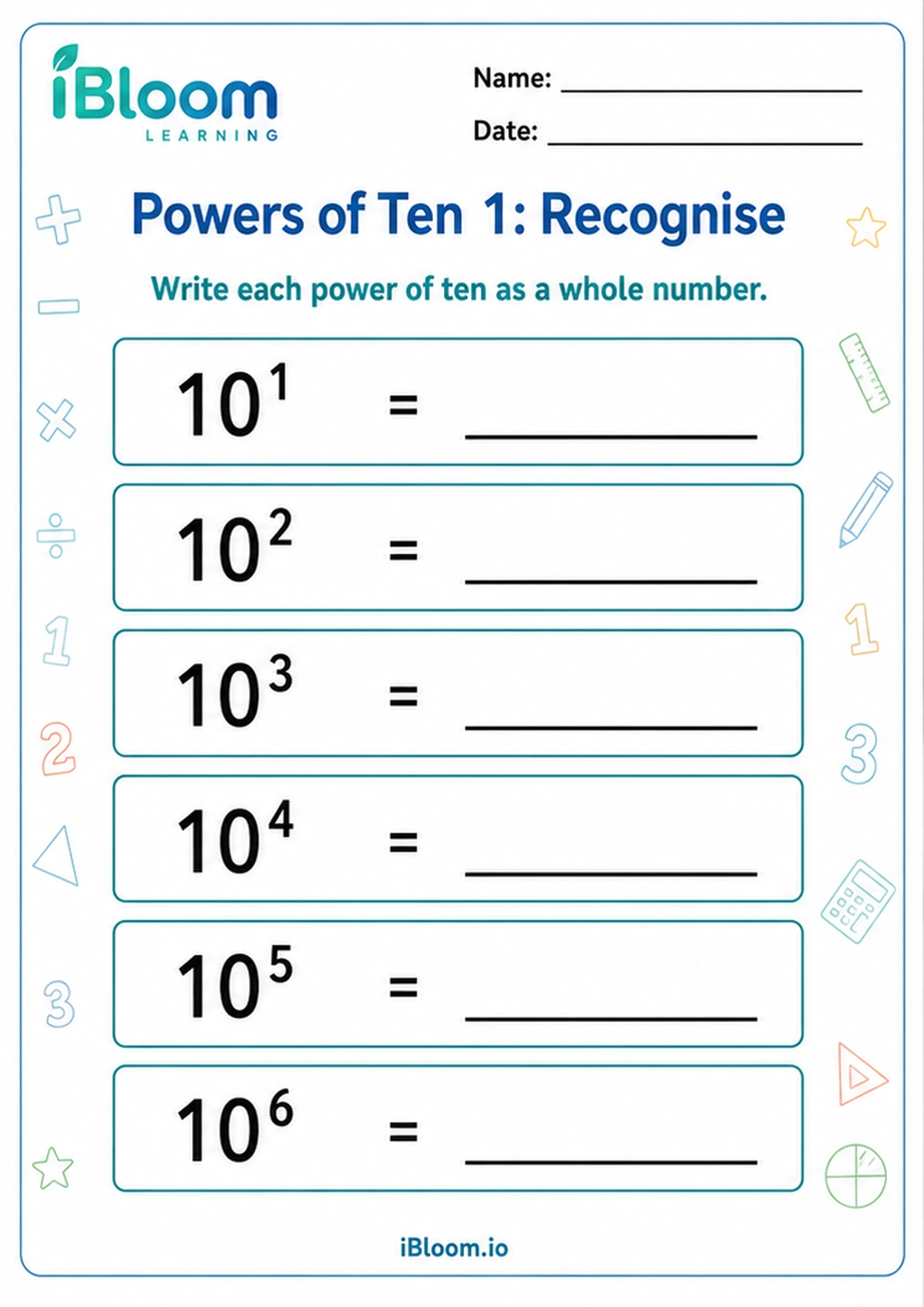 Powers of Ten 1: RecogniseClass 5 printable practice for Powers of Ten.Class 5Free PDF preview
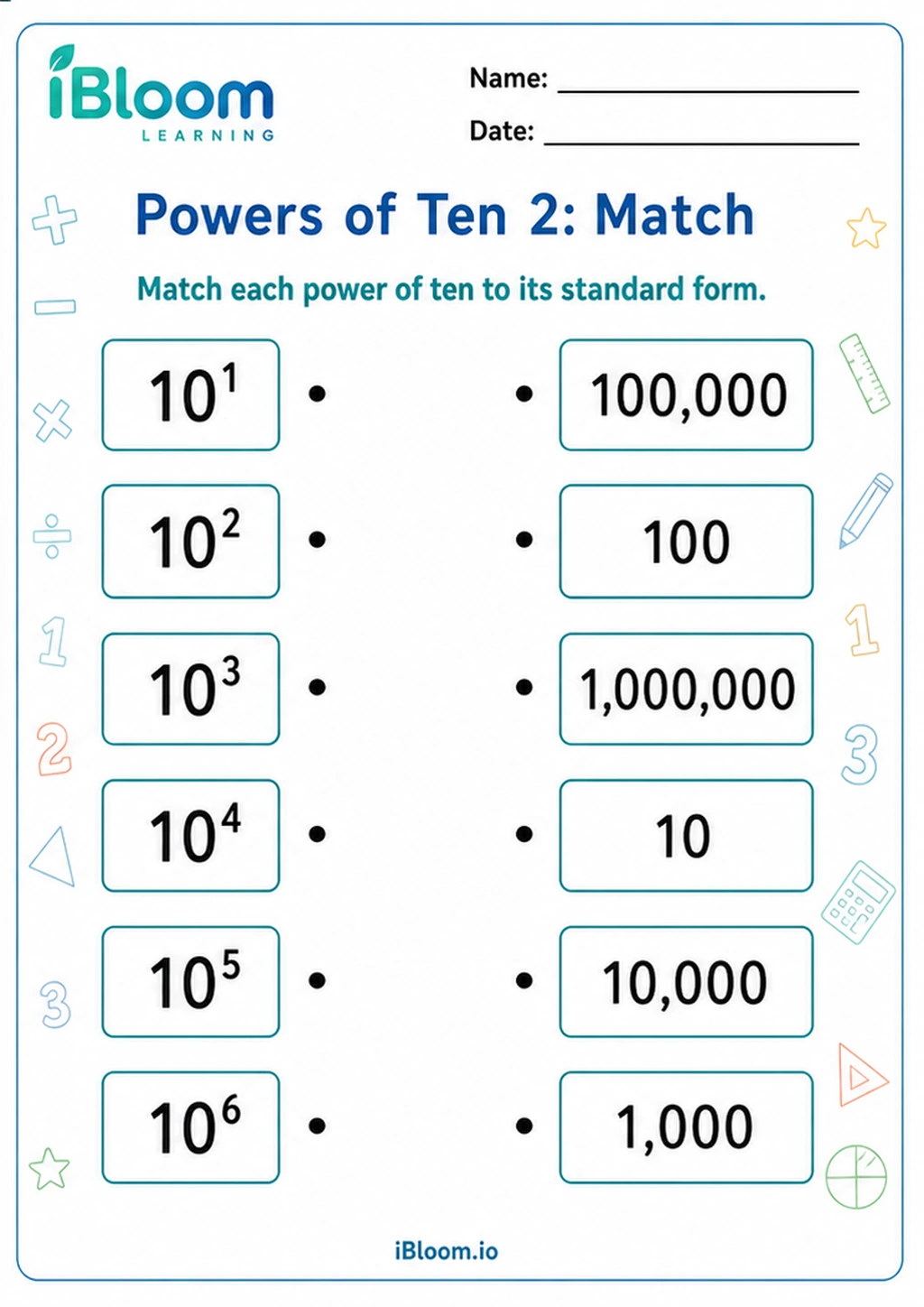 Powers of Ten 2: MatchClass 5 printable practice for Powers of Ten.Class 5Free PDF preview
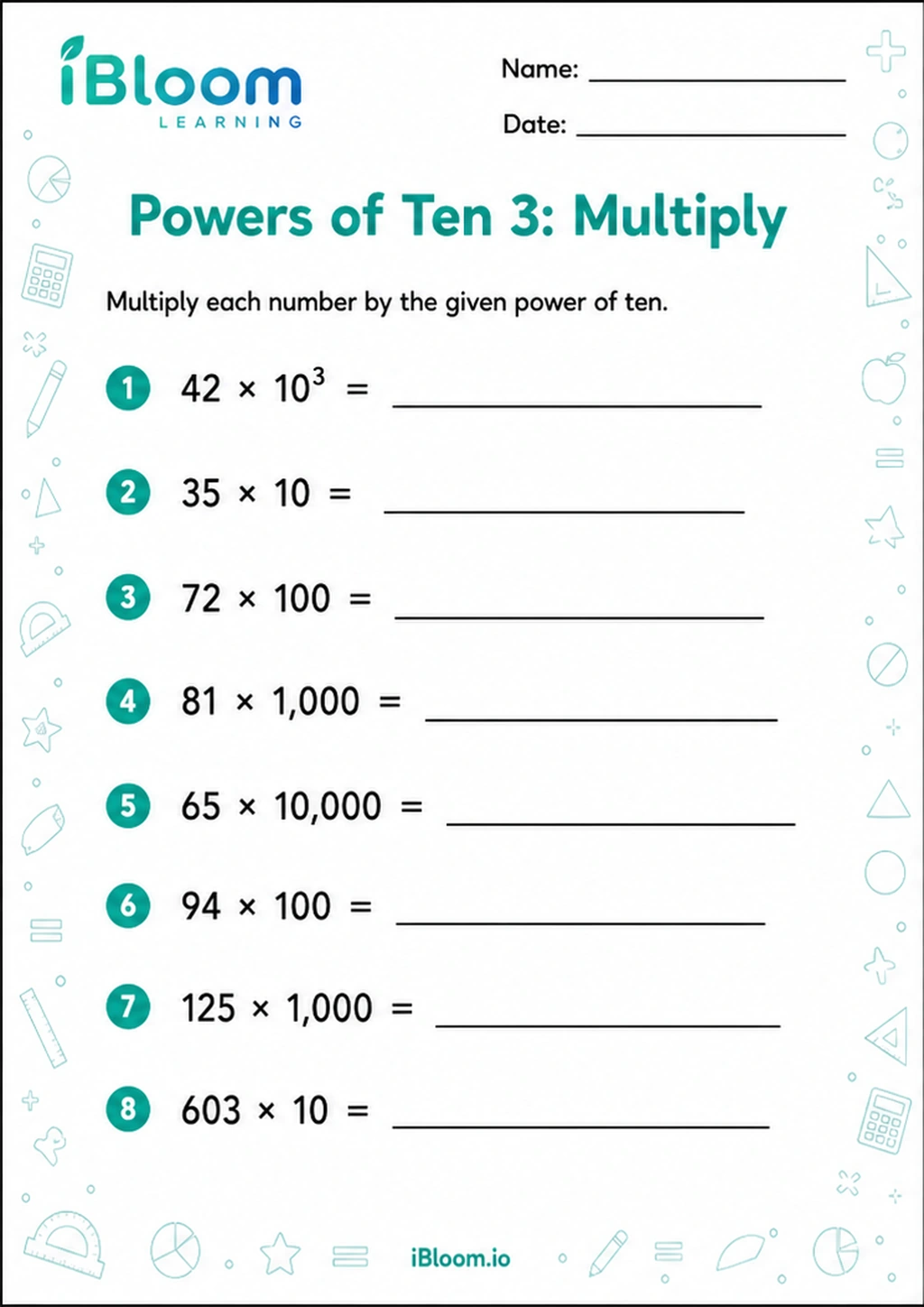 Powers of Ten 3: MultiplyClass 5 printable practice for Powers of Ten.Class 5Free PDF preview
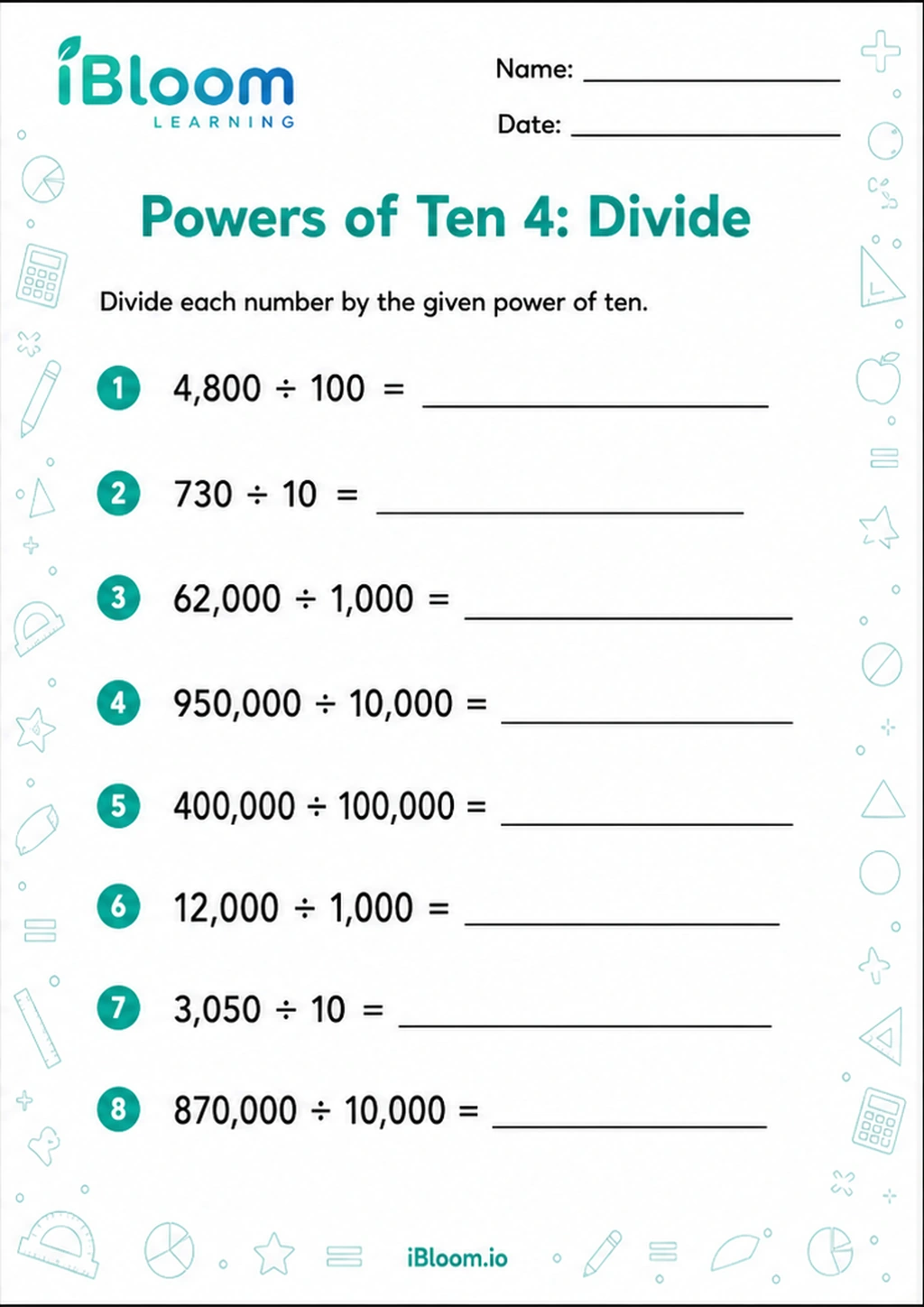 Powers of Ten 4: DivideClass 5 printable practice for Powers of Ten.Class 5Free PDF preview
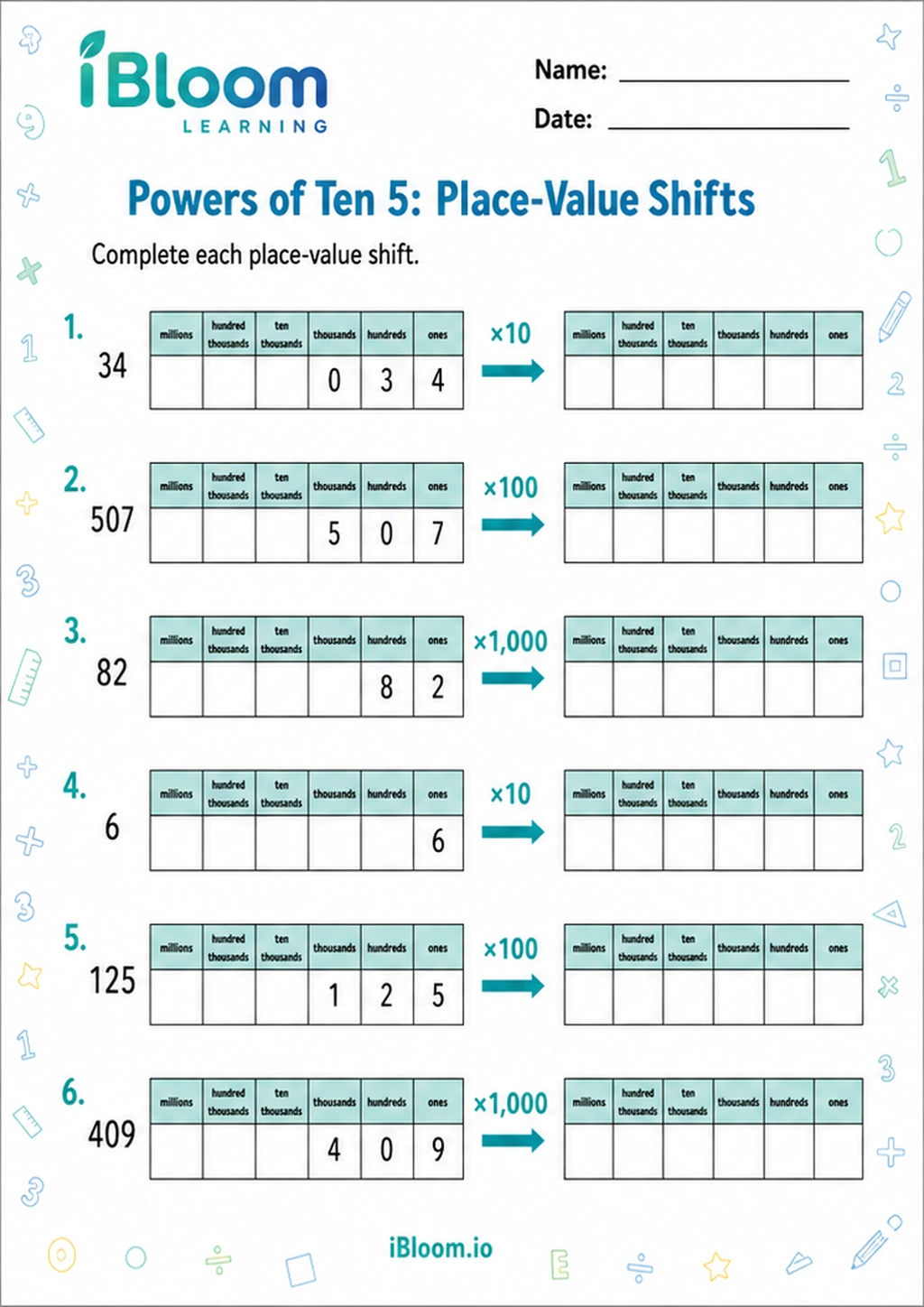 Powers of Ten 5: Place-Value ShiftsClass 5 printable practice for Powers of Ten.Class 5Free PDF preview
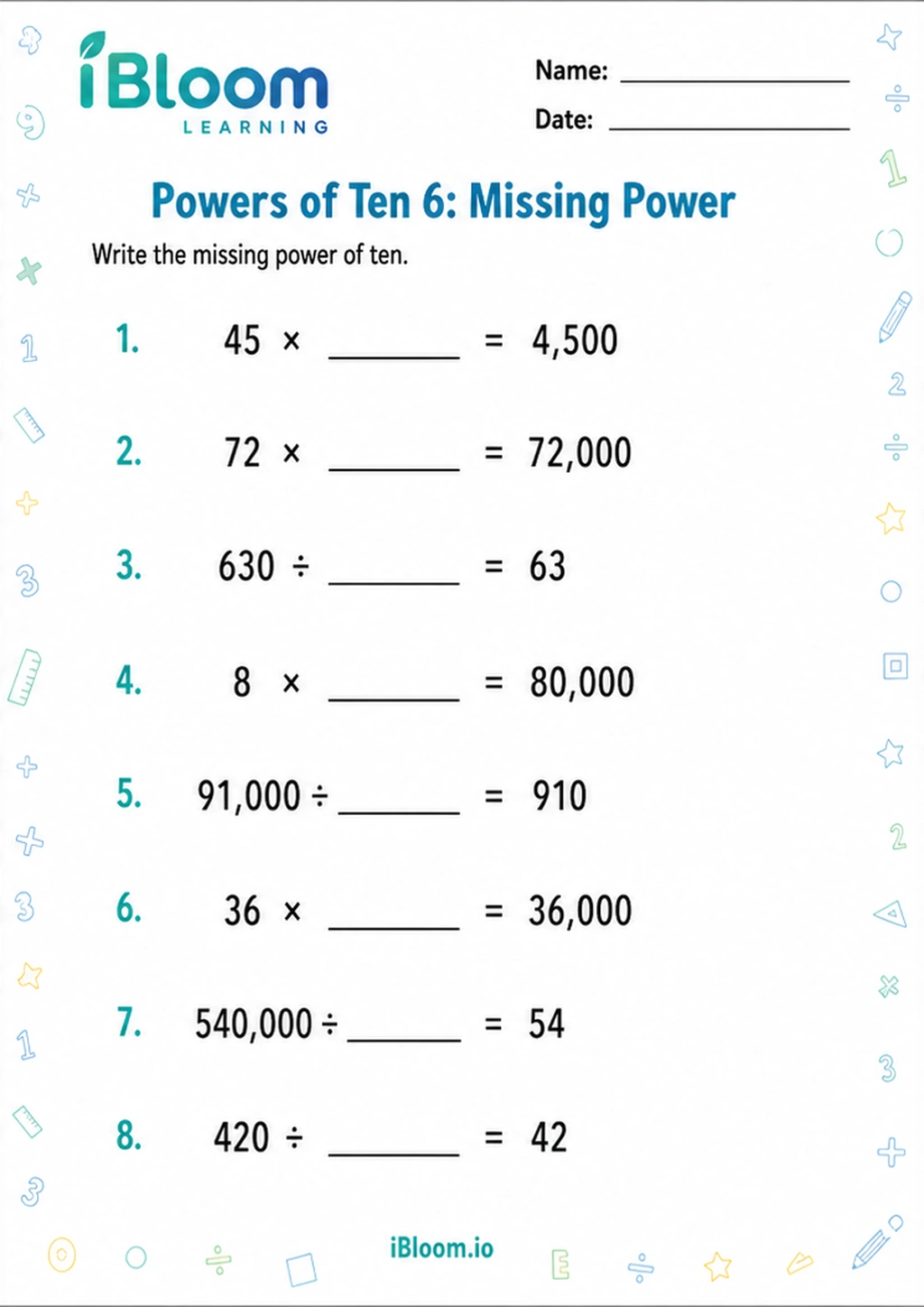 Powers of Ten 6: Missing PowerClass 5 printable practice for Powers of Ten.Class 5Free PDF preview
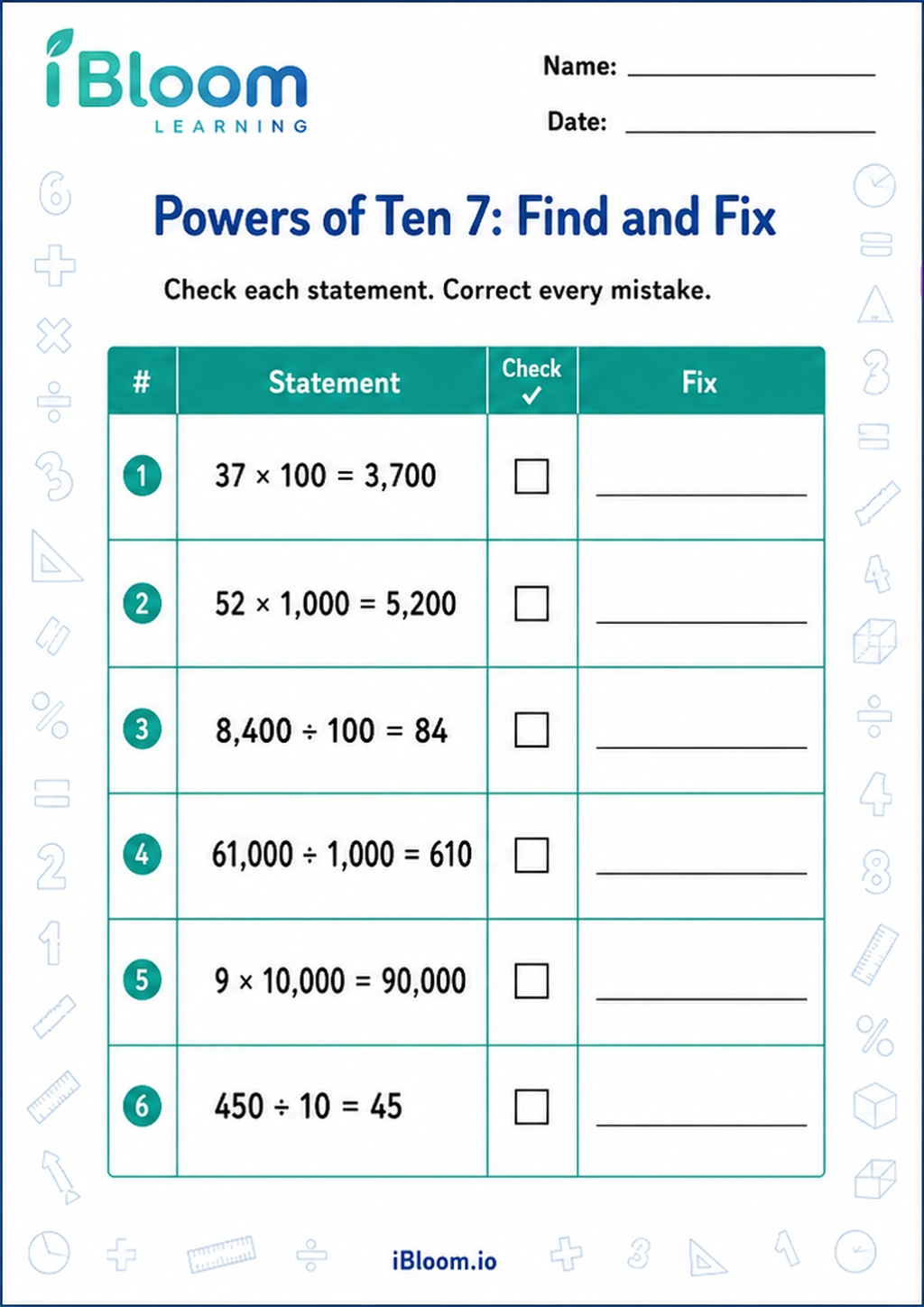 Powers of Ten 7: Find and FixClass 5 printable practice for Powers of Ten.Class 5Free PDF preview
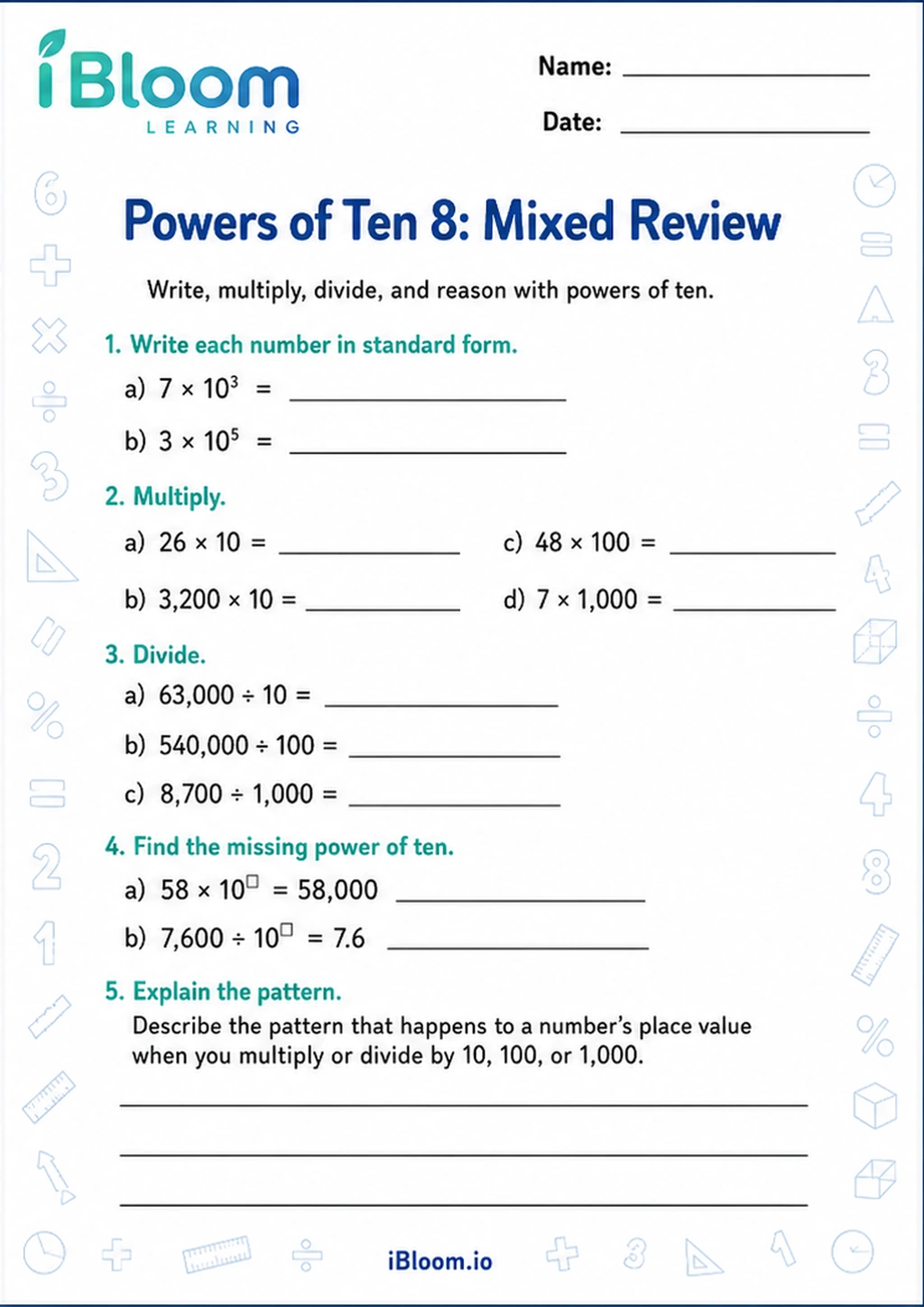 Powers of Ten 8: Mixed ReviewClass 5 printable practice for Powers of Ten.Class 5Free PDF preview
Practice that builds confidence
From multiplication to exponents
These Class 5 maths worksheets help children understand exponents as a short way to show repeated multiplication. They practise recognising the base and exponent, reading expressions such as 4³, and connecting powers to multiplication sentences.
The printable activities include introduction tasks, reading and writing powers, and focused practice with powers of ten. Children move from simple examples to clearer notation, helping them build confidence before larger calculations appear.
Exponents can feel new because the small raised number changes how an expression is read. These worksheets begin with the idea that 3⁴ means 3 × 3 × 3 × 3, not 3 × 4. Children identify the base as the number being multiplied and the exponent as the number of times it is used as a factor.

Reading powers aloud
Reading practice matters in Class 5 because children often know the answer but say the expression incorrectly. Activities ask them to read 5² as “five squared”, 2³ as “two cubed”, and other powers as “to the power of”. This builds the vocabulary needed for later maths discussions.
Writing powers accurately
Writing tasks help children translate between repeated multiplication and exponent form. For example, 7 × 7 × 7 becomes 7³. Learners also practise placing the exponent correctly above and to the right of the base, so the notation is neat and unambiguous.
Powers of ten and place value
Powers of ten connect exponents to place value. Children see that 10¹ is 10, 10² is 100, and 10³ is 1,000, then use this pattern to understand how zeros grow in a controlled way. This supports expanded form and mental calculation with large numbers.
A simple home routine
Ask your child to build one “power chain” each day: write a repeated multiplication sentence, change it into exponent form, read it aloud, then find the value if it is small enough. A helpful strategy is: “Base stays, exponent counts.” This short phrase reminds children not to multiply the base by the exponent.

Classroom use and common errors
Teachers can use the pages for warm-ups, maths centres, peer checking, or quick revision before work on larger numbers. Watch for common mistakes such as reading 6² as 12, writing the exponent on the line as 62, or counting the base as an extra factor. Encourage children to expand the power first when unsure.

Free printable PDF download
Use this Class 5 exponents worksheet page to preview the activity, print it, or download it as a PDF for quick practice. It works well for homework, homeschool lessons, tutoring, morning work, revision, and classroom centers.
Answers and answer key support
After the child completes the worksheet independently, parents and teachers can use the answer support or answer key information to check the work, review mistakes, and choose the next practice step.
Why iBloom worksheets help
The iBloom sequence separates introduction, reading, writing, and powers of ten so children are not asked to master everything at once. Clear spacing, varied question types, and repeated exposure to key vocabulary help learners form accurate habits with exponent notation.
Helpful answers
Frequently asked questions
What will my child learn in these Class 5 exponents worksheets?
Children learn that exponents show repeated multiplication. They practise identifying the base and exponent, reading powers correctly, writing repeated multiplication in exponent form, and recognising powers of ten.
How should a child read an expression like 4³?
4³ is read as “four cubed” or “four to the power of three”. It means 4 × 4 × 4, where 4 is the base and 3 is the exponent.
What is the most common mistake with exponents at this level?
A common mistake is multiplying the base by the exponent, such as thinking 5² means 5 × 2. Encourage children to expand it first: 5² means 5 × 5.
Why are powers of ten included with exponents?
Powers of ten help children connect exponents to place value. They show patterns such as 10¹ = 10, 10² = 100, and 10³ = 1,000, which supports understanding of large numbers.
Can these worksheets be used before teaching advanced exponent rules?
Yes. These pages focus on the foundation: meaning, reading, writing, and powers of ten. They do not require children to use advanced laws of exponents.
Is this Class 5 exponents worksheet free?
Yes. You can preview it for free and use the printable worksheet for home or classroom practice.
Can I download this Class 5 exponents worksheet as a PDF?
Yes. Use the worksheet download option to save a printable PDF, or print the worksheet directly from the page.
Does this Class 5 exponents worksheet include answers or an answer key?
When the activity has fixed answers, iBloom includes answer support so parents and teachers can check the completed worksheet.