Free printable practice
Prime Factor Trees Practice Activities
Class 5 maths worksheets that help children break composite numbers into prime factors using clear factor tree steps.
Free printable worksheet PDFs
Preview every available page, then download the free worksheet PDF for home, homeschool, tutoring, or classroom practice.
Preview the exact activity before downloading it.
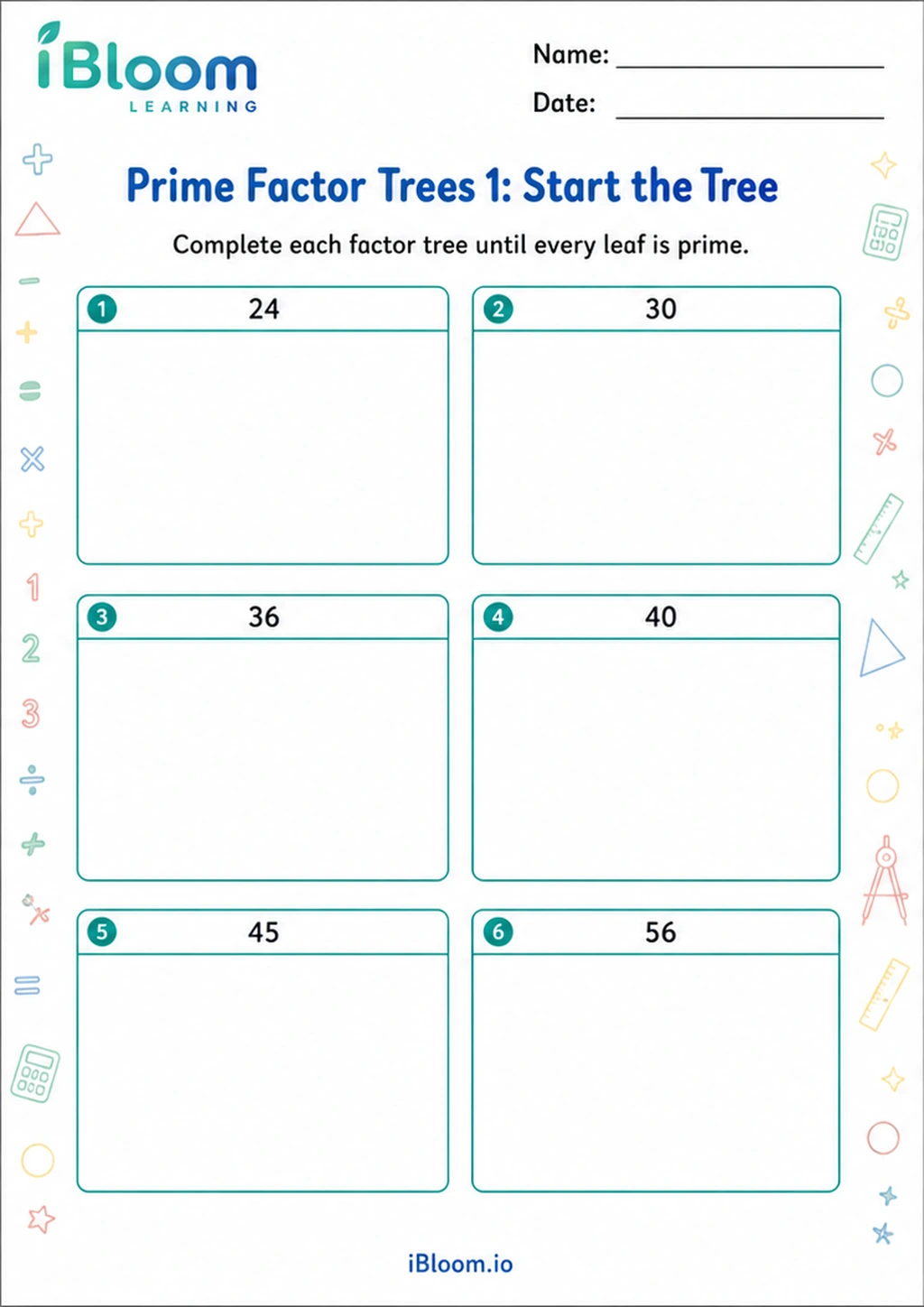 Prime Factor Trees 1: Start the TreeClass 5 printable practice for Prime Factor Trees.Class 5Free PDF preview
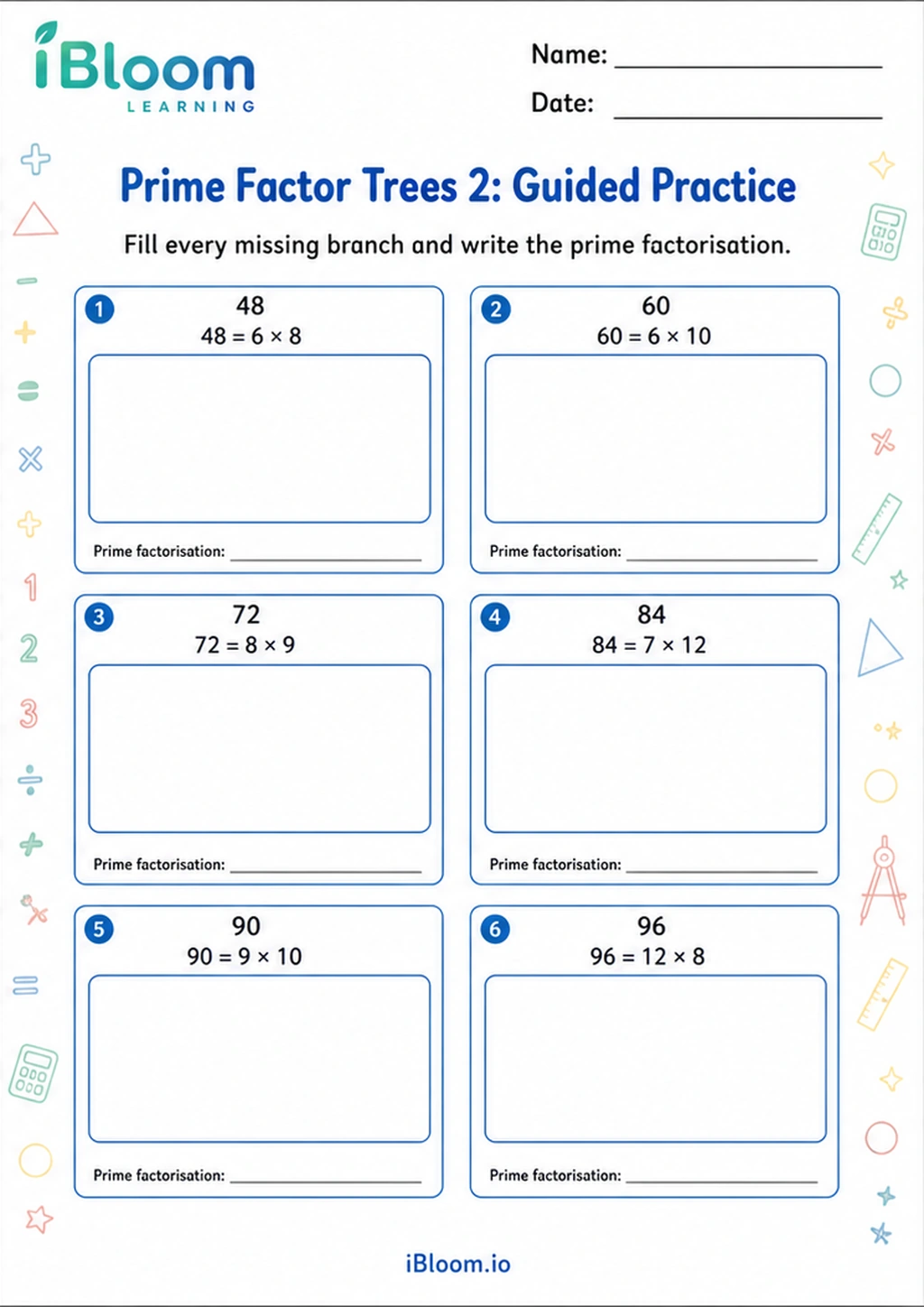 Prime Factor Trees 2: Guided PracticeClass 5 printable practice for Prime Factor Trees.Class 5Free PDF preview
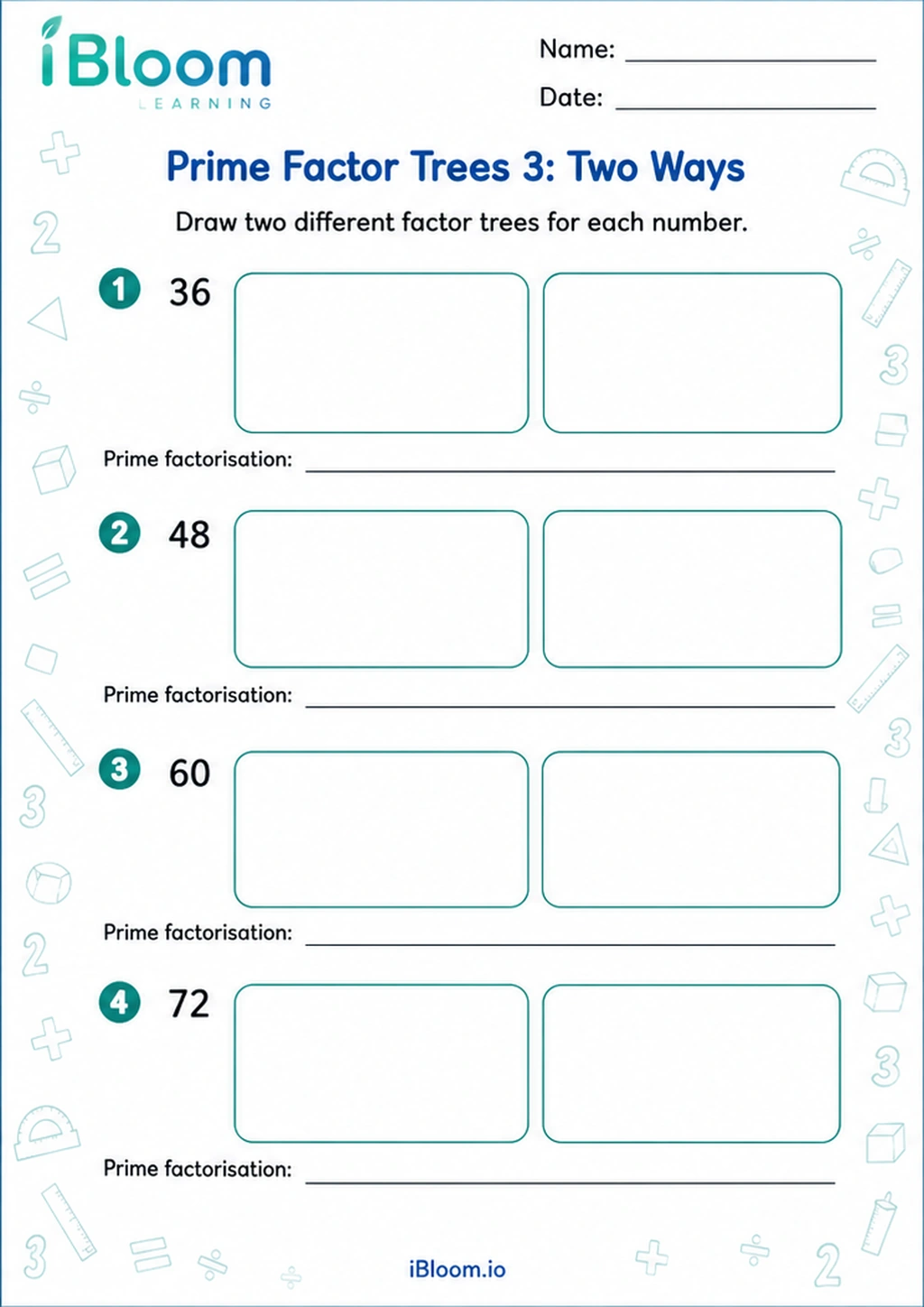 Prime Factor Trees 3: Two WaysClass 5 printable practice for Prime Factor Trees.Class 5Free PDF preview
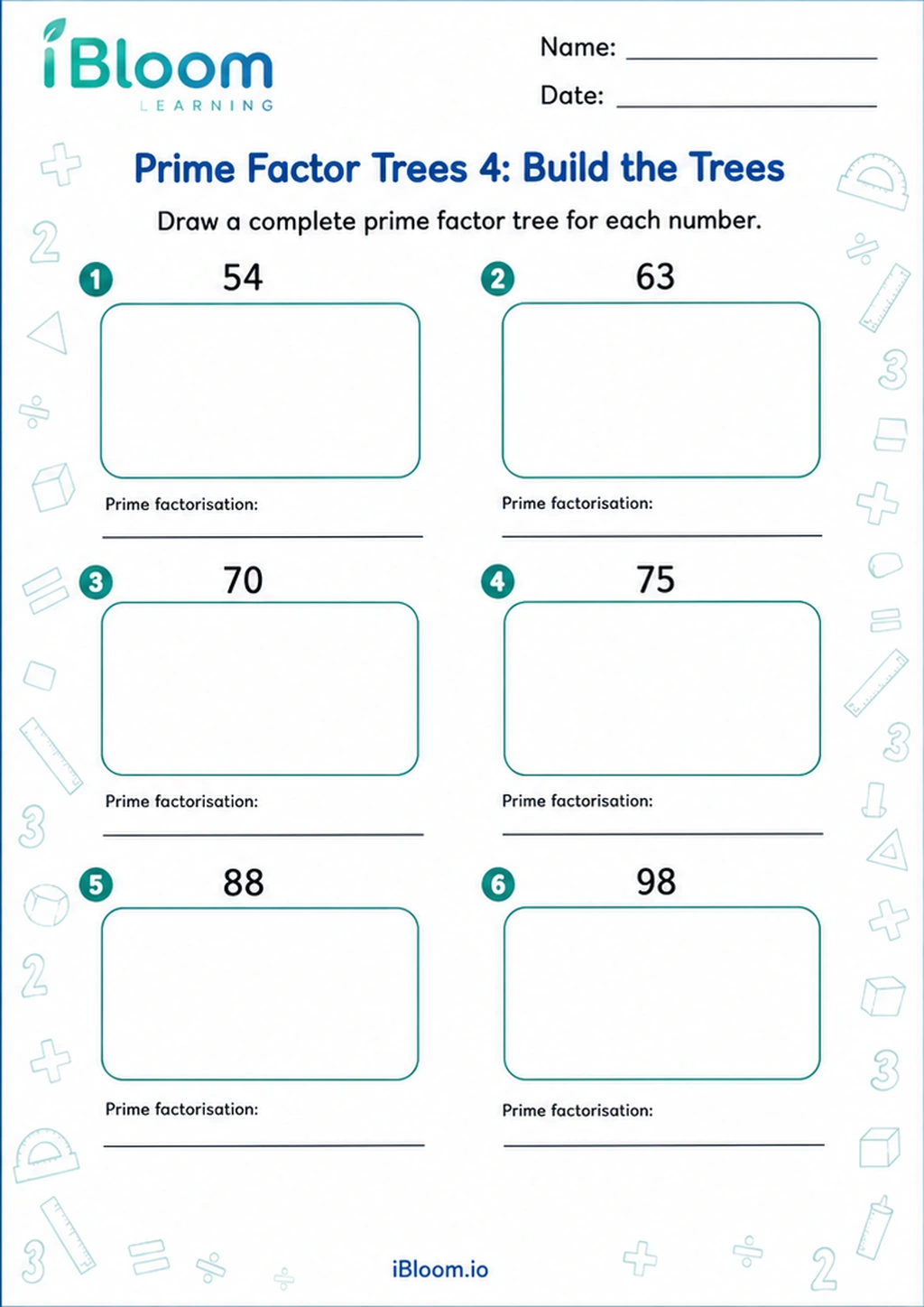 Prime Factor Trees 4: Build the TreesClass 5 printable practice for Prime Factor Trees.Class 5Free PDF preview
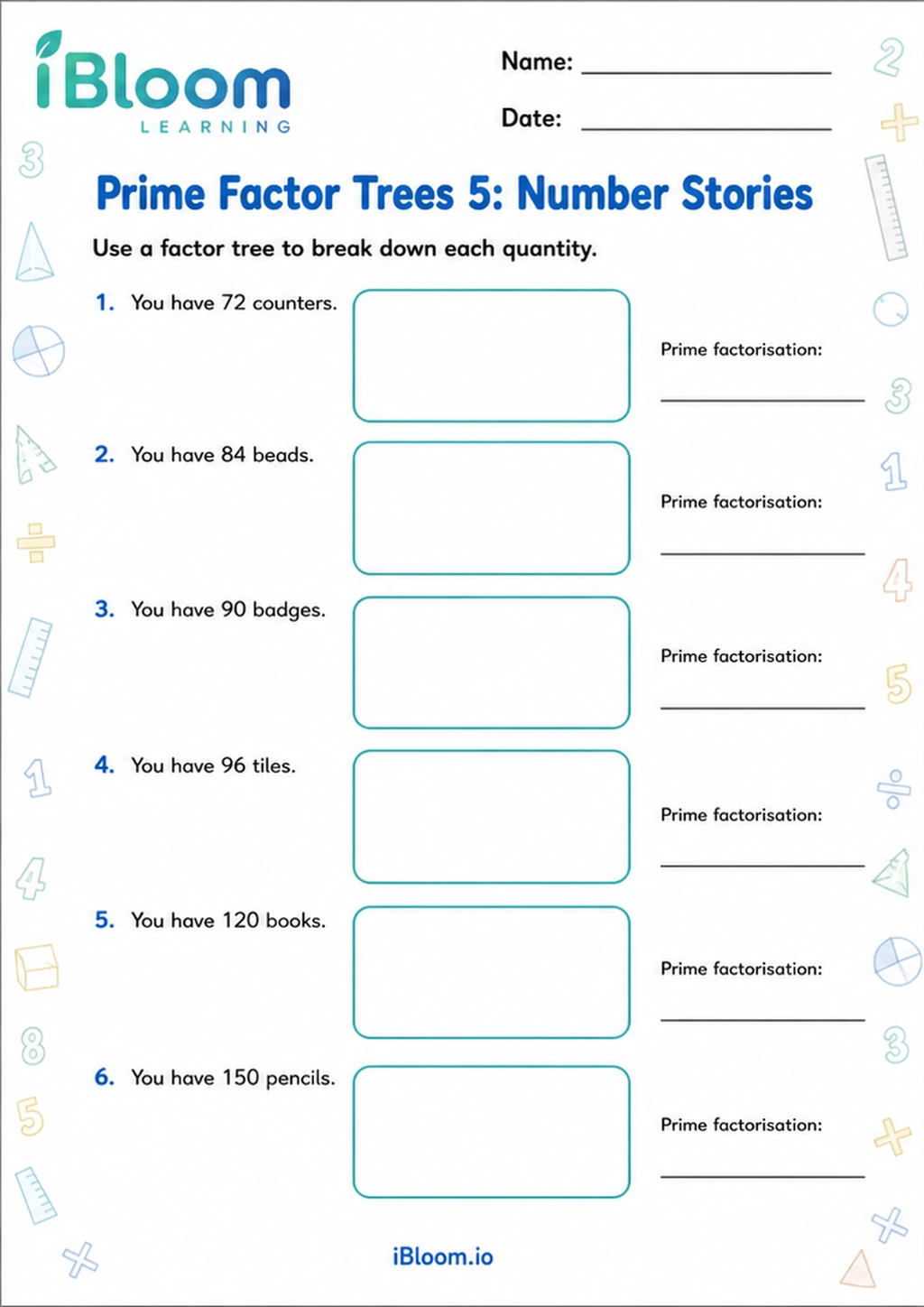 Prime Factor Trees 5: Number StoriesClass 5 printable practice for Prime Factor Trees.Class 5Free PDF preview
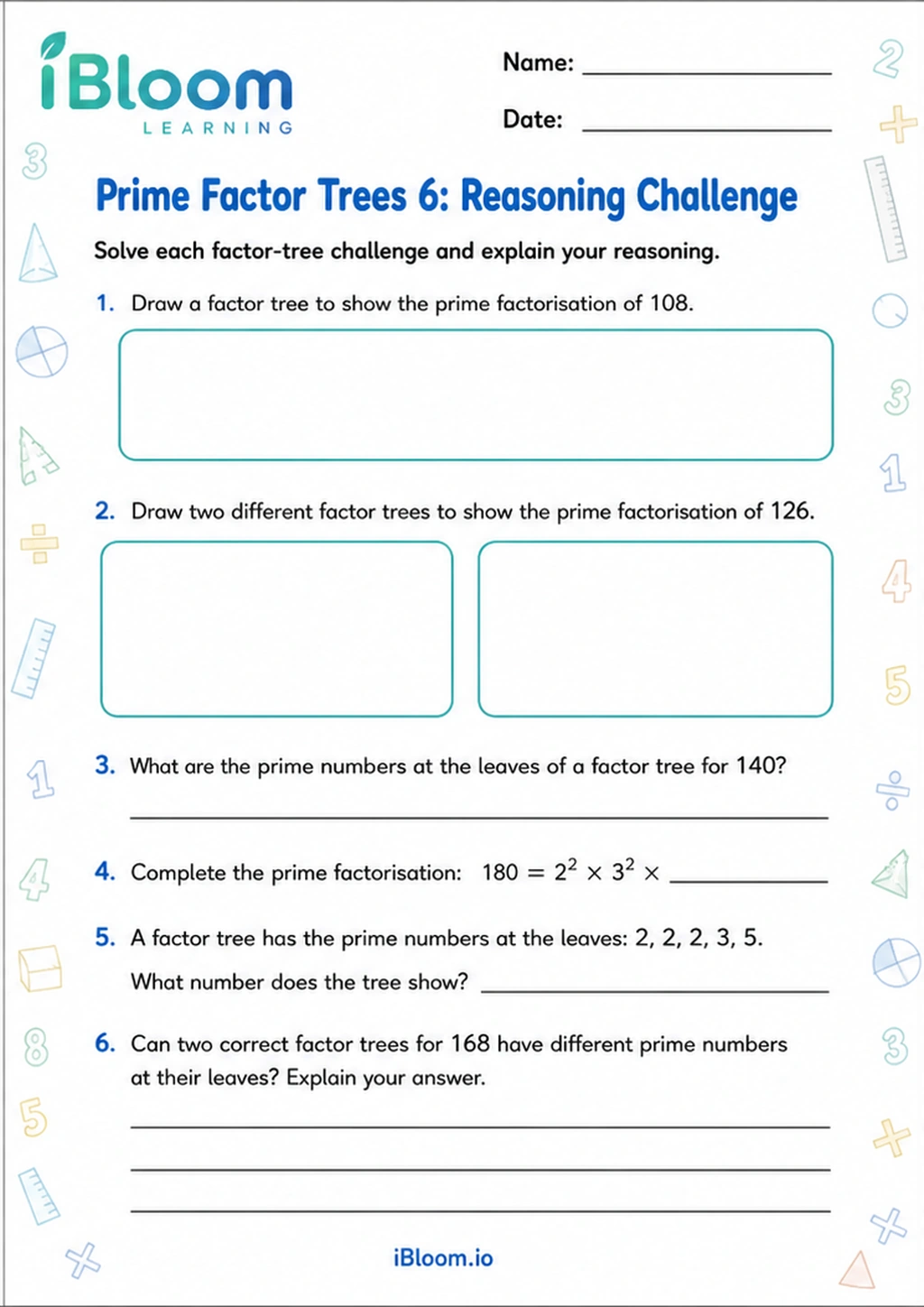 Prime Factor Trees 6: Reasoning ChallengeClass 5 printable practice for Prime Factor Trees.Class 5Free PDF preview
Practice that builds confidence
What children learn
These Class 5 maths worksheets focus on prime factor trees within the Factoring unit. Children practise splitting composite numbers into factor pairs, continuing until every branch ends in a prime number.
The printable activities include guided trees, partly completed trees, and independent practice where pupils write the final prime factorisation. They build accuracy with multiplication facts, divisibility thinking, and prime versus composite numbers.
Prime factor trees show that a composite number can be broken into smaller factors until only prime numbers remain. In these worksheets, children start with a number, choose a factor pair, and keep branching any composite factor. For example, a child may split 36 into 4 × 9, then 4 into 2 × 2 and 9 into 3 × 3, giving 2 × 2 × 3 × 3.

Progression in the practice
The activities move from supported work to independent factorisation. Early questions may show the first split or leave blanks in a tree. Later questions ask pupils to choose their own factor pairs and write the complete product of primes. This helps them see that different trees for the same number still finish with the same prime factors.
Parent routine at home
Choose one number from the worksheet and ask your child to say two factors aloud before writing. After each split, ask, “Is this number prime or can it break again?” Keep a small multiplication table or rough-work space nearby. At the end, let your child multiply the leaf numbers to check that they return to the original number.

Classroom uses for teachers
Teachers can use these sheets during Class 5 maths practice, revision of factors, or small-group support. A useful board activity is to give different groups the same composite number and compare their trees. This shows why order may change but the final prime factorisation must match.

Common errors to watch for
Children often stop too early at a composite number such as 4, 6, 8, 9, or 10. Some write 1 as a prime factor, which should be corrected because 1 is not prime. Others copy a branch twice or forget one leaf number when writing the final answer.
Free printable PDF download
Use this class 5 prime factor trees worksheet page to preview the activity, print it, or download it as a PDF for quick practice. It works well for homework, homeschool lessons, tutoring, morning work, revision, and classroom centers.
Answers and answer key support
After the child completes the worksheet independently, parents and teachers can use the answer support or answer key information to check the work, review mistakes, and choose the next practice step.
Why iBloom worksheets help
The layouts give enough space for branches, factor pairs, and final answers, so pupils can follow their own reasoning. A child-friendly strategy is: “Split, check, circle primes, then multiply back.” This keeps the process clear and makes prime factor trees a reliable way to understand factoring.
Helpful answers
Frequently asked questions
What is a prime factor tree?
A prime factor tree is a branching diagram that breaks a composite number into factor pairs until every final number is prime.
Are these worksheets suitable for Class 5 maths revision?
Yes. They are designed for the Class 5 factoring topic and help pupils revise factors, primes, composites, and prime factorisation.
Can a number have more than one correct factor tree?
Yes. Children may begin with different factor pairs, but the final prime factors should be the same when the tree is completed correctly.
What mistake should my child avoid in prime factor trees?
The most common mistake is stopping at a composite number. Every branch must continue until it ends in prime numbers only.
How can children check their final prime factorisation?
They can multiply all the prime factors at the ends of the branches. The product should equal the original number at the top of the tree.
Is this class 5 prime factor trees worksheet free?
Yes. You can preview it for free and use the printable worksheet for home or classroom practice.
Can I download this class 5 prime factor trees worksheet as a PDF?
Yes. Use the worksheet download option to save a printable PDF, or print the worksheet directly from the page.
Does this class 5 prime factor trees worksheet include answers or an answer key?
When the activity has fixed answers, iBloom includes answer support so parents and teachers can check the completed worksheet.