Free printable practice
Distributive Property Practice Activities
Printable Class 5 maths activities that help children use the distributive property to break multiplication and division into easier parts.
Free printable worksheet PDFs
Preview every available page, then download the free worksheet PDF for home, homeschool, tutoring, or classroom practice.
Preview the exact activity before downloading it.
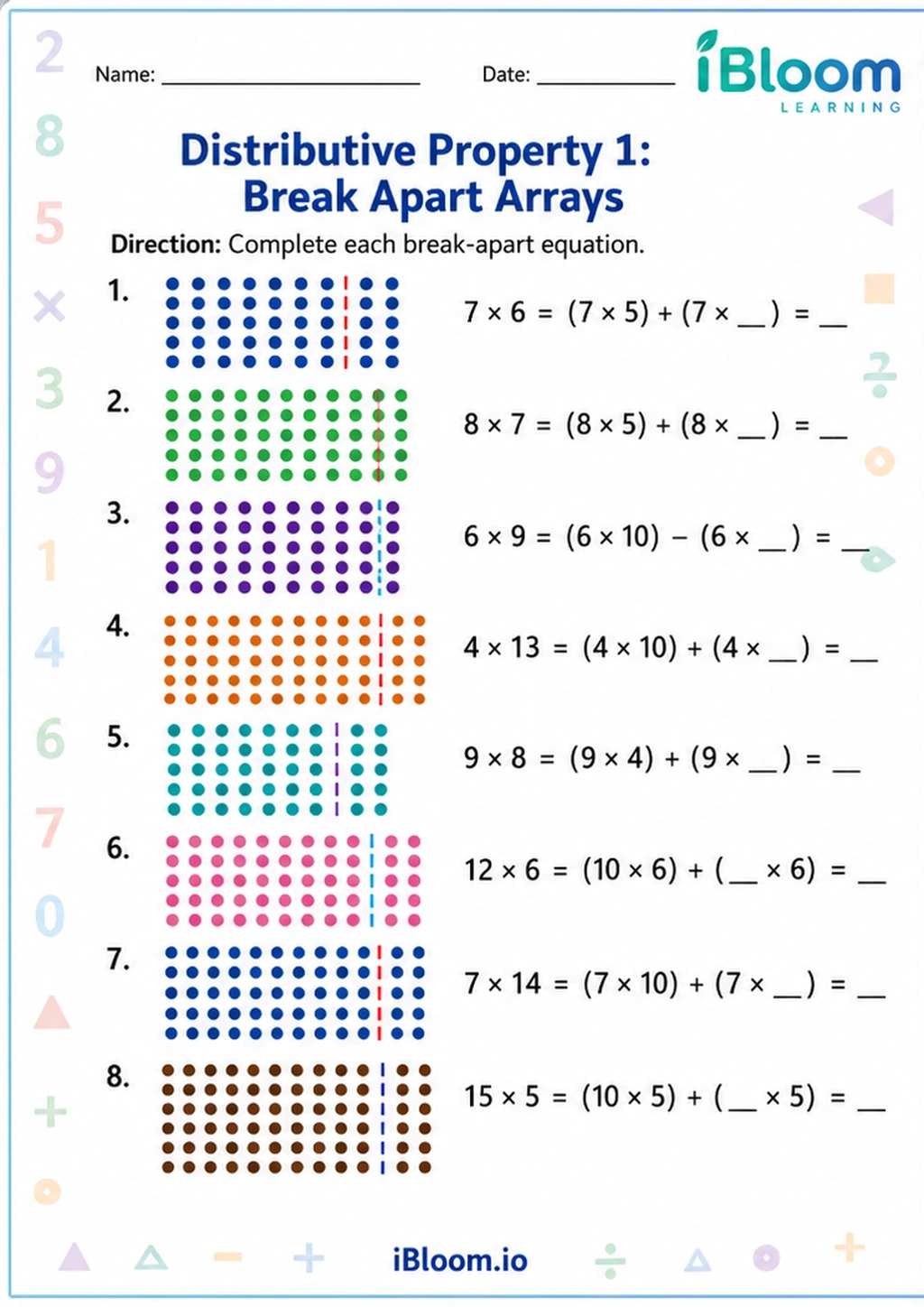 Distributive Property 1: Break Apart ArraysClass 5 printable practice for distributive property with a clear, age-appropriate learning task.Class 5Free PDF preview
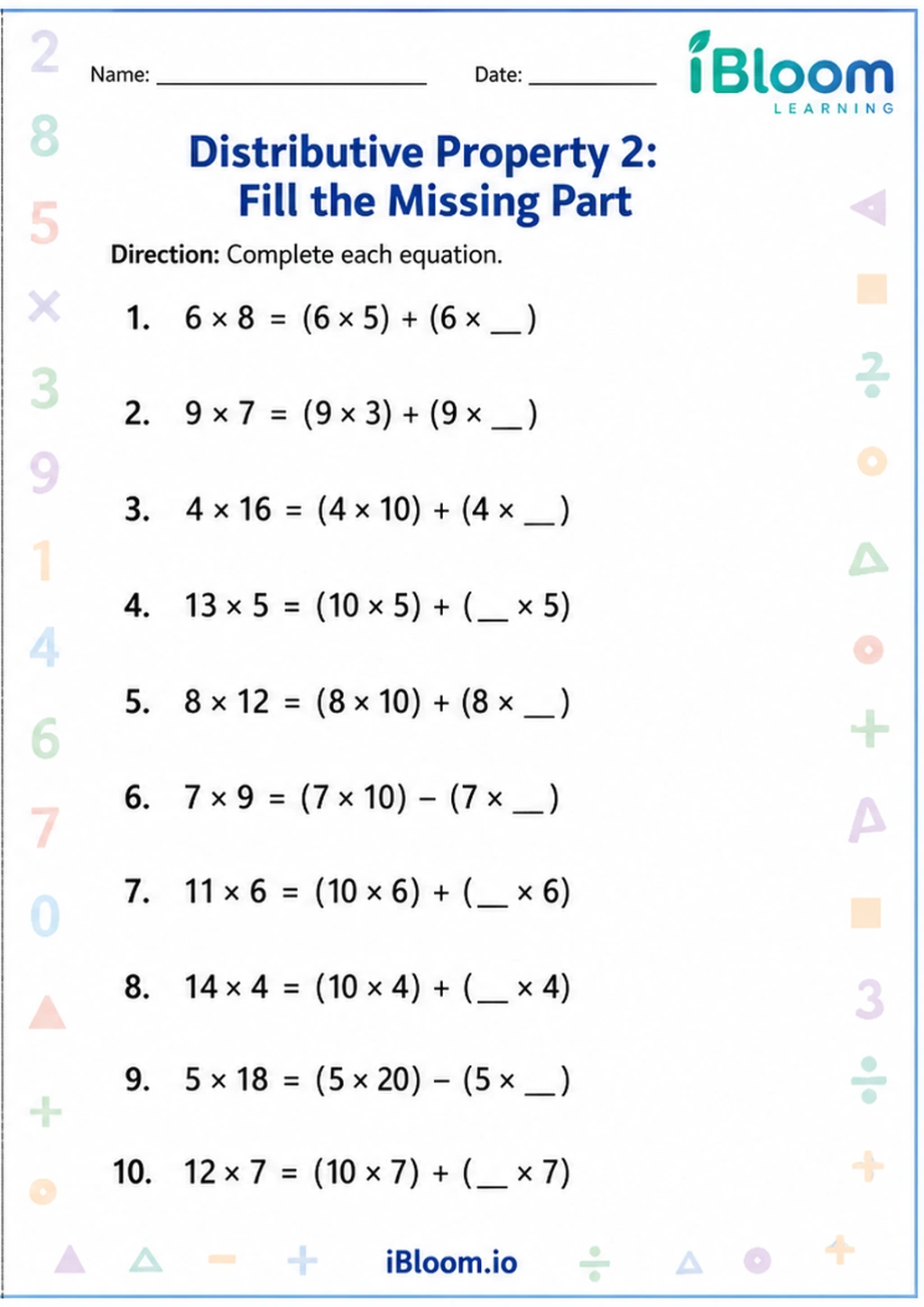 Distributive Property 2: Fill the Missing PartClass 5 printable practice for distributive property with a clear, age-appropriate learning task.Class 5Free PDF preview
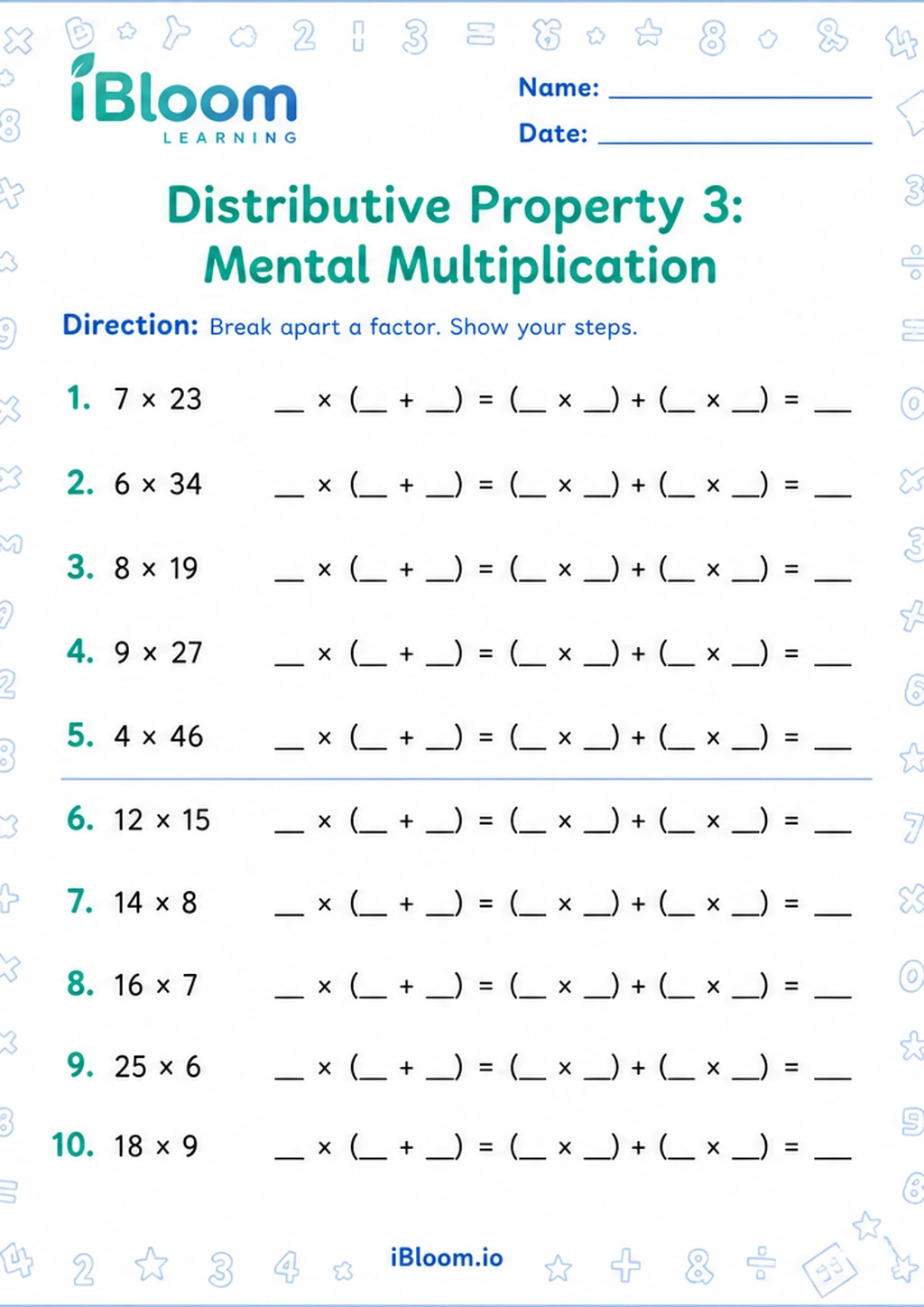 Distributive Property 3: Mental MultiplicationClass 5 printable practice for distributive property with a clear, age-appropriate learning task.Class 5Free PDF preview
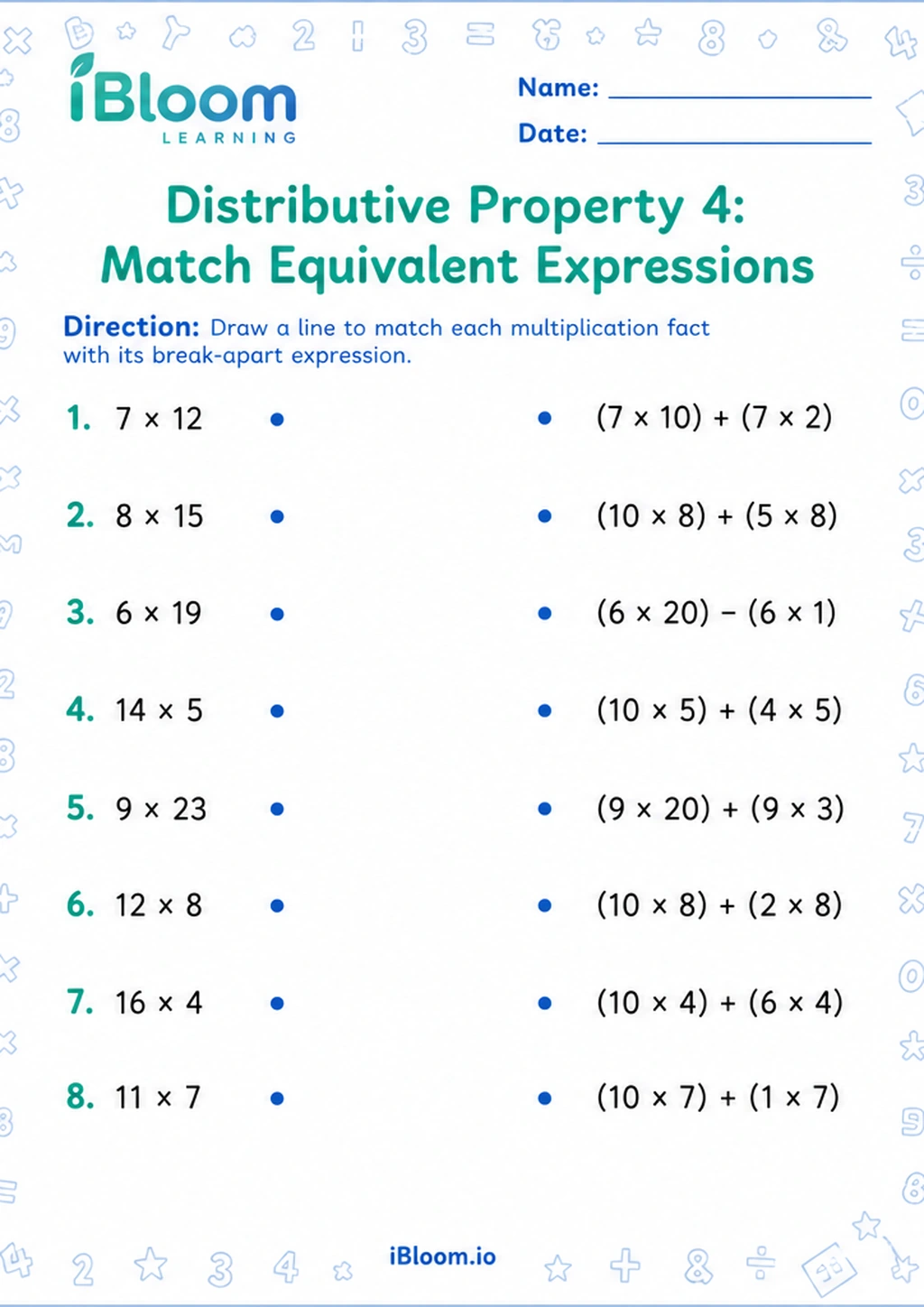 Distributive Property 4: Match Equivalent ExpressionsClass 5 printable practice for distributive property with a clear, age-appropriate learning task.Class 5Free PDF preview
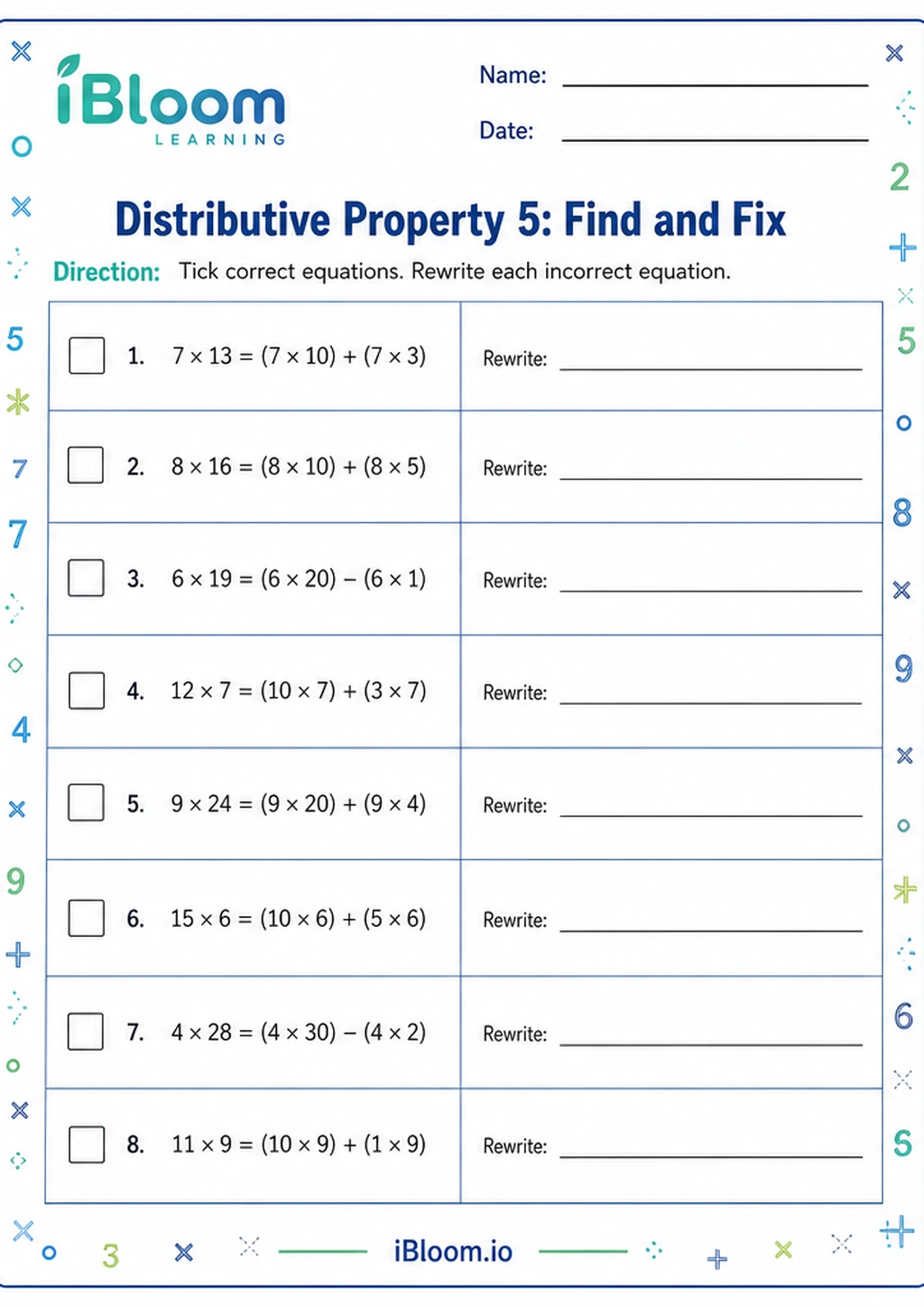 Distributive Property 5: Find and FixClass 5 printable practice for distributive property with a clear, age-appropriate learning task.Class 5Free PDF preview
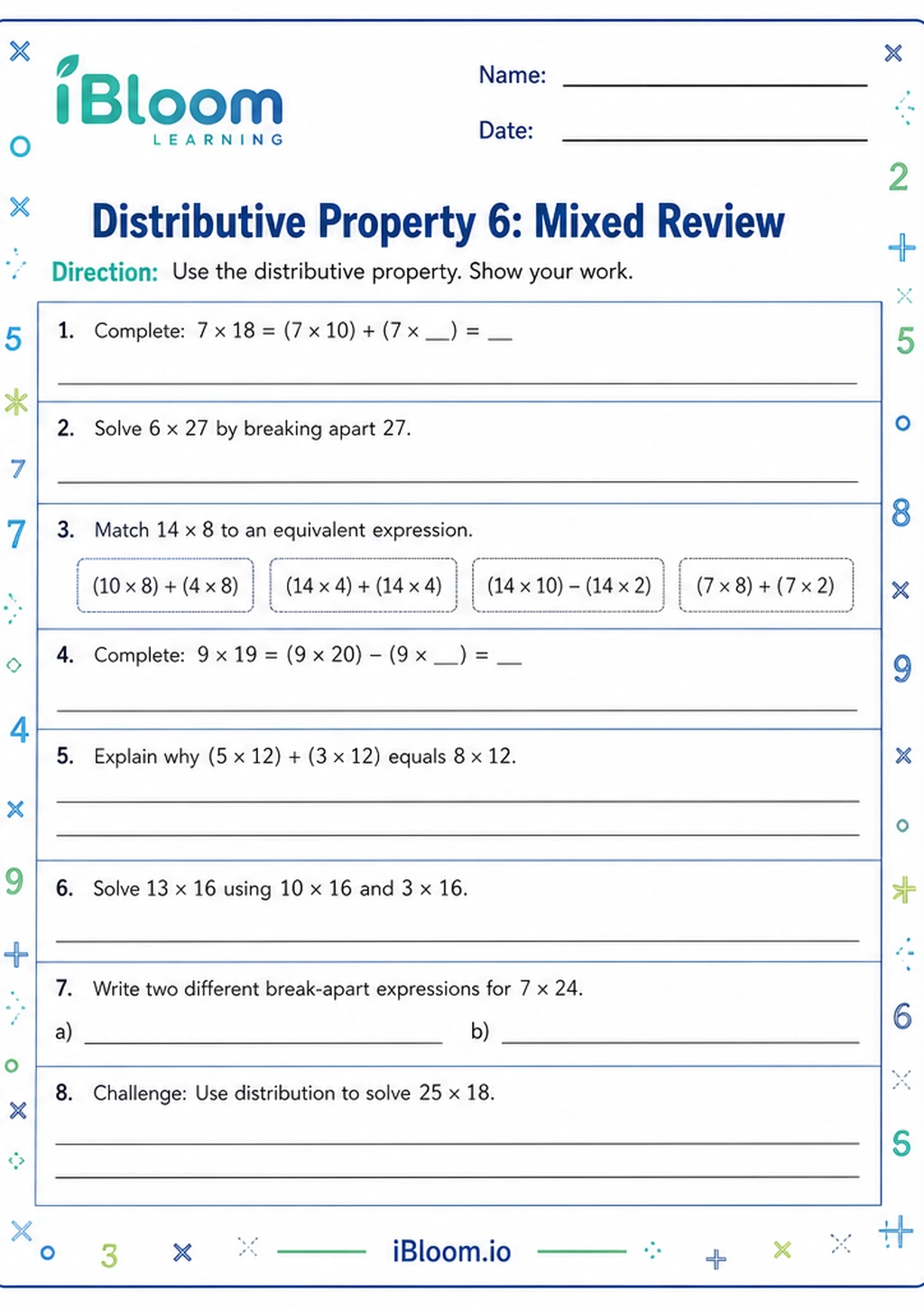 Distributive Property 6: Mixed ReviewClass 5 printable practice for distributive property with a clear, age-appropriate learning task.Class 5Free PDF preview
Practice that builds confidence
What the property means
These Class 5 distributive property worksheets help children understand how a difficult multiplication or division expression can be split into friendlier parts without changing its value. Learners practise ideas such as 7 × 48 = 7 × (40 + 8) and then combine the partial products correctly.
The printable activities include missing-number equations, expanded multiplication, mental maths practice, word-based reasoning and error spotting. They strengthen fluency in multiplication and division while also building the habit of explaining why an answer works.
The distributive property shows that one factor can be shared across a sum or difference: a × (b + c) = a × b + a × c. In Class 5, this is especially useful when children meet larger numbers. For example, 6 × 39 can become 6 × (40 - 1), making the calculation 240 - 6.

Progression in the worksheets
The practice usually begins with visible brackets and expanded forms, then moves towards children choosing the best split themselves. Activities may ask them to match equivalent expressions, fill missing values, solve products using expanded form, or decide whether a given equation is true. Division is handled carefully through cases such as 84 ÷ 6 = (60 ÷ 6) + (24 ÷ 6), where each part is divisible by the same divisor.
Parent routine for home practice
Ask your child to read the expression aloud, circle the factor being distributed, and split the other number into easy parts. Keep one rough-work column for the split and one for the final answer. After every few sums, ask, “Did we break the number, multiply each part, and then join the answers?” This routine turns the property into a clear thinking process, not just a rule to memorise.

Classroom uses for teachers
Teachers can use these pages in maths centres, small-group remediation or independent practice after introducing brackets and expanded notation. They also work well for board discussions: show two different splits for the same product, such as 8 × 47 as 8 × (40 + 7) and 8 × (50 - 3), and ask learners to compare efficiency.

Errors to watch for
Common mistakes include multiplying only one part, dropping the bracket, adding before applying the outside factor, or using division incorrectly. Children may write 5 × (30 + 4) as 150 + 4 instead of 150 + 20. For division, remind them that 96 ÷ (8 + 4) is not the same as 96 ÷ 8 + 96 ÷ 4.
Free printable PDF download
Use this distributive property worksheets class 5 page to preview the activity, print it, or download it as a PDF for quick practice. It works well for homework, homeschool lessons, tutoring, morning work, revision, and classroom centers.
Answers and answer key support
After the child completes the worksheet independently, parents and teachers can use the answer support or answer key information to check the work, review mistakes, and choose the next practice step.
Why iBloom worksheets help
iBloom worksheets give repeated, varied practice so children see the distributive property in equations, numbers and reasoning tasks. A child-friendly strategy is: “Break it, share it, solve it, join it.” This short phrase helps learners remember the order of steps and build confidence with multiplication and division.
Helpful answers
Frequently asked questions
What is the distributive property in Class 5 maths?
It is the idea that a number can be multiplied by each part of a sum or difference separately, then the results can be combined. For example, 4 × (20 + 3) = 4 × 20 + 4 × 3.
Do these worksheets include division as well as multiplication?
Yes. The focus is multiplication, but division examples are included where a dividend is split into parts that can each be divided by the same divisor, such as 72 ÷ 6 = 60 ÷ 6 + 12 ÷ 6.
How can I help my child choose a good split?
Encourage splits into tens, hundreds or near-round numbers. For example, 9 × 58 may be easier as 9 × (60 - 2) than as 9 × (50 + 8), depending on the child’s comfort.
What mistake should I look for first?
Check whether your child has multiplied every part inside the bracket. In 7 × (30 + 5), both 30 and 5 must be multiplied by 7.
Are these worksheets useful for mental maths?
Yes. The distributive property helps children turn harder products into easier mental steps, such as changing 6 × 49 into 6 × 50 - 6.
Is this distributive property worksheets class 5 free?
Yes. You can preview it for free and use the printable worksheet for home or classroom practice.
Can I download this distributive property worksheets class 5 as a PDF?
Yes. Use the worksheet download option to save a printable PDF, or print the worksheet directly from the page.
Does this distributive property worksheets class 5 include answers or an answer key?
When the activity has fixed answers, iBloom includes answer support so parents and teachers can check the completed worksheet.