Free printable practice
Writing Decimals As Mixed Numbers Practice Activities
Printable Class 6 maths worksheets for changing decimal numbers into mixed numbers using place value, fraction denominators, and simplification.
Free printable worksheet PDFs
Preview every available page, then download the free worksheet PDF for home, homeschool, tutoring, or classroom practice.
Preview the exact activity before downloading it.
 Writing Decimals As Mixed Numbers — Concept FoundationsConcept Foundations for writing decimals as mixed numbers in Class 6. Identify decimal place values, then write each decimal as a mixed number in simplest form.Class 6Free PDF preview
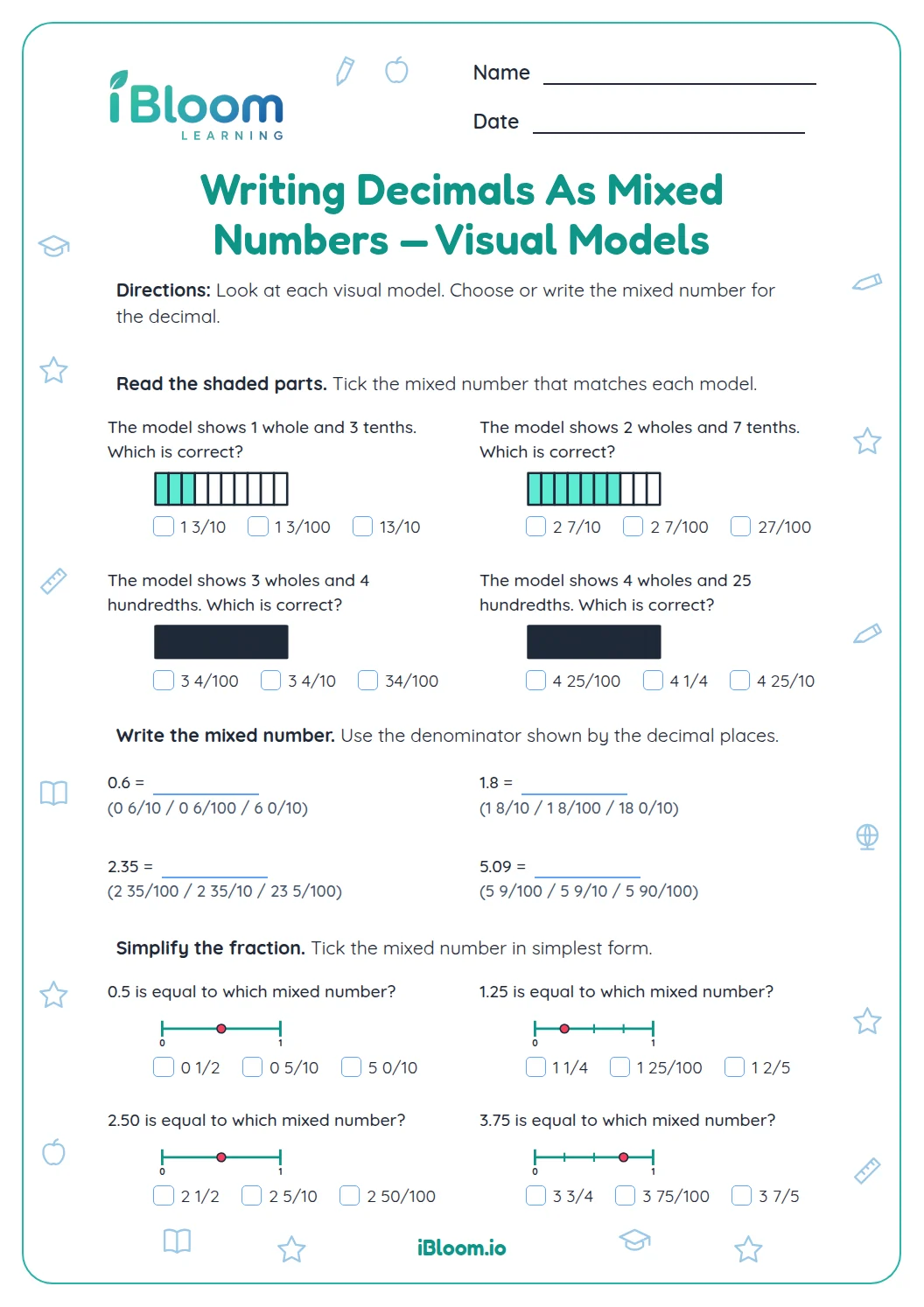 Writing Decimals As Mixed Numbers — Visual ModelsVisual Models for writing decimals as mixed numbers in Class 6. Use shaded fraction bars and number lines to convert each decimal into a correctly simplified mixed number.Class 6Free PDF preview
 Writing Decimals As Mixed Numbers — Guided PracticeGuided Practice for writing decimals as mixed numbers in Class 6. Convert each decimal into a mixed number by writing the fractional part, choosing its denominator, and simplifying when needed.Class 6Free PDF preview
 Writing Decimals As Mixed Numbers — Independent PracticeIndependent Practice for writing decimals as mixed numbers in Class 6. Convert each decimal to a mixed number, write the decimal fraction over its place-value denominator, and simplify when needed.Class 6Free PDF preview
 Writing Decimals As Mixed Numbers — Real-World ProblemsReal-World Problems for writing decimals as mixed numbers in Class 6. Convert each real-world decimal into a simplified mixed number using place value and fraction denominators.Class 6Free PDF preview
 Writing Decimals As Mixed Numbers — Reasoning ChallengeReasoning Challenge for writing decimals as mixed numbers in Class 6. Convert decimals to mixed numbers, simplify where needed, and explain the place-value reasoning behind selected answers.Class 6Free PDF preview
Practice that builds confidence
Understanding the conversion
These Class 6 maths practice activities help children write decimals as mixed numbers by separating the whole-number part from the decimal part. Learners connect tenths, hundredths, and thousandths to fractions such as 4/10, 75/100, and 125/1000, then simplify where possible.
The printable worksheets include place-value based conversions, guided examples, and independent questions with decimals greater than 1. Children practise reading decimals carefully, choosing the correct denominator, and writing answers in clear mixed-number form.
Writing a decimal as a mixed number means keeping the whole number and changing only the decimal part into a fraction. For example, 6.8 becomes 6 8/10, which simplifies to 6 4/5. A number such as 12.75 becomes 12 75/100, then 12 3/4. These worksheets build the link between decimal place value and fraction notation.

Skill progression in the worksheets
Children begin with decimals in tenths, where the denominator is 10. They then move to hundredths and thousandths, where careful counting of decimal places matters. Some questions require simplification after conversion, while others focus on writing the unsimplified fraction correctly first. This progression supports the wider Fractions To Decimals topic by showing that decimals and fractions can describe the same quantity.
A simple parent routine
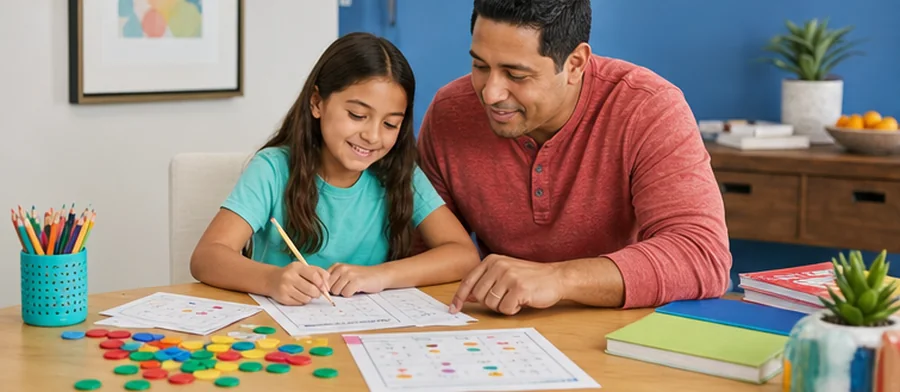
At home, ask your child to read one decimal aloud, underline the whole-number part, and circle the digits after the decimal point. Then ask, “Is this tenths, hundredths, or thousandths?” Let them write the fraction using 10, 100, or 1000 as the denominator before simplifying. A quick check is to convert the fraction back mentally: 3 25/100 should match 3.25.
Classroom uses for teachers
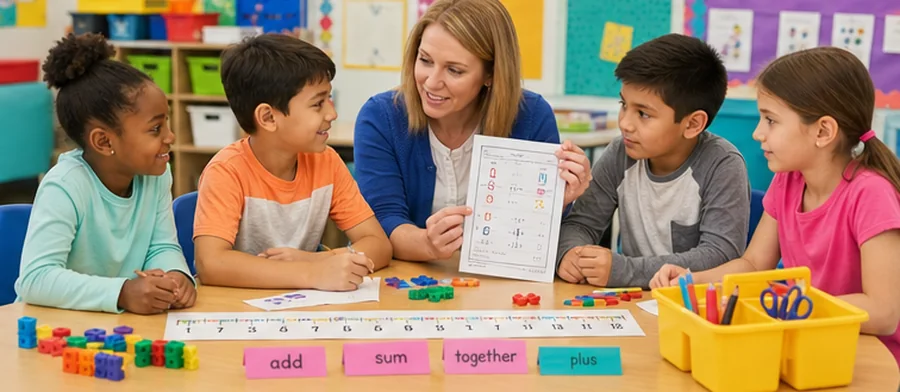
Teachers can use these printables for maths warm-ups, revision after teaching place value, small-group support, or independent practice. They also work well as exit slips: give one decimal in tenths, one in hundredths, and one that needs simplification. Students can explain the denominator they chose, which reveals whether they understand the decimal places or are guessing.
Common errors to watch for
A frequent mistake is using the decimal digits as a whole number without the correct denominator, such as writing 4.06 as 4 6/10 instead of 4 6/100. Some learners drop zeros, confuse hundredths with tenths, or forget to simplify fractions like 50/100. Encourage neat place-value alignment so the decimal point is not ignored.
Free printable PDF download
Use this writing decimals as mixed numbers worksheets class 6 page to preview the activity, print it, or download it as a PDF for quick practice. It works well for homework, homeschool lessons, tutoring, morning work, revision, and classroom centers.
Answers and answer key support
After the child completes the worksheet independently, parents and teachers can use the answer support or answer key information to check the work, review mistakes, and choose the next practice step.
Why iBloom worksheets help
iBloom worksheets give Class 6 learners repeated, focused practice without mixing too many skills at once. A child-friendly strategy is: “whole number stays, decimal part becomes a fraction, denominator follows the places, then simplify.” This short routine helps children approach each decimal confidently and check their own work.
Helpful answers
Frequently asked questions
What does it mean to write a decimal as a mixed number?
It means keeping the whole-number part and writing the decimal part as a fraction. For example, 5.6 is written as 5 6/10, which simplifies to 5 3/5.
Which denominators should Class 6 children use for decimal parts?
They choose the denominator from the number of decimal places: tenths use 10, hundredths use 100, and thousandths use 1000. For example, 2.43 becomes 2 43/100.
Should the mixed number always be simplified?
When possible, yes. After writing the decimal part as a fraction, children should reduce it to lowest terms, such as changing 7 40/100 to 7 2/5.
How can I help my child avoid mistakes with zeros in decimals?
Ask your child to read the place value before converting. For 3.05, the 05 is five hundredths, so the answer is 3 5/100, simplified to 3 1/20—not 3 5/10.
Are these worksheets useful for the Fractions To Decimals chapter?
Yes. They strengthen the reverse connection as well: children see that decimals and fractions are equivalent forms, which supports later work with comparing, converting, and simplifying numbers.
Is this writing decimals as mixed numbers worksheets class 6 free?
Yes. You can preview it for free and use the printable worksheet for home or classroom practice.
Can I download this writing decimals as mixed numbers worksheets class 6 as a PDF?
Yes. Use the worksheet download option to save a printable PDF, or print the worksheet directly from the page.
Does this writing decimals as mixed numbers worksheets class 6 include answers or an answer key?
When the activity has fixed answers, iBloom includes answer support so parents and teachers can check the completed worksheet.