Free printable practice
Proportions Decimals Practice Activities
Class 6 worksheets for practising proportions with decimal ratios, missing values, equivalent forms, and real-life decimal word problems.
Free printable worksheet PDFs
Preview every available page, then download the free worksheet PDF for home, homeschool, tutoring, or classroom practice.
Preview the exact activity before downloading it.
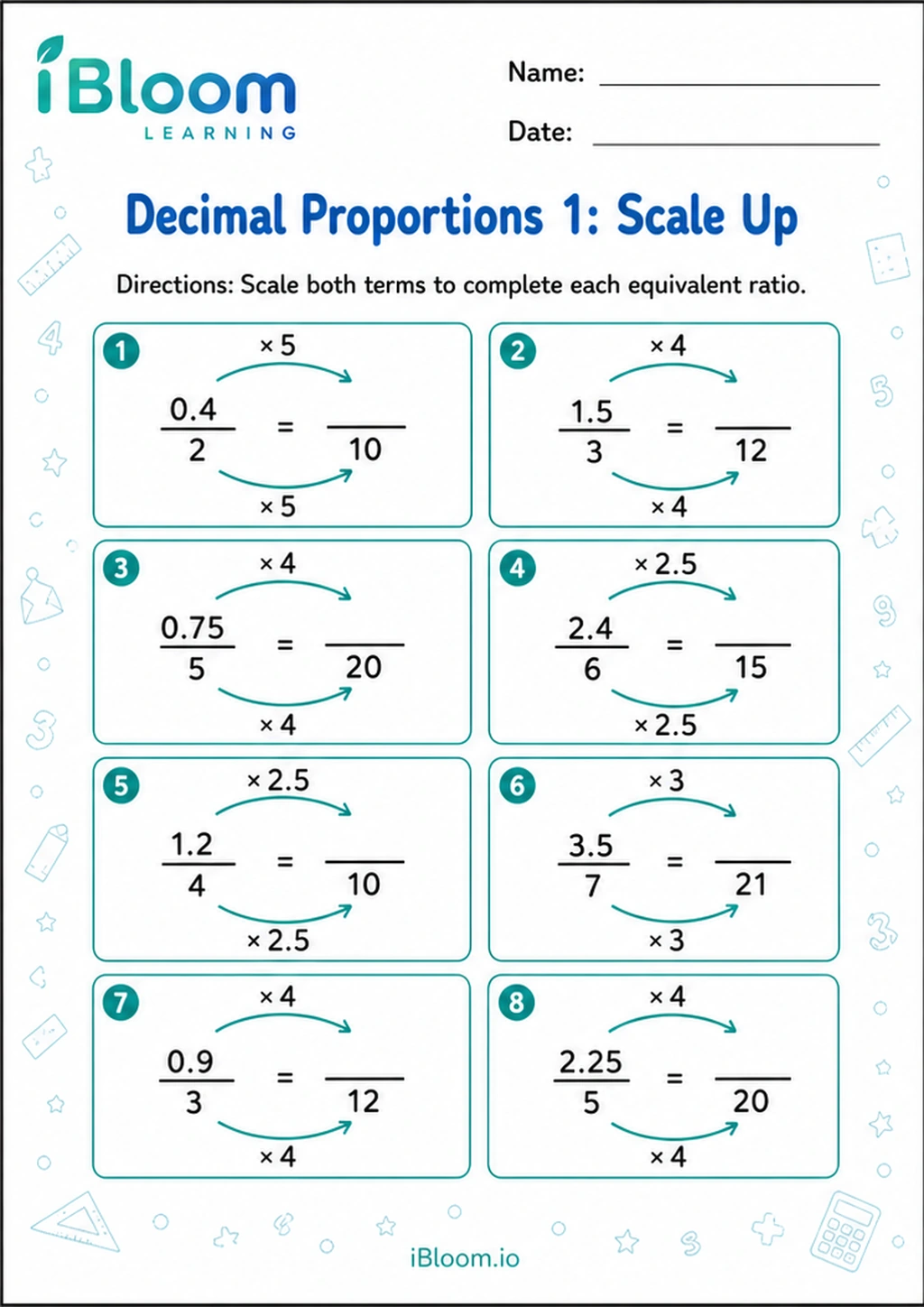 Decimal Proportions 1: Scale UpClass 6 printable practice for Decimal Proportions.Class 6Free PDF preview
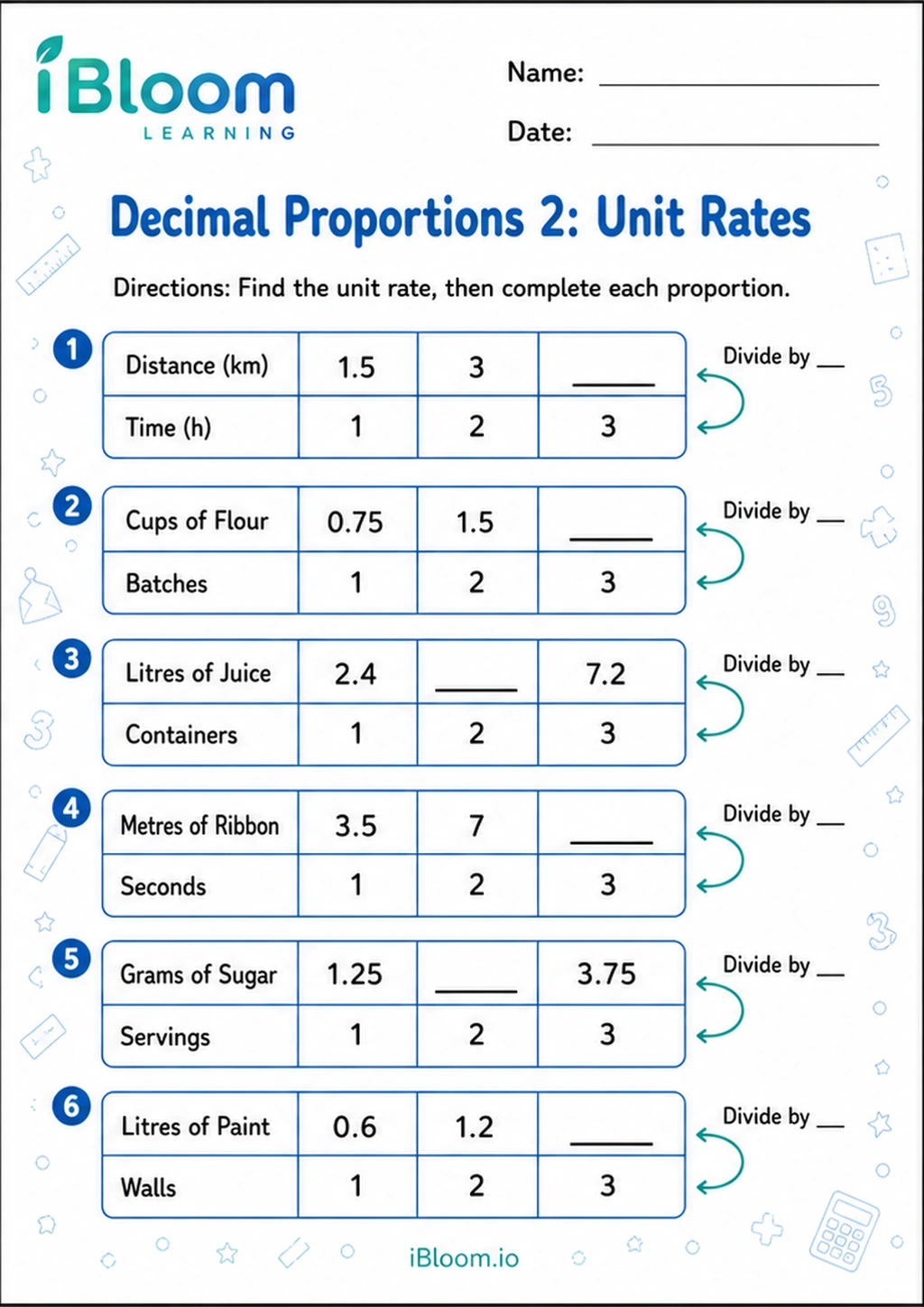 Decimal Proportions 2: Unit RatesClass 6 printable practice for Decimal Proportions.Class 6Free PDF preview
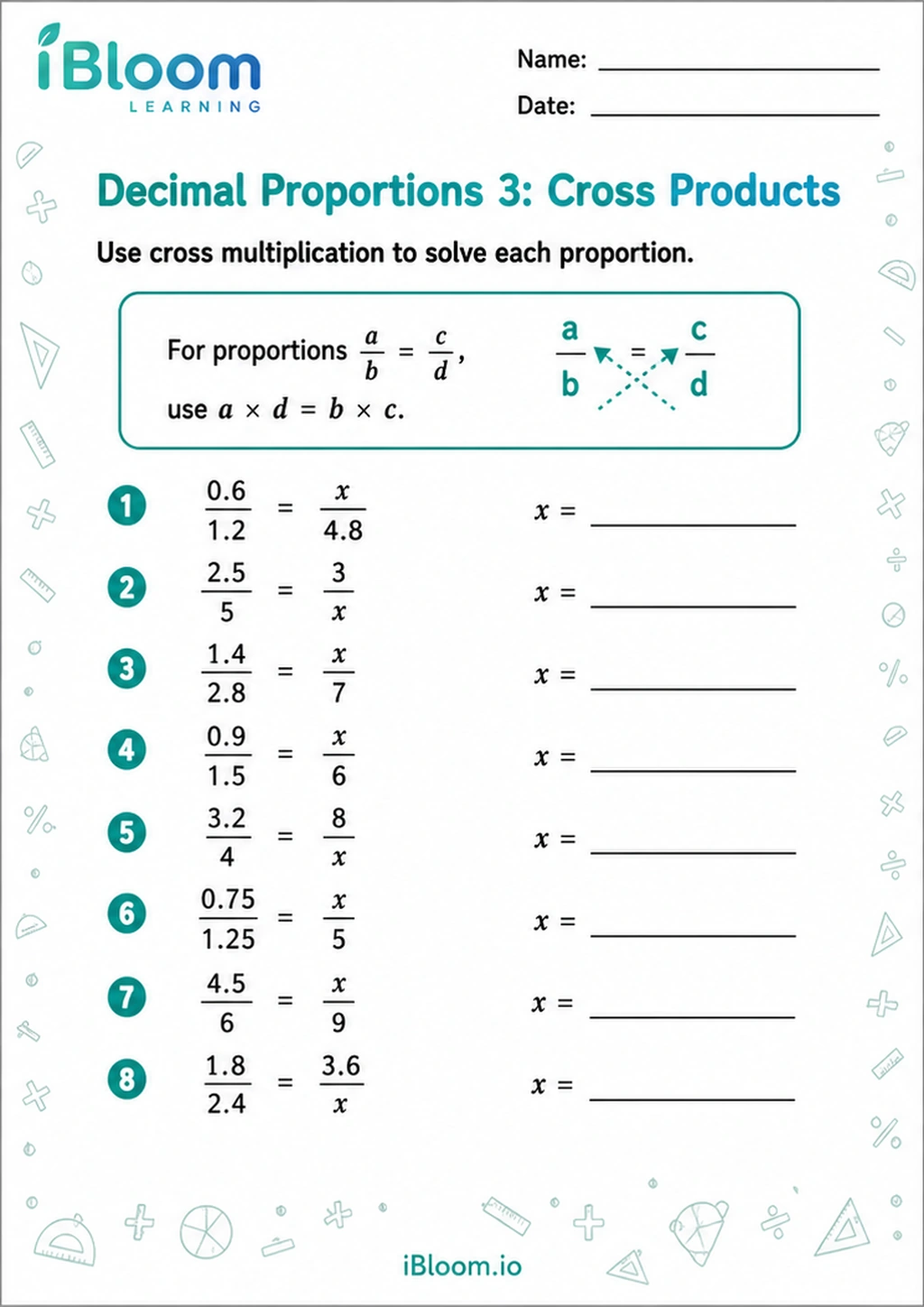 Decimal Proportions 3: Cross ProductsClass 6 printable practice for Decimal Proportions.Class 6Free PDF preview
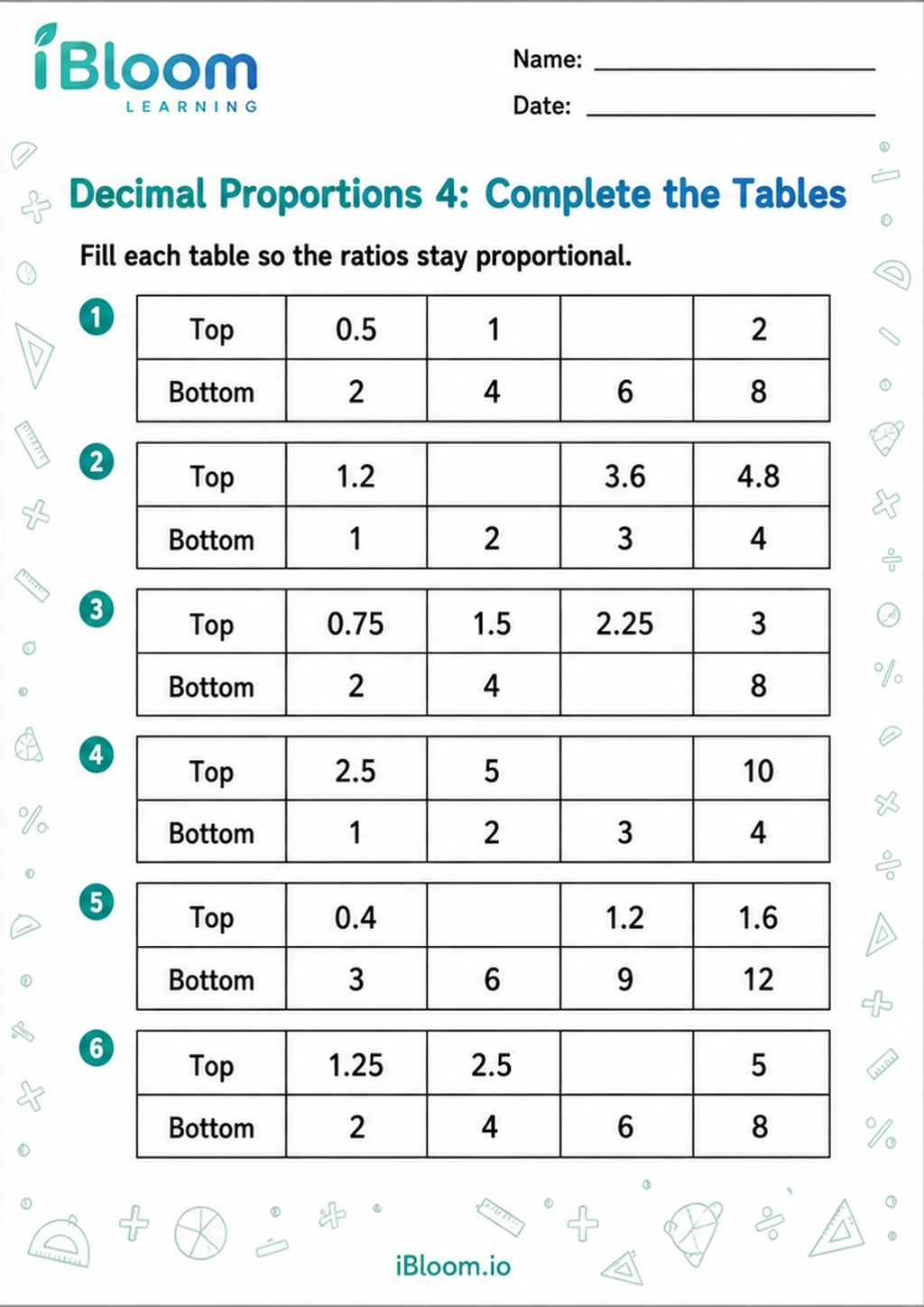 Decimal Proportions 4: Complete the TablesClass 6 printable practice for Decimal Proportions.Class 6Free PDF preview
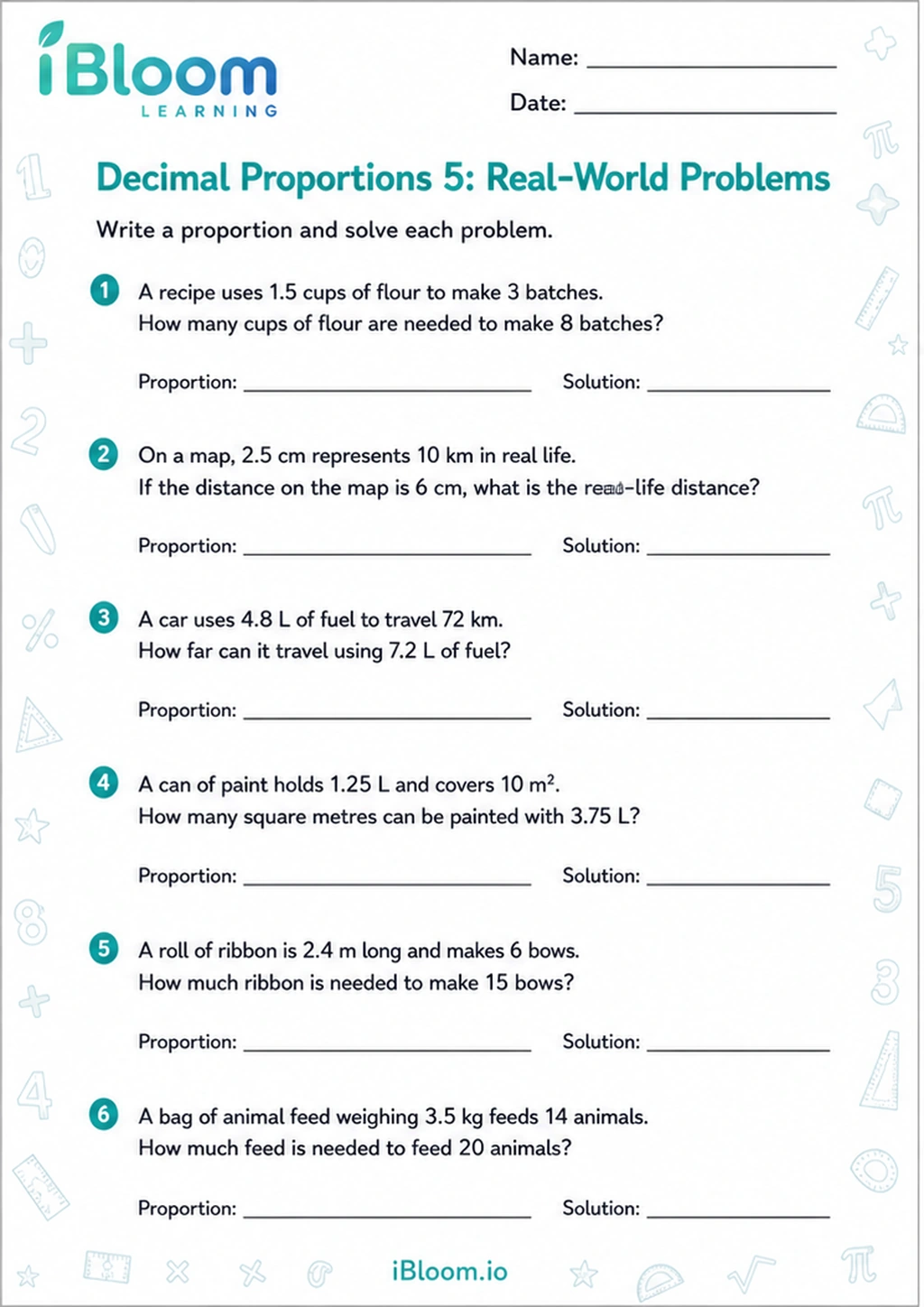 Decimal Proportions 5: Real-World ProblemsClass 6 printable practice for Decimal Proportions.Class 6Free PDF preview
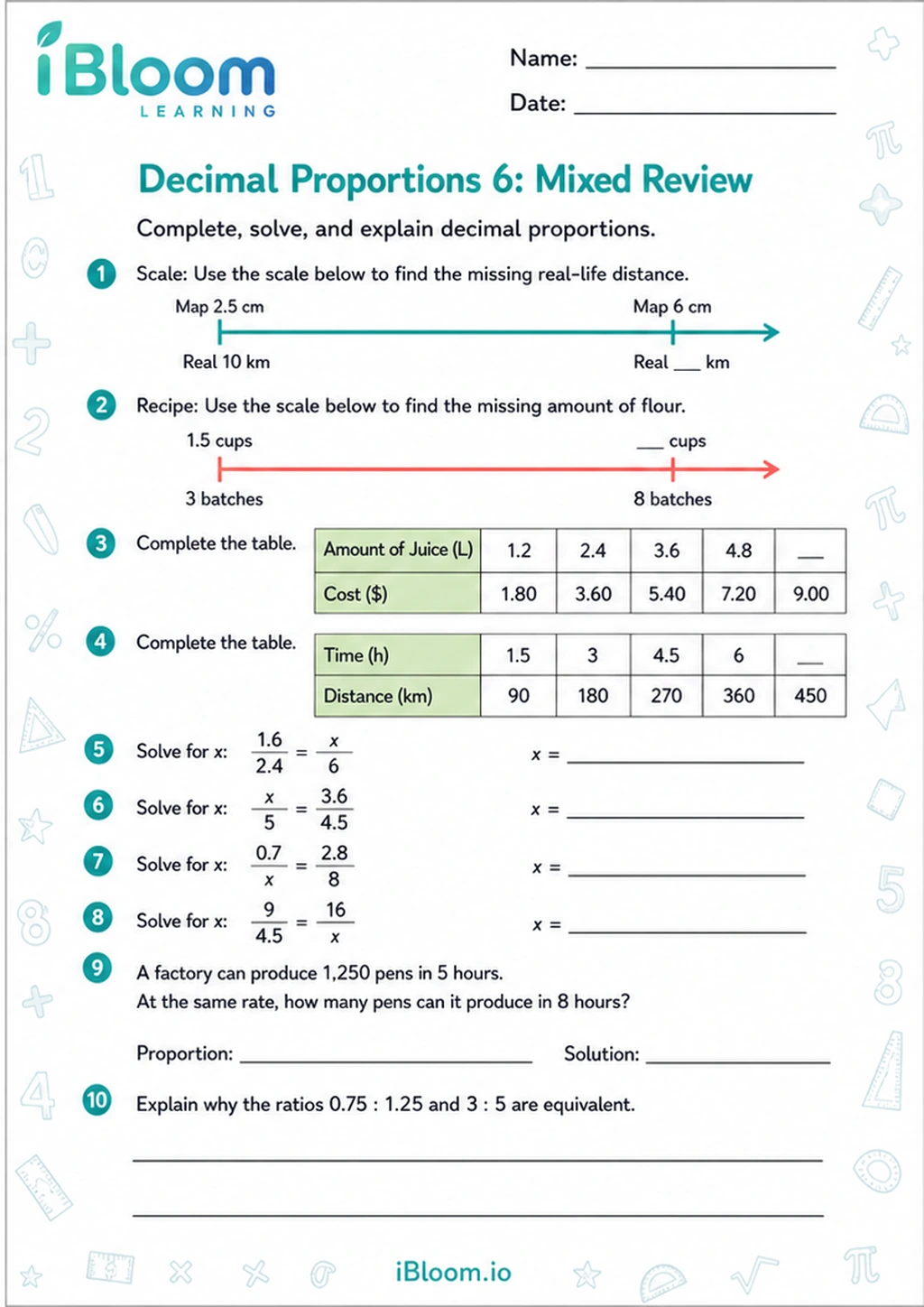 Decimal Proportions 6: Mixed ReviewClass 6 printable practice for Decimal Proportions.Class 6Free PDF preview
Practice that builds confidence
What this skill builds
These Class 6 maths worksheets help children practise proportions where the numbers include decimals. Learners compare two ratios, decide whether decimal ratios are equivalent, and find a missing value in a proportion using careful place-value thinking.
The printable activities include proportion checks, fill-in-the-blank questions, mixed decimal examples, and word problems drawn from prices, measurements, recipes, and distances. Each page encourages children to show steps rather than guess from appearance.
Proportions with decimals connect ratio reasoning to everyday quantities such as ₹12.50 for 2 items, 1.5 litres for 3 bottles, or 0.75 km in a fixed time. Children learn that a proportion is not about matching digits; it is about two ratios having the same value. They may scale both terms, simplify by the same factor, or multiply by 10 or 100 to remove decimal points before comparing.

How the practice progresses
The worksheets begin with direct comparisons of decimal ratios, then move to missing-number proportions such as 0.6 : 3 = 1.2 : __. Later questions include word problems where children must first identify the two related quantities. This progression helps them move from visual checking to a reliable method: write the ratios in the same order, make equivalent forms, and verify the answer.
A parent routine at home
Ask your child to read one question aloud and underline the two quantities being compared. Next, have them say the ratio in words, for example, “litres to bottles” or “cost to packets”. Let them solve on paper, then ask, “What did you multiply or divide by?” For a quick real-life link, use a grocery bill or recipe and discuss whether doubling, halving, or multiplying by 10 keeps the proportion true.

Classroom uses for teachers
Teachers can use these printables for guided maths practice, revision after decimal operations, peer-check activities, or short assessment tasks. They also work well in centres: one group can convert decimal ratios to whole-number ratios, another can solve missing values, and a third can explain word problems using ratio language.

Common errors to watch for
Many children line up decimals and compare only the visible digits, so 0.4 : 2 may look smaller than 0.8 : 4 even though the ratios are equal. Others reverse the order of quantities in word problems or multiply only one part of a ratio. Encourage neat columns, matching units, and the habit of checking whether both terms changed by the same factor.
Free printable PDF download
Use this class 6 proportions decimals worksheet page to preview the activity, print it, or download it as a PDF for quick practice. It works well for homework, homeschool lessons, tutoring, morning work, revision, and classroom centers.
Answers and answer key support
After the child completes the worksheet independently, parents and teachers can use the answer support or answer key information to check the work, review mistakes, and choose the next practice step.
Why iBloom worksheets help
iBloom worksheets keep the focus on one Class 6 skill: proportions involving decimals. The questions give enough variety for practice without mixing in unrelated topics. A child-friendly strategy is: write the ratio, match the order, clear decimals if helpful, scale both parts, and check the sentence makes sense.
Helpful answers
Frequently asked questions
What do Class 6 children practise in proportions with decimals?
They practise deciding whether decimal ratios are equivalent, finding missing values in proportions, and applying the same idea to measurement, money, recipe, and distance word problems.
Should children convert decimal ratios to whole numbers?
Yes, when it helps. Multiplying both terms of a ratio by 10 or 100 can remove decimal points, but children must multiply both parts by the same number to keep the ratio unchanged.
What is a common mistake in decimal proportion questions?
A common mistake is changing only one part of the ratio or reversing the order of quantities. For example, cost to packets must be compared with cost to packets, not packets to cost.
How can I help my child check a missing value answer?
Ask them to explain the scale factor. If one term was multiplied by 2, the matching term in the other ratio should also be multiplied by 2. They can also simplify both ratios to compare.
Are these worksheets suitable after learning decimal operations?
Yes. They are especially useful once children can multiply and divide decimals, because proportion problems require accurate calculation along with ratio reasoning.
Is this class 6 proportions decimals worksheet free?
Yes. You can preview it for free and use the printable worksheet for home or classroom practice.
Can I download this class 6 proportions decimals worksheet as a PDF?
Yes. Use the worksheet download option to save a printable PDF, or print the worksheet directly from the page.
Does this class 6 proportions decimals worksheet include answers or an answer key?
When the activity has fixed answers, iBloom includes answer support so parents and teachers can check the completed worksheet.