
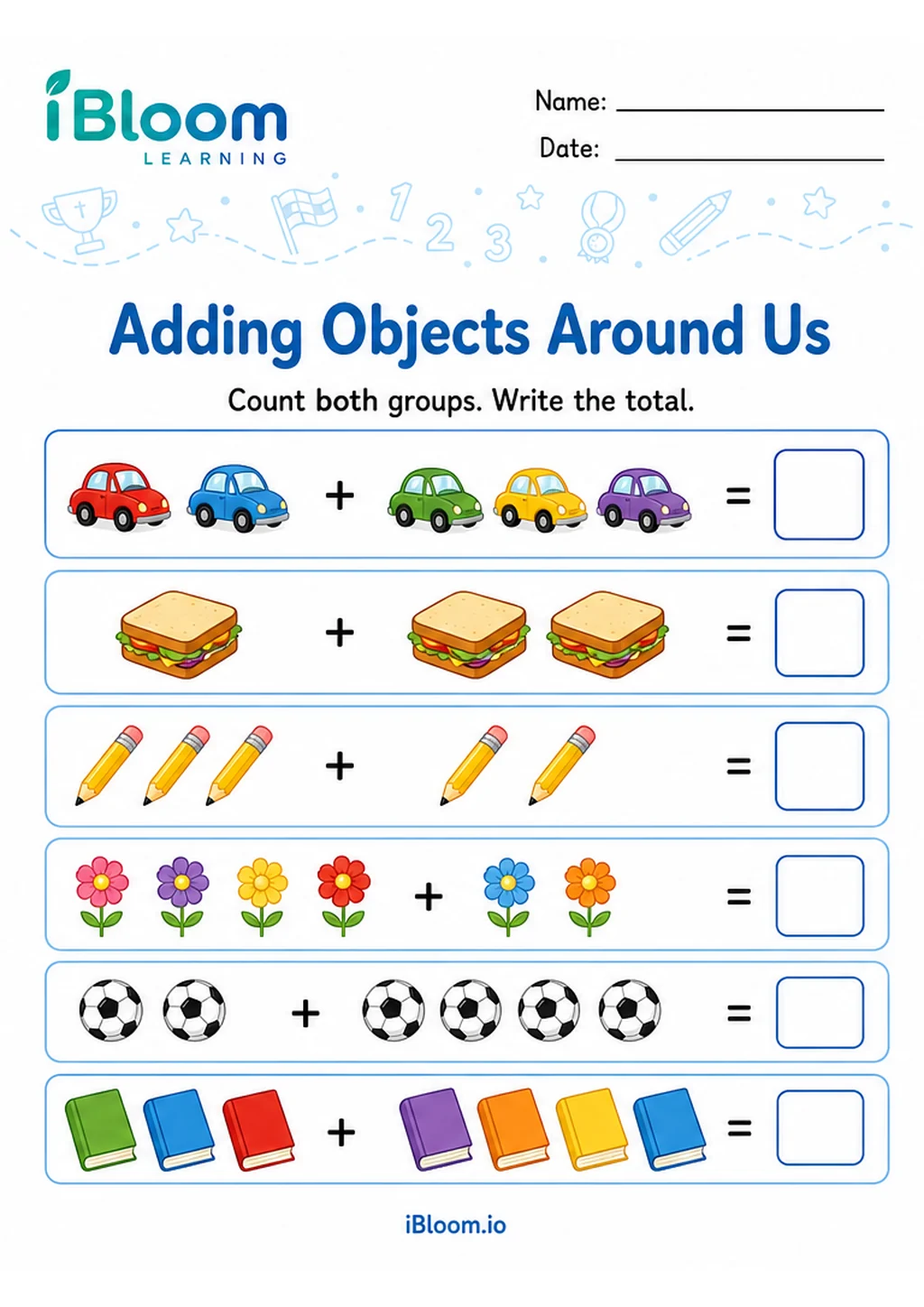


About this worksheet
This printable gives preschool and kindergarten learners 16 addition equations with sums through 10. Each equation is paired with a number bond that shows the same two addends and total. Children can count on or use the model to see how two parts make a whole. The separate answer key makes checking straightforward.
Aligned to K.OA.A.1
What does addition show?
Addition puts two groups together. The plus sign tells the learner to join the amounts, and the equals sign introduces the total.
- 12 + 1 = ___
- 2The number bond shows parts 2 and 1.
- 32 + 1 makes 3 altogether.
How can pictures support the counting?
Each number bond repeats the two addends and their total. Point to each part, then the whole, and connect those values to the equation.
What is on the worksheet?
Part A practices sums from 3 to 10. Part B revisits addition facts through 10. All 16 equations have a matching number bond.
How to use this worksheet
- 1Read the first number and name that many pictures.
- 2Read the second number and count on that many more.
- 3Say the total and write it in the blank.
- 4For a check, draw or point to each item once.
- 5Use the answer key after the child has tried the equations.
Common mistakes and quick fixes
The mistake
Counting one group twice.
The fix
Touch each picture once, then move to the next group.
The mistake
Stopping at the last addend.
The fix
Count on from the first number until all of the second group is added.
The mistake
Writing an addend instead of the total.
The fix
Ask, “How many are there altogether?” and check both groups.
Common Core alignment
The picture groups and equations give children more than one way to represent addition.
Use addition equations and pictures to show groups joined together.
On this sheet: Children solve addition equations and connect each sum to picture groups.
Show the official wordingHide the official wording
Represent addition and subtraction with objects, fingers, mental images, drawings¹, sounds (e.g., claps), acting out situations, verbal explanations, expressions, or equations.
What to practice next
Make more practice
Further reading
Questions parents and teachers ask
What does the plus sign mean?
Addition joins two amounts to find how many there are altogether. In 2 + 1, start with two and add one more to make three. The number bond shows the two parts and the whole, so a child can connect the model to the equation.
How do the number bonds help?
Each number bond shows the same two parts and total as its addition equation. A child can point to each part, count on, and then check that the whole matches the sum. The bonds give a visual way to connect addends with the total.
Do the sums stay within ten?
Yes. All 16 equations have sums from 3 through 10. The number bonds show how each pair of addends makes its total, including combinations such as 6 + 4 and 7 + 3. Children can use the models or solve from memory.
Should my child draw dots?
Dots are one optional way to check a sum. This version also includes a number bond for every equation, so a child can use the two parts and whole as a model. Fingers, counters, or counting on are other ways to check.
How do I use the answer key?
Invite the child to try each equation first, then compare the totals with the separate key. If an answer differs, use the number bond to rebuild the two parts and count them together. This helps connect the correction to the addition equation.
How long does this worksheet take?
About ten minutes is a reasonable estimate for 16 short equations. Allow more time if the learner counts each combination aloud or talks through the number bonds. An adult can read the equations and point to the parts as needed.