


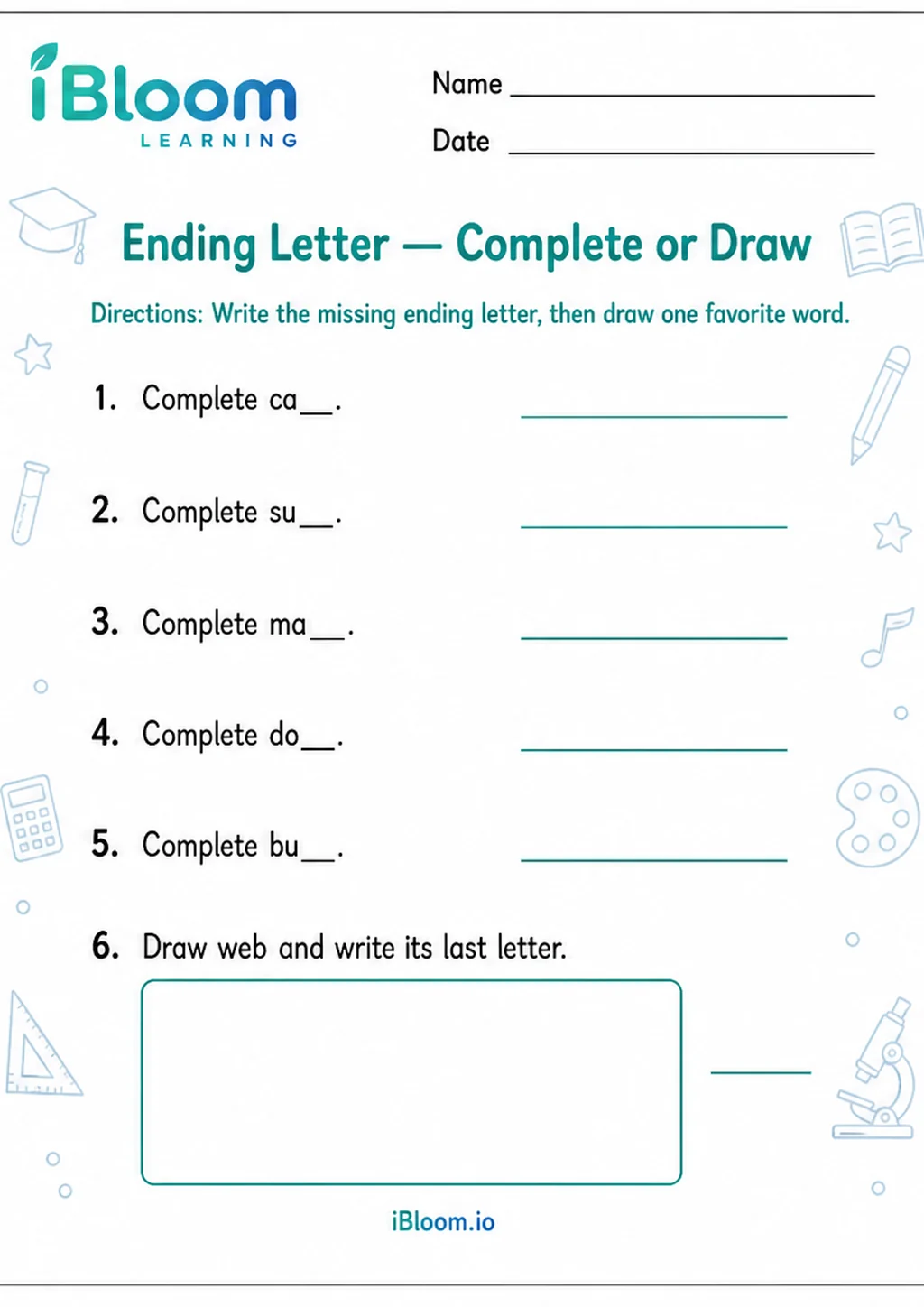
About this worksheet
This preschool and Kindergarten phonics printable gives children 14 picture questions for hearing the final consonant in a spoken word. Each item pairs a familiar picture with two letter choices. The practice connects consonant letters with their sounds, aligned with CCSS RF.K.3.a.
Aligned to RF.K.3.a
How do children hear the last sound?
Say the word aloud, then say the final sound slowly. In question 1, say “cat” and listen for /t/ at the end. The matching letter is t.
Name the object before looking at the letters.
- 1Picture: cat
- 2Say “cat” slowly: c-a-t.
- 3The last sound is /t/.
- 4Choose t.
Why say the word slowly?
A short word can be said quickly enough that its last sound is easy to miss. Saying the word slowly helps children hear its sounds in order. The final sound is the one heard just before the word ends.
What does the worksheet include?
Fourteen familiar picture words give practice hearing a final consonant and matching it to a letter. The answer key identifies the correct final letter for each word.
- Part A listens for final sounds in pictured words.
- Part B continues with additional final consonants.
- The key lists the final letter for each word.
How to use this worksheet
- 1Name the picture before choosing a letter.
- 2Say the word slowly from beginning to end.
- 3Listen for the sound just before the word stops.
- 4Choose the letter that usually spells that sound.
- 5Use the answer key after the child finishes.
Common mistakes and quick fixes
The mistake
Choosing the first sound instead of the last.
The fix
Say the word slowly and track sounds from beginning to end.
The mistake
Choosing a letter because its name sounds right.
The fix
Listen to the sound in the word, not the letter name.
The mistake
Giving a picture a different name.
The fix
Agree on the familiar name first, such as “sock.”
Curriculum alignment
This worksheet practices the skills described in the standards below.
Connect consonant letters with their sounds.
On this sheet: Children identify a consonant letter that represents the final sound in each pictured word.
Show the official wordingHide the official wording
Demonstrate basic knowledge of one-to-one letter-sound correspondences by producing the primary sound or many of the most frequent sounds for each consonant.
What to practice next
Further reading
Questions parents and teachers ask
How many picture words are on the page?
There are 14 picture prompts across two worksheet pages. Each shows a familiar short word and asks the child to choose the final consonant from two letter options. Saying the word aloud and moving from the first sound to the last gives a child a consistent way to decide.
What should my child do for each item?
Have your child name the picture, say the word slowly, and listen for its final sound. For the cat picture, stretching “cat” makes the /t/ sound at the end easier to notice. Saying the word aloud and moving from the first sound to the last gives a child a consistent way to decide.
Are the answer choices letters or words?
Each question offers two consonant letters. The child selects the letter that spells the last sound heard in the pictured word, then can check the choice with the separate answer key. Saying the word aloud and moving from the first sound to the last gives a child a consistent way to decide.
What if my child names a picture differently?
Say the object name together before choosing. A consistent familiar name keeps attention on its sounds. For example, settle on “sock” for the sock picture, then listen for /k/ at the end. Saying the word aloud and moving from the first sound to the last gives a child a consistent way to decide.
Is there a key for parents?
Yes. A separate answer key lists the expected ending consonant for all 14 pictures. Let your child finish the two worksheet pages first, then review any letter choices that were tricky. Saying the word aloud and moving from the first sound to the last gives a child a consistent way to decide.