Ending Information Writing worksheet for Class 5

Lesson-Wise Builder
A premium AI tool that creates syllabus-aligned questions and worksheets for any lesson in seconds.
A strong information-writing conclusion brings the central idea and the most important details together, then leaves the reader with a clear final insight. It does not introduce a disconnected new fact, copy the opening word for word, or end on one narrow detail that represents only a small part of the article.
What this Class 5 activity asks
The activity asks learners to choose an effective conclusion for an informational article and to identify a sentence that best summarises information. These are related skills. A summary captures what a passage is mainly about; a conclusion uses that understanding to close the writing in a purposeful way.
The supplied page includes audio-based questions designed for interactive digital use. The page itself explains that those items rely on sound and are not included in printed versions. Learners should therefore complete the listening portions on screen and use the visible text, diagrams and answer choices as supporting evidence.
Four jobs of an effective informational conclusion
Reconnect to the central idea
The ending should remind the reader what the whole article explained. It can restate the central idea in fresh words, but it should not repeat the introduction sentence exactly.
Synthesise key information
A useful conclusion brings related details together. Synthesis is more than listing facts: it shows what the facts collectively explain. If a report compares several volcano types, the ending should reflect the comparison rather than mention only one feature of one volcano.
Explain significance
A final insight can show why the information matters. The insight must grow naturally from the article. It should not make a dramatic promise or unsupported claim.
Give the writing a definite finish
The final sentence should sound complete. A reader should not expect another body paragraph after it. Precise words and a calm, informative tone help create that sense of closure.
Worked example: concluding an article about volcanoes
One visible question asks which sentence belongs in the conclusion of an article about volcano types. The diagram refers to shield and cone volcanoes, while the choices contrast a specific formation fact with a broader final insight.
- Specific detail: composite volcanoes form from alternating layers of lava and ash. This may be a useful body-paragraph fact, but by itself it covers only one type and does not close the whole article.
- Broader insight: knowing different volcano types helps geologists predict eruptions and protect communities. This choice connects the article's information to its importance and works as the stronger conclusion.
The reasoning matters more than memorising the option. Ask: “Does this sentence reflect the article as a whole, or does it zoom in on one detail?” That question transfers to science reports, history explanations and other informational texts.
How to summarise before writing the ending
Another visible prompt asks the learner to highlight the sentence that best summarises information in a paragraph about Earth's layers. The supplied screenshot does not show the full paragraph, so no unseen sentence or answer should be invented. Learners can still use a dependable method:
- Read or listen to the complete paragraph once for overall meaning.
- Name the topic in a few words.
- Ask what the paragraph mostly explains about that topic.
- Separate essential details from examples, labels and interesting extras.
- Choose the sentence that includes the central idea without adding an opinion.
- Use that summary to plan a conclusion that fits the full article.
A summary is usually objective. A conclusion may add a final statement of significance, but that statement still needs to be supported by the information already presented.
A practical conclusion-writing routine
Step 1: reread the purpose
Look at the title, opening and topic sentences. Complete this thought: “This article mainly explains…” If the learner cannot finish the sentence, more rereading is needed before drafting the ending.
Step 2: select two or three essential ideas
Do not copy every fact. Choose the ideas a reader must remember to understand the topic. Group details that make the same point.
Step 3: paraphrase the central idea
Use different wording and sentence structure from the introduction. Paraphrasing shows understanding; swapping one or two words does not.
Step 4: add a supported final insight
Ask why the information matters, what the comparison reveals, or what the reader now understands. Keep the insight closely tied to the article.
Step 5: revise for focus and flow
Remove new facts, repeated examples, vague phrases and unrelated advice. Read the paragraph aloud. Each sentence should lead naturally to the final one.
Strong and weak endings
Consider an article explaining how Earth's layers differ.
- Too narrow: “The inner core is extremely hot.” This is one detail, not a conclusion for the whole article.
- Too vague: “Earth is very interesting.” The sentence gives no useful summary.
- Unsupported: “Everyone should become a geologist.” The article may not support this recommendation.
- Focused: “Together, Earth's layers explain the structure beneath the surface and help scientists understand how the planet changes.” This ending synthesises the topic and gives a supported final insight.
A learner can improve almost any weak ending by asking what the whole article showed and why that understanding matters.
Useful transitions without repetition
Transitions such as “In conclusion” or “To sum up” can be useful, but they cannot do the thinking for the writer. Often a direct sentence sounds stronger: “Together, these features show…” or “Understanding these differences helps…” The wording should suit the article and avoid a mechanical ending copied into every piece.
Parent guidance
At home, use a short article from the child's current subject. Ask the child to say the main idea aloud, choose two essential facts and propose two different endings. Compare the endings: Which one reflects the whole article? Which one merely repeats a detail? Oral rehearsal reduces the writing load and makes the reasoning visible.
If the child copies the introduction, cover it temporarily and ask for a spoken explanation in new words. A multilingual learner may explain the idea in a familiar language first, then build the English conclusion from that understanding.
Teacher and tutor guidance
Model one conclusion with a think-aloud. Mark the central idea, key details and final insight in different ways, then show why a tempting body detail does not belong as the ending. In small groups, give learners three possible conclusions and ask them to rank the choices with evidence.
- Use conclusion sorting as a warm-up.
- Ask partners to explain why one option is broader and more relevant.
- Give focused feedback on one issue: repetition, new information, vagueness or weak connection.
- Use an exit prompt that asks for one concluding sentence and one reason it fits.
- Return to the same skill with science, social studies and English passages.
Common mistakes to watch for
- Copying the introduction instead of paraphrasing it.
- Ending with one isolated supporting detail.
- Adding a new fact that the article never explained.
- Using a vague opinion such as “This topic is nice.”
- Listing every body detail instead of synthesising them.
- Changing the topic in the final sentence.
- Choosing a dramatic claim that the evidence cannot support.
- Writing a transition phrase but no meaningful conclusion.
Practice ideas
- Turn three body details into one central-idea sentence.
- Write a narrow ending and revise it to reflect the full article.
- Compare an objective summary with a conclusion that adds significance.
- Draft two endings for the same volcano article and explain which is stronger.
- Remove the final sentence from a short report and write a replacement.
- Highlight any new information in a draft conclusion, then revise it out.
Related concepts
Conclusion writing connects with identifying main ideas, selecting supporting details, summarising objectively, paraphrasing, organising paragraphs, maintaining an informative tone and revising for coherence. Learners who can explain the relationship among those skills are more likely to produce an ending that feels earned rather than attached at the last moment.
Continue with related iBloom practice
- practise summarising information texts: Supports selecting central ideas and key details before writing a conclusion.
- connect the conclusion to the start of information writing: Helps learners connect the opening purpose with the final conclusion.
Frequently Asked Questions
What belongs in an informational conclusion?
Include a fresh restatement of the central idea, a synthesis of the most important information and, when the article supports it, a clear final insight about why the topic matters.
Should a conclusion introduce a new fact?
No. A conclusion should grow from information already explained. A new major fact belongs in the body, where it can be developed and supported.
Is a summary the same as a conclusion?
Not exactly. A summary states the essential information objectively. A conclusion uses that understanding to close the writing and may add a supported statement of significance.
How long should a Class 5 conclusion be?
Length depends on the task. A short article may need two or three focused sentences, while a longer report may need a full paragraph. Completeness and relevance matter more than a fixed sentence count.
How can a learner check an ending?
Ask three questions: Does it reflect the whole article? Does it avoid unsupported new information? Does the final sentence give the reader a clear sense of completion?
More practice for this grade
More English Language Arts worksheets
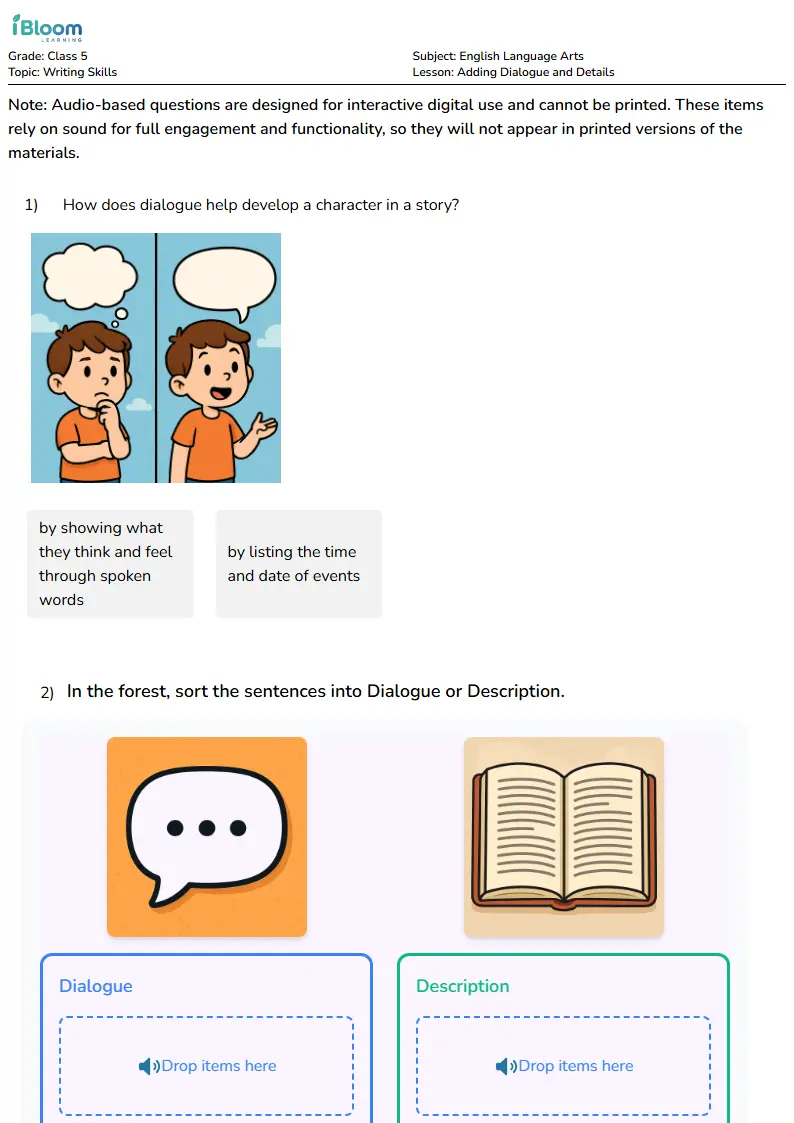
Free Adding Dialogue and Details Worksheets for Class 5
Looking for class 5 english language arts help? Download free, interactive adding dialogue and details worksheets. AI-personalized and Common Core-aligned. Practice early literacy with iBloom.
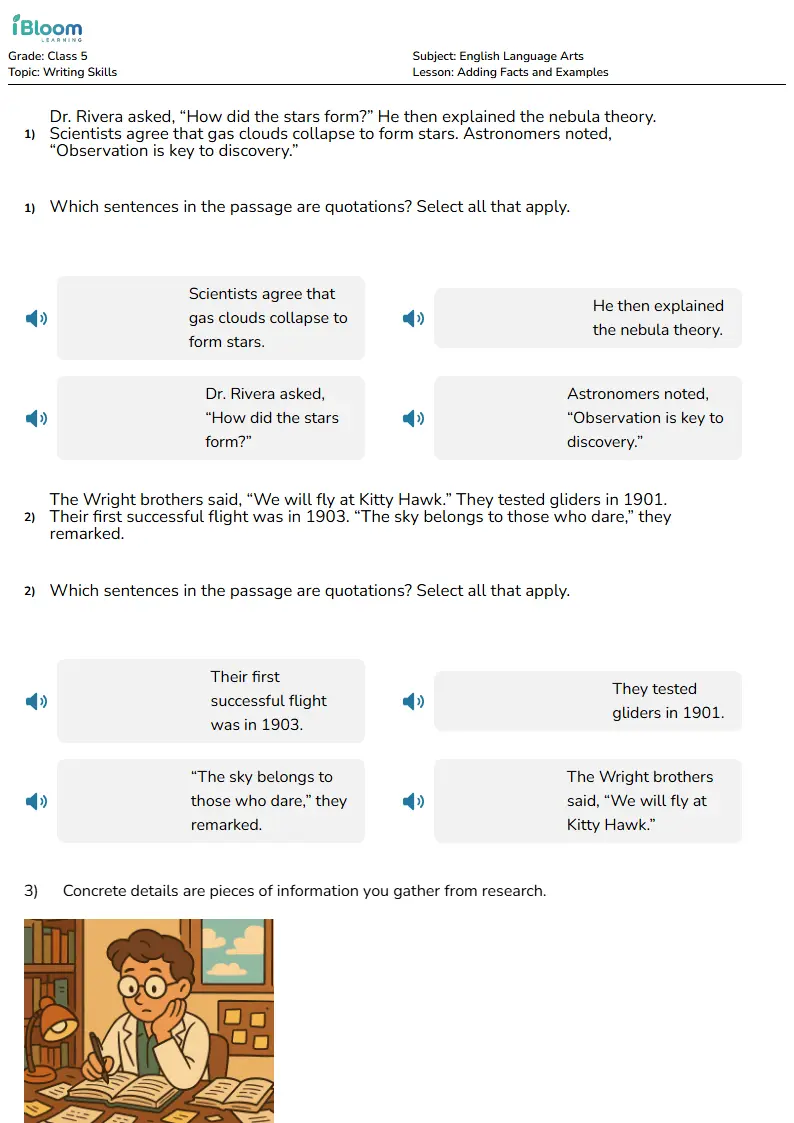
Free Adding Facts and Examples Worksheets for Class 5
Looking for class 5 english language arts help? Download free, interactive adding facts and examples worksheets. AI-personalized and Common Core-aligned. Practice early literacy with iBloom.
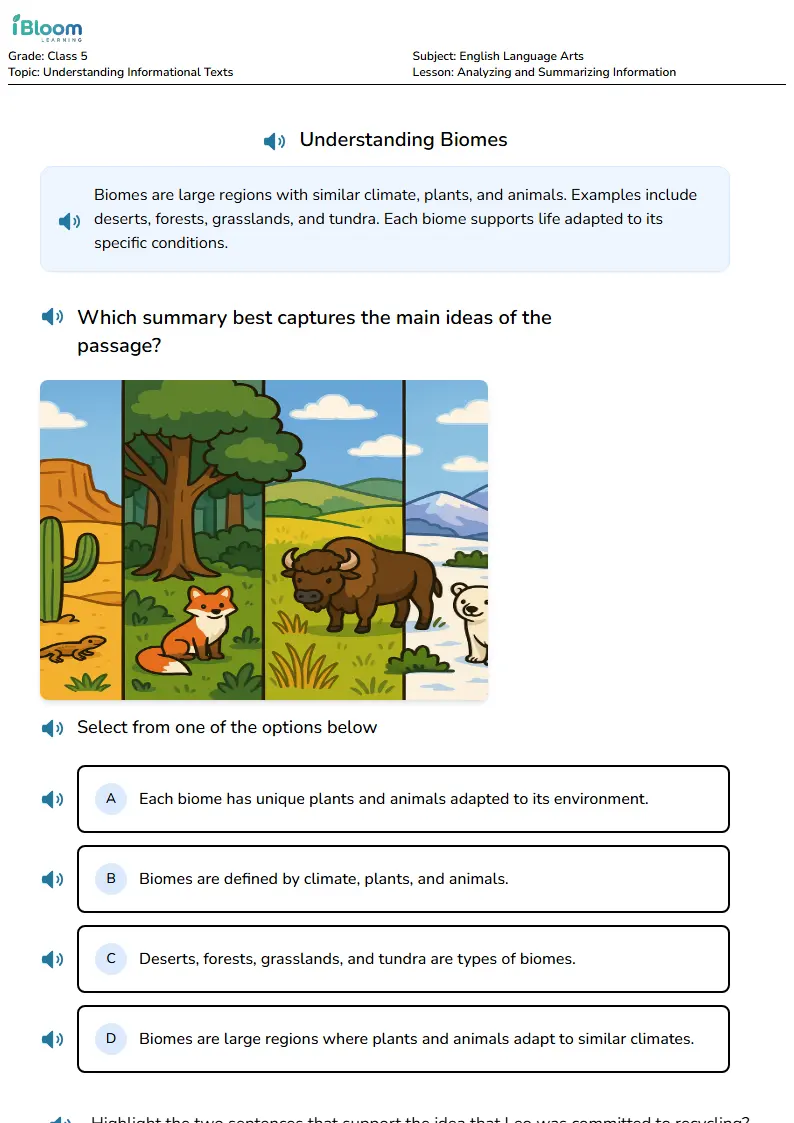
Free Analyzing and Summarizing Information Worksheets for Class 5
Looking for class 5 english language arts help? Download free, interactive analyzing and summarizing information worksheets. AI-personalized and Common Core-aligned. Practice early literacy with iBloom.
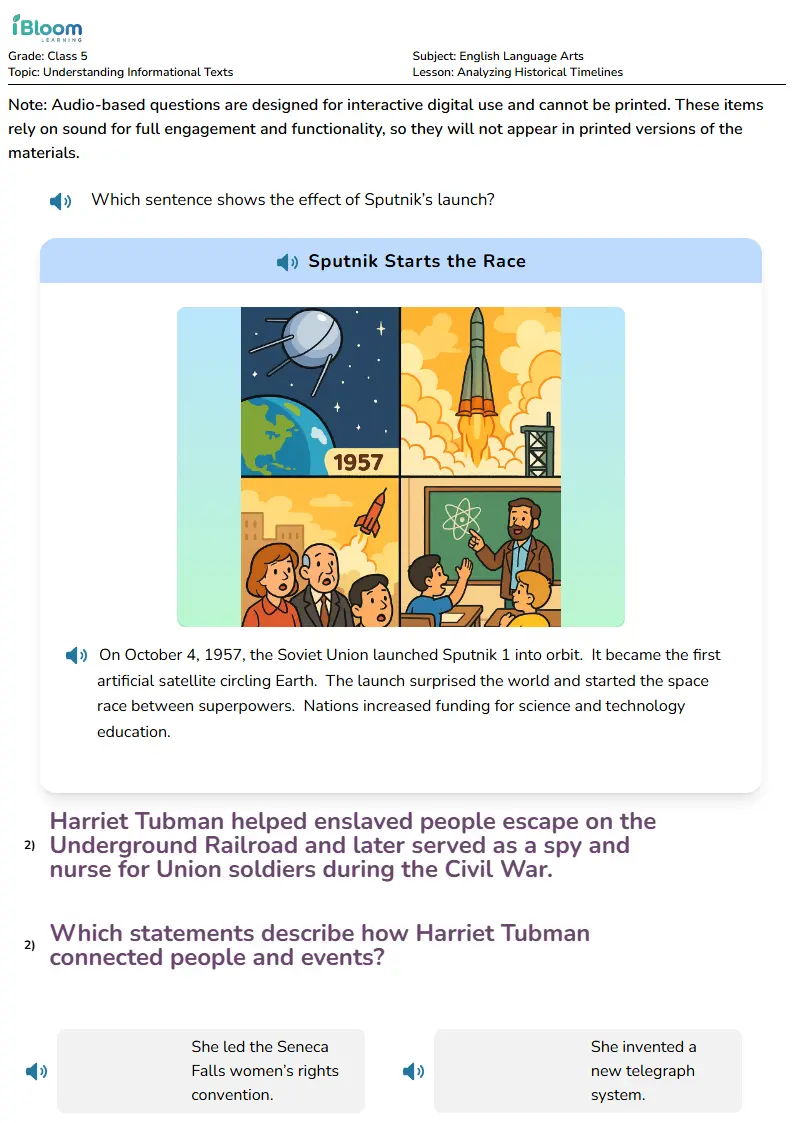
Free Analyzing Historical Timelines Worksheets for Class 5
Looking for class 5 english language arts help? Download free, interactive analyzing historical timelines worksheets. AI-personalized and Common Core-aligned. Practice early literacy with iBloom.
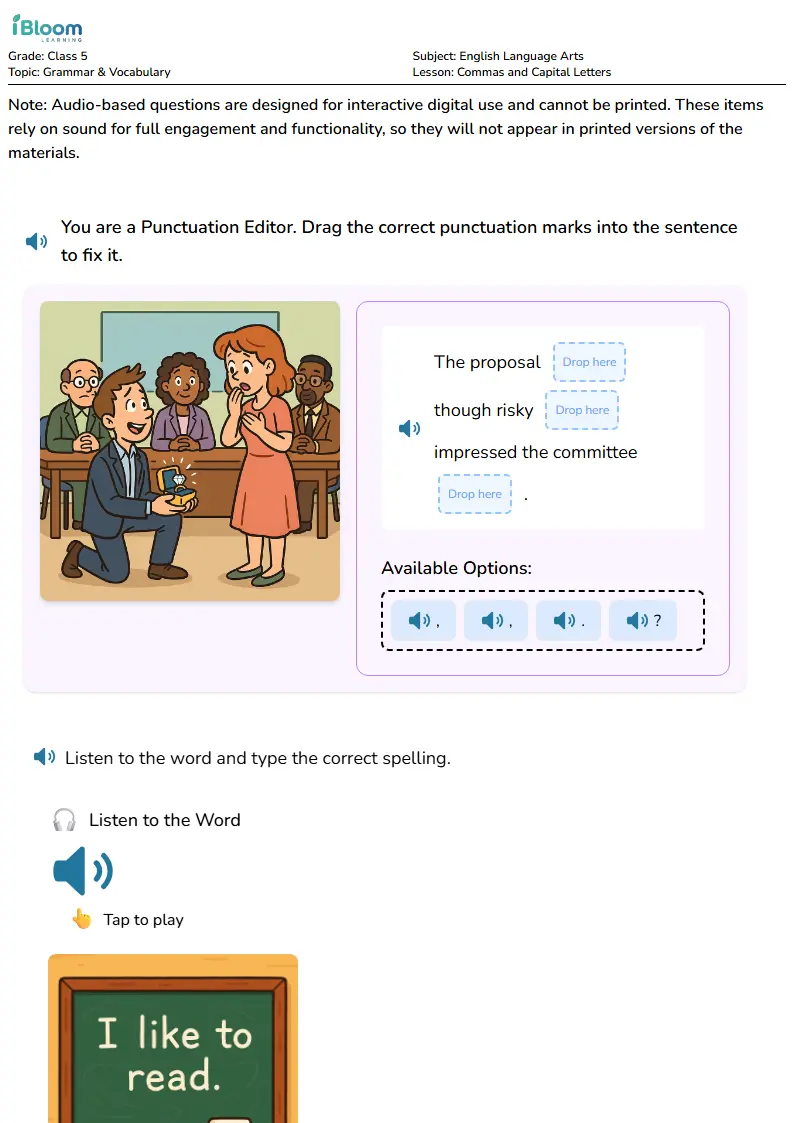
Free Commas and Capital Letters Worksheets for Class 5
Looking for class 5 english language arts help? Download free, interactive commas and capital letters worksheets. AI-personalized and Common Core-aligned. Practice early literacy with iBloom.
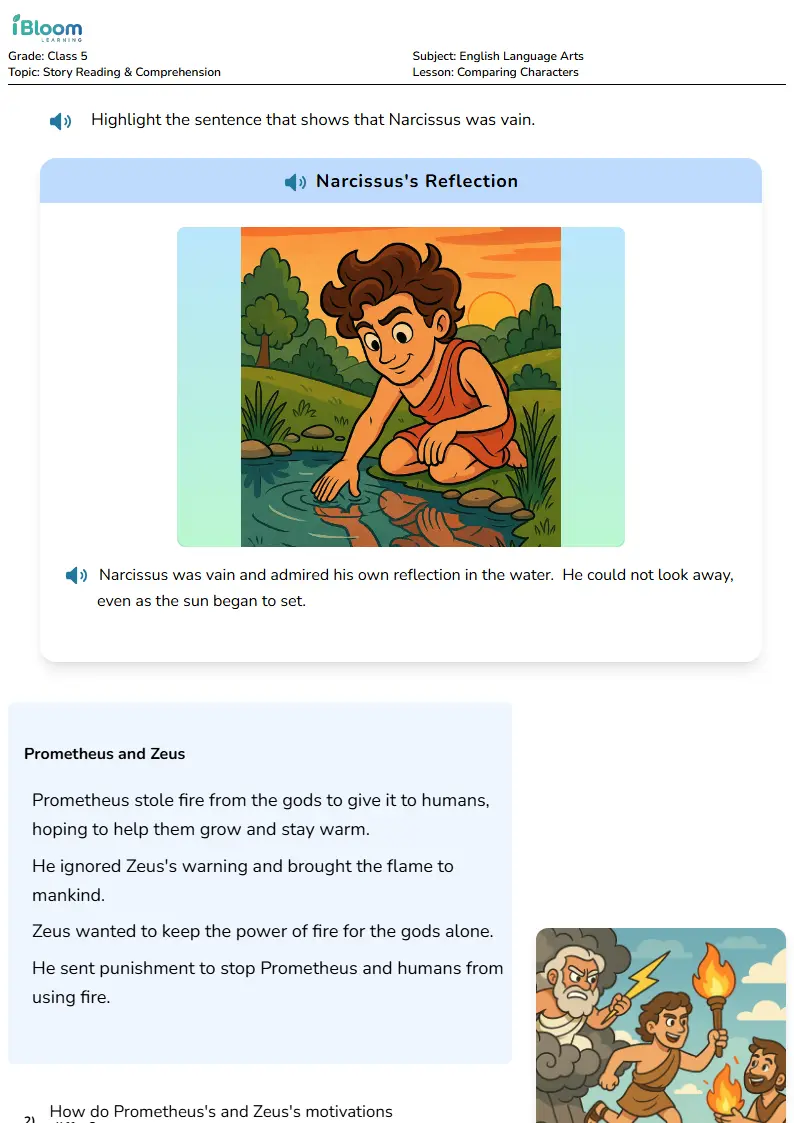
Free Comparing Characters Worksheets for Class 5
Looking for class 5 english language arts help? Download free, interactive comparing characters worksheets. AI-personalized and Common Core-aligned. Practice early literacy with iBloom.
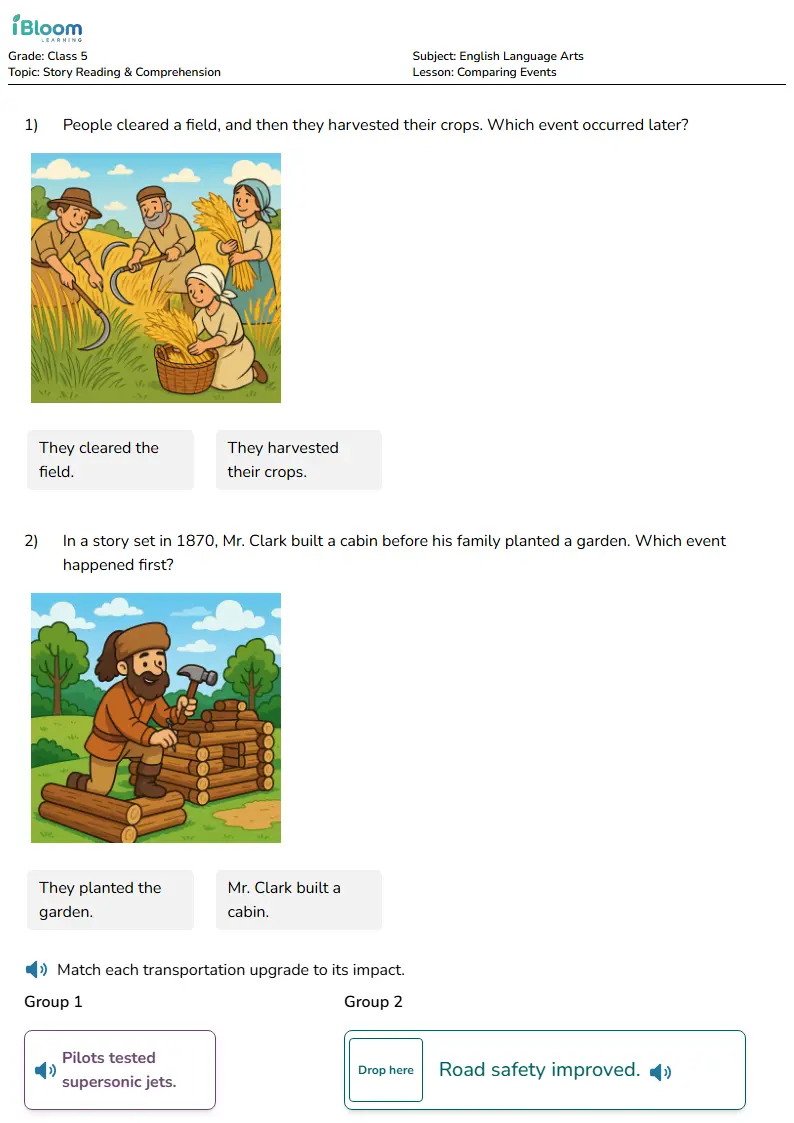
Free Comparing Events Worksheets for Class 5
Looking for class 5 english language arts help? Download free, interactive comparing events worksheets. AI-personalized and Common Core-aligned. Practice early literacy with iBloom.
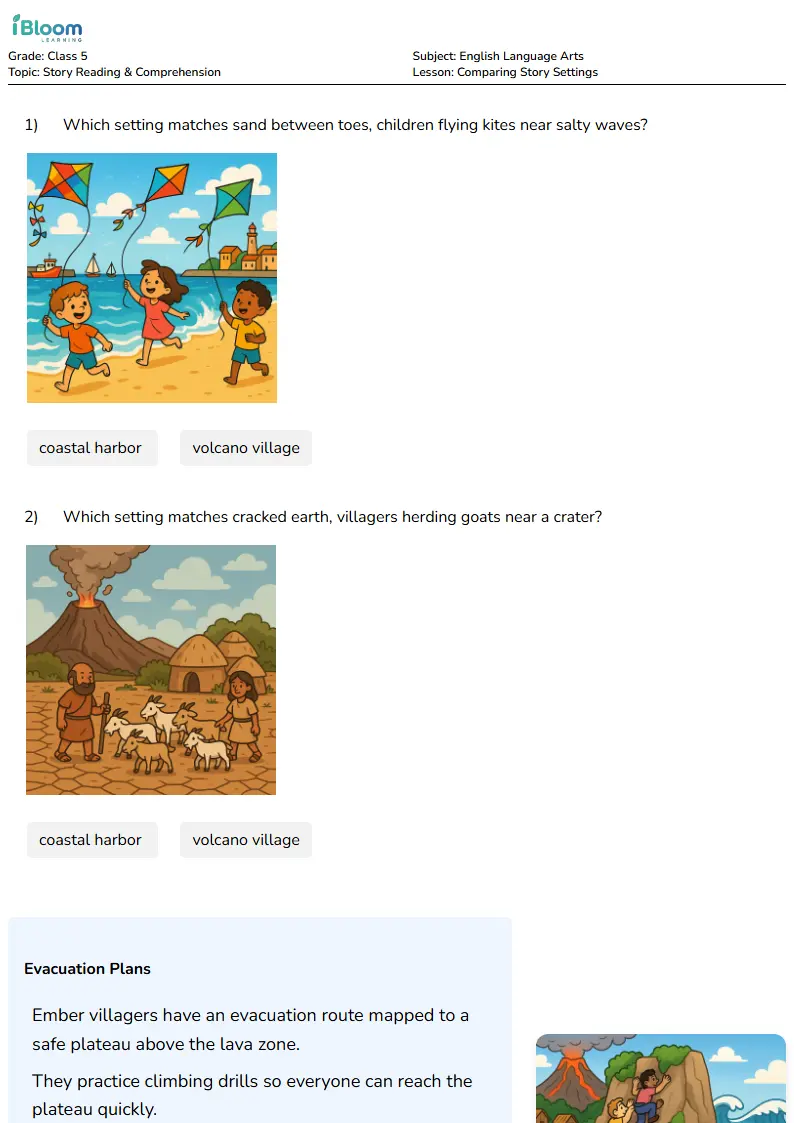
Free Comparing Story Settings Worksheets for Class 5
Looking for class 5 english language arts help? Download free, interactive comparing story settings worksheets. AI-personalized and Common Core-aligned. Practice early literacy with iBloom.
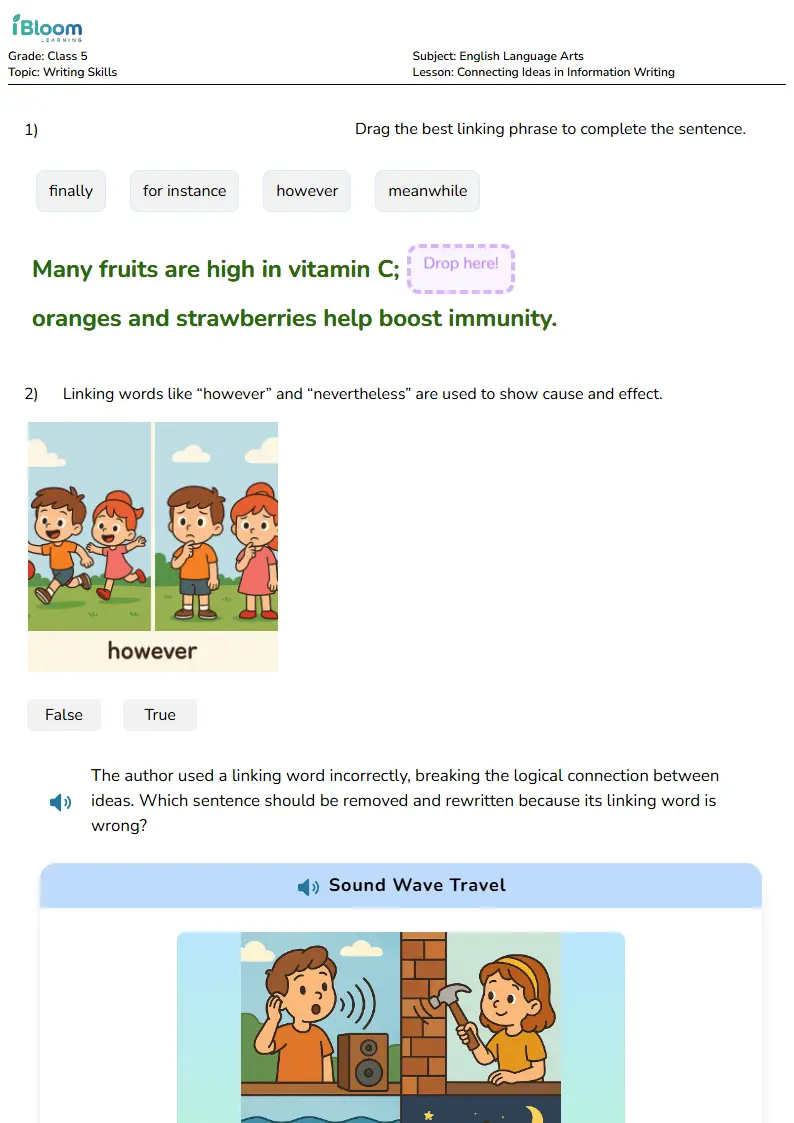
Free Connecting Ideas in Information Writing Worksheets for Class 5
Looking for class 5 english language arts help? Download free, interactive connecting ideas in information writing worksheets. AI-personalized and Common Core-aligned. Practice early literacy with iBloom.
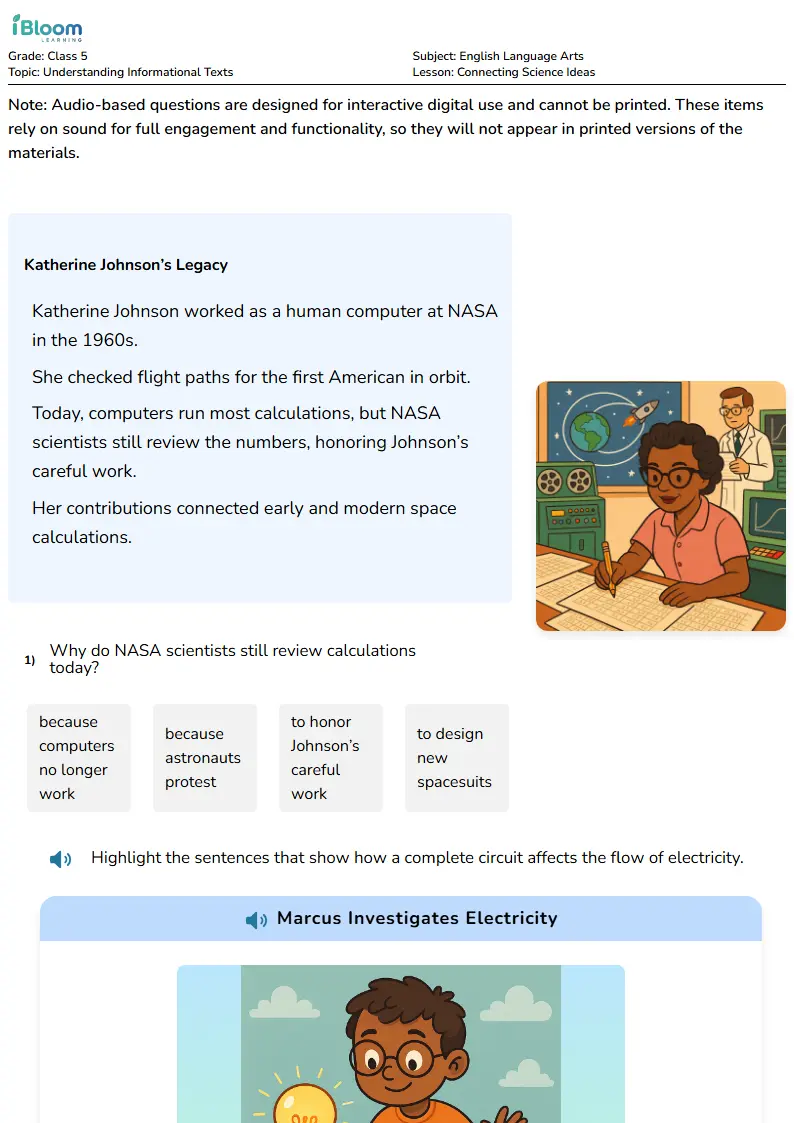
Free Connecting Science Ideas Worksheets for Class 5
Looking for class 5 english language arts help? Download free, interactive connecting science ideas worksheets. AI-personalized and Common Core-aligned. Practice early literacy with iBloom.
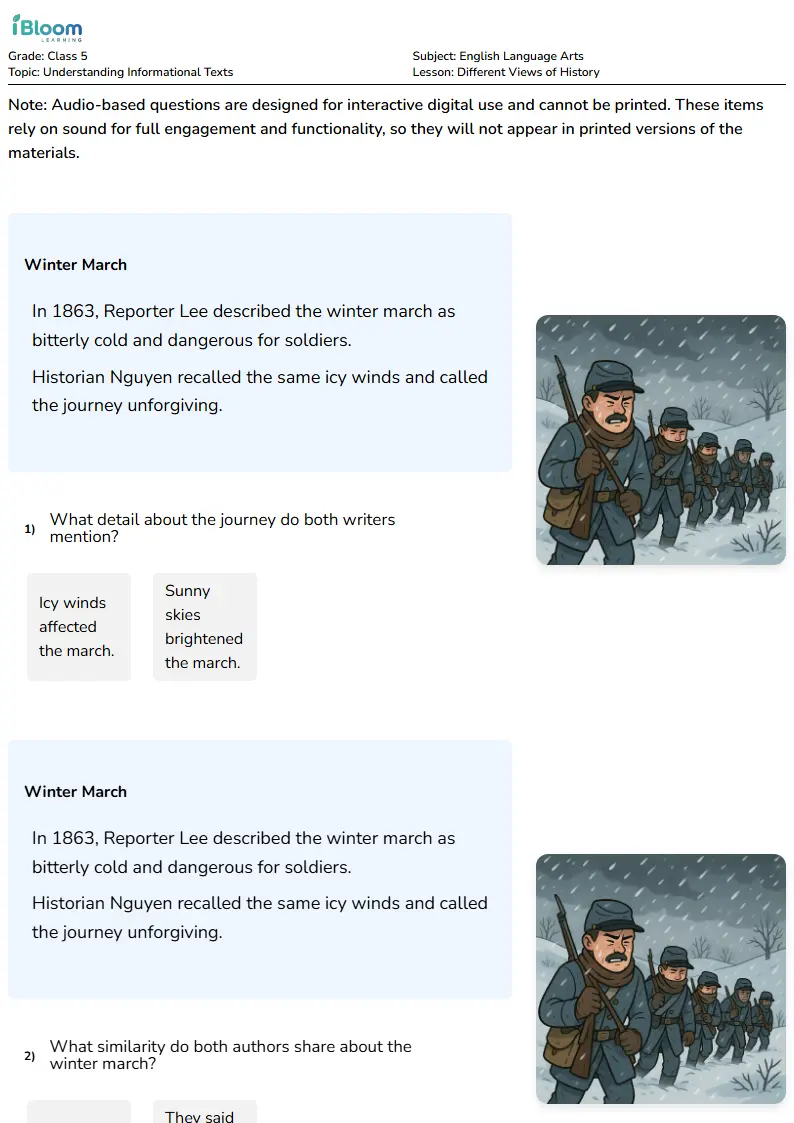
Free Different Views of History Worksheets for Class 5
Looking for class 5 english language arts help? Download free, interactive different views of history worksheets. AI-personalized and Common Core-aligned. Practice early literacy with iBloom.
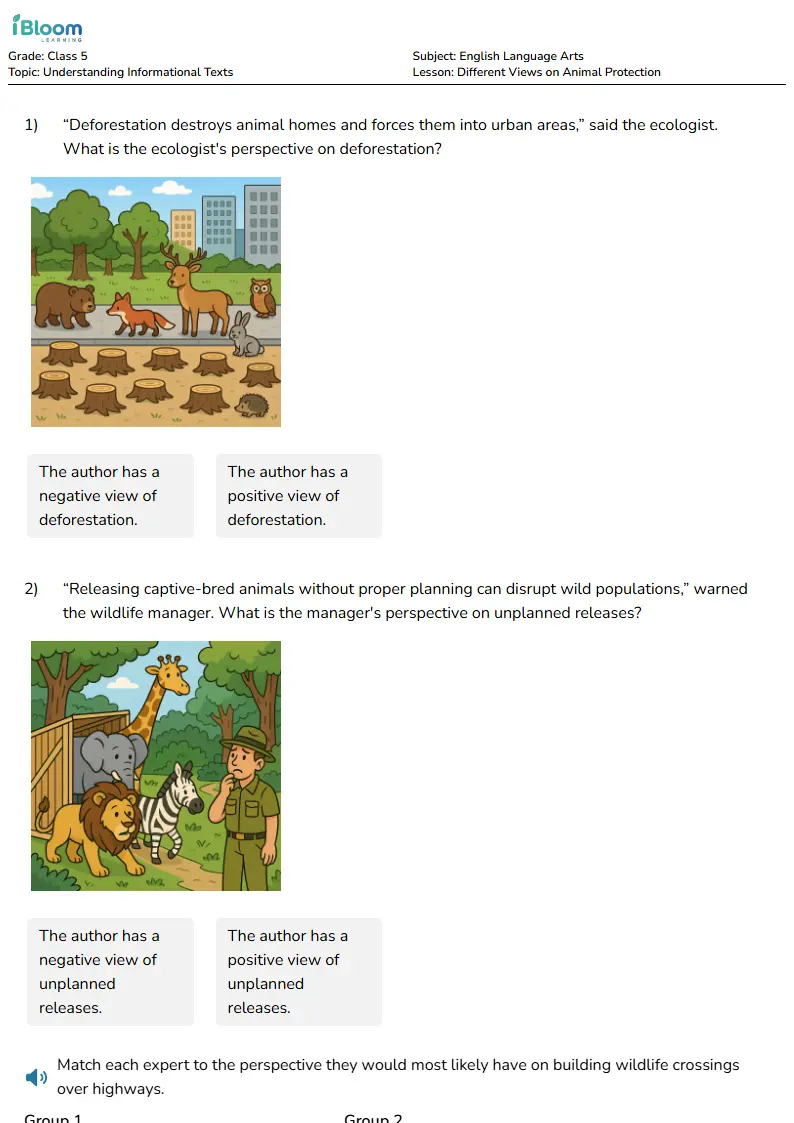
Free Different Views on Animal Protection Worksheets for Class 5
Looking for class 5 english language arts help? Download free, interactive different views on animal protection worksheets. AI-personalized and Common Core-aligned. Practice early literacy with iBloom.
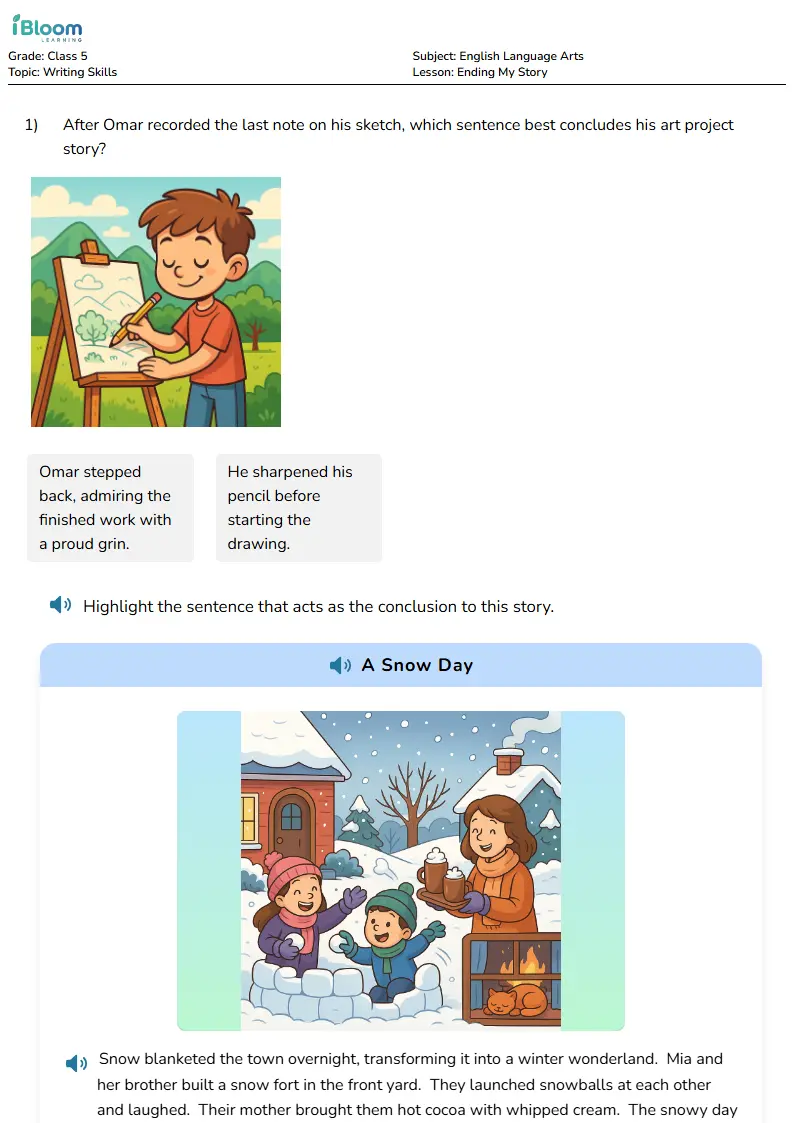
Free Ending My Story Worksheets for Class 5
Looking for class 5 english language arts help? Download free, interactive ending my story worksheets. AI-personalized and Common Core-aligned. Practice early literacy with iBloom.
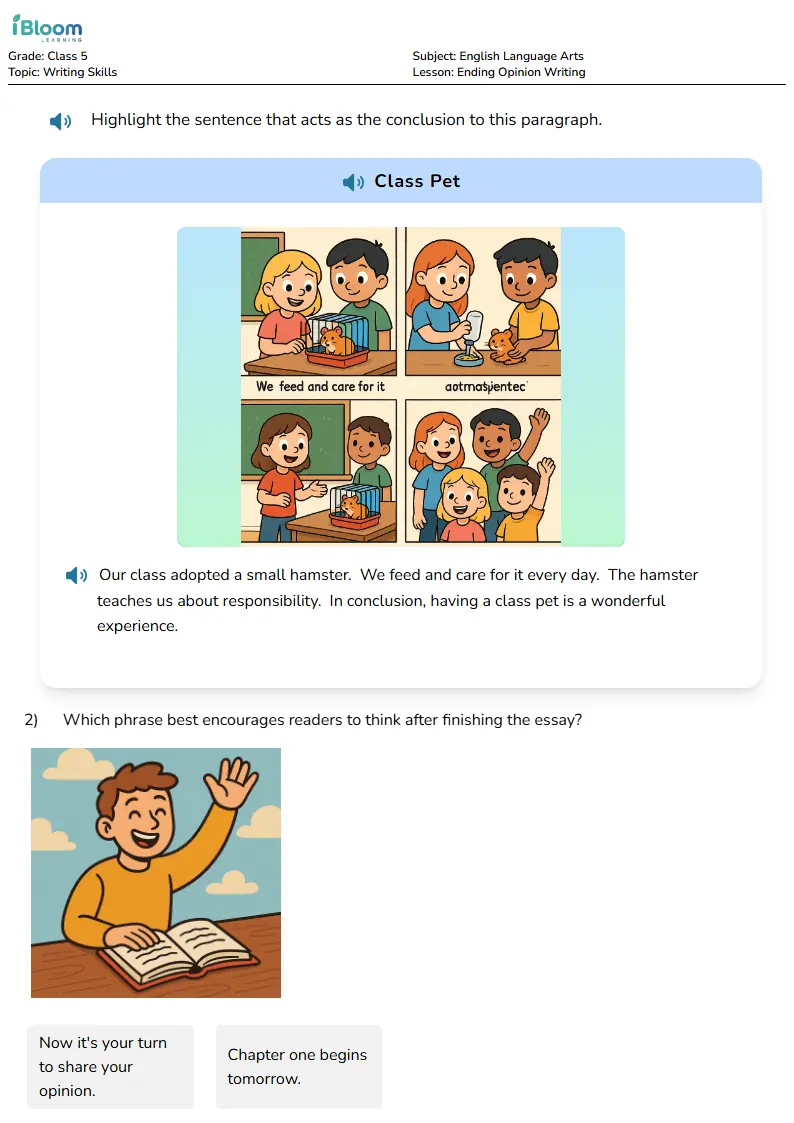
Free Ending Opinion Writing Worksheets for Class 5
Looking for class 5 english language arts help? Download free, interactive ending opinion writing worksheets. AI-personalized and Common Core-aligned. Practice early literacy with iBloom.
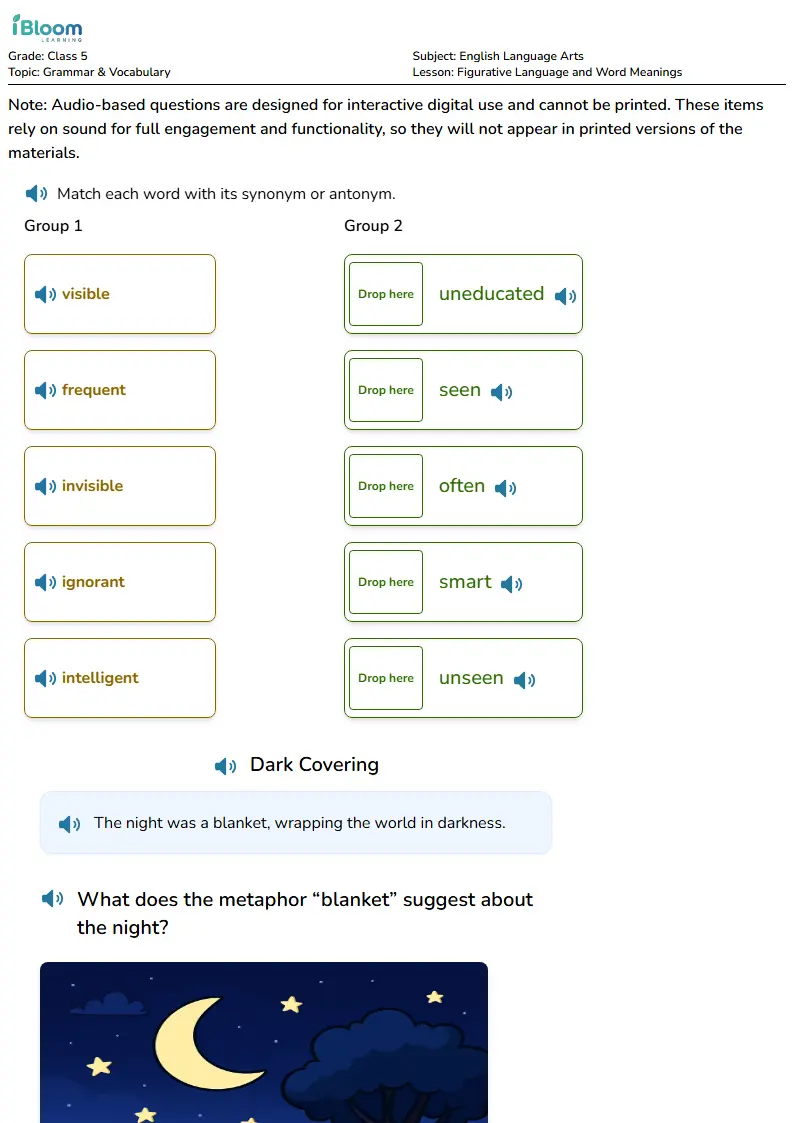
Free Figurative Language and Word Meanings Worksheets for Class 5
Looking for class 5 english language arts help? Download free, interactive figurative language and word meanings worksheets. AI-personalized and Common Core-aligned. Practice early literacy with iBloom.
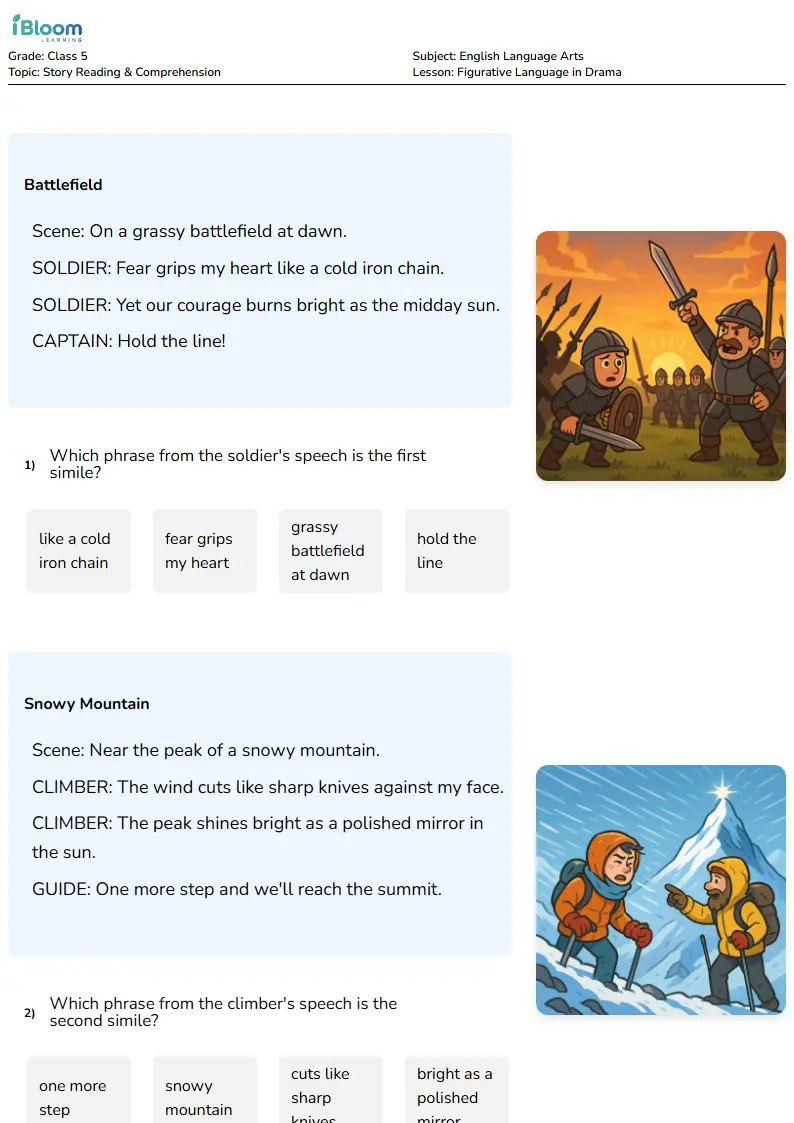
Free Figurative Language in Drama Worksheets for Class 5
Looking for class 5 english language arts help? Download free, interactive figurative language in drama worksheets. AI-personalized and Common Core-aligned. Practice early literacy with iBloom.
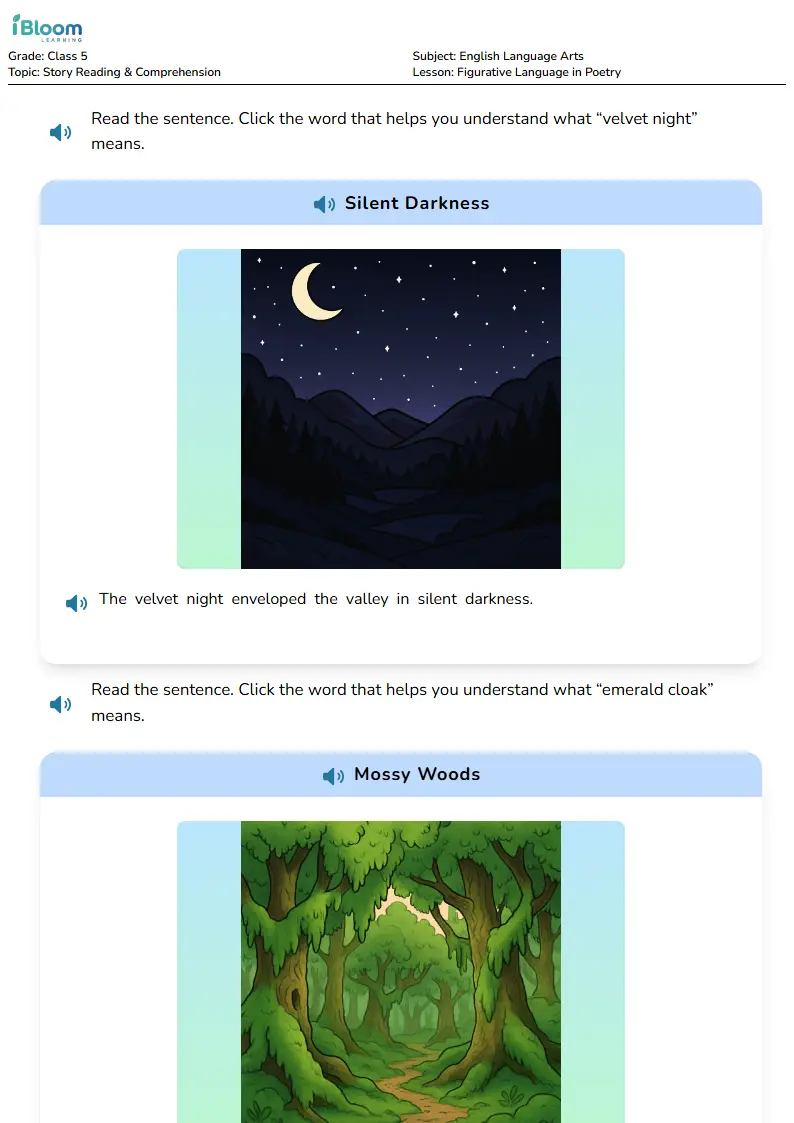
Free Figurative Language in Poetry Worksheets for Class 5
Looking for class 5 english language arts help? Download free, interactive figurative language in poetry worksheets. AI-personalized and Common Core-aligned. Practice early literacy with iBloom.
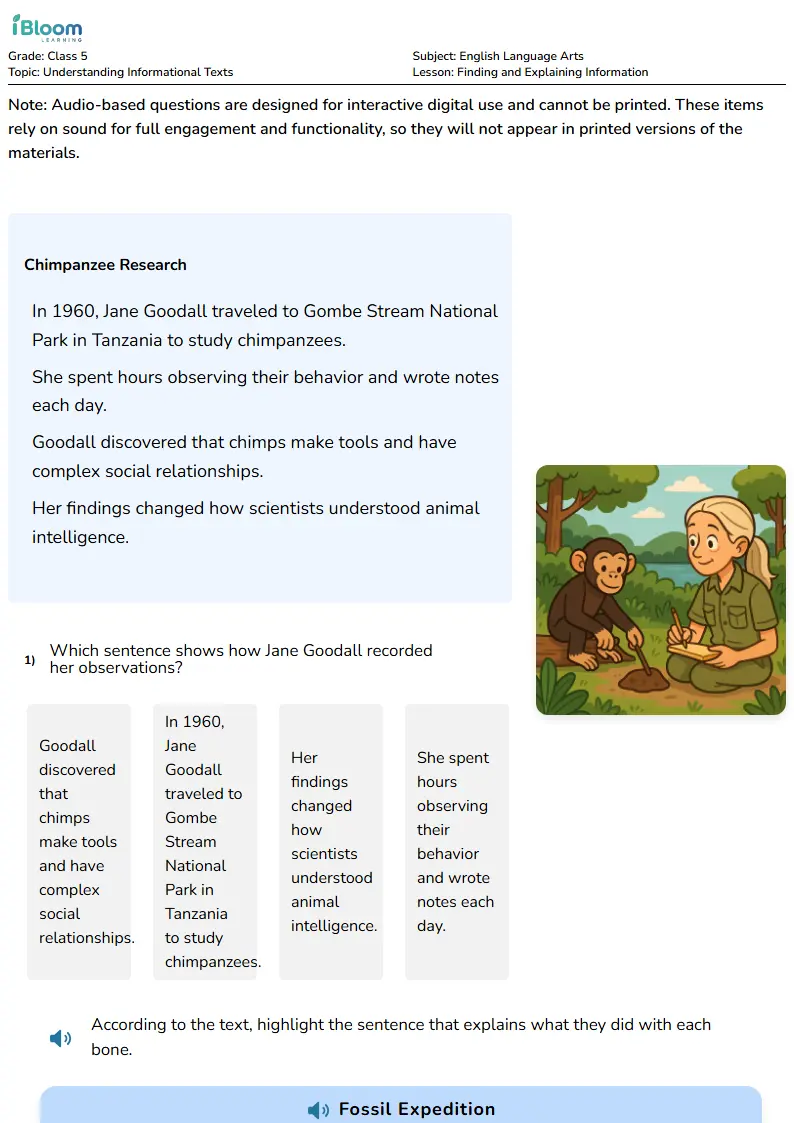
Free Finding and Explaining Information Worksheets for Class 5
Looking for class 5 english language arts help? Download free, interactive finding and explaining information worksheets. AI-personalized and Common Core-aligned. Practice early literacy with iBloom.
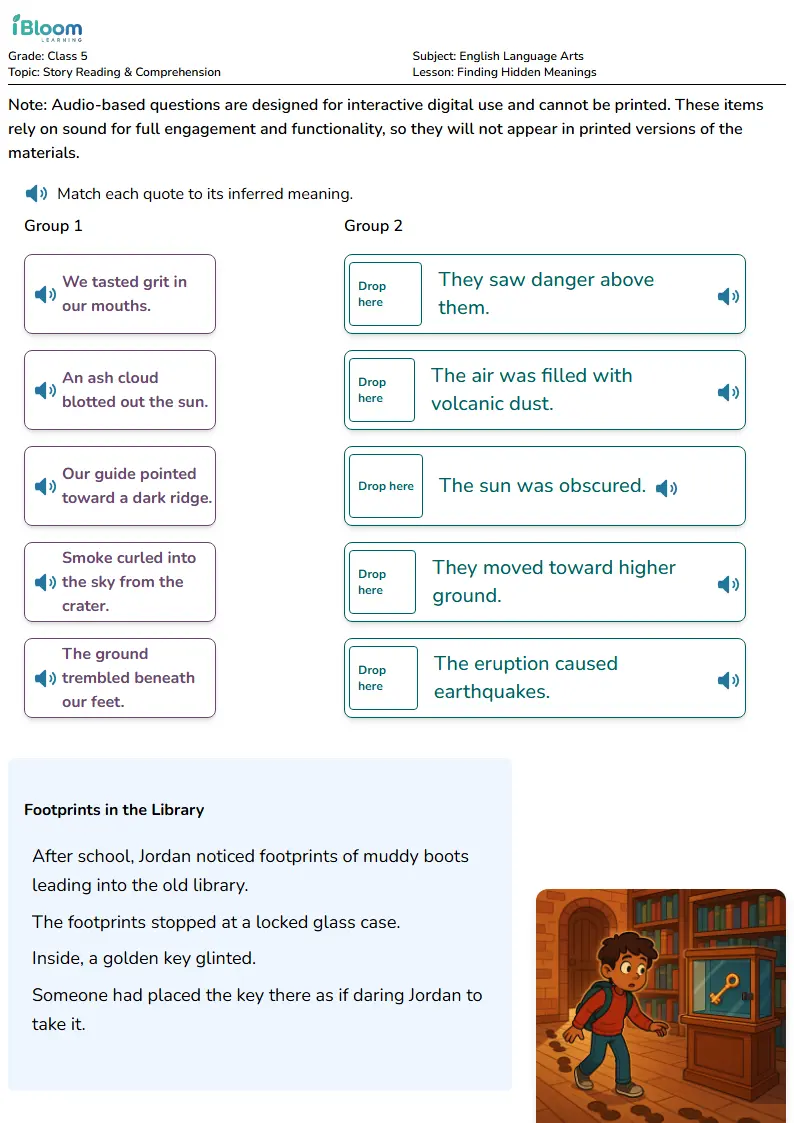
Free Finding Hidden Meanings Worksheets for Class 5
Looking for class 5 english language arts help? Download free, interactive finding hidden meanings worksheets. AI-personalized and Common Core-aligned. Practice early literacy with iBloom.
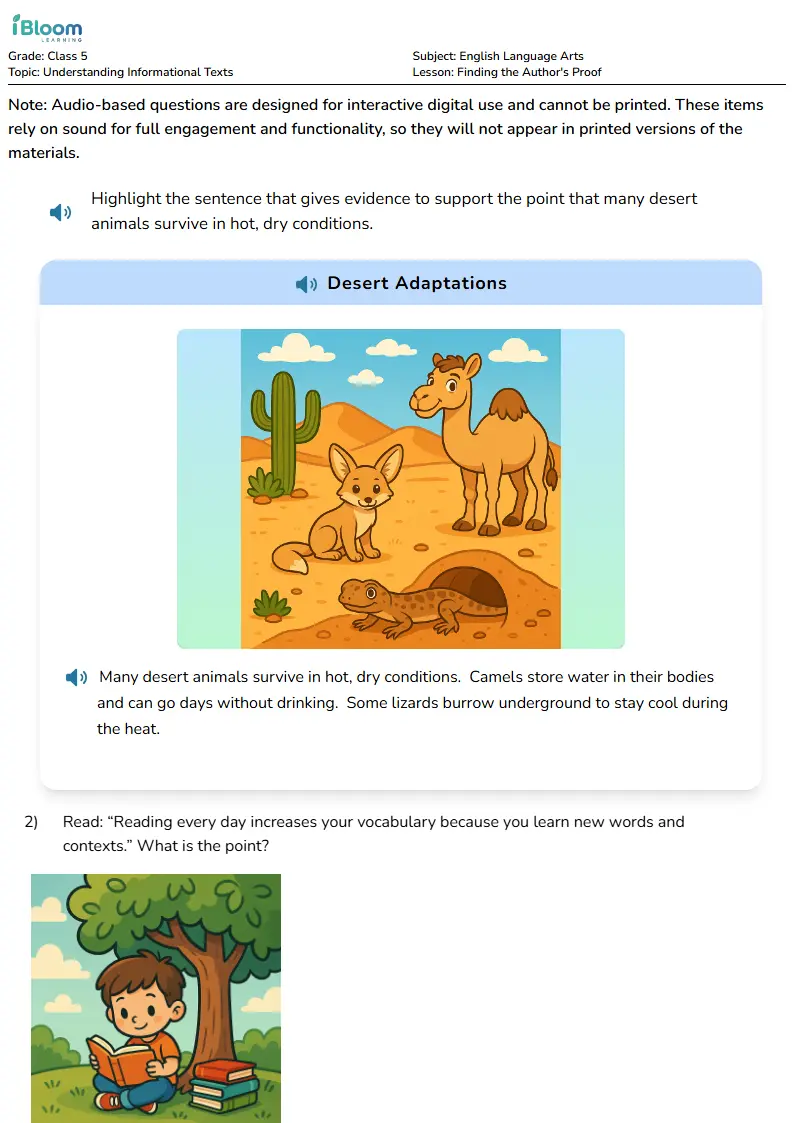
Free Finding the Author's Proof Worksheets for Class 5
Looking for class 5 english language arts help? Download free, interactive finding the author's proof worksheets. AI-personalized and Common Core-aligned. Practice early literacy with iBloom.
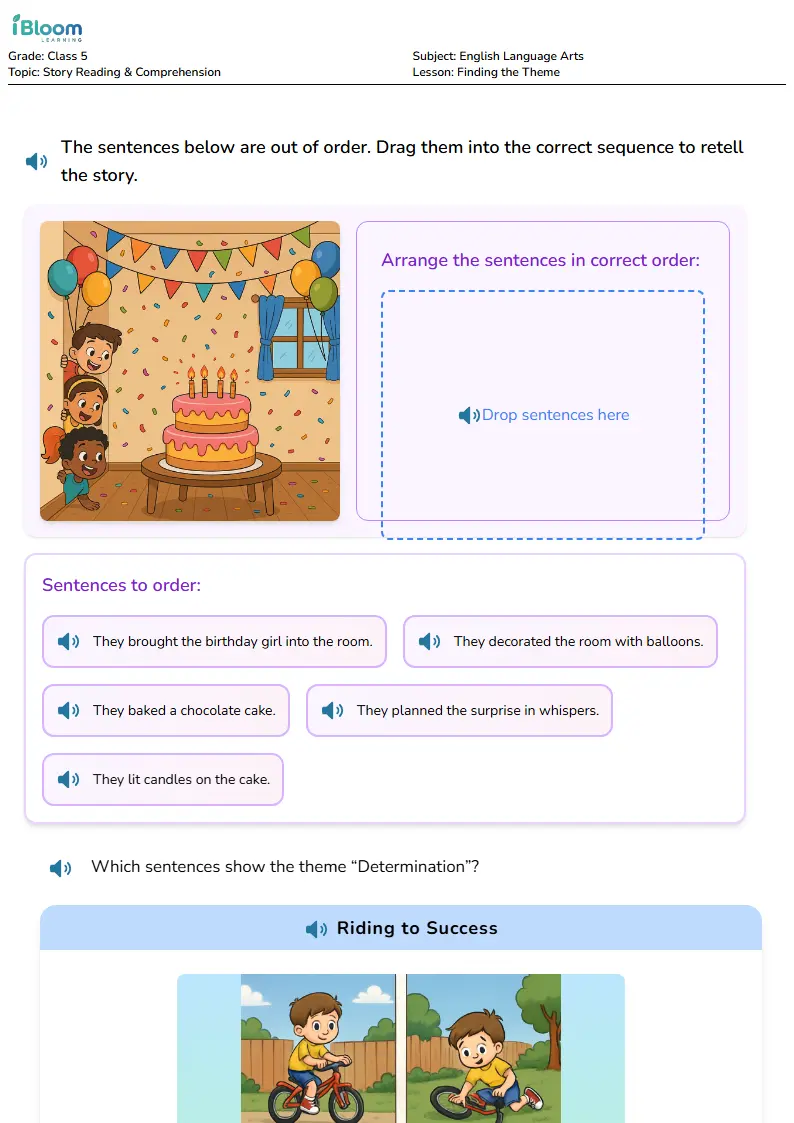
Free Finding the Theme Worksheets for Class 5
Looking for class 5 english language arts help? Download free, interactive finding the theme worksheets. AI-personalized and Common Core-aligned. Practice early literacy with iBloom.
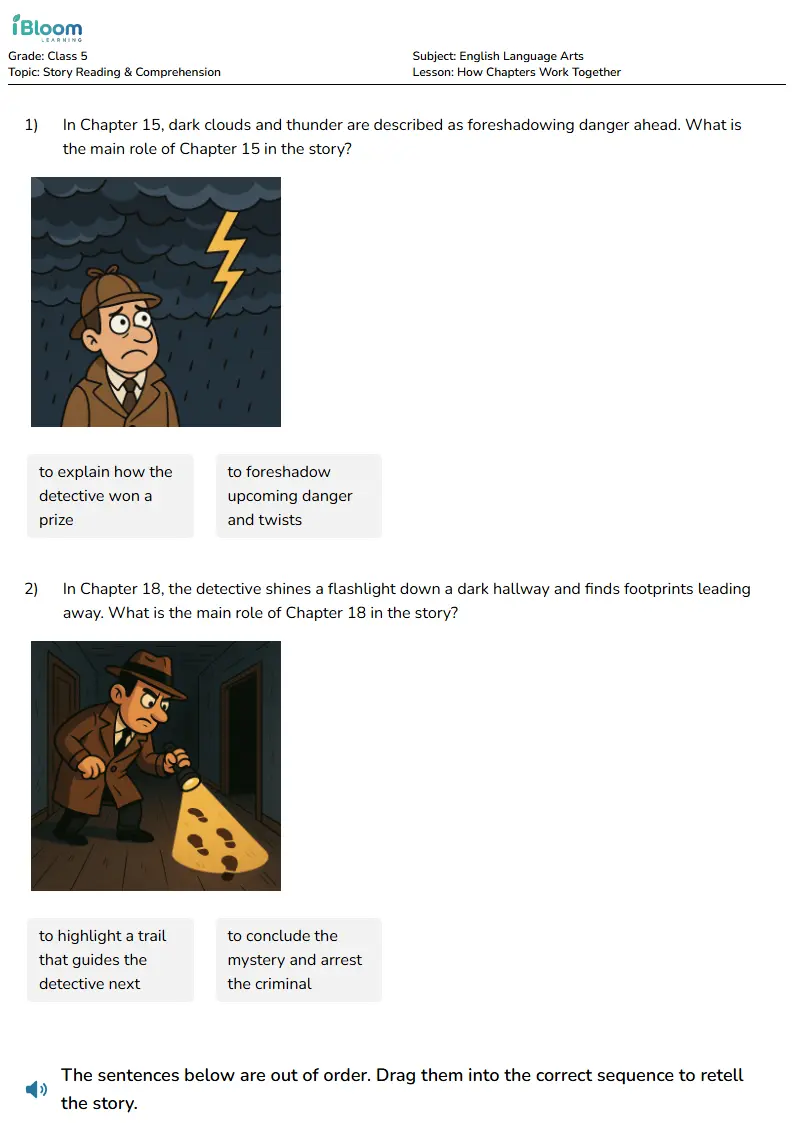
Free How Chapters Work Together Worksheets for Class 5
Looking for class 5 english language arts help? Download free, interactive how chapters work together worksheets. AI-personalized and Common Core-aligned. Practice early literacy with iBloom.
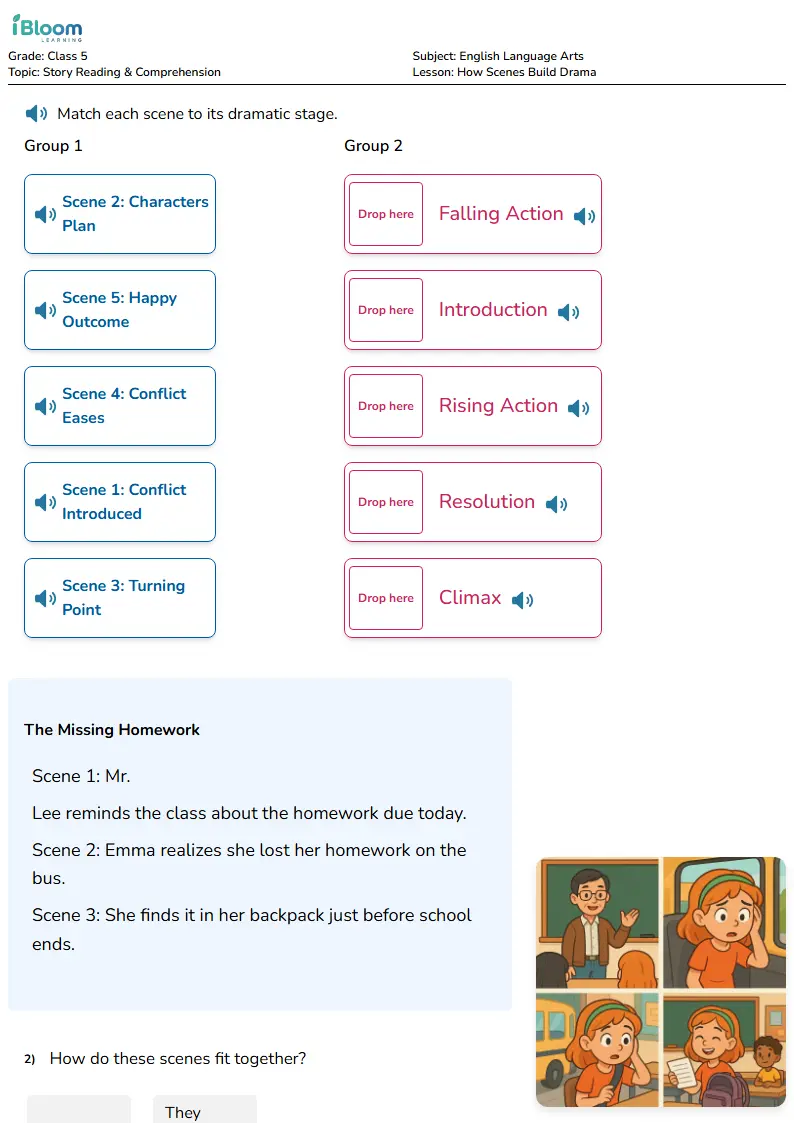
Free How Scenes Build Drama Worksheets for Class 5
Looking for class 5 english language arts help? Download free, interactive how scenes build drama worksheets. AI-personalized and Common Core-aligned. Practice early literacy with iBloom.
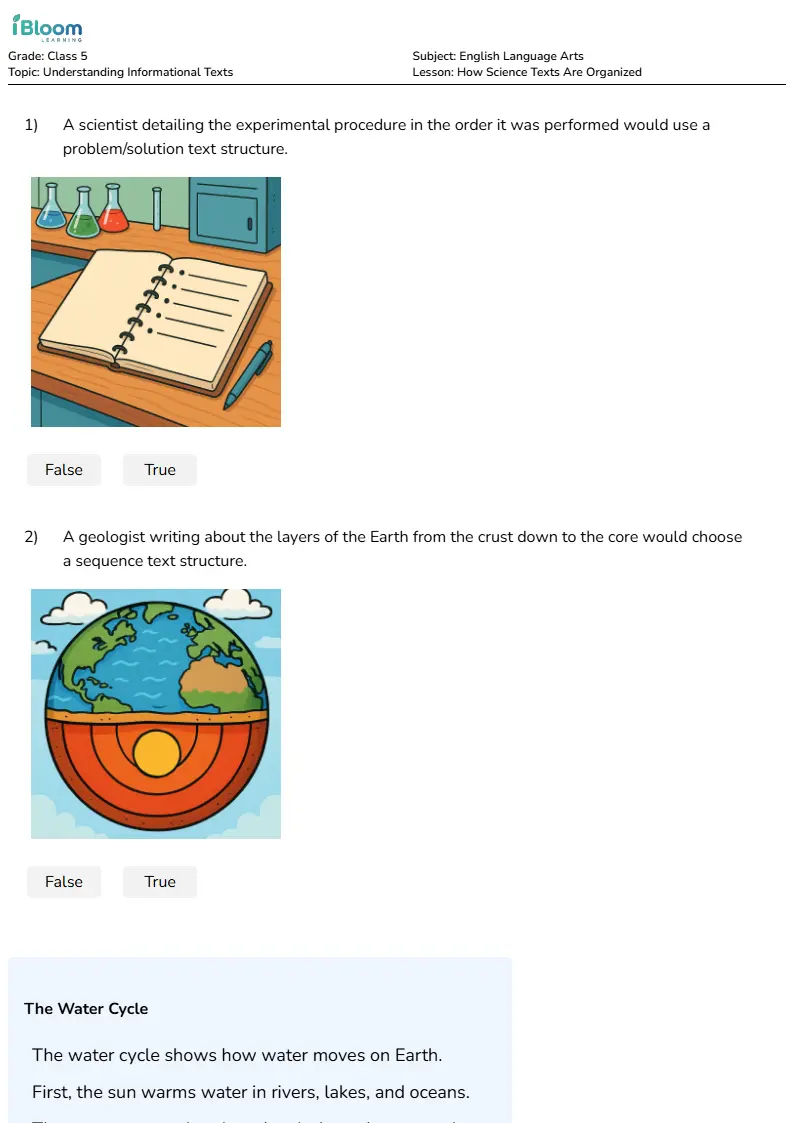
Free How Science Texts Are Organized Worksheets for Class 5
Looking for class 5 english language arts help? Download free, interactive how science texts are organized worksheets. AI-personalized and Common Core-aligned. Practice early literacy with iBloom.