Rounding Decimals To Tenths, Hundredths, Thousandths worksheet for Class 5

Lesson-Wise Builder
A premium AI tool that creates syllabus-aligned questions and worksheets for any lesson in seconds.
To round a decimal to the nearest tenth, hundredth or thousandth, find the requested place and inspect the digit immediately to its right. If that deciding digit is 0, 1, 2, 3 or 4, keep the target digit. If it is 5, 6, 7, 8 or 9, increase the target digit by one. Then remove the digits to the right of the rounded place.
About the examples: The worked numbers below are original teaching examples for this guide. They explain the skill but do not claim to reproduce a populated question set on the activity page.
What rounding a decimal means
Rounding replaces a decimal with a nearby value that is easier to use while keeping the requested level of precision. For example, 4.73 lies between 4.7 and 4.8. It is closer to 4.7, so 4.73 rounded to the nearest tenth is 4.7.
The word nearest matters. A number line can show the two possible benchmark values on either side of the decimal. The deciding digit is a quick place-value method for choosing the nearer benchmark. When a value is exactly halfway, the conventional school rule used in these examples rounds the target digit up.
Read tenths, hundredths and thousandths
| Position | Place name | Value of one unit | Digit in 26.843 |
|---|---|---|---|
| First | Tenths | 0.1 | 8 |
| Second | Hundredths | 0.01 | 4 |
| Third | Thousandths | 0.001 | 3 |
In 26.843, the 8 represents eight tenths, the 4 represents four hundredths and the 3 represents three thousandths. Do not confuse tenths with tens, hundredths with hundreds or thousandths with thousands. The ending -ths tells us that the place is a fraction of one whole.
A reliable four-step rounding routine
- Name the place: Decide whether the answer needs tenths, hundredths or thousandths.
- Mark the target digit: Underline the digit in that place.
- Inspect one digit: Circle the digit immediately to the right. This is the deciding digit.
- Round once: Keep the target digit for 0-4 or increase it for 5-9, then remove everything after the target place.
Round directly to the requested place. Do not round from thousandths to hundredths and then round that result to tenths. Repeated rounding can produce a different answer from inspecting the correct deciding digit in the original number.
Round to the nearest tenth
The tenths digit is the first digit after the decimal point. To round to tenths, inspect the hundredths digit.
Example: 4.73 to the nearest tenth
The target is the 7 in the tenths place. The deciding digit is 3, so the 7 stays unchanged. Therefore, 4.73 rounds to 4.7.
Example: 6.87 to the nearest tenth
The target is 8 and the deciding digit is 7. Increase 8 to 9 and remove the hundredths digit. Therefore, 6.87 rounds to 6.9.
More nearest-tenth checks
| Number | Deciding digit | Rounded value | Reason |
|---|---|---|---|
| 12.431 | 3 | 12.4 | Keep the tenths digit |
| 2.347 | 4 | 2.3 | Keep the tenths digit |
| 0.46 | 6 | 0.5 | Increase the tenths digit |
| 7.05 | 5 | 7.1 | Increase the tenths digit |
| 9.99 | 9 | 10.0 | Increasing 9 causes a carry |
| 15.24 | 4 | 15.2 | Keep the tenths digit |
| 3.65 | 5 | 3.7 | Halfway rounds up under this rule |
| 8.04 | 4 | 8.0 | Keep 0 in the tenths place |
Round to the nearest hundredth
The hundredths digit is the second digit after the decimal point. To round to hundredths, inspect the thousandths digit.
Example: 8.342 to the nearest hundredth
The target is 4 and the deciding digit is 2. Keep 4, so 8.342 rounds to 8.34.
Example: 5.678 to the nearest hundredth
The target is 7 and the deciding digit is 8. Increase 7 to 8, so 5.678 rounds to 5.68.
More nearest-hundredth checks
| Number | Deciding digit | Rounded value | Reason |
|---|---|---|---|
| 3.145 | 5 | 3.15 | Increase the hundredths digit |
| 26.843 | 3 | 26.84 | Keep the hundredths digit |
| 7.256 | 6 | 7.26 | Increase the hundredths digit |
| 0.104 | 4 | 0.10 | Keep the hundredths digit |
| 0.106 | 6 | 0.11 | Increase the hundredths digit |
| 4.996 | 6 | 5.00 | Rounding carries through both 9s |
| 12.304 | 4 | 12.30 | Keep the hundredths digit |
| 9.875 | 5 | 9.88 | Increase the hundredths digit |
Round to the nearest thousandth
The thousandths digit is the third digit after the decimal point. To round to thousandths, inspect the fourth decimal digit, called the ten-thousandths digit.
Example: 2.7184 to the nearest thousandth
The target is 8 and the deciding digit is 4. Keep the 8, so 2.7184 rounds to 2.718.
Example: 9.4167 to the nearest thousandth
The target is 6 and the deciding digit is 7. Increase 6 to 7, so 9.4167 rounds to 9.417.
More nearest-thousandth checks
| Number | Deciding digit | Rounded value | Reason |
|---|---|---|---|
| 6.2835 | 5 | 6.284 | Increase the thousandths digit |
| 0.1234 | 4 | 0.123 | Keep the thousandths digit |
| 0.9876 | 6 | 0.988 | Increase the thousandths digit |
| 12.3455 | 5 | 12.346 | Increase the thousandths digit |
| 4.0006 | 6 | 4.001 | Increase the thousandths digit |
| 7.9994 | 4 | 7.999 | Keep the thousandths digit |
| 7.9996 | 6 | 8.000 | Rounding carries into the whole number |
| 15.2038 | 8 | 15.204 | Increase the thousandths digit |
What happens when the deciding digit is 5
Under the conventional school rule used here, a deciding digit of 5 belongs with 5-9, so the target digit increases by one. For example, 1.05 rounded to the nearest tenth is 1.1, 0.105 rounded to the nearest hundredth is 0.11, and 6.2835 rounded to the nearest thousandth is 6.284.
Only the digit immediately to the right of the target decides the result. In 12.3455 rounded to the nearest thousandth, the final 5 is the deciding digit. Increase the thousandths digit 5 to 6; the answer is 12.346.
Carry correctly when the target digit is 9
Increasing a target digit of 9 creates 10, so write 0 in that position and carry 1 to the place on its left. The carry may continue through more than one 9.
Why 4.996 becomes 5.00
To round 4.996 to the nearest hundredth, inspect the 6. The hundredths digit 9 must increase, which carries into the tenths digit. That tenths digit is also 9, so the carry continues into the ones place. The result is 5.00.
Why 7.9996 becomes 8.000
To round to the nearest thousandth, inspect the final 6. Increasing the thousandths digit carries through the three 9s and changes the whole-number part from 7 to 8. The result is 8.000.
Why trailing zeros can matter
Decimals such as 7.5 and 7.50 have the same numerical value. However, 7.50 communicates that the value has been written to the hundredths place. When a question asks for the nearest hundredth, retaining two decimal places makes the requested precision visible.
That is why 4.996 rounded to the nearest hundredth is written as 5.00 rather than simply 5, and why 7.9996 rounded to the nearest thousandth is written as 8.000. The zeros do not change the value; they show the place to which the number was rounded.
Rounding is not the same as truncating
Truncating means cutting off digits after a chosen place without checking the next digit. Rounding uses the next digit to choose the nearest value. For 5.678 to two decimal places, truncating gives 5.67, while rounding gives 5.68 because the thousandths digit is 8.
Another common error is changing every digit after the target one at a time. Instead, look once at the original deciding digit and round directly to the requested place.
Common decimal-rounding mistakes
- Marking the wrong place: Count positions to the right of the decimal point before inspecting another digit.
- Looking too far right: Only the digit immediately after the target place decides whether the target changes.
- Rounding in stages: Work from the original decimal, not from a result rounded to another place.
- Changing earlier digits: Digits to the left stay unchanged unless increasing a 9 creates a carry.
- Cutting off for every answer: A deciding digit of 5-9 requires the target digit to increase.
- Dropping useful zeros: Preserve one, two or three decimal places when the question asks for tenths, hundredths or thousandths.
- Confusing the place names: Tenths, hundredths and thousandths are to the right of the decimal point.
How to check whether an answer is reasonable
- Count the decimal places in the answer. Tenths needs one, hundredths needs two and thousandths needs three.
- Name the lower and upper benchmarks around the original value.
- Check which benchmark is nearer, or apply the halfway rule if the distances match.
- Confirm that the deciding digit came from the original number.
- For a carry, rebuild the place-value change from right to left.
For example, 26.843 lies between 26.84 and 26.85 when rounding to hundredths. It is 0.003 above 26.84 and 0.007 below 26.85, so 26.84 is reasonable. This distance check supports the place-value rule.
Parent guide for practice at home
Begin by asking the child to name the requested place before doing any calculation. Use a short spoken routine: mark the place, look next door, decide, then write the requested number of places. Ask the child to explain why an answer rounds up or stays.
Money can make hundredths familiar: two digits after the decimal point can represent paise within a rupee amount. Measurement examples can illustrate tenths or thousandths, but label units carefully and keep the mathematical focus on place value. Mix values below one, values near a whole number and values that require a carry.
Teacher ideas for Class 5
Start with a place-value chart and a number line before introducing the short rule. Give pairs of benchmark values such as 8.34 and 8.35, then ask learners where 8.342 belongs. This connects the deciding-digit procedure with the meaning of nearest.
- Warm-up: Name the place occupied by a highlighted digit.
- Guided example: Mark the target and deciding digits in different colours.
- Error analysis: Compare rounding with truncating and ask which step changed the answer.
- Mixed practice: Change the requested place while keeping the original number visible.
- Exit question: Include a value ending in 9 so learners must explain a carry and retain precision zeros.
Related iBloom decimal practice
- Rounding Decimals to Tenths, Hundredths and Thousandths lesson for Class 5 addresses the same target-place skill.
- Understanding Decimal Place Value for Class 5 supports identification of tenths, hundredths and thousandths.
- Comparing Decimal Numbers up to Thousandths for Class 5 helps learners judge which benchmark is nearer.
- Decimals in Word, Standard and Expanded Form for Class 5 reinforces the value represented by each decimal digit.
Frequently Asked Questions
What does nearest tenth mean?
It means choosing the closest value with one digit after the decimal point. Inspect the hundredths digit to decide whether the tenths digit stays or increases.
What does nearest hundredth mean?
It means choosing the closest value with two digits after the decimal point. Inspect the thousandths digit to decide what happens to the hundredths digit.
What does nearest thousandth mean?
It means choosing the closest value with three digits after the decimal point. Inspect the ten-thousandths digit to decide what happens to the thousandths digit.
Which digit decides decimal rounding?
The deciding digit is immediately to the right of the place being rounded. Digits farther right do not need to be processed separately.
Does 5 always round up in this guide?
Yes. These examples use the conventional school rule in which a deciding digit from 5 through 9 increases the target digit by one.
Should a rounded decimal keep trailing zeros?
Keep them when they communicate the requested place. Writing 5.00 shows a result rounded to hundredths, even though 5, 5.0 and 5.00 have the same value.
Is rounding the same as truncating?
No. Truncating only removes later digits. Rounding inspects the next digit and may increase the target digit.
How do you round a decimal ending in 9?
If the target 9 must increase, write 0 in that place and carry 1 to the left. Continue the carry through any additional 9s.
Why does 4.996 round to 5.00?
For nearest hundredth, the deciding digit is 6, so the hundredths 9 increases. The carry passes through the tenths 9 and raises 4 to 5. Two zeros show hundredth-place precision.
More practice for this grade
More Math worksheets
.webp)
Free Adding and Subtracting Fractions (Unlike Denominators and Mixed Numbers) Worksheets for Class 5
Looking for class 5 math help? Download free, interactive adding and subtracting fractions (unlike denominators and mixed numbers) worksheets. AI-personalized and Common Core-aligned. Practice math with iBloom.
Free Adding Decimal Numbers up to Hundredths Worksheets for Class 5
Looking for class 5 math help? Download free, interactive adding decimal numbers up to hundredths worksheets. AI-personalized and Common Core-aligned. Practice math with iBloom.
Free Adding Decimal Numbers up to Tenths Worksheets for Class 5
Looking for class 5 math help? Download free, interactive adding decimal numbers up to tenths worksheets. AI-personalized and Common Core-aligned. Practice math with iBloom.
Free Adding Fractions with Different Denominators Worksheets for Class 5
Looking for class 5 math help? Download free, interactive adding fractions with different denominators worksheets. AI-personalized and Common Core-aligned. Practice math with iBloom.
.webp)
Free Adding Fractions with Unlike Denominators (Including Mixed Fractions) Worksheets for Class 5
Looking for class 5 math help? Download free, interactive adding fractions with unlike denominators (including mixed fractions) worksheets. AI-personalized and Common Core-aligned. Practice math with iBloom.
Free Comparing Decimal Numbers up to Hundredths Worksheets for Class 5
Looking for class 5 math help? Download free, interactive comparing decimal numbers up to hundredths worksheets. AI-personalized and Common Core-aligned. Practice math with iBloom.
Free Comparing Decimal Numbers up to Tenths Worksheets for Class 5
Looking for class 5 math help? Download free, interactive comparing decimal numbers up to tenths worksheets. AI-personalized and Common Core-aligned. Practice math with iBloom.
Free Comparing Decimal Numbers up to Thousandths Worksheets for Class 5
Looking for class 5 math help? Download free, interactive comparing decimal numbers up to thousandths worksheets. AI-personalized and Common Core-aligned. Practice math with iBloom.
Free Converting Decimal Numbers from Expanded to Standard Form Worksheets for Class 5
Looking for class 5 math help? Download free, interactive converting decimal numbers from expanded to standard form worksheets. AI-personalized and Common Core-aligned. Practice math with iBloom.
Free Converting Decimal Numbers from Numbers to Words Worksheets for Class 5
Looking for class 5 math help? Download free, interactive converting decimal numbers from numbers to words worksheets. AI-personalized and Common Core-aligned. Practice math with iBloom.
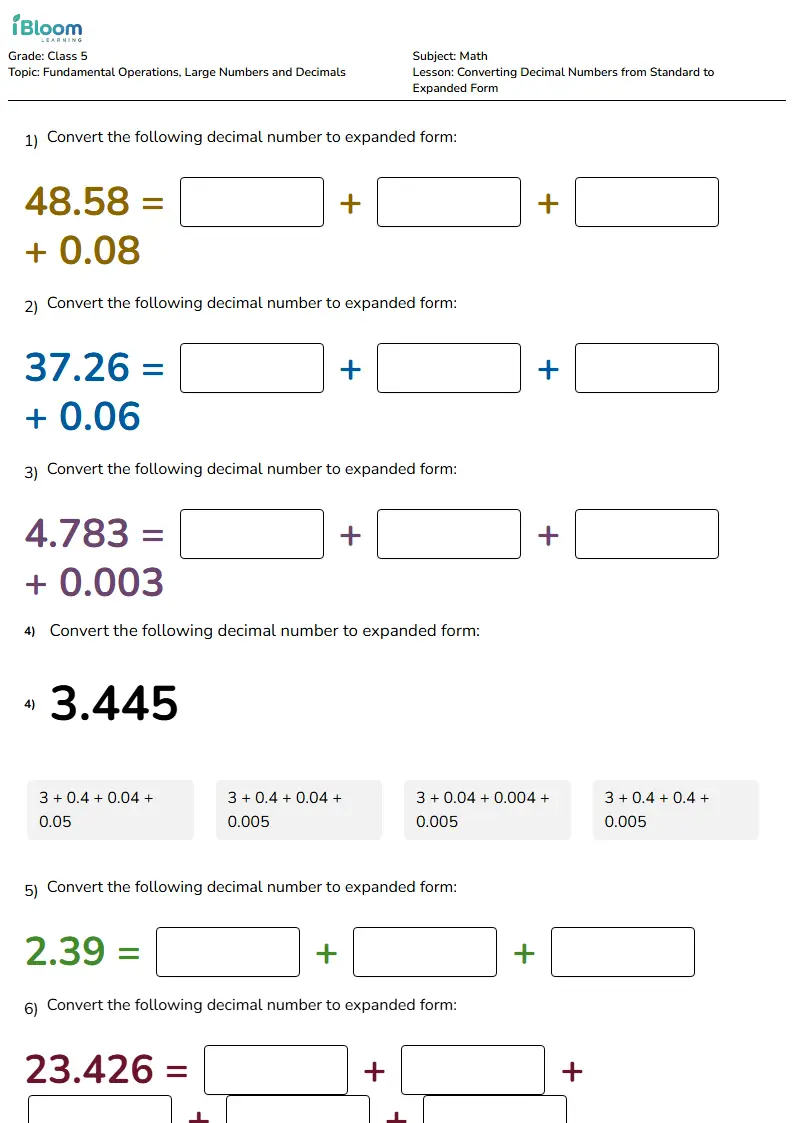
Free Converting Decimal Numbers from Standard to Expanded Form Worksheets for Class 5
Looking for class 5 math help? Download free, interactive converting decimal numbers from standard to expanded form worksheets. AI-personalized and Common Core-aligned. Practice math with iBloom.
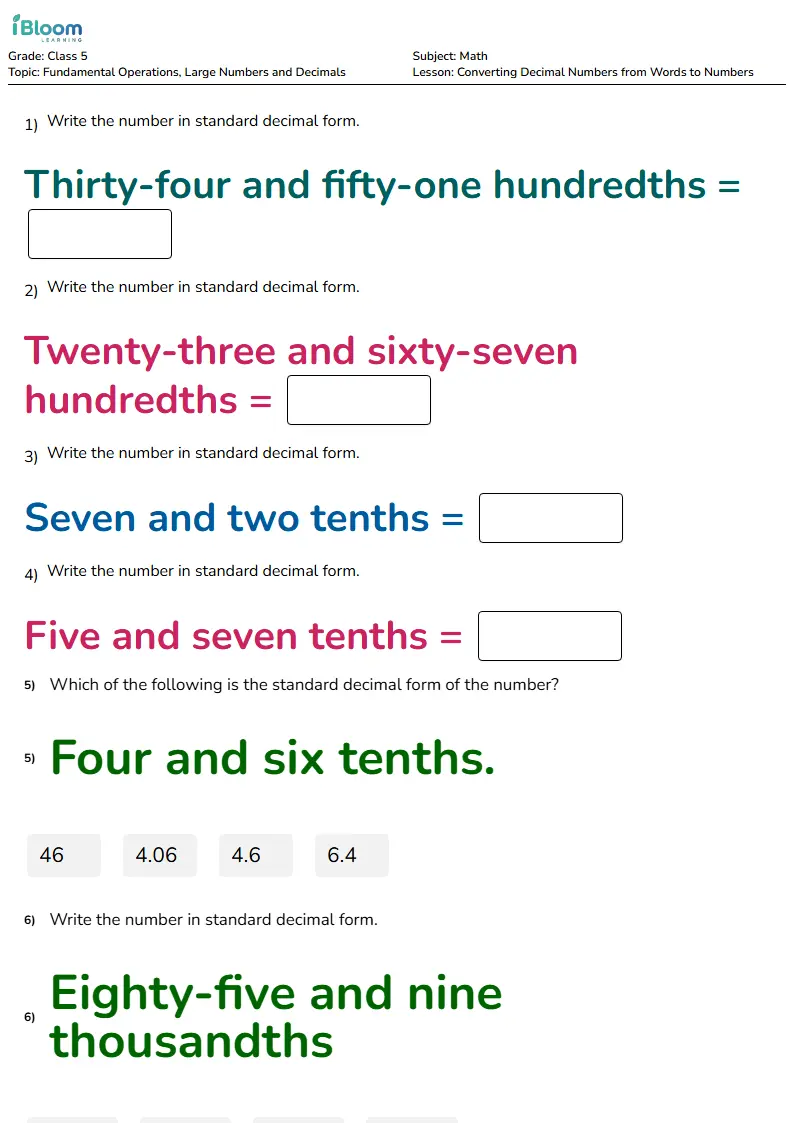
Free Converting Decimal Numbers from Words to Numbers Worksheets for Class 5
Looking for class 5 math help? Download free, interactive converting decimal numbers from words to numbers worksheets. AI-personalized and Common Core-aligned. Practice math with iBloom.
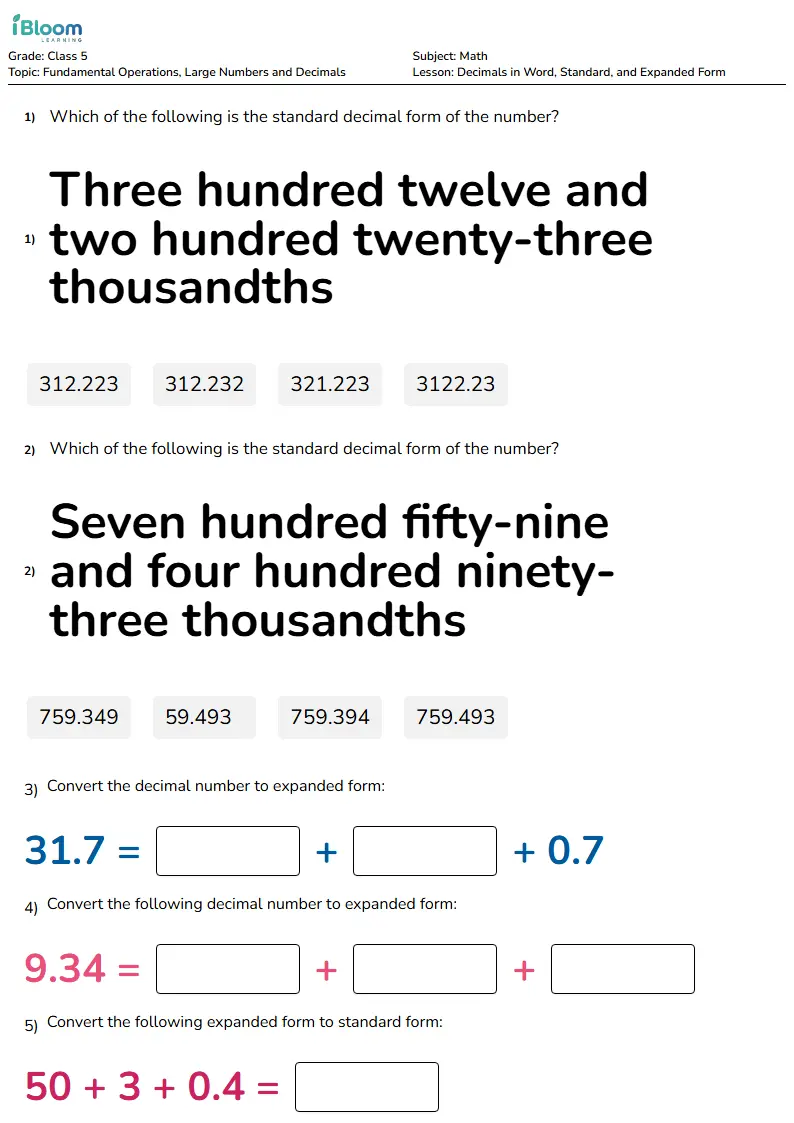
Free Decimals in Word, Standard, and Expanded Form Worksheets for Class 5
Looking for class 5 math help? Download free, interactive decimals in word, standard, and expanded form worksheets. AI-personalized and Common Core-aligned. Practice math with iBloom.
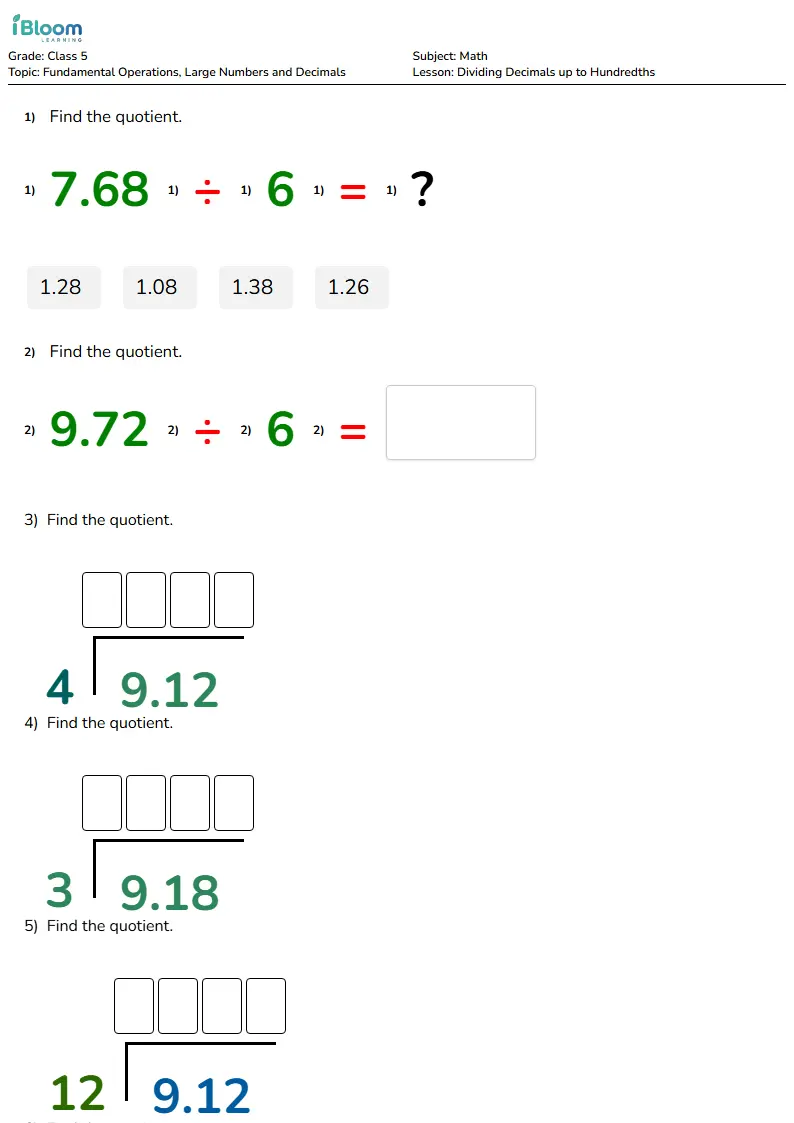
Free Dividing Decimals up to Hundredths Worksheets for Class 5
Looking for class 5 math help? Download free, interactive dividing decimals up to hundredths worksheets. AI-personalized and Common Core-aligned. Practice math with iBloom.
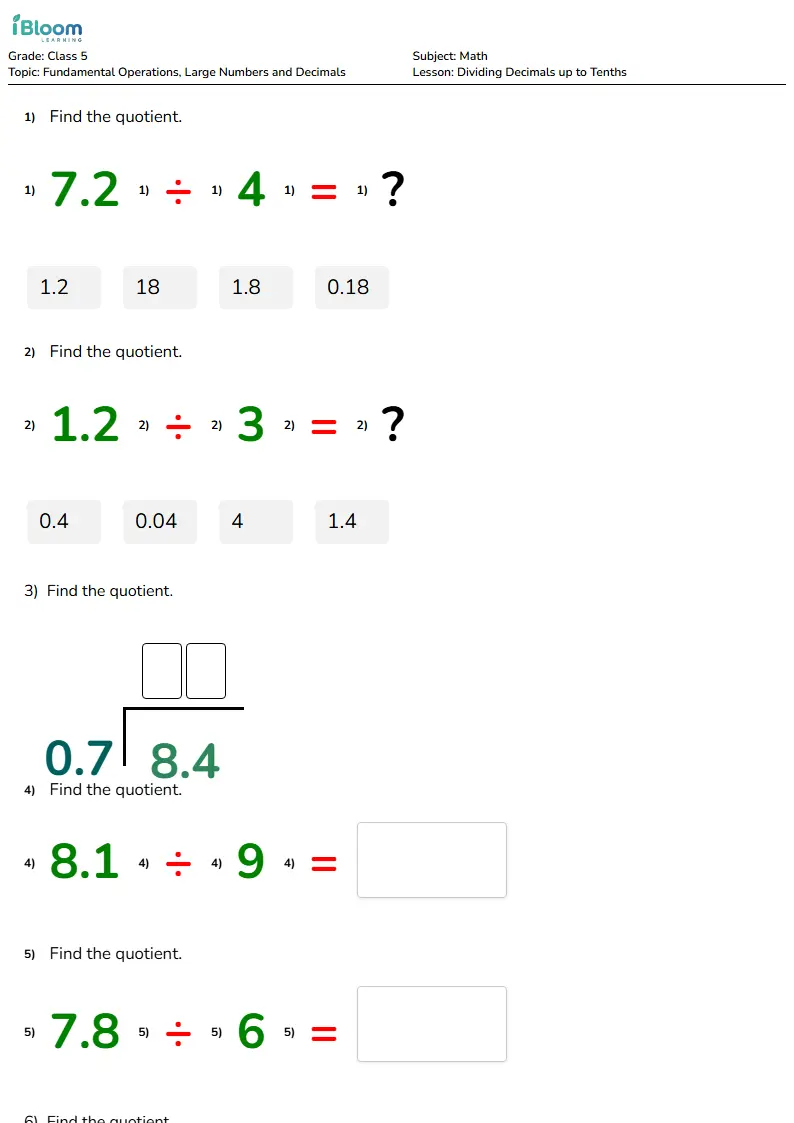
Free Dividing Decimals up to Tenths Worksheets for Class 5
Looking for class 5 math help? Download free, interactive dividing decimals up to tenths worksheets. AI-personalized and Common Core-aligned. Practice math with iBloom.
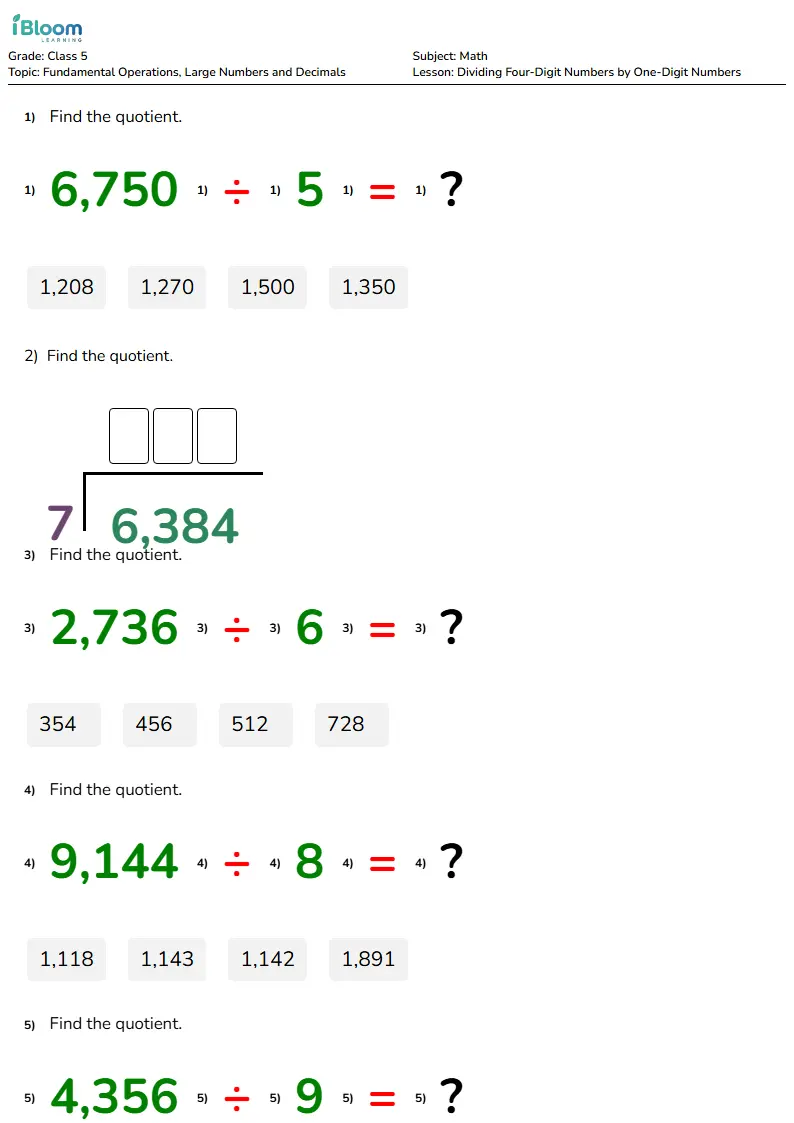
Free Dividing Four-Digit Numbers by One-Digit Numbers Worksheets for Class 5
Looking for class 5 math help? Download free, interactive dividing four-digit numbers by one-digit numbers worksheets. AI-personalized and Common Core-aligned. Practice math with iBloom.
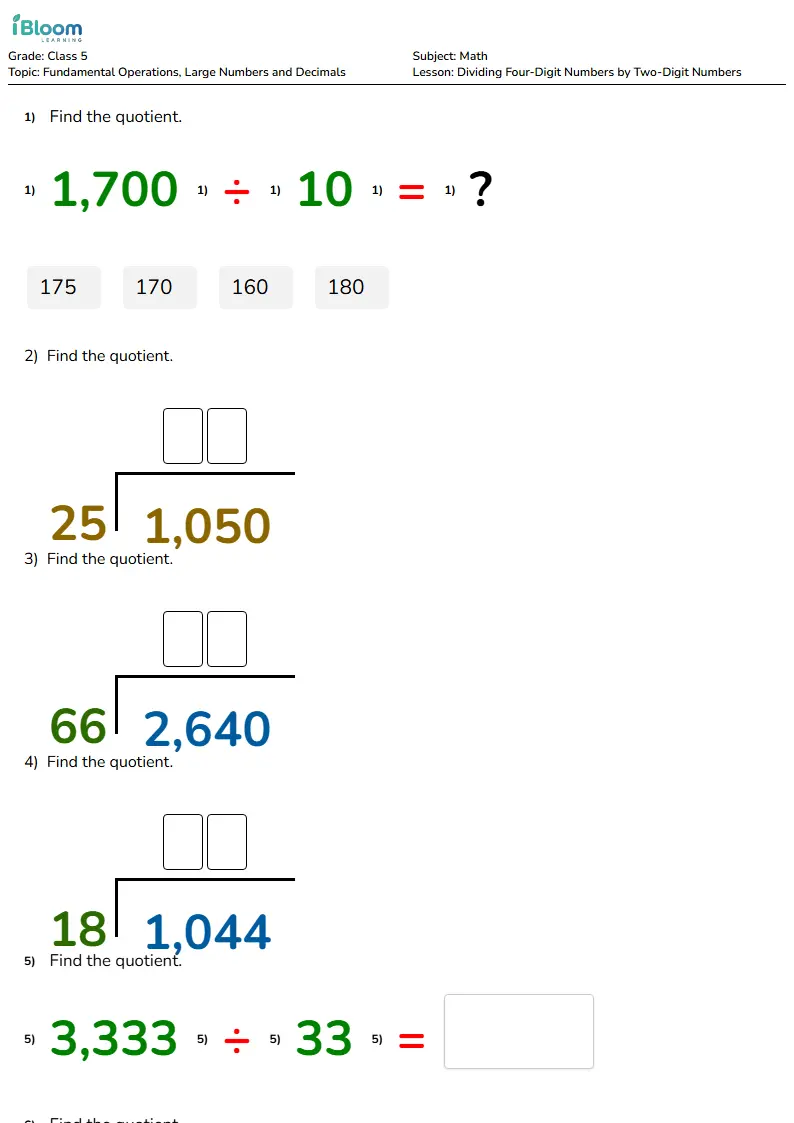
Free Dividing Four-Digit Numbers by Two-Digit Numbers Worksheets for Class 5
Looking for class 5 math help? Download free, interactive dividing four-digit numbers by two-digit numbers worksheets. AI-personalized and Common Core-aligned. Practice math with iBloom.
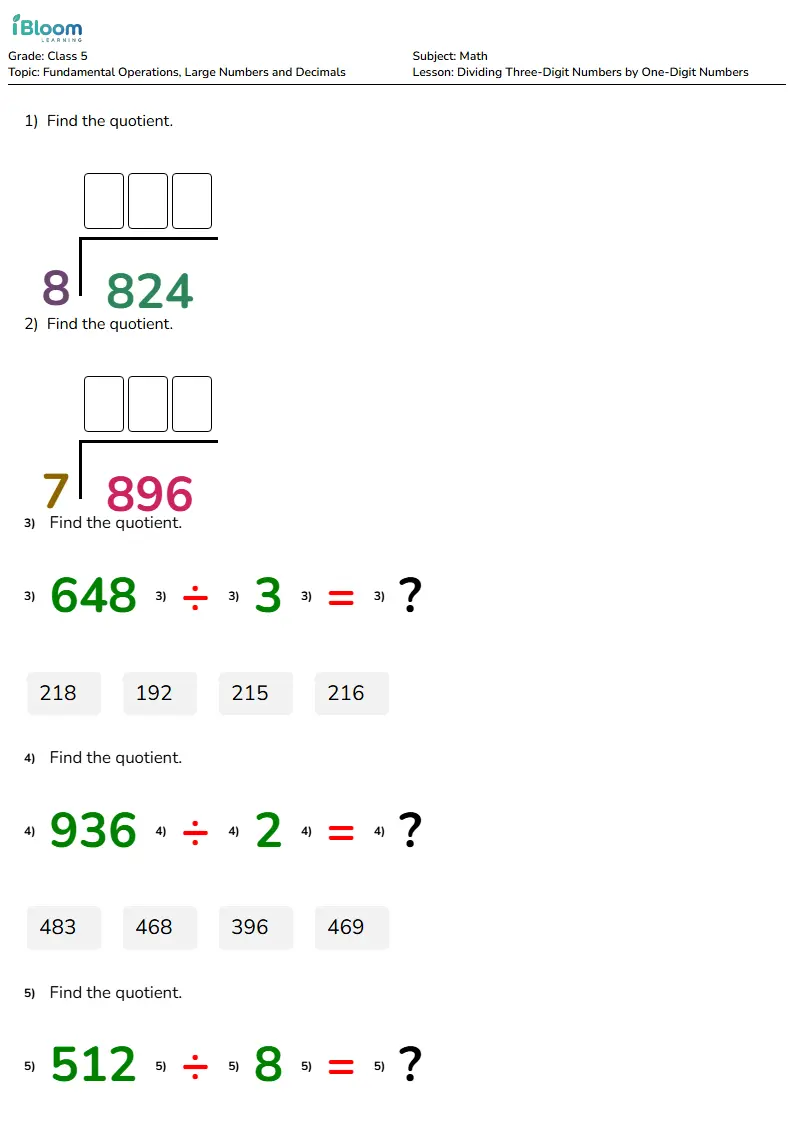
Free Dividing Three-Digit Numbers by One-Digit Numbers Worksheets for Class 5
Looking for class 5 math help? Download free, interactive dividing three-digit numbers by one-digit numbers worksheets. AI-personalized and Common Core-aligned. Practice math with iBloom.
Free Dividing Three-Digit Numbers by Two-Digit Numbers Worksheets for Class 5
Looking for class 5 math help? Download free, interactive dividing three-digit numbers by two-digit numbers worksheets. AI-personalized and Common Core-aligned. Practice math with iBloom.
Free Dividing Two-Digit Numbers by One-Digit Numbers Worksheets for Class 5
Looking for class 5 math help? Download free, interactive dividing two-digit numbers by one-digit numbers worksheets. AI-personalized and Common Core-aligned. Practice math with iBloom.
Free Dividing Whole Numbers by Decimals up to Hundredths Worksheets for Class 5
Looking for class 5 math help? Download free, interactive dividing whole numbers by decimals up to hundredths worksheets. AI-personalized and Common Core-aligned. Practice math with iBloom.
Free Dividing Whole Numbers by Decimals up to Tenths Worksheets for Class 5
Looking for class 5 math help? Download free, interactive dividing whole numbers by decimals up to tenths worksheets. AI-personalized and Common Core-aligned. Practice math with iBloom.
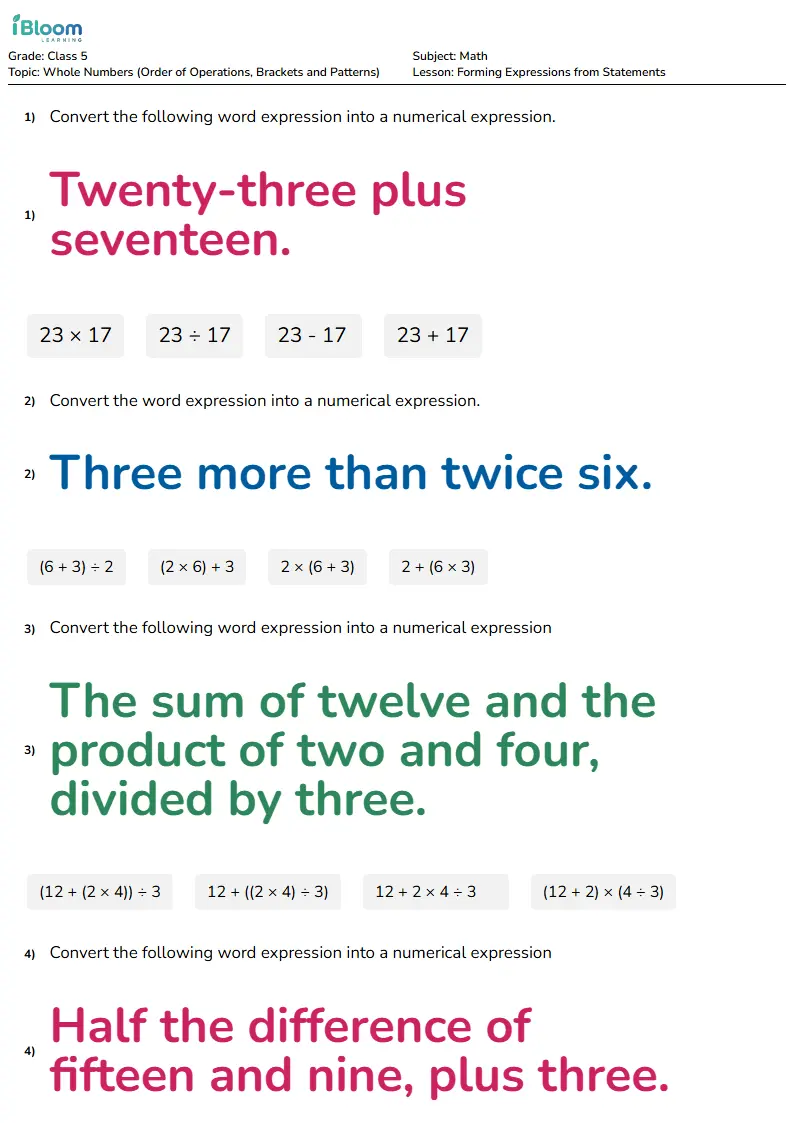
Free Forming Expressions from Statements Worksheets for Class 5
Looking for class 5 math help? Download free, interactive forming expressions from statements worksheets. AI-personalized and Common Core-aligned. Practice math with iBloom.
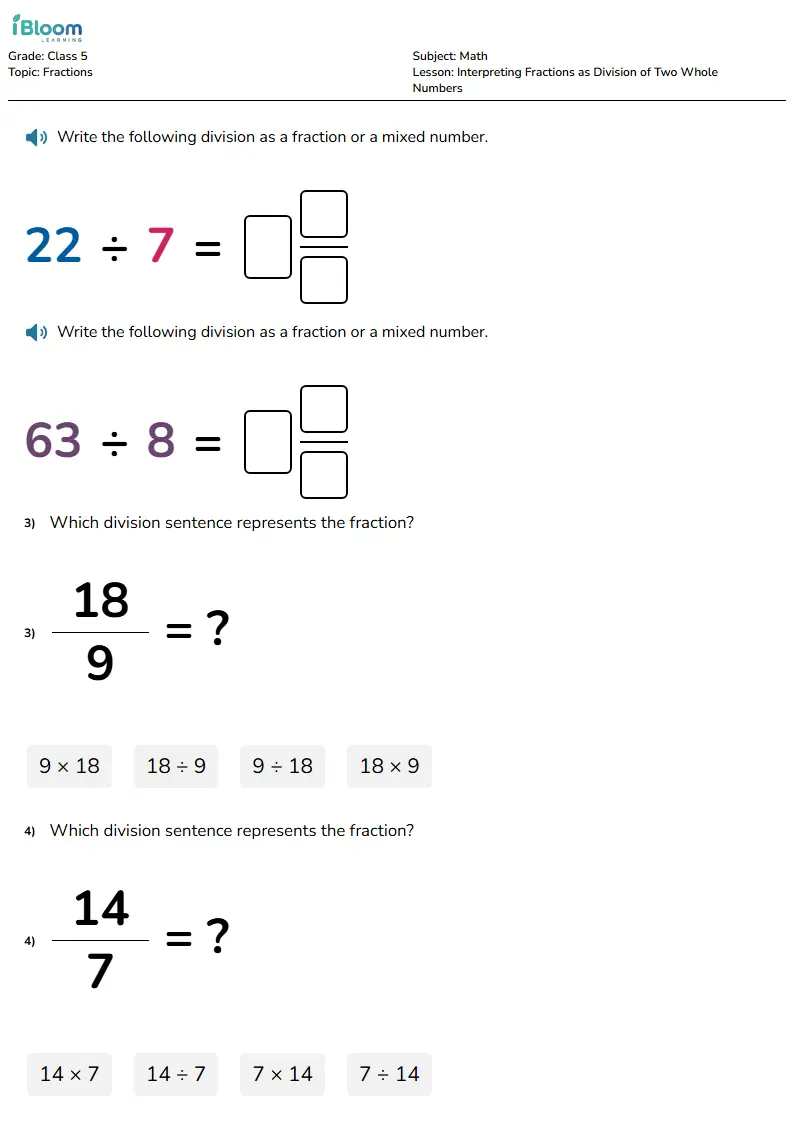
Free Interpreting Fractions as Division of Two Whole Numbers Worksheets for Class 5
Looking for class 5 math help? Download free, interactive interpreting fractions as division of two whole numbers worksheets. AI-personalized and Common Core-aligned. Practice math with iBloom.