Before, After and Between Numbers 1 to 20 Worksheet
Teach number order with clear 1 to 20 examples, a number line, short practice, and a free printable Grade 1 worksheet with answer key.
Free printable worksheet
Free before, after, and between numbers 1 to 20 worksheet
This two-page printable contains 12 questions, a complete 1 to 20 number line, and a matching answer key. The three number trains separate before, after, and between so a young learner can focus on one direction word at a time.
- Free PDF download
- Answer key included
- Ready to print
Free to print and use at home or in class. How to use this worksheet
Before, after, and between tell us where a number sits in the counting order. On a number line, the number before is one step left, the number after is one step right, and the number between sits in the middle of two consecutive numbers.
Use a number line from 1 to 20
A number line gives the child a visible path:
- Find the given number.
- Move left for before.
- Move right for after.
- Look at the empty place for between.
- Read the completed sequence aloud.
Cover the number line once the child answers several questions without pointing. Bring it back when the teen numbers become confusing. The goal is accurate counting order, not removing support as fast as possible.
The Common Core counting sequence standard asks kindergarten learners to count forward from a number other than 1 and write numerals from 0 to 20. NCERT's Class I mathematics learning outcomes include working with numbers 1 to 20 and using concrete, pictorial, and symbolic representations. Both support short tasks that connect spoken counting, number cards, and written numerals.
Before, after, and between examples
| Question | How to solve it | Answer |
|---|---|---|
| What comes before 6? | Count back one: 5, 6 | 5 |
| What comes after 13? | Count on one: 13, 14 | 14 |
| What comes between 17 and 19? | Say the sequence: 17, 18, 19 | 18 |
| Fill in 9, __, 11 | The missing number must follow 9 and come before 11 | 10 |
The words describe position, not size. A child may know that 14 is larger than 13 and still pause when asked what comes before 14. Say the full sentence: “13 comes before 14.” That connects the direction word to the number sequence.
How to find the number before
Start on the given number and move one place to the left.
- Before 4 is 3.
- Before 11 is 10.
- Before 20 is 19.
Use this sentence frame: “One less than __ is __.” For example, “One less than 15 is 14.” The child can check by counting forward: 14, 15.
Do not begin a 1 to 20 worksheet with “What comes before 1?” until the child has learned zero. The answer is 0, but that question moves outside the stated 1 to 20 range.
How to find the number after
Start on the given number and move one place to the right.
- After 3 is 4.
- After 9 is 10.
- After 19 is 20.
Use the matching sentence frame: “One more than __ is __.” If the question asks what comes after 12, the child can touch 12, move one step right, and land on 13.
A focused 1 to 20 worksheet should stop at “after 19.” Asking for the number after 20 requires 21, which lies outside the practice range.
How to find the number between
Two consecutive counting numbers have one number between them when their difference is two.
- 2, 3, 4
- 7, 8, 9
- 12, 13, 14
- 17, 18, 19
Ask the child to read all three numbers aloud after filling the blank. Hearing “12, 13, 14” helps catch a reversed or skipped answer.
Try these questions
Let the child answer before opening the solutions.
- What comes before 9?
- What comes after 6?
- Fill in: 4, __, 6
- What comes before 17?
- Fill in: 10, __, 12
- What comes after 14?
- Fill in: __, 19, 20
- Fill in: 15, 16, __
Show the answers
- 8
- 7
- 5
- 16
- 11
- 15
- 18
- 17
Free before, after, and between numbers 1 to 20 worksheet
This two-page printable contains 12 questions, a complete 1 to 20 number line, and a matching answer key. The three number trains separate before, after, and between so a young learner can focus on one direction word at a time.
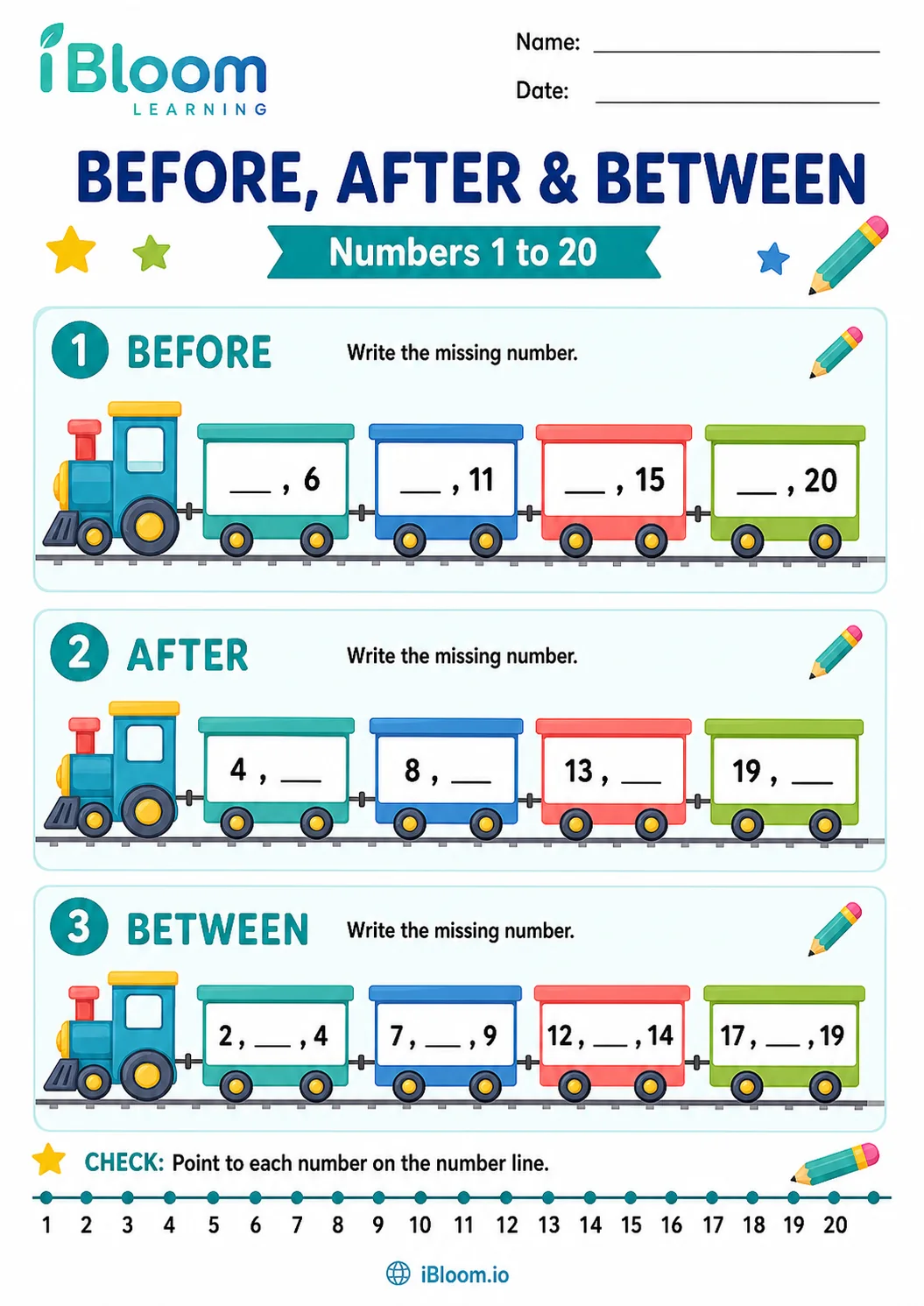
Download the free before, after and between numbers 1 to 20 worksheet PDF
Answer key preview
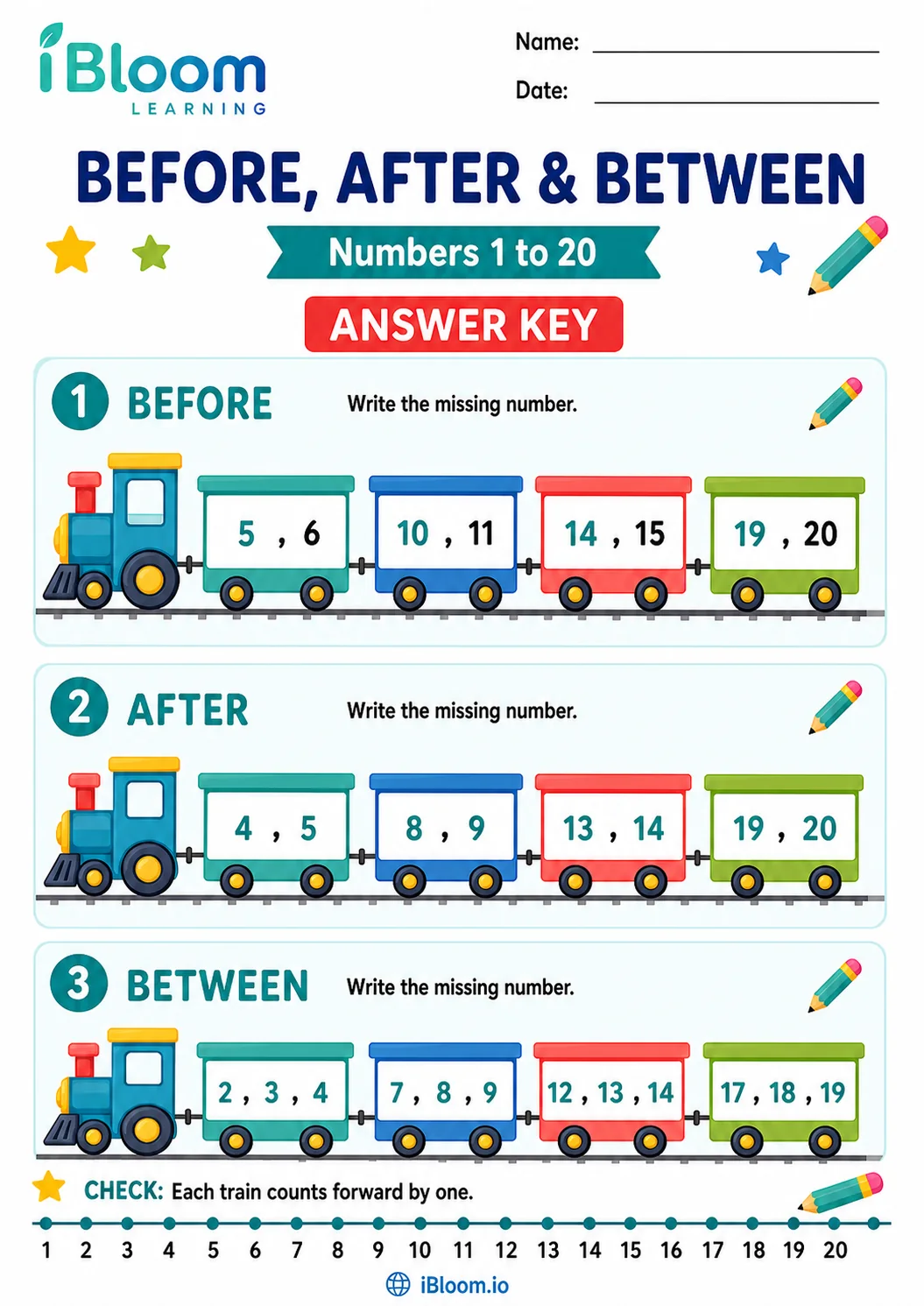
Print page 1 for the child. Keep page 2 nearby for a quick check, or ask the child to use the number line to correct one mistake before showing the answer.
For more practice, create a fresh page with the free missing numbers worksheet generator, browse Grade 1 math worksheets, or choose another activity from the free printable worksheet library.
A five-minute teaching routine
1. Build the sequence
Place number cards from 1 to 10 in order. Remove one card and ask which number is missing. Extend the row to 20 when the child can rebuild the first ten without help.
2. Add the direction words
Point to 8 and ask for the number before it. Point to 8 again and ask for the number after it. Keep the starting number the same so the child can compare the two directions.
3. Switch to written practice
Complete four worksheet questions. Ask the child to read each finished sequence rather than saying only the missing answer.
4. Check one mistake
Return to the number cards or number line. Let the child find the mismatch. A correction made with evidence teaches more than an adult replacing the answer.
Use the short daily number-talk routine when you want the child to explain how a number sequence works. For another early vocabulary activity, try the full and empty worksheet for LKG and UKG.
Common mistakes and useful prompts
| What the child does | What it may mean | Prompt to try |
|---|---|---|
| Gives the same number again | The child has not moved on the number line | “Touch 12. Now move one space.” |
| Reverses before and after | The direction words are not secure yet | “Which way do we count forward?” |
| Says 19 after 9 | The teen sequence is getting mixed with the ones | “Start at 8 and count three numbers.” |
| Counts from 1 for every item | The child knows the sequence but cannot start from a given number | “Begin at 13. What comes next?” |
| Writes a reversed numeral | Number order may be correct even when formation needs practice | Ask for the spoken answer, then practise writing the numeral separately. |
Keep math thinking and handwriting as separate checks. If a child says “14” but writes the numeral backward, the sequence is correct. Work on numeral formation after acknowledging the correct answer.
When is the child ready to move beyond 20?
Move to a larger range when the child can:
- begin counting from any number within 1 to 20;
- name the number before and after without restarting at 1;
- fill a between-number blank;
- explain an answer with a number line or spoken sequence;
- notice and correct a skipped number.
The National Curriculum Framework for the Foundational Stage presents early number learning as a progression. Accurate work within 1 to 20 gives the child a sound base for larger numbers, comparison, and simple addition.
Frequently asked questions
What comes before 1?
Zero comes before 1. If the worksheet promises practice only with numbers 1 to 20, teachers often avoid that item until zero has been introduced.
What comes after 20?
Twenty-one comes after 20. A strict 1 to 20 worksheet asks only up to “What comes after 19?”
What number comes between 10 and 12?
Eleven. Read the completed sequence as 10, 11, 12.
Is this topic for kindergarten or Grade 1?
Both. Many kindergarten programs build the counting sequence and numeral recognition to 20. Grade/Class 1 learners may use the same skill for review, missing-number work, and early addition.
Should a child use a number line?
Yes. A number line makes the direction visible. Remove it after the child can find several answers accurately, and bring it back when a new number range causes confusion.
How many questions should a child complete at once?
Four to twelve focused questions are enough for most early learners. Stop after the child can explain one answer and correct one mistake.