AI Literacy for Kids: Parent and Teacher Guide
Teach kids safe AI habits with parent and teacher rules, prompt examples, fact-checking routines, and linked iBloom practice pages.

Start with the Matching Practice
Use this guide with a direct iBloom worksheet or lesson so children can move from reading the explanation into real practice.
Introduction
AI literacy for kids is becoming a basic learning skill, like knowing how to search the web, check a source, or explain your answer in your own words. Children are already seeing AI in homework tools, search summaries, writing helpers, image generators, study planners, spelling games, and classroom platforms. The question for parents and teachers is not whether children will meet AI. The question is whether they will understand it well enough to use it safely and honestly.
This guide is written for families, teachers, tutoring centers, homeschool groups, and school leaders who want a practical AI literacy framework for elementary children. It supports iBloom's broader AI topic cluster, especially AI Tools for Kids in 2026: Parent Safety Guide, Safe AI Homework Helper for Kids, Free AI Homework Helper for Kids, and AI Powered Learning for Kids.
The goal is simple: help children use AI as a thinking partner, not an answer machine. When AI gives a hint, children still need structured practice. That is where iBloom's English worksheets, context clues practice, key details practice, and Pictures Help Us Read worksheet become useful follow-up steps.
What AI Literacy Means for Kids
AI literacy is not the same as teaching children to use one chatbot. Tools change. Interfaces change. School rules change. The lasting skill is understanding how AI behaves and how a learner should respond.
For children, AI literacy includes five ideas:
- AI can generate helpful explanations, examples, questions, and summaries.
- AI can also be wrong, incomplete, biased, or too confident.
- AI should not receive private personal information from a child.
- AI help should be visible to adults and allowed by school rules.
- AI is most useful when the child checks, explains, and practices afterward.
The Day of AI project is a useful external reference because it treats AI literacy as a learning progression rather than a one-time warning. The Common Sense Media AI research report is also useful for parents because it shows why families need clear rules around children's use of generative AI. For resilience and family boundaries, the Brookings parent guide on raising learners in an AI world is a strong companion source.
The Parent-Teacher AI Literacy Checklist
Before introducing AI to children, use this checklist.
| AI literacy skill | What children should learn | Adult check |
|---|---|---|
| Purpose | AI can help explain, practice, and brainstorm. | Ask: What are you using AI for? |
| Privacy | Do not share full name, school, address, phone, photos, or private family details. | Review prompts before children use them. |
| Accuracy | AI answers must be checked with a text, teacher, parent, source, or worksheet. | Ask the child to point to evidence. |
| Ownership | The child owns the final answer and explanation. | Ask the child to explain in their own words. |
| Fair use | Some assignments allow AI help and some do not. | Check classroom rules. |
| Healthy limits | AI is a short learning tool, not a constant companion. | Use timed sessions and offline practice. |
This is especially important for elementary children because they may not recognize when an AI answer sounds polished but misses the task. A child may believe a confident answer because it looks neat. Adults need to teach the habit of checking, not just the habit of prompting.
AI Literacy by Age Band
Ages 4 to 6: Adult-Facing AI Only
For pre-kindergarten, LKG, UKG, and kindergarten learners, AI should mostly sit behind the adult. A parent or teacher can use it to create a picture prompt, a story question, a rhyming-word list, or a simple speaking game. The child should still do the human learning: listening, talking, sorting, drawing, reading aloud, tracing letters, counting, and answering.
Good AI literacy language for this age is simple:
- "A computer can make a guess."
- "A grown-up checks the guess."
- "We do not tell the computer private things."
- "You still have to say what you think."
Pair any AI-generated prompt with real iBloom practice such as My Daily Activities, Words for Feelings, and Listening to Stories.
Ages 7 to 9: Hint Helper, Not Answer Helper
Children in grades 1 to 3 can begin learning safe prompting. They can ask AI to give one clue, explain a word in simpler language, or create a similar practice question. The rule should be clear: AI can help you think, but it cannot finish your work for you.
This is a good stage for reading and vocabulary support. After an AI hint, send the child to an actual practice page, such as Pictures Help Us Read, Building Sentences with Nouns and Verbs, or Use Context Clues to Determine Word Meaning.
Ages 10 to 12: Verification and Authorship
Older elementary learners can handle a deeper conversation. They can compare two AI explanations, ask AI to quiz them, request feedback on a paragraph, or use AI to plan a study routine. They should also learn that AI may produce facts without sources, overstate certainty, or write in a voice that does not sound like the child.
At this stage, teach the "three checks" routine:
- Does the answer match the question?
- Can I find evidence in the text, worksheet, notes, or trusted source?
- Can I explain it without reading the AI answer?
For reading practice, link AI literacy to Identify and Analyze Key Details. For vocabulary and word learning, use Crossword Puzzles for Vocabulary Practice and Spelling Bee Practice Schedule for Kids.
Classroom and Home Activities
Activity 1: AI or Human?
Show children three short explanations. One can be written by the teacher, one by a parent, and one by AI. Ask students to compare them. Which one is clearest? Which one gives evidence? Which one sounds too general? The goal is not to shame AI. The goal is to teach children to read critically.
Activity 2: One Hint Only
Give students a reading question or math problem. Let them ask AI for one hint, not the answer. Then they complete the original task themselves. This builds the habit that AI is a support step, not the final step.
Activity 3: Check the Claim
Ask AI a question about a story, a science fact, or a vocabulary word. Then ask students to verify the answer using a text, teacher note, dictionary, worksheet, or trusted source. Reading Rockets has useful background on vocabulary development and reading comprehension, which are both relevant when children learn to check meaning and evidence.
Activity 4: Make a Better Prompt
Start with a weak prompt such as "help me with reading." Ask children to improve it. A stronger prompt might be: "Ask me three questions that help me find the main idea. Do not give me the answer." This teaches clarity and boundaries together.
Activity 5: Offline Finish
After using AI, every child completes one offline action. They write a sentence, solve a similar problem, read a paragraph aloud, explain a clue, or teach a parent what they learned. This final step protects learning from becoming passive.
How to Teach Safe Prompting
Safe prompting is a practical AI literacy skill. Children should learn prompt frames that protect privacy and prevent answer copying.
Useful prompt frames include:
- "Give me one hint, not the answer."
- "Ask me a question that helps me think."
- "Show me a similar example with different numbers."
- "Explain this word for a third grader."
- "Quiz me on these five spelling words."
- "Help me check whether my answer explains why."
Unsafe or weak prompts include:
- "Do my homework."
- "Write my essay."
- "Pretend to be my parent."
- "Here is my full name and school."
- "Give me the answer without explaining."
Parents and teachers can keep a small prompt card near the study area. The card should include safe prompts, privacy reminders, and a rule that every AI answer must be checked.
How to Check AI Answers
Children need a repeatable checking routine. Use the E-E-E method:
| Step | Question | Example |
|---|---|---|
| Explain | Can I say the answer in my own words? | "The main idea is what the whole paragraph is mostly about." |
| Evidence | Where did I find proof? | "This sentence tells me the character is nervous." |
| Extend | Can I do one more similar task? | "Now I can answer another context-clue question." |
This checking routine connects directly to iBloom practice. For evidence-based reading, use Identify and Analyze Key Details. For vocabulary, use Use Context Clues to Determine Word Meaning. For early readers, use Pictures Help Us Read.
Connecting AI Literacy to iBloom Practice
AI literacy becomes stronger when it points children toward real practice. A child who asks AI about story details should then answer story-detail questions. A child who uses AI to understand a word should then complete vocabulary practice. A child who asks AI for spelling help should then spell aloud, review patterns, and use words in sentences.
Use this internal practice map:
| AI literacy need | iBloom next step |
|---|---|
| Reading evidence | Identify and Analyze Key Details |
| Vocabulary reasoning | Use Context Clues to Determine Word Meaning |
| Early reading with pictures | Pictures Help Us Read |
| Sentence building | Building Sentences with Nouns and Verbs |
| Spelling confidence | iBloom SpellBee and Spelling Bee Practice Schedule |
| Vocabulary games | Crossword Puzzles for Vocabulary Practice |
This link map matters for SEO and for users. Families searching for AI education guidance should not land on an isolated opinion article. They should find a pathway from AI literacy into actual learning pages.
Common Mistakes to Avoid
Mistake 1: Teaching Tools Instead of Thinking
If a lesson only teaches children where to click, it will expire quickly. Teach durable habits: ask clearly, protect privacy, check evidence, explain the answer, and practice afterward.
Mistake 2: Treating AI as Always Right
AI can be useful and wrong at the same time. Children should see examples where AI makes a small mistake. Then they should correct it using a source or worksheet.
Mistake 3: Skipping School Rules
Every family should know what the teacher allows. Some assignments may allow brainstorming but not drafting. Others may ban AI. AI literacy includes honesty about when help is allowed.
Mistake 4: Letting AI Replace Reading
Children still need to read full sentences, listen to stories, notice details, and build vocabulary. AI summaries can support reading, but they should not replace it.
Mistake 5: No Follow-Up Practice
If the AI session ends with a copied answer, learning is weak. If it ends with iBloom practice, oral explanation, or a similar problem, learning is stronger.
Frequently Asked Questions
What is AI literacy for kids?
AI literacy for kids means understanding what AI can and cannot do, how to ask safe questions, how to protect private information, and how to check AI answers before using them.
What age should children learn AI literacy?
Children can start with simple AI literacy language around ages 4 to 6, but direct tool use should be adult-supervised. Older elementary students can learn safe prompts, source checking, and authorship rules.
Should children use AI for homework?
Children can use AI for hints, examples, practice questions, and explanations when parents and teachers allow it. They should not use AI to complete final answers without understanding.
How can parents make AI safer at home?
Parents can keep AI use visible, set time limits, avoid personal data in prompts, use adult-controlled accounts, and require children to explain answers after using AI.
How should teachers introduce AI literacy?
Teachers can start with discussion, examples of AI mistakes, safe prompt frames, and short verification routines. They should also give clear rules about what AI help is allowed for each assignment.
Why connect AI literacy to worksheets and lessons?
AI can explain, but children learn through practice. Worksheets and lessons help children apply the explanation, make mistakes, and build recall.
Conclusion
AI literacy for kids is not about making children dependent on new tools. It is about helping them stay thoughtful, honest, private, and active in a world where AI will appear in many learning spaces.
The strongest routine is simple: use AI for a hint, check the answer with evidence, explain the idea in your own words, and then practice on a real learning page. That is how AI literacy becomes a learning habit instead of a shortcut.
Practice This Skill Next
After reading this guide, children can practise the same skill on iBloom. Start with context clues practice or Pictures Help Us Read worksheet, then ask the child to explain one answer before moving on.
Worksheet And Lesson Previews
Pictures Help Us Read Worksheets for Class 1 Preview
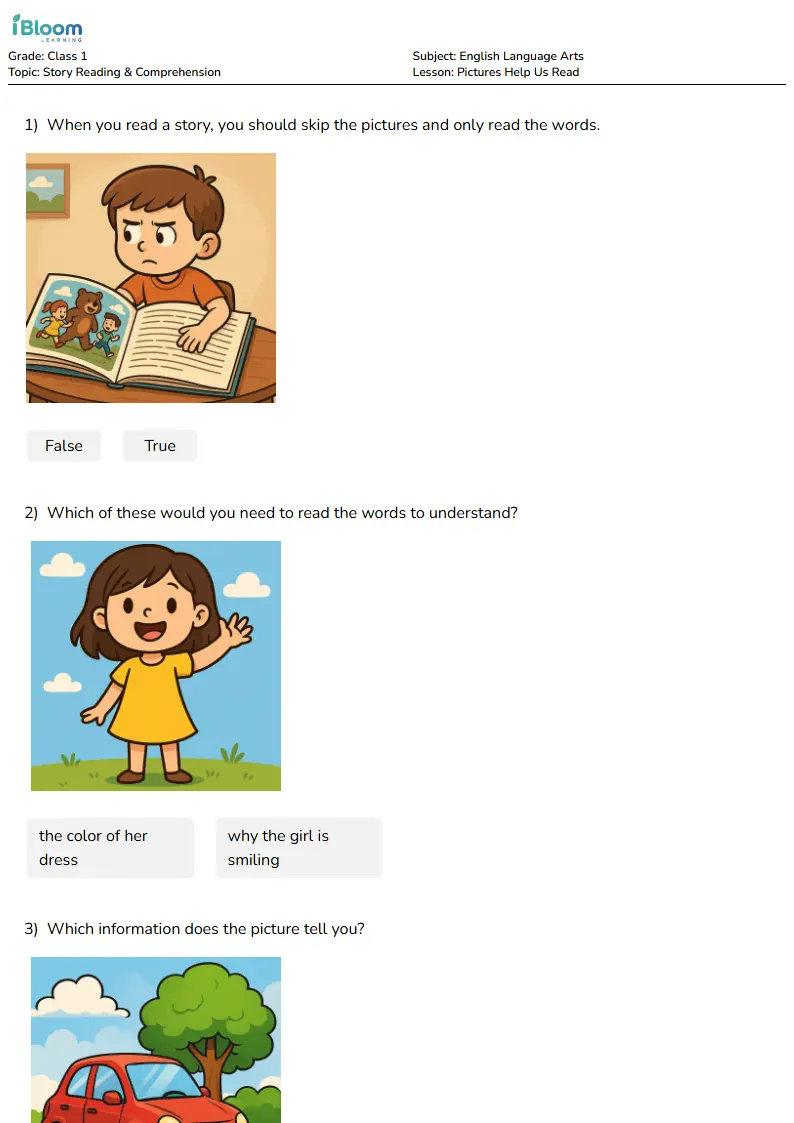
Use this preview to see the kind of practice children will open before you start the routine.
Identify and analyze key details Lesson for Fourth Grade Preview
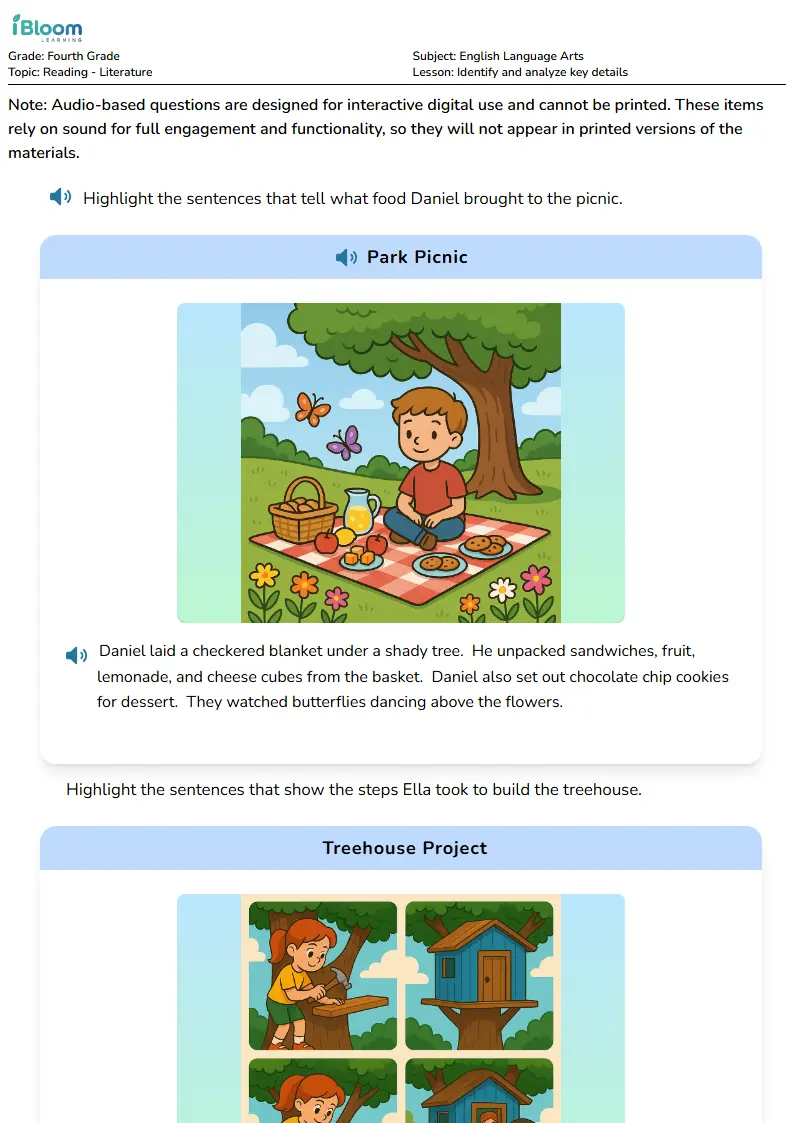
Use this preview to see the kind of practice children will open before you start the routine.
My Daily Activities Lesson for Lkg Preview
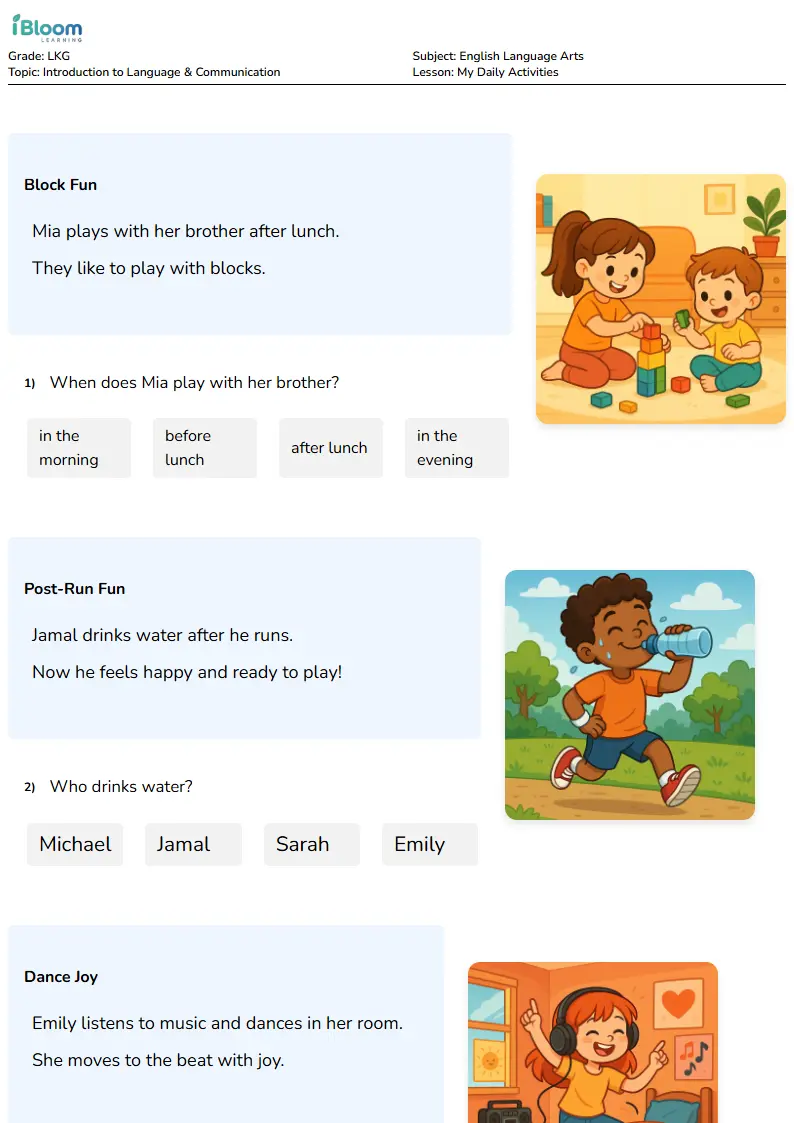
Use this preview to see the kind of practice children will open before you start the routine.