Crossword Puzzles for Kids
Use crossword puzzles for kids to build vocabulary, spelling, reading clues, and confident parent-teacher literacy routines.

Overview
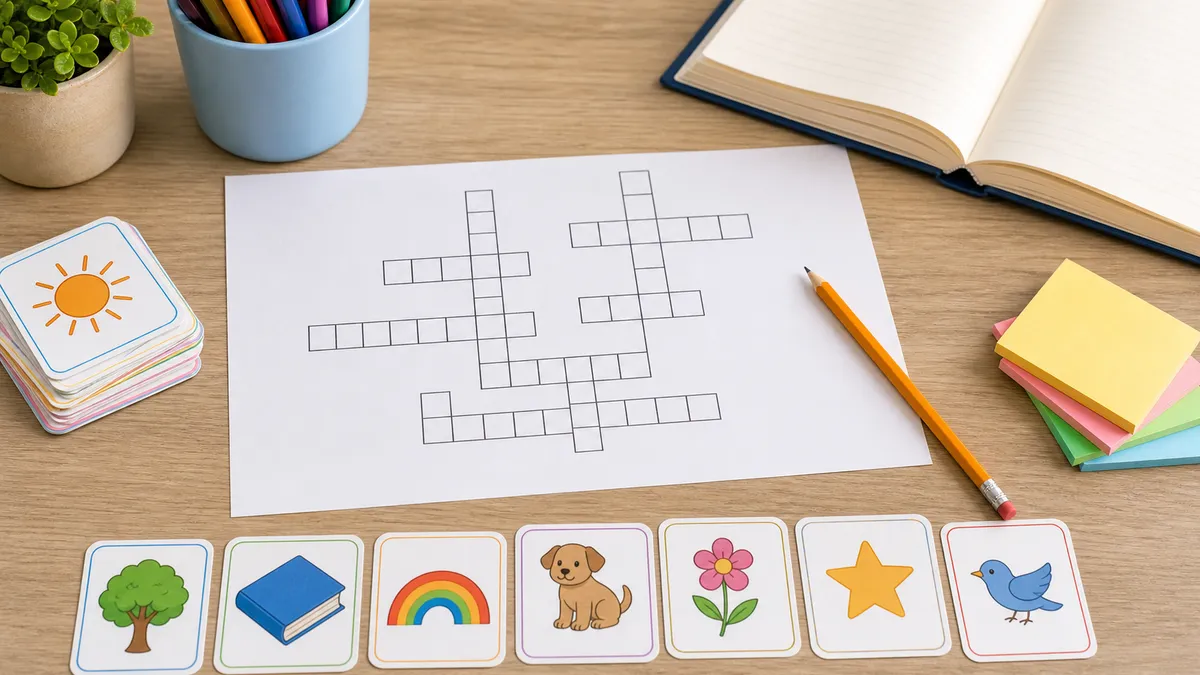
Crossword Puzzles for Kids is a practical guide for parents, teachers, tutors, and children who want word study, vocabulary, spelling, and reading practice to feel active. It is built around crossword puzzles for kids and connected iBloom pages such as Crossword Puzzles for Teachers, Crossword Puzzles for Vocabulary Practice, and Use Context Clues to Determine Word Meaning.
Start with the Matching Practice
Use this guide with a direct iBloom worksheet or lesson so children can move from reading the explanation into real practice.
Key Takeaways
- Crossword Puzzles for Kids should combine clue reading, vocabulary meaning, spelling, and one clear next step.
- Children need to explain how the clue works, not only fill boxes silently.
- Parents can support the skill in short, calm sessions.
- Teachers can use this as a mini-lesson, literacy center, review game, or small-group task.
- iBloom links should be used throughout the routine, not only at the end.
Why This Skill Matters
Crossword puzzles for kids work best when the puzzle feels like a reading game, not a silent test. A clue asks the child to connect meaning, spelling, word shape, and sometimes context. Parents can use a small crossword after homework, teachers can use one in a literacy center, and children can use the grid to slow down and think about words carefully. Start with Crossword Puzzles for Teachers, connect it to Crossword Puzzles for Vocabulary Practice, and return to iBloom English practice when a child needs guided examples.
The IES reading comprehension practice guide emphasizes teaching students to use strategies and discuss text meaning. Vocabulary guidance from Reading Rockets also highlights the value of repeated, meaningful word exposure. Adult-facing sources such as https://ies.ed.gov/ncee/wwc/PracticeGuide/14 and https://www.readingrockets.org/topics/vocabulary help adults plan better prompts; iBloom gives children the practice surface.

Step-by-Step Routine
Start with one short model. Read a clue aloud, underline the important word, say two possible answers, and check which answer fits the crossing letters. Then ask the child to explain the clue in their own words before filling the grid. This order matters because children often know a word partly before they can spell or define it clearly.
- Preview the task and name the skill.
- Model one example aloud.
- Let the child try one example with support.
- Ask, "How did you know?" or "What did you add?"
- Use Crossword Puzzles for Teachers or Crossword Puzzles for Vocabulary Practice for connected practice.
Examples for Children
For younger learners, keep the crossword short and visual. Use clues such as "a place where you read books" or "the opposite of hot." For older learners, use passage-based clues, synonyms, prefixes, suffixes, and context clues. A strong response can be simple: "The clue says a word that means almost the same as happy, and joyful fits the boxes."

Parent Guidance
Parents can use Crossword Puzzles for Kids in ten to fifteen minutes. Choose a small grid, read one clue at a time, let the child think aloud, and ask how the crossing letters helped. If the child makes a mistake, ask them to reread the clue, check the spelling, and try one nearby word. Use Context Clues for Kids when the child needs more context-clue support.
Teacher Guidance
Teachers can use Crossword Puzzles for Kids for a mini-lesson, a literacy center, small-group support, retrieval practice, or homework preparation. The best classroom routine is model, solve, explain, compare, and reuse the words in a sentence. Use English Worksheets for wider reading practice and Use Context Clues to Determine Word Meaning when the class needs more connected English pages.
Regional Learning Notes
In India, this can support CBSE, ICSE, and state-board English work in Delhi, Mumbai, Bengaluru, Chennai, Hyderabad, Pune, Kolkata, Ahmedabad, Jaipur, Lucknow, Kerala, Tamil Nadu, Karnataka, Maharashtra, Telangana, Gujarat, Rajasthan, and West Bengal. In the United States, it fits classroom and home literacy practice in California, Texas, Florida, New York, Illinois, Pennsylvania, Ohio, Georgia, North Carolina, Michigan, Los Angeles, Houston, Chicago, Phoenix, Philadelphia, Dallas, Austin, Seattle, Boston, Denver, Atlanta, and Miami. In the UAE, the routine works for Dubai, Abu Dhabi, Sharjah, Ajman, Ras Al Khaimah, Fujairah, Umm Al Quwain, and Al Ain families across British, American, IB, and Indian curriculum settings.
Common Mistakes
One mistake is choosing a crossword with clues that are too obscure. Another is treating the puzzle as busywork without discussion. A third is correcting every answer too quickly. Keep feedback specific: reread the clue, look at the crossing letter, say a synonym, check the spelling pattern, or use the word in a sentence.
Related iBloom Practice
Frequently Asked Questions
Who should use Crossword Puzzles for Kids?
Use it with elementary learners who need vocabulary, spelling, clue reading, context clues, or comprehension review, whether the support comes from a parent, teacher, tutor, homeschool adult, or older sibling.
How long should one session take?
Ten to fifteen focused minutes is enough. Stop after one strong explanation or one clear revision.
Which iBloom page should I use first?
Start with Crossword Puzzles for Teachers, then move to Crossword Puzzles for Vocabulary Practice or Use Context Clues to Determine Word Meaning for connected practice.
What should parents do after a mistake?
Ask the child to reread the clue, check the crossing letters, say the word aloud, and explain why that answer fits. Keep the correction specific and calm.
What should teachers check?
Teachers should check whether the child can explain the clue, define the answer, spell it correctly, and use the word in a sentence or passage discussion.
Practice Path for crossword puzzles for kids
Use this section when a child needs a direct next step after reading the guide. Start with the explanation in this article, then move into a connected iBloom practice path so the child sees the idea in a lesson, a worksheet, and a short review routine.
- crossword puzzles for vocabulary practice
- crossword puzzles for reading comprehension
- crossword puzzles for teachers
For parents, the simplest routine is: read one example aloud, let the child try two items, ask for the reason, then revisit the article section that explains the skill. For teachers and tutors, the same path can become a small-group rotation or a homework support set. The goal is steady improvement on the exact skill, not just more pages.
Practice This Skill Next
After reading this guide, children can practise the same skill on iBloom. Start with Use Context Clues to Determine Word Meaning, then ask the child to explain one answer before moving on.