How to Identify Quadrilaterals by Their Properties
A property-first routine that helps students classify squares, rectangles, rhombuses, parallelograms, trapezoids, and unfamiliar quadrilaterals.
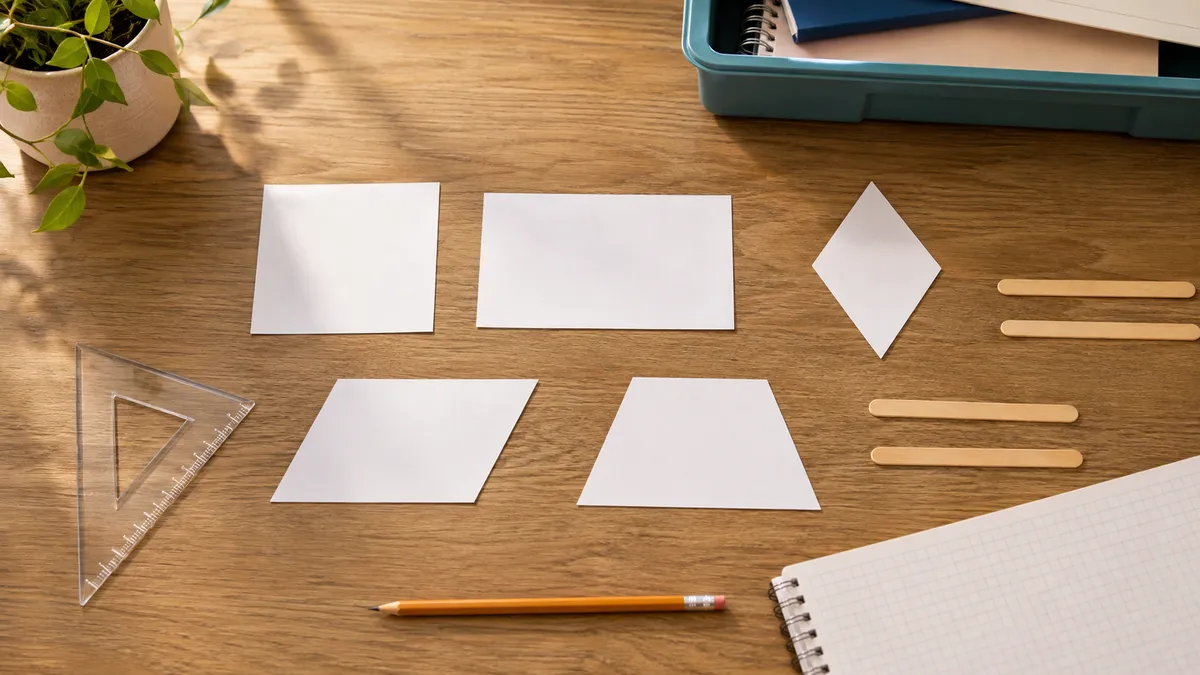
To identify a quadrilateral, check its properties in a fixed order: first confirm that it is a closed shape with four straight sides, then count pairs of parallel sides, test for four right angles, and compare side lengths. A shape may have more than one correct name. For example, a square is also a rectangle, a rhombus, a parallelogram, and a quadrilateral.
That last fact is where many students get stuck. Everyday speech treats a square and a rectangle as separate objects. Mathematics sorts shapes into families. A square belongs inside the rectangle family because it meets every requirement for a rectangle, then adds the extra requirement that all four sides have equal length.
This guide gives students, parents, and teachers a repeatable property test. It works even when a shape is tilted, stretched, or drawn in an unfamiliar way.
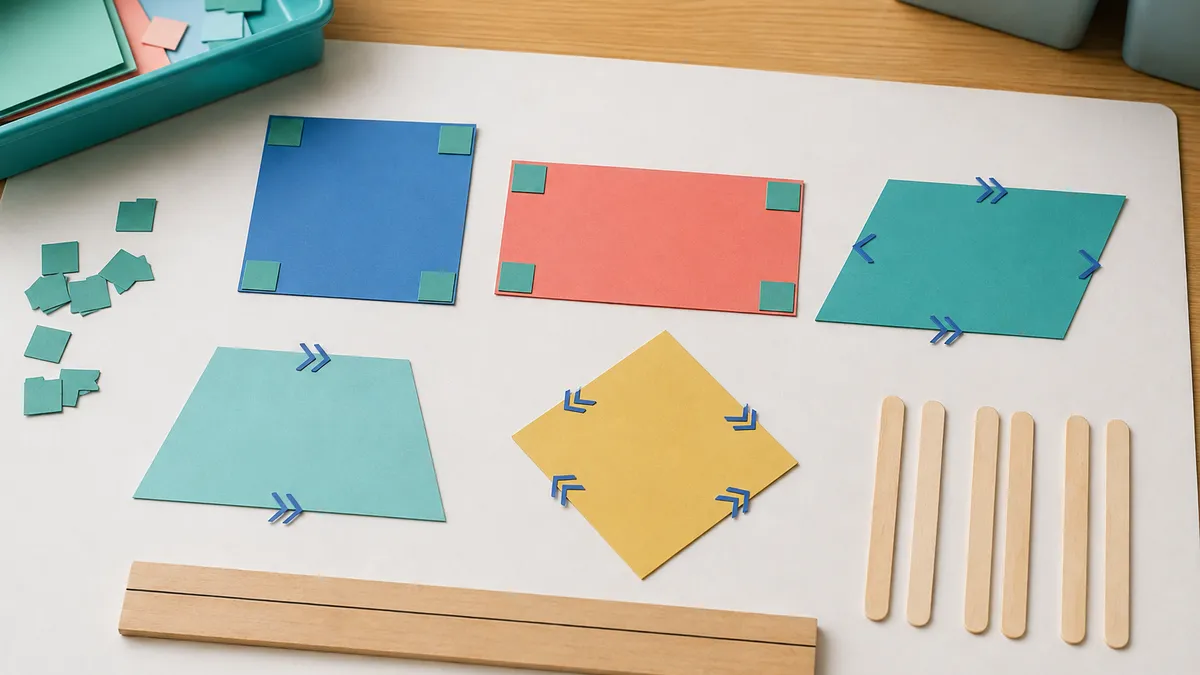
Test properties in the same order: sides, parallel pairs, right angles, then equal lengths.
The four questions to ask every time
Do not begin by guessing a name from the picture. Begin with evidence. Ask these four questions in order.
- Is it a closed shape with exactly four straight sides? If not, it is not a quadrilateral.
- How many pairs of opposite sides are parallel? Look for zero, one, or two pairs.
- How many right angles does it have? A right angle forms a square corner and measures 90 degrees.
- Which sides are equal in length? Check all four sides, opposite pairs, or no confirmed equal sides.
These checks separate appearance from definition. A long, narrow rectangle and an almost-square rectangle still satisfy the same rectangle test. A diamond-looking figure is not automatically a rhombus. It is a rhombus only when all four sides are equal.
The Khan Academy quadrilaterals review uses the same core attributes: number of sides, parallel sides, right angles, and equal sides. The Minnesota Department of Education quadrilateral hierarchy also shows why several names can apply to one figure.
Step 1: Confirm that the figure is a quadrilateral
A quadrilateral is a closed polygon with four straight sides. Each word matters.
- Closed means the final side meets the first side. A gap makes an open figure, not a polygon.
- Four sides means four line segments and four vertices. A bent side can create an extra segment.
- Straight sides exclude curves. A rounded corner may be part of a drawing, but the mathematical figure must be defined by straight segments.
- Simple classroom figures usually do not cross over themselves. If sides cross, ask the teacher which definition the lesson uses before assigning a familiar family name.
Students often count corners instead of sides. That usually works for a simple polygon, but tracing each side with a pencil is more reliable. Place a small dot at every change in direction, then count the segments between dots.
For extra practice with the basic sorting step, use iBloom's Grade 3 quadrilateral attribute sort. It is a useful bridge before students classify one shape under several names.
Step 2: Find parallel sides before naming the shape
Parallel lines stay the same distance apart and do not meet, even if extended. In a quadrilateral, compare opposite sides rather than neighboring sides.
A student can test parallel sides without relying only on eyesight:
- Place two straight craft sticks along one pair of opposite sides.
- Extend the direction mentally or with a ruler.
- Check whether the distance between the two lines stays constant.
- Repeat for the other pair of opposite sides.
Two pairs of parallel opposite sides place the shape in the parallelogram family. Rectangles, rhombuses, and squares all pass this test. One pair may indicate a trapezoid, depending on the definition used by the curriculum. Some sources define a trapezoid as having at least one pair of parallel sides; others use exactly one pair. The Minnesota hierarchy above displays both conventions, so students should use the definition stated in their class materials.
This is an important reading habit: when a definition can vary, write the definition before solving the problem. Do not silently switch rules halfway through.
Students who need practice recognizing lines can review lines, rays, and line segments before working on parallel pairs.
Step 3: Test right angles rather than trusting orientation
A rectangle has four right angles. A square also has four right angles, so every square meets the rectangle definition.
The easiest physical test is a right-angle corner made from an index card or the corner of a sheet of paper. Place it inside each vertex. If all four corners match, the figure passes the right-angle test. Turning the shape does not change its angles.
This corrects a common visual mistake. Students sometimes reject a tilted square because it looks like a diamond. Rotation changes where the shape points, but it does not change side lengths, angle measures, or parallel relationships.
If a child confuses acute, right, and obtuse angles, pause classification and use Grade 4 angle measurement practice. Students can also review types of angles practice before returning to the property test.
Step 4: Compare side lengths carefully
Equal-looking sides are not proof. Use tick marks supplied in a diagram, count grid units, or measure with the same ruler.
- Four equal sides place a parallelogram in the rhombus family.
- Four right angles place a parallelogram in the rectangle family.
- Four equal sides and four right angles make a square.
A square therefore sits where the rectangle and rhombus families overlap. This is not a trick. It follows directly from the definitions.
The Ohio State University resource on comparing shapes by properties explains the same special-case relationship: the rectangle definition is contained within the square definition, while the square adds more properties.
A practical quadrilateral decision routine
Use this routine on homework, tests, and unfamiliar diagrams.
Check A: Four straight sides and closed?
If no, stop. It is not a quadrilateral. If yes, continue.
Check B: Two pairs of parallel sides?
If yes, it is a parallelogram. Keep checking because a more specific name may also fit.
Check C: Four right angles?
If yes, it is a rectangle. Keep checking the sides.
Check D: Four equal sides?
If yes, it is a rhombus. If it also has four right angles, it is a square.
Check E: Only one pair of parallel sides?
It may be a trapezoid under the exactly-one-pair definition. Under an at-least-one-pair definition, some parallelograms also belong to the trapezoid family. Follow the definition printed in the assignment.
Check F: None of those special tests pass?
It can still be a quadrilateral. Not every four-sided polygon is a rectangle, rhombus, parallelogram, square, or trapezoid.
The decision routine is more dependable than memorizing isolated pictures because it tells students what evidence to gather and why each name applies.
Worked examples
Example 1: Four right angles, opposite sides equal
Suppose a figure has four straight sides, two pairs of parallel sides, and four right angles. Its top and bottom sides are 7 units each; its left and right sides are 4 units each.
It is a quadrilateral, a parallelogram, and a rectangle. It is not a rhombus or square because all four sides are not equal.
Example 2: Four equal sides, no right angles
Suppose all four sides measure 5 units. Opposite sides are parallel, but two angles are acute and two are obtuse.
It is a quadrilateral, parallelogram, and rhombus. It is not a rectangle or square because it does not have four right angles.
Example 3: Four equal sides and four right angles
Suppose all four sides measure 6 units and every corner is a right angle.
It is a square. It is also a rectangle, rhombus, parallelogram, and quadrilateral. If a question says “select every correct name,” all five names should be considered.
Example 4: One pair of parallel sides
Suppose the top and bottom are parallel, while the other sides would meet if extended. The figure has four straight sides and is closed.
It is a quadrilateral. Under the exactly-one-pair classroom definition, it is also a trapezoid. It is not a parallelogram because it does not have two pairs of parallel opposite sides.
Example 5: A tilted rectangle
Suppose the page has been rotated so the rectangle stands on one corner. Its four angles remain right angles and its opposite sides remain parallel.
It is still a rectangle. Position is not a defining property.
Why “name the most specific shape” can be confusing
Two different instructions can produce different-looking answers.
“Name every category that fits” asks for the complete family: a square is a square, rectangle, rhombus, parallelogram, and quadrilateral.
“Give the most specific name” usually expects square. That answer communicates the most properties in one word. It does not make the broader names false.
Students should underline the instruction before solving. Words such as all, every, most specific, and best name determine the expected response.
The Illustrative Mathematics lesson on ways to look at quadrilaterals explicitly asks students to reason about shared attributes and figures that can have more than one name.
Common mistakes and how to correct them
Mistake: Naming by appearance
A child says “diamond” because a square or rhombus is tilted.
Correction: Rotate the paper, then ask what stayed unchanged. Measure sides and angles instead of naming the pose.
Mistake: Stopping at the first correct name
A child calls a square only a quadrilateral.
Correction: Ask, “Can we say something more specific?” Continue through parallel sides, right angles, and equal sides.
Mistake: Thinking a rectangle must have two long sides
A child believes a square cannot be a rectangle because it has no longer pair.
Correction: Return to the rectangle requirement: four right angles. Unequal adjacent sides are not required.
Mistake: Treating diagram appearance as measured evidence
A child assumes two sides are equal because they look equal.
Correction: Use measurement, grid units, or matching tick marks. In geometry diagrams, visual appearance alone may be intentionally misleading.
Mistake: Ignoring the trapezoid definition
Two resources seem to disagree about whether a parallelogram counts as a trapezoid.
Correction: Write the resource's definition at the top of the page. Both inclusive and exclusive conventions exist. Solve consistently under the assigned convention.
A 10-minute practice activity at home or school
Cut five unlabeled quadrilaterals from paper: an irregular quadrilateral, trapezoid, parallelogram, rectangle, rhombus, and square. Tilt at least three of them so none rests in its familiar textbook position.
Give the student four tools: a ruler, a paper right-angle corner, two craft sticks, and a recording sheet with these columns:
- four straight sides and closed;
- pairs of parallel sides;
- number of right angles;
- equal-side groups;
- every correct name;
- most specific name.
Ask the student to test one property at a time. Require an evidence sentence, such as “This is a rectangle because it has four right angles,” rather than accepting a name alone.
Finish with the square. Ask why it belongs in more groups than the other pieces. Then compare classifications with the iBloom quadrilateral attribute sort.
How parents can help without giving the answer
Use prompts that direct attention to evidence:
- “Which property have you checked?”
- “What would prove those sides are parallel?”
- “Can the shape have another correct name?”
- “Did rotating it change any measurements?”
- “What definition is your worksheet using for trapezoid?”
Avoid asking only, “What shape is that?” The child may guess from a memorized picture. Asking for evidence builds a method that transfers to new diagrams.
How teachers can diagnose the exact misconception
Show a square, a non-square rectangle, a rhombus without right angles, and a tilted example. Ask students to mark every statement that is true.
If a student rejects the tilted shape, the issue is orientation. If the student says a square is not a rectangle, the issue is hierarchical classification. If the student calls any diamond-looking figure a rhombus, the issue is measurement evidence. If the student gives only one name when several fit, the issue is understanding category inclusion.
This quick diagnosis helps the next explanation target the actual reasoning gap rather than repeating a list of shape names.
Frequently Asked Questions
Is every square a rectangle?
Yes. A rectangle is a quadrilateral with four right angles, and every square has four right angles. A square adds the requirement that all four sides are equal.
Is every rectangle a square?
No. A rectangle can have two long sides and two short sides. It is a square only when all four sides are equal.
Is a square also a rhombus?
Yes. A rhombus has four equal sides, and a square has four equal sides. The square also has four right angles.
Does turning a shape change its name?
No. Rotation does not change side lengths, angle measures, parallel sides, or the number of vertices.
Can a quadrilateral have no parallel sides?
Yes. A closed polygon with four straight sides is a quadrilateral even if none of its opposite sides are parallel.
Why do trapezoid definitions differ?
Some curricula define a trapezoid as having at least one pair of parallel sides. Others require exactly one pair. Use the definition specified by the lesson or assessment and apply it consistently.
The property-first takeaway
To identify quadrilaterals accurately, replace “What does it look like?” with four checks: closed four-sided figure, parallel-side pairs, right angles, and equal side lengths. Record every category that fits, then give the most specific name when the question asks for it.
Once students use the same property order on every figure, tilted and unfamiliar examples become evidence problems rather than guessing games.