How to Prepare for a Spelling Bee: A Kids Practice Guide
Follow a six-week spelling bee programme with word study, mock rounds, pronouncer questions, confidence practice, and event-day preparation.

A spelling bee is a performance, but preparation should not feel like rehearsing for a spelling emergency. The strongest spellers build a dependable process: they hear the word, connect it to meaning, notice its structure, retrieve the letters, and recover calmly when a word is unfamiliar.
This guide is for a parent, teacher, or child preparing for a school spelling bee. Start with the official word list and current rules supplied by the organiser. Then use the six-week programme below to turn that material into real vocabulary knowledge and stage confidence. iBloom practice can add variety, but it should supplement—not replace—the event’s official resources.
Teach one word in five meaningful moves
Copying a word ten times can produce tidy paper without reliable recall. Use a short sequence that makes the learner process the word.
- Hear and say it. The adult pronounces the word naturally. The child repeats it and identifies the syllables.
- Clarify meaning. Give a child-friendly definition and one sentence. Ask the learner for another sentence.
- Locate the challenge. Circle or say the part that is not predictable from ordinary sound-letter matching.
- Spell from memory. Hide the word. The child spells aloud, writes it, or types it without copying.
- Retest later. Return after ten minutes, the next day, and several days later.
For necessary, the useful clue may be one c and two s letters. For sign, the child may connect the silent g to signal. For decision, the relationship to decide helps explain both meaning and form. The learner should be able to explain the clue in their own words.
Use the downloadable spelling practice pack to record meanings, tricky parts, and retest dates. For more list-building ideas, open the spelling words by grade guide.
Start with the event, not a random word list
Before making flash cards, confirm the date, eligibility rules, word-list source, and competition format. Ask whether the bee is written, oral, or both. Find out what a speller may request from the pronouncer: repetition, definition, a sentence, part of speech, language of origin, or alternate pronunciation. Permissions vary by event.
For a Scripps-affiliated bee, use the current materials distributed through the enrolled school and review the organiser’s official study tips. For a school or private competition in India, the UAE, or elsewhere, follow that organiser’s current handbook. A polished list from another competition can still omit the words and procedures your child actually needs.
Write the rules on one page. Include the start time, arrival instructions, allowed questions, what happens after a misspelling, and whether a child may restart a word. Removing uncertainty makes later mock rounds much more useful.
Find the learner’s true starting point
Do not begin by assigning twenty new words a day. Read the official list aloud in a neutral voice while the child spells without seeing it. Divide the results into three groups:
- Secure: spelled correctly and confidently on two different days.
- Learning: correct with hesitation, or missed because of one identifiable pattern.
- Unfamiliar: unknown meaning, unclear pronunciation, or several uncertain parts.
The first practice week should contain mostly “learning” words, a smaller set of unfamiliar words, and a few secure words for retrieval. This creates productive effort without making every session feel like failure.
Keep the original attempt. It reveals patterns that a final score hides. A child who writes hoping as hopeing needs a suffix lesson; a child who writes separate as seperate needs attention to an unstressed vowel. Those are different teaching jobs.
Use a six-week preparation programme
Six weeks gives enough time for spacing and review. If the event is sooner, keep the sequence but combine adjacent weeks instead of cramming longer sessions.
The multi-grade Spell Bee practice page can supply structured retrieval between official-list sessions. Keep the organiser’s list and rules as the competition authority.
Week 1: map the list. Complete the diagnostic sort, confirm pronunciations and meanings, and start a missed-word notebook. Aim to understand what makes each difficult word difficult.
Week 2: listen for structure. Clap syllables, segment sounds, notice silent letters, and group words by useful patterns. Compare decide, decision, and decisive rather than learning each as an isolated string.
Week 3: connect spelling to meaning. Add a brief definition and an original sentence. Contrast homophones and commonly confused words. A child who knows what a word is doing in a sentence has more clues available on stage.
Week 4: study word families. Explore prefixes, suffixes, roots, and origins when they genuinely explain the spelling. Avoid turning every word into an etymology lecture; use the clue only when it helps retrieval.
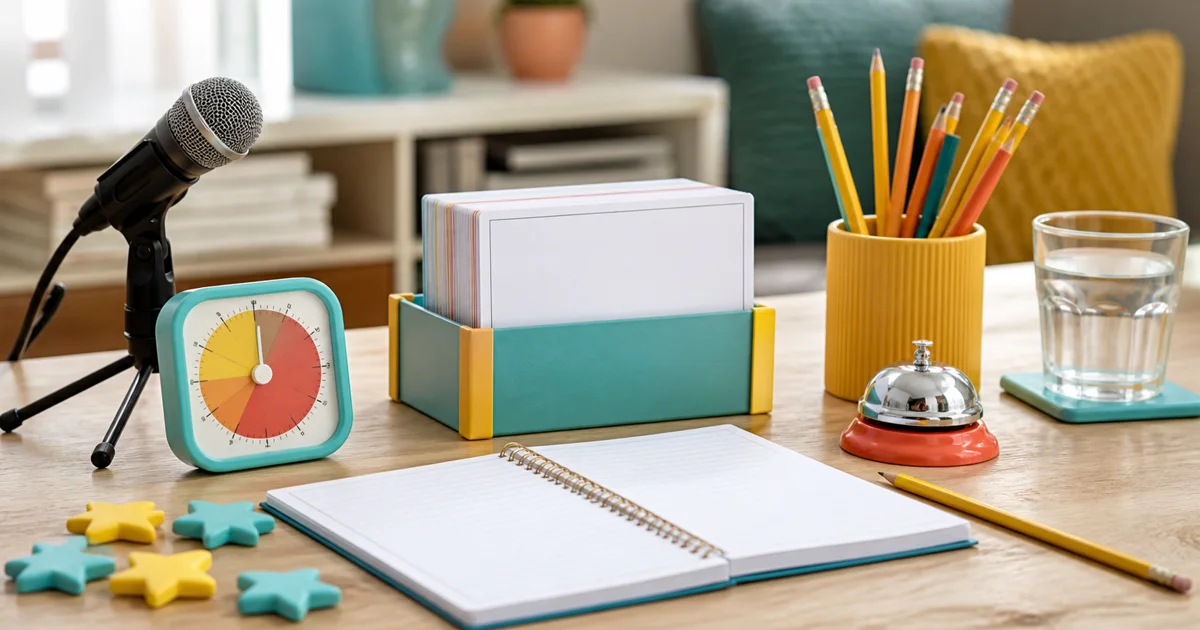
Week 5: simulate the event. Run short mock bees under the real rules. Practise walking to the mark, listening, requesting allowed information, spelling clearly, and leaving the round calmly.
Week 6: consolidate and rest. Reduce the number of new words. Retest missed words after gaps, rehearse the event routine, organise travel and materials, and protect sleep. The final evening is for confidence, not a marathon.
Run a home mock bee that feels real
A useful mock bee is brief and consistent. Choose ten to fifteen words. Put the official procedure where both people can see it. The pronouncer says the word, pauses, gives requested information that the rules allow, and does not accidentally emphasise the difficult syllable.
The child should practise a repeatable response:
- listen to the full word before speaking;
- repeat it to confirm what was heard;
- request useful information when allowed;
- pause for one slow breath;
- spell at a steady volume;
- repeat the word at the end if the rules require it.
Record only the audio for one round, then listen together. Is every letter distinct? Does the child rush after requesting a definition? Does a long pause become panic? Choose one performance habit to improve in the next round.
Keep score occasionally, not every day. A non-scored round allows the adult to stop and teach. A scored round tests retrieval and composure. Mixing both prevents practice from becoming a nightly audition.
Use digital practice without losing depth
Digital games are useful when they create frequent retrieval and immediate feedback. They are less useful when a child guesses rapidly, recognises a word only from choices, or chases rewards without studying mistakes.
In iBloom SpellBee, select a level that produces success with some genuine challenge. After a missed item, pause the game and ask: “What part fooled you?” Add that word to the notebook, study it away from the screen, and retry later. Browse the complete iBloom SpellBee guide to understand levels, feedback, and progress.
Pair spelling games with reading. When the child encounters a study word in a book, article, or English worksheet, stop briefly to notice how it works in context. Recognition in real text strengthens the word beyond competition practice.
The What Works Clearinghouse foundational reading practice guide is an evidence-based reference for sound-letter relationships, decoding, and connected text work, especially for younger spellers.
Respond to mistakes without rehearsing anxiety
When a child misses a word, first say the correct spelling plainly. Then diagnose the error. Was the word misheard? Did the child know the meaning? Was a syllable omitted? Did a familiar pattern compete with an irregular spelling?
Give one useful correction, not five. For example: “The ending sounds like shun, but this word uses -tion because it belongs to the same family as construct.” Ask the child to spell it once correctly, use it in a sentence, and place it in the next retest group.
Avoid labels such as “careless” or “easy word.” A missed easy word often indicates speed, attention, or pronunciation—not a lack of ability. Calm error analysis teaches the exact recovery skill a child needs after a difficult practice round.
Build confidence that survives a hard word
Confidence is not the belief that every answer will be correct. It is the expectation that the child can follow a process even under pressure.
Practise the physical details: standing comfortably, looking toward the pronouncer, speaking loudly enough, and taking one slow exhale before starting. Let the child deliberately practise an unknown word. They can request information, make a reasoned attempt, hear the correction, say “thank you,” and leave the practice area with composure.
Adults should praise behaviours the child controls: regular practice, careful listening, explaining a spelling clue, asking an appropriate question, and returning after a mistake. “You used the definition before you started” is more useful than “You’re a natural speller.”

Prepare for competition day
The day before, confirm transport, registration time, clothing, and any required identification. Pack water and a simple snack if permitted. Review a small set of personal trouble patterns rather than the entire list.
On the day, arrive early enough to settle. Avoid comparing how many words other children studied. During a turn, the child should listen, repeat, ask only questions that may provide information, breathe, and spell at a deliberate pace.
If eliminated, let the first response be warmth rather than analysis. Later, record the word, what happened, and one lesson for next time. A bee can build vocabulary, public speaking, listening, and poise even when the final result is not a trophy.
For continued language practice between events, mix reading, writing, free printable worksheets, and short spelling rounds rather than maintaining competition intensity all year.
Frequently asked questions
How many spelling bee words should a child practise each day?
Choose an amount that leaves time to study meaning, structure, and retrieval. Ten carefully learned words are more valuable than fifty copied once. Younger learners may work with five to eight; experienced spellers may handle more if review remains spaced.
Should we use words that are not on the official list?
Master the official material first. Related words and roots can deepen understanding, but random difficult lists may consume time without matching the event. Ask the organiser whether competition words can extend beyond the supplied list.
What if my child freezes during mock rounds?
Reduce the audience and remove scoring. Rehearse only the first three steps—hear, repeat, breathe—using familiar words. Gradually add harder words and another listener after the routine feels safe.
Is spelling aloud enough preparation?
No. Oral practice is essential for an oral bee, but writing exposes missing letters and supports visual memory. Combine saying, writing, meaning, sentence use, and later retrieval.
How can a teacher prepare a whole class fairly?
Teach shared spelling patterns and word-study routines, then provide different challenge groups. Rotate the pronouncer role, use clear rules, and give every pupil practice speaking without making public elimination the only activity.
What matters most after the competition?
Recognise the preparation and courage first. When emotions have settled, review one or two lessons, save useful study records, and return to normal reading and vocabulary work. The long-term result should be a stronger learner, not merely a remembered ranking.