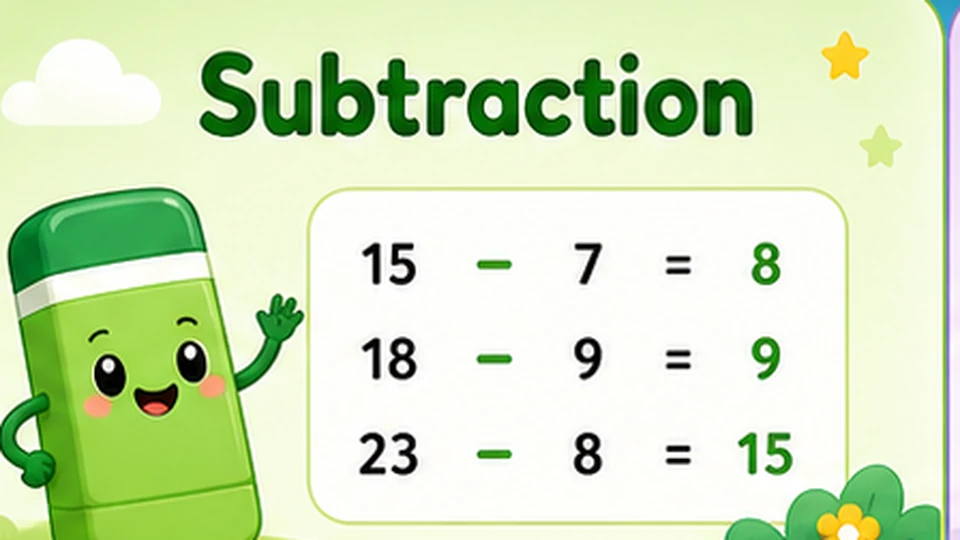
Subtraction Word Problems for Class 1: Free Worksheet
Teach subtraction story sums within 20 with worked examples, picture strategies, an answer key, and a free printable Class 1 worksheet.
Free printable worksheet
Free Class 1 subtraction word-problems worksheet
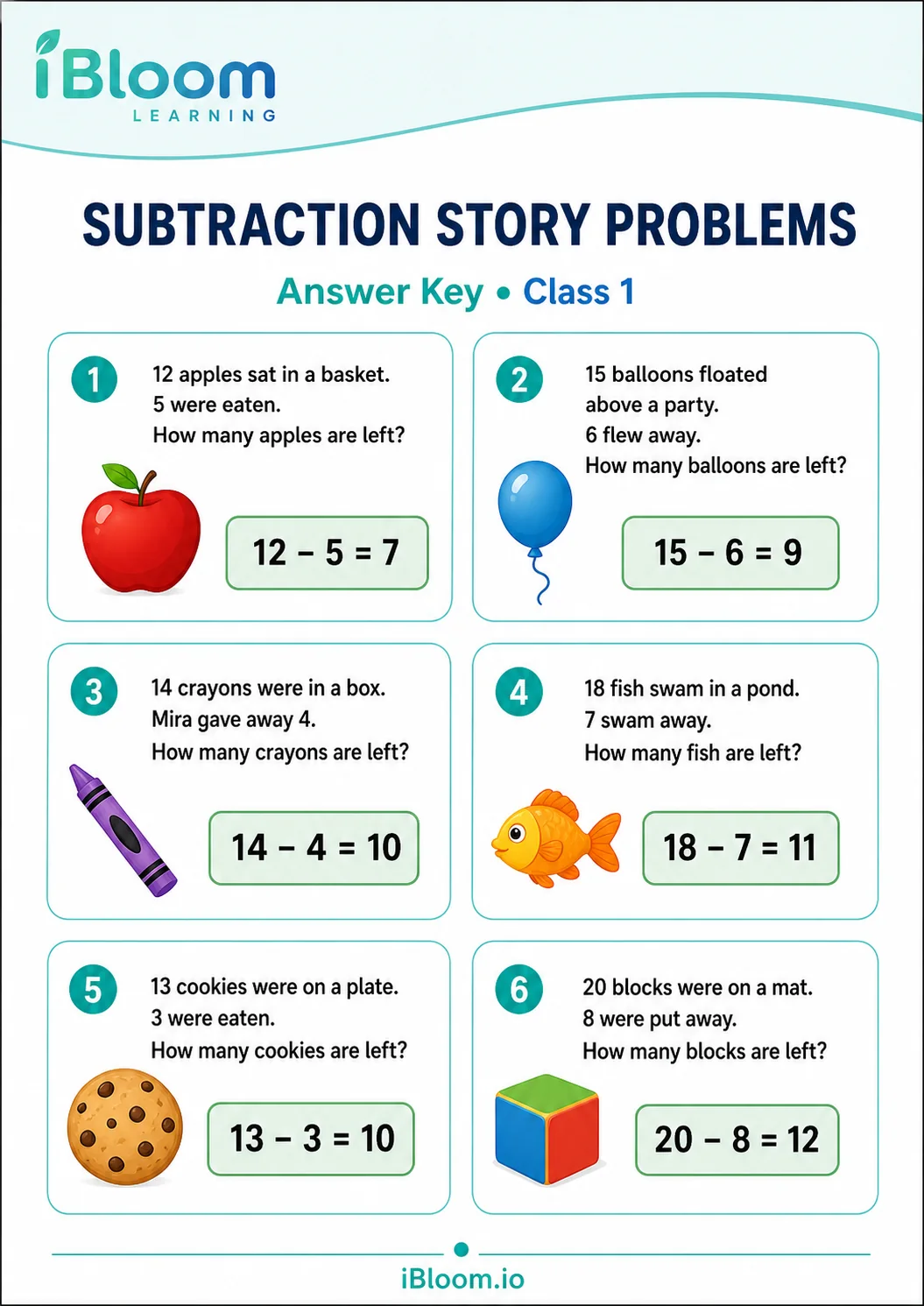
The printable worksheet below contains six subtraction stories within 20. Each question gives space for an equation and an answer. The second page is a complete answer key, so a parent or teacher can check the work quickly.
- Free PDF download
- Answer key included
- Ready to print
Free to print and use at home or in class. How to use this worksheet
Subtraction word problems become much easier when a child can see what changed in the story. Something may be taken away, a missing part may need to be found, or two amounts may be compared. The calculation is short, but understanding the situation comes first.
This guide gives parents and teachers a clear way to teach subtraction story sums within 20. It includes worked examples, simple checking strategies, practice questions, and a free printable Class 1 worksheet with an answer key.
Free Class 1 subtraction word-problems worksheet
The printable worksheet below contains six subtraction stories within 20. Each question gives space for an equation and an answer. The second page is a complete answer key, so a parent or teacher can check the work quickly.
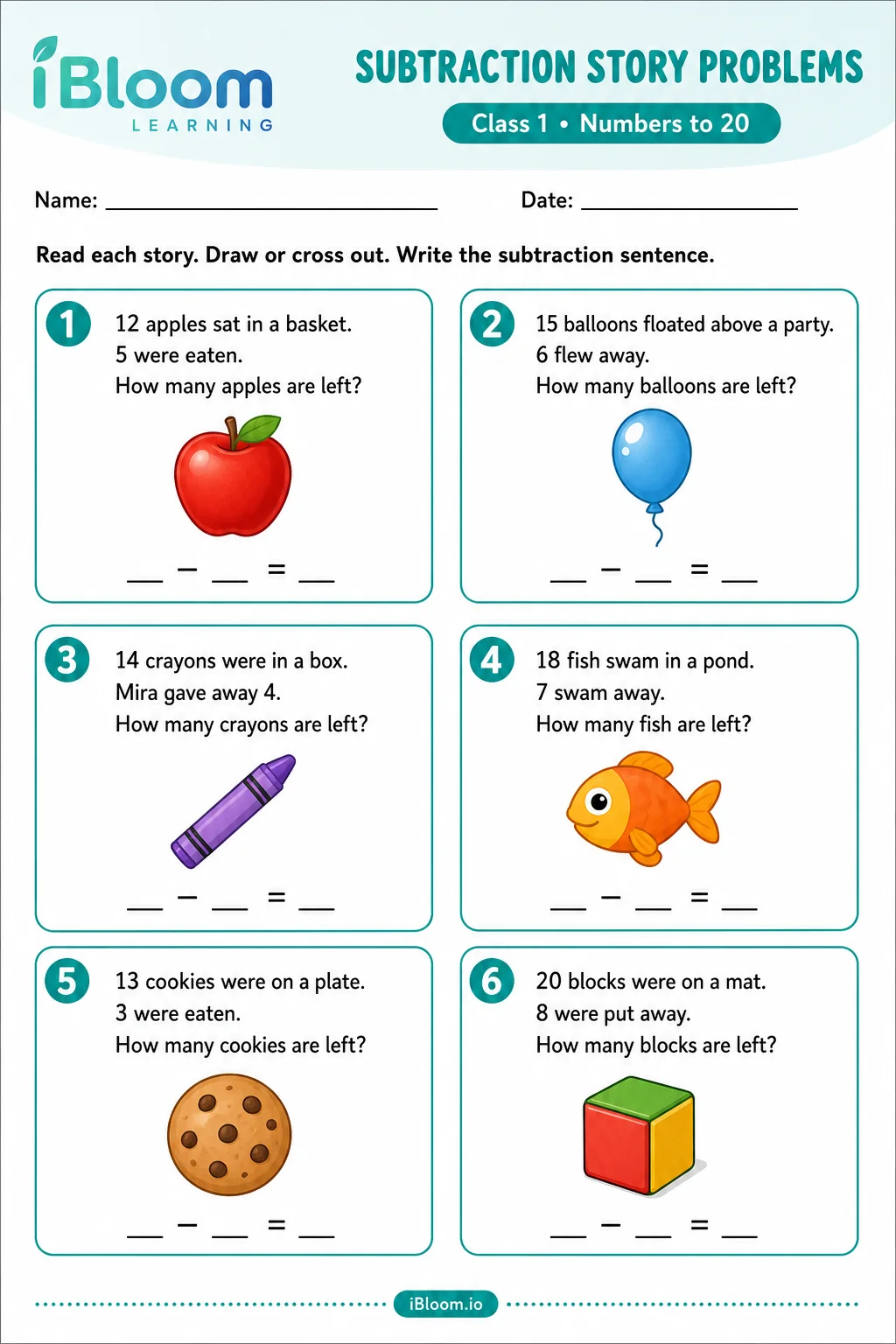
Download the free Class 1 subtraction word-problems worksheet PDF
Answer-key preview
Use the worksheet after the learner has practised with objects or drawings. For extra questions with adjustable number ranges, open the free subtraction worksheet generator. You can also browse Grade 1 subtraction worksheets, review how to teach subtraction to first graders, or practise number order with before, after, and between numbers 1 to 20.
What is a subtraction word problem?
A subtraction word problem tells a short story in which one amount must be found by taking away, finding a missing part, or comparing two groups. A child turns the story into a number sentence such as 12 - 5 = 7.
Class 1 learners usually meet three useful types:
| Story type | What the child needs to find | Example |
|---|---|---|
| Take away | How many are left? | There are 12 balloons. 5 fly away. How many remain? |
| Missing part | How many belong to the other group? | There are 18 pencils. 7 are red. How many are blue? |
| Compare | How many more or fewer? | Mira has 14 shells. Ben has 9. How many more does Mira have? |
The words left, remain, fewer, and difference can suggest subtraction, but they are not rules by themselves. The child should decide what happens in the story before choosing an operation.
Use the read, draw, and write routine
A repeatable three-step routine prevents guessing.
- Read the whole story. Ask, “What do we know?” and “What must we find?”
- Draw or model it. Make quick circles, tally marks, counters, or a bar model. Cross out objects only when the story describes taking away.
- Write the equation and answer. Record the larger amount first, subtract the part being removed or compared, and write a short answer with a label.
For example: “There are 12 balloons. Five fly away.” Draw 12 quick circles, cross out 5, and count 7 circles. Then write 12 - 5 = 7 balloons.
The drawing does not need decoration. Its job is to show the quantities and the action clearly.
Three worked subtraction story sums
1. A take-away problem
Story: A basket holds 12 apples. A family eats 5 apples. How many apples are left?
- Start with 12.
- Remove 5.
- Calculate 12 - 5.
- Answer: 7 apples are left.
The phrase “eats 5” describes an amount leaving the original group. A crossed-out picture or counters work well here.
2. A comparison problem
Story: Aarav has 14 stickers. Riya has 9 stickers. How many more stickers does Aarav have?
- Compare 14 with 9.
- Match 9 stickers from each group.
- Count the unmatched stickers in the larger group.
- Calculate 14 - 9.
- Answer: Aarav has 5 more stickers.
Nothing is taken away in the story. Subtraction finds the difference between the two amounts.
3. A missing-part problem
Story: There are 18 pencils. Seven are red and the rest are blue. How many are blue?
- The whole is 18.
- One known part is 7.
- The missing part is 18 - 7.
- Answer: 11 pencils are blue.
A part-part-whole drawing helps here: write 18 in the whole box, 7 in one part, and a question mark in the other part.
How to know when to subtract
Instead of asking a child to circle clue words, ask one question: What happens to the amounts?
- If a group gets smaller, subtraction may find what remains.
- If two groups are compared, subtraction may find the difference.
- If the whole and one part are known, subtraction may find the missing part.
A keyword can support understanding, but it cannot replace it. “How many are left?” often signals subtraction. However, the word left may also describe a direction or location. Reading the complete sentence matters.
If a learner is unsure, let them act out the story with buttons, blocks, crayons, or bottle caps. Moving real objects makes the operation visible before the child writes symbols.
Check subtraction with addition
Addition can confirm a subtraction answer. For 12 - 5 = 7, add the answer and the removed part:
7 + 5 = 12
If the sum returns to the starting amount, the subtraction is correct. This check also strengthens the relationship between addition and subtraction.
For a comparison problem such as 14 - 9 = 5, check 9 + 5 = 14. Ask the child to say the complete thought: “Nine and five more make fourteen.”
Try these subtraction word problems within 20
Let the child draw before calculating. Keep the written answer short and include the object name.
- A tree has 11 birds. Four fly away. How many birds remain?
- Sam has 15 crayons. He gives 6 to a friend. How many crayons does he have now?
- A shelf holds 17 books. Eight are storybooks. The rest are picture books. How many picture books are there?
- Tina has 13 beads. Noor has 9 beads. How many more beads does Tina have?
- There are 16 cookies. Seven are eaten. How many cookies are left?
- A box has 20 blocks. Twelve are blue. How many are not blue?
- Leo scores 18 points. Ana scores 14 points. How many fewer points does Ana score?
- A pond has 10 ducks. Three swim away. How many ducks stay in the pond?
Show the answers
- 11 - 4 = 7 birds
- 15 - 6 = 9 crayons
- 17 - 8 = 9 picture books
- 13 - 9 = 4 beads
- 16 - 7 = 9 cookies
- 20 - 12 = 8 blocks
- 18 - 14 = 4 points
- 10 - 3 = 7 ducks
A focused 10-minute practice routine
Short, calm practice is more useful than a long page completed in a rush.
- Warm up for two minutes. Use counters to solve one subtraction fact within 10.
- Read one story together. Let the child underline the known amounts and box the question.
- Draw the situation. Ask the child to explain what each mark represents.
- Write the equation. Check that the starting amount and removed or compared amount are in the correct places.
- Check with addition. Say the answer as a complete sentence.
Stop after three or four thoughtful questions if attention drops. Return to the remaining questions later. A learner who can explain one problem has gained more than a learner who guesses through a full page.
Common mistakes and quick fixes
| Common difficulty | What to try |
|---|---|
| Adding every time two numbers appear | Ask the child to act out what changes in the story. |
| Subtracting the larger number from the smaller one in the wrong order | Mark the starting amount or larger comparison group first. |
| Copying a clue word without understanding | Cover the question and let the child retell the event in their own words. |
| Giving only a number | Ask, “Seven what?” and add the object label. |
| Counting a drawing inaccurately | Arrange counters in a line or ten-frame before removing any. |
| Skipping the final check | Use addition to rebuild the starting amount. |
If basic subtraction facts are slowing the learner down, use the Math worksheets library or choose another activity from the free printable worksheets. Keep the number range small until the child can explain the story and operation with confidence.
What learning standards say
The Common Core Grade 1 operations and algebraic thinking standard asks learners to solve addition and subtraction word problems within 20 using objects, drawings, and equations. It includes adding to, taking from, putting together, taking apart, and comparing situations.
India's NCERT learning outcomes for the elementary stage include applying addition and subtraction of numbers from 1 to 20 in daily-life contexts. The National Curriculum Framework for the Foundational Stage also supports movement from concrete materials to pictures and then symbols.
These expectations point to the same teaching sequence: understand the story, model it, write the equation, and explain the answer.
Frequently asked questions
What kind of subtraction word problems should Class 1 learners solve?
Begin with one-step take-away stories within 10. Then introduce missing-part and comparison problems. Move toward 20 when the child can model and explain smaller-number stories.
Should children circle subtraction clue words?
They can notice words such as left, fewer, or difference, but they should not rely on a keyword alone. Ask what happens to the quantities in the complete story.
Can a child draw every answer?
Yes. Quick circles, counters, ten-frames, and bar models are valid ways to reason. Over time, the child will use known facts and equations more often.
How can I help when the child reverses the numbers?
Ask which number describes the starting whole or larger group. Build that amount first with counters, then remove or match the smaller amount.
How often should we practise subtraction story sums?
Three or four carefully explained questions several times a week are enough for many learners. Mix worksheet practice with oral stories and real objects so the skill stays meaningful.
Related practice
Practice this topic
Continue with a lesson, generator, or printable worksheet.