What Does It Mean to Synthesize Multiple Sources?
Synthesis combines relevant ideas from multiple sources into a connected explanation or conclusion instead of stacking separate summaries.
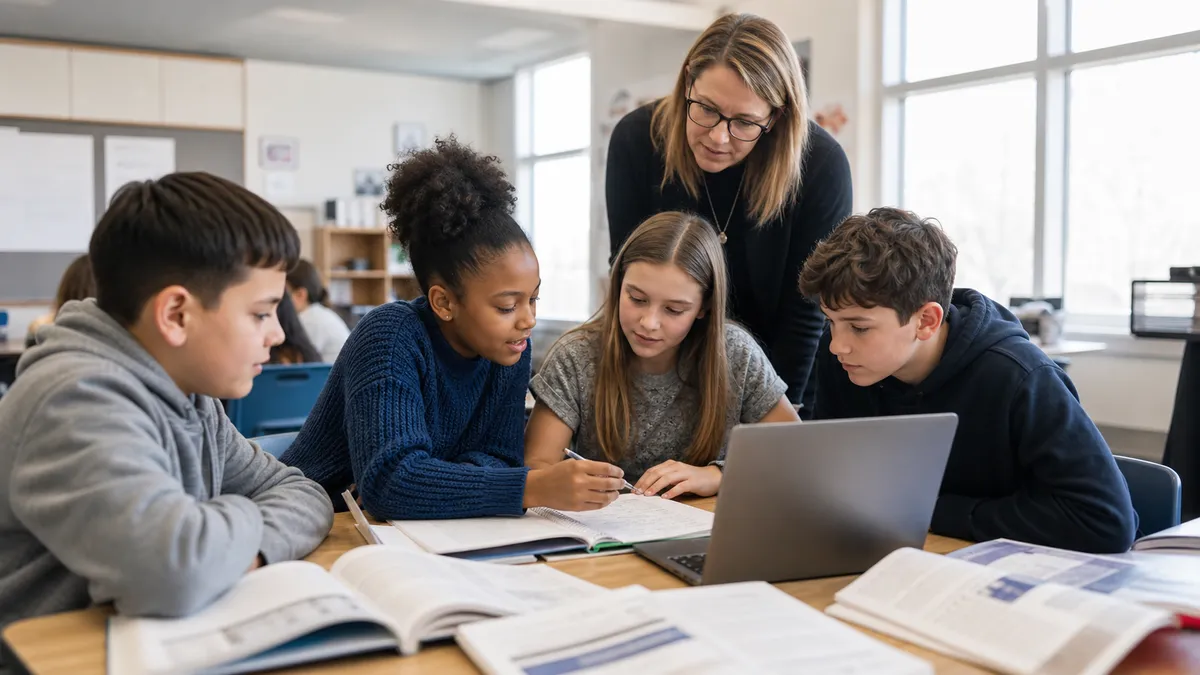
Children synthesize information when they combine ideas from two or more sources to create a clearer understanding, explanation, or conclusion. They are not merely stacking summaries. A useful teaching routine is: ask one focused question, read each source for relevant evidence, organize ideas by theme, compare where sources agree or differ, explain the connection, and cite every contribution.
This guide is for U.S. families and teachers of children ages 9 to 12, roughly Grades 4 to 6. It supports English language arts, science, social studies, research reports, presentations, and project-based learning.
What Synthesis Means for a Child
Use this definition:
“Synthesis means putting useful ideas from different sources into conversation so you can explain something that no single note says by itself.”
Synthesis has four essential parts:
- Selection: The child chooses information relevant to one question.
- Connection: The child notices agreement, difference, cause, sequence, perspective, or a missing piece.
- Transformation: The writing is organized around ideas, not around the order of sources.
- Credit: The reader can see which sources support each part.
The Indiana University of Pennsylvania guide to synthesizing sources describes synthesis as interpreting multiple sources, identifying connections among them, and adding the writer's own analysis. Although its examples serve older writers, the central process can be made concrete for primary learners.
Summary, Comparison, and Synthesis Are Different
| Skill | Child's task | Example |
|---|---|---|
| Summary | State the main point of one source | “Source A explains how tree shade cools paved surfaces.” |
| Comparison | Identify a similarity or difference | “Both sources discuss shade, but only Source B measures temperature.” |
| Synthesis | Combine the relationship into a new explanation | “Together, the sources suggest that tree placement matters because shade changes which surfaces receive direct sunlight, and measured temperatures can show the size of that effect.” |
A report can contain accurate summaries and still fail to synthesize. If paragraph one is “Source A says,” paragraph two is “Source B says,” and paragraph three is “Source C says,” the sources remain in separate boxes.
The BRIDGE Synthesis Routine
B: Begin with one guiding question
Synthesis needs a purpose. “Tell me about rainforests” is too broad. “How do rainforest plants compete for sunlight at different forest layers?” gives the child a relationship to investigate.
If the question is still vague, use the iBloom guide to asking good research questions. Write the final question at the top of every note page and source matrix.
R: Read each source for relevance
Children should not copy everything interesting. Ask:
- Does this information help answer our question?
- Which part of the question does it address?
- Is it evidence, background, an example, or an opinion?
- Does the source explain how it knows?
Start with two short, teacher-selected sources. One may be a diagram and the other an article. Multiple modes reduce the chance that synthesis becomes sentence copying.
The iBloom lesson on summarizing important information helps children identify central information before comparing sources. The matching summarizing worksheet provides a contained follow-up.
I: Identify themes and relationships
Instead of keeping notes only under source names, move them into theme rows. Common relationships include:
- both sources support the same idea;
- one source explains why another source's result occurs;
- sources focus on different parts of a process;
- one source adds an example or measurement;
- sources disagree;
- sources use different definitions or time periods;
- one source leaves a gap another source fills.
Use symbols at first: = for agreement, + for added detail, ↔ for contrast, and ? for an unresolved gap.
D: Draft a connection sentence
Give children language frames:
- “Both sources show ___, while Source B adds ___.”
- “Source A explains the cause, and Source B shows the result.”
- “Although the sources agree about ___, they differ on ___.”
- “Taken together, the evidence suggests ___.”
- “Source B helps explain the pattern reported in Source A because ___.”
- “The sources answer different parts of the question: ___.”
A frame supports reasoning but does not supply the conclusion. The child must fill it with accurate ideas.
G: Give each source clear credit
Credit belongs beside the idea it supports. A synthesis sentence may need more than one source:
“The environment department's shade map and the class temperature observations both indicate that paved areas under tree canopies remain cooler during the measured period.”
The iBloom guide to citing sources and making a bibliography explains source phrases, in-text credit, and final source lists for children.
E: Explain the new understanding
Ask, “What can you say after reading both sources that you could not explain as well after reading only one?”
The answer may be a conclusion, a qualification, a more complete process, a comparison, or a new question. It must remain within the evidence. Synthesis does not permit invented facts.
Build a Child-Friendly Source Matrix
A matrix organizes notes by ideas rather than by source order.
| Theme or supporting question | Source A | Source B | Source C | Connection |
|---|---|---|---|---|
| What creates shade? | Tree canopy blocks direct light | Diagram shows sun angle | — | A explains the action; B shows when direction changes |
| What gets cooler? | Pavement under trees | Air-temperature data mixed | Wall photo shows shaded area | Sources describe different things being measured |
| What affects the result? | Canopy size | Time of day | Surface material | Several conditions influence temperature |
Do not require full sentences in every source cell. Keywords, small sketches, and short paraphrases reduce writing load. The connection column is the intellectual center.
A Complete Worked Example
Guiding question
How do wetlands reduce flooding after heavy rain?
Source A
A science article explains that wetland soils and plants can hold water temporarily.
Source B
A map compares areas with and without wetlands after a storm and shows different water coverage.
Source C
An interview with a local planner explains that drains, buildings, rainfall amount, and soil also affect flooding.
Separate-source response
“Source A says wetlands hold water. Source B has a map. Source C says many things affect flooding.”
This is accurate but weak. The sources remain disconnected.
Synthesized response
“The article explains the process by which wetland soil and plants temporarily hold rainwater, while the storm map shows a pattern of different water coverage in places with and without wetlands. The planner's explanation adds an important limit: wetlands are one factor, and drainage, buildings, soil, and rainfall amount also shape flood risk.”
This response links mechanism, observed pattern, and qualification. It does not claim that the map alone proves cause.
Adult think-aloud
Say:
“I will not write about each source in order. My themes are water storage, flood pattern, and other factors. Source A helps with water storage. Source B helps with the pattern. Source C prevents me from making the claim too simple. My final explanation needs all three roles.”
A Five-Day Teaching Plan
Day 1: Combine familiar information
Use two pictures of the same school garden from different angles. Ask what each reveals and what becomes clear only when both are viewed. Synthesis begins before formal reading.
Day 2: Compare two short sources
Provide a paragraph and diagram. Students identify one shared idea, one unique detail from each, and one connection.
The iBloom combining information from two texts worksheet offers direct practice after a teacher model.
Day 3: Build the matrix
Use three themes and two sources. Model moving a note from “Source A” into the relevant theme row. Students fill the connection column orally before writing.
Day 4: Draft synthesis sentences
Students use relationship frames, cite both sources, and explain what the sources do differently. Review one sentence for accuracy and one for connection quality.
Day 5: Write a short synthesized response
Students answer the guiding question in one paragraph with:
- a direct answer;
- evidence from at least two sources;
- an explicit relationship;
- source credit;
- a concluding insight or limitation.
End with reflection: “Which source changed or improved your understanding most, and how?”
Parent Guidance for Home Projects
Parents can prevent source-by-source reports without writing the project for the child.
Ask:
- What question are all these sources helping you answer?
- Which two sources discuss the same idea?
- Does one explain why another source's fact happens?
- Where do they disagree or use different conditions?
- What is missing?
- How would you organize by themes instead of websites?
- Which source supports this sentence?
- What new understanding comes from combining them?
Use sticky notes in one color per source. Place notes under theme headings. Then look at each column of related notes and speak a connection sentence aloud.
A fifteen-minute home routine
- Choose two short sources about one question.
- Record source details.
- Identify two themes.
- Write one note from each source under the correct theme.
- Mark agreement, added detail, or contrast.
- Say one connection sentence.
- Draft it in the child's own words.
- Add source credit.
- Check that the sentence does not claim more than the evidence.
One well-explained connection is enough for a first session.
Teacher Implementation
Begin with vetted source sets
When synthesis is new, select sources that are readable, reliable, and meaningfully related. Edutopia's guidance on teaching young students to use multiple sources recommends beginning with organized, teacher-vetted source sets before expecting students to find everything independently.
Vary source type, not only reading length
Pair text with a map, chart, photograph, video transcript, or observation. Ask what each medium can and cannot show.
Model source roles
Label a source as background, evidence, example, explanation, perspective, or limitation. A source can play more than one role, but naming the role improves intentional use.
Grade connection separately from correctness
A response can contain correct facts but weak synthesis. Use separate criteria for accuracy, relevance, relationship, source credit, and new understanding.
Discuss disagreement
Do not treat disagreement as an error to erase. Ask whether sources use different dates, definitions, methods, places, populations, or purposes. Sometimes both can be reasonable within different conditions.
Require the matrix before the paragraph
Collect the organizing process. It reveals whether a child is comparing evidence or writing from memory.
Source Reliability Before Synthesis
Combining weak sources does not create a strong conclusion. Before the matrix, apply the iBloom routine for checking reliable sources.
Ask who created each source, what evidence it uses, when it was produced, and what purpose or perspective may shape it. Compare independent sources rather than five pages repeating the same original claim.
The ERIC report on fourth- and fifth-grade synthesis from multiple texts describes difficulties such as copying, narrow selection of relevant information, and misunderstanding the task's purpose. Explicitly naming the purpose and modeling organization by idea addresses those barriers.
Paraphrasing Within Synthesis
Children cannot synthesize effectively if every matrix cell contains copied sentences. Use short keyword notes and paraphrases. The iBloom guide to paraphrasing without copying provides a read-cover-tell-write-check routine.
Keep necessary technical terms. Change the explanation and sentence structure, not the scientific meaning. Cite paraphrases because the information still came from a source.
Grade and Age Adaptations
Ages 7 to 9
Combine two pictures, oral accounts, or short read-alouds. Ask for one shared idea and one difference. The adult records the connection.
Ages 9 to 10
Use two brief sources, two theme rows, color-coded notes, and one written synthesis sentence.
Ages 10 to 12
Use three or four sources, perspective and reliability checks, a fuller matrix, citations, and a paragraph organized by themes.
Older students
Add counterarguments, methods, source hierarchy, disciplinary evidence, uncertainty, and multi-paragraph organization. The basic matrix remains useful.
Multilingual Learners and Accessibility
Allow multilingual learners to discuss source relationships in their strongest language before drafting in the language of instruction. Provide visual relationship symbols and sentence frames, but preserve the child's reasoning.
For dyslexia or handwriting difficulty, use printed note cards, speech-to-text, audio sources with transcripts, and reduced copying. For attention difficulties, reveal one matrix row at a time. For working-memory challenges, keep source codes and colors visible.
The Harvard Library guide to primary sources explains that primary sources provide firsthand testimony or direct evidence about a topic under investigation. Teachers should ask children to distinguish what a source states from what they infer.
Advanced learners can analyze why sources disagree and what additional evidence would resolve the question.
Common Synthesis Problems
The report is a list of source summaries
Fix: Reorganize notes under themes and require a connection column.
The child copies from every source
Fix: Use keyword notes, close the source, explain orally, and paraphrase before adding the note.
The child forces agreement
Fix: Preserve differences. Ask whether methods, dates, definitions, or perspectives vary.
The conclusion goes beyond evidence
Fix: Use cautious language such as suggests, during the measured period, or in these sources.
One source dominates
Fix: Ask what unique role each source plays. Remove sources that add no relevant evidence.
The child includes every fact
Fix: Return to the guiding question. Relevance is more important than quantity.
Sources repeat the same original claim
Fix: Trace information back to its origin and seek independent evidence.
Citation becomes unclear
Fix: Place source credit immediately beside the supported idea and audit every note code.
A Synthesis Rubric
Score each area from 0 to 2:
| Area | 0 | 1 | 2 |
|---|---|---|---|
| Relevance | Mostly unrelated | Some useful evidence | Evidence answers the question |
| Accuracy | Meaning changed | Minor errors | Sources represented accurately |
| Connection | Sources listed | Relationship implied | Relationship clearly explained |
| Organization | By source only | Mixed structure | Organized by themes or claims |
| Insight | No combined understanding | Simple combined point | New conclusion or qualification |
| Credit | Missing | Inconsistent | Every contribution traceable |
Use low scores diagnostically. Weak relevance needs a better question. Weak connection needs oral comparison. Weak credit needs source codes and a citation audit.
Practical Synthesis Activities
Puzzle overlap
Give two partial diagrams. Students identify what each contributes and what the combined view reveals.
Color-coded evidence
Assign one color per source. In a synthesis paragraph, every evidence phrase is underlined in its source color and the child's connecting analysis remains uncolored.
Source-role cards
Students label sources as background, measurement, example, explanation, perspective, or limitation.
Agreement triangle
Place three sources at the corners. Write shared ideas on connecting lines and a conclusion in the center.
Contradiction clinic
Give two apparently conflicting claims. Students inspect dates, definitions, populations, methods, and purpose before deciding whether the conflict is real.
Missing-source challenge
Remove one source from a set. Ask what part of the final explanation becomes weaker. This reveals each source's role.
Frequently Asked Questions
What is synthesis for elementary students?
Synthesis is combining relevant ideas from multiple sources, explaining how they relate, and forming a clearer understanding or conclusion with source credit.
Is synthesis the same as summarizing?
No. A summary condenses one source. Synthesis connects ideas across sources and adds the learner's analysis.
How many sources should a child use?
Begin with two short sources. Move to three or four only when the child can organize by theme and explain relationships accurately.
What if sources disagree?
Do not choose a winner immediately. Compare dates, methods, definitions, evidence, places, and perspectives. Explain the disagreement and what more evidence is needed.
Can a child synthesize pictures and videos?
Yes. Sources can include text, maps, charts, photographs, interviews, observations, and videos. The child should identify what each medium contributes and credit it.
Does every source need a citation?
Every source that contributes borrowed information, wording, data, or media needs clear credit according to the assignment's style.
How can parents help without writing the paragraph?
Help the child sort notes by theme and ask relationship questions. Let the child speak and draft the connection sentence.
When is a learner ready for synthesis?
The child should be able to identify main ideas, make relevant notes, paraphrase, and track sources. These skills can continue developing during guided synthesis practice.
Final Checklist
Before accepting the work, ask:
- Is there one focused guiding question?
- Are all sources reliable enough and relevant?
- Are notes organized by themes rather than source order?
- Does the child identify agreement, contrast, cause, sequence, perspective, or a gap?
- Are source meanings represented accurately?
- Are paraphrases genuinely in the child's words?
- Does every borrowed contribution have credit?
- Does the response explain a new combined understanding?
- Are limitations or disagreements preserved?
- Could another reader trace each claim to its source?
Planning a Full Synthesis Paragraph
When children are ready to move beyond one connection sentence, teach a five-part paragraph plan.
1. Answer the guiding question
The opening sentence should state the child's current answer, not announce the assignment. Replace “I read three sources about wetlands” with “Wetlands can reduce some flood risk by storing water temporarily, although their effect depends on surrounding land and drainage.”
2. Introduce the first evidence role
Use the source that provides the clearest process, definition, or central evidence. Explain what it contributes and cite it. Do not copy a sentence simply to make the paragraph sound formal.
3. Connect the next source
Name the relationship explicitly. The second source may confirm the first, add a measurement, show an example, challenge a limit, or present another perspective. The transition should reveal that role: “A local map adds…,” “However, the interview qualifies…,” or “This pattern is also visible in…”
4. Add the child's reasoning
Ask what the evidence means together. This sentence should not contain a new unsupported fact. It may explain a cause, draw a careful comparison, identify a pattern, or state why a limitation matters.
5. Conclude with scope
End by answering the question at the level the evidence permits. A responsible conclusion may acknowledge uncertainty: “These sources support the value of wetland storage, but they do not show that wetlands prevent every flood.”
This plan prevents two common extremes: a paragraph made entirely of source facts and a paragraph containing a confident opinion with little evidence.
How to Conference With a Child
During a short conference, ask the child to point rather than merely answer verbally:
- Point to the guiding question.
- Point to one matrix row where two sources connect.
- Explain the relationship in a spoken sentence.
- Point to the source code supporting each part.
- Show where the paragraph adds the child's reasoning.
- Identify one claim that needs softer or more precise wording.
If the child cannot point to evidence, return to the matrix. If the child can point to evidence but cannot explain the relationship, rehearse orally with a sentence frame. If the relationship is clear aloud but weak in writing, support sentence construction rather than assigning more research.
Choosing the Next Instructional Step
Use the child's work to diagnose the bottleneck:
- Accurate notes but no connections: practise sorting and oral comparison.
- Strong connections but copied language: return to paraphrasing.
- Relevant evidence but vague question: narrow the guiding question.
- Clear synthesis but missing credit: audit source codes and citations.
- Confident conclusion but mixed evidence: teach qualification and source reliability.
- Overloaded matrix: reduce the source set and theme rows.
Synthesis improves through targeted feedback. “Use more sources” is rarely useful when the real problem is that the learner does not yet know what relationship to look for.
Synthesis is the bridge between collecting information and thinking with information. Teach children to organize around a question, compare ideas visibly, and explain relationships in their own words. With a small source set, a clear matrix, and repeated modeling, even primary learners can move beyond “Source A says” toward accurate, connected, evidence-based understanding.