What Should Kids Do When Sources Disagree?
A practical process for helping students compare conflicting claims, investigate why sources differ, and state the best-supported conclusion honestly.
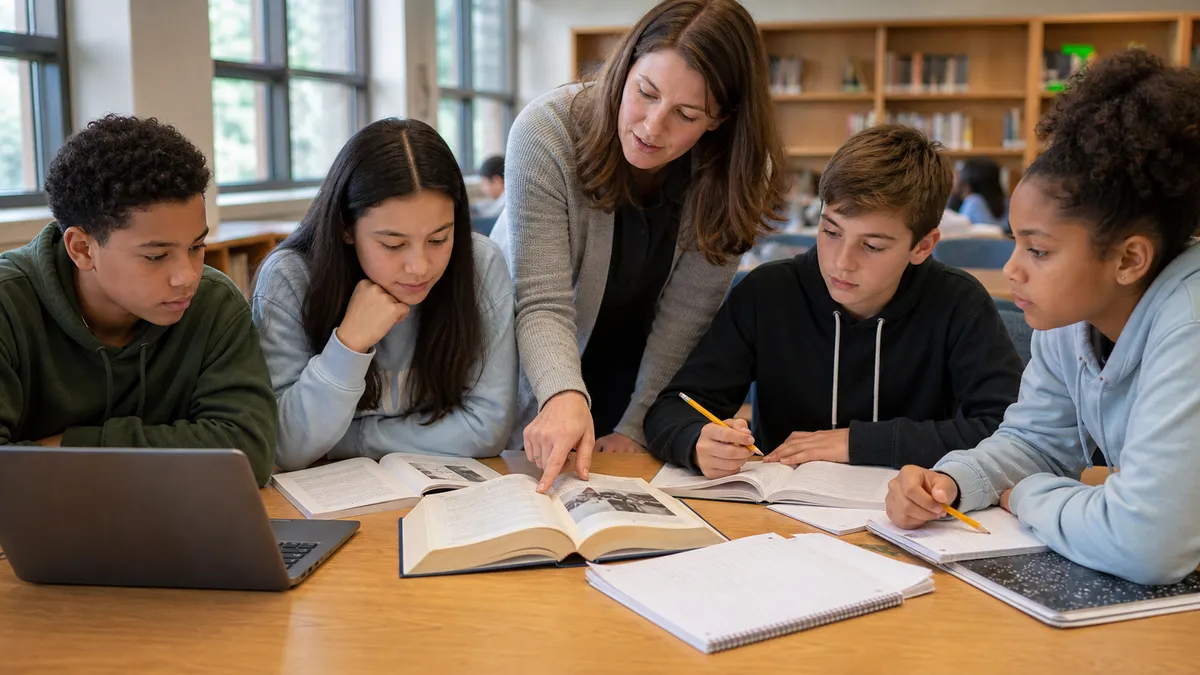
When two sources disagree, children should not guess which one is “right” or simply choose the source they like. They should identify the exact point of disagreement, compare what each source actually claims, check dates, definitions, evidence, methods, and purpose, then state the best-supported conclusion with an honest level of certainty.
This guide gives parents and teachers a repeatable way to teach that process to children ages 9 to 12, roughly Classes 4 to 6 in India and Grades 4 to 6 in the United States. It works for science, social studies, English language arts, health information, charts, websites, books, videos, and AI-assisted research.
Why Good Sources Can Still Disagree
Children often assume that disagreement means one source is false. Sometimes that is true, but many conflicts have more ordinary explanations.
Two sources may:
- use different definitions for the same word;
- describe different places, groups, or time periods;
- measure the same thing with different methods;
- report a preliminary result and a later update;
- emphasise different parts of a complex issue;
- interpret the same evidence from different perspectives;
- round numbers differently;
- rely on evidence of unequal quality;
- contain an error that needs correction.
The goal is not to make every disagreement disappear. The goal is to understand what produces the difference and decide what the available evidence can responsibly support.
This is a distinct skill from deciding whether a source is generally trustworthy. Begin with iBloom’s guide to checking whether an online source is reliable, then teach learners how to compare sources that survive that first check.
The COMPARE Routine
Use the word COMPARE as a seven-step routine:
- C: Clarify the question.
- O: Outline each source’s exact claim.
- M: Match the context and definitions.
- P: Probe the evidence and method.
- A: Account for agreement as well as conflict.
- R: Resolve what the evidence allows.
- E: Express the conclusion and remaining uncertainty.
Children can put these seven letters down the left side of a notebook page. With practice, the routine becomes a habit rather than a one-time worksheet.
C: Clarify the Exact Question
Many apparent conflicts begin with a vague question. “Is homework good?” could mean whether homework improves recall, test scores, study habits, family stress, or long-term achievement. A source answering one version may not contradict a source answering another.
Ask the child:
- What exact claim are we investigating?
- What would count as an answer?
- Which age group, place, subject, or time period matters?
- Are we asking what happened, why it happened, or what someone recommends?
A useful comparison question is narrow enough to test. For example:
For children in Classes 4 to 6, do the two sources agree about whether ten minutes of retrieval practice improves recall of recently learned vocabulary?
If the research question itself is unclear, use the iBloom guide to what makes a good student research question.
O: Outline Each Source’s Exact Claim
Children should paraphrase each source separately before comparing them. A simple frame is:
Source A says ___ about ___ under ___ conditions.
Source B says ___ about ___ under ___ conditions.
This prevents a common mistake: comparing a headline from one source with a detailed conclusion from another. Headlines compress information and may omit limits.
Ask children to underline qualifying words such as “may,” “often,” “in this study,” “among the participants,” or “during the observed period.” Those words are not decoration. They define how broad the claim is.
Then label the relationship:
- same claim;
- partly overlapping claims;
- different questions;
- direct contradiction;
- not enough information to tell.
Do not move to deciding which source is stronger until the claims have been represented fairly.
M: Match Context, Definitions, Dates, and Units
Create four boxes titled Who, Where, When, and What exactly.
Who
Are the sources describing the same age group, population, sample size, or type of learner? Findings about university students cannot automatically answer a question about ten-year-olds.
Where
Are both sources discussing the same country, climate, school system, or setting? Advice for a controlled laboratory may not transfer directly to a crowded classroom or home.
When
Check publication dates and the dates of the evidence. A recent article can repeat old data, while an older source can remain authoritative if the underlying facts have not changed. Date is a clue, not an automatic score.
What exactly
Definitions and units matter. One report may define “screen time” as recreational phone use while another includes schoolwork on a tablet. One weather table may report daily maximum temperature while another reports a daily average. One chart may use percentages while another uses raw counts.
Teach children to convert units only when they understand the conversion. Otherwise, record that the values cannot yet be compared.
P: Probe Evidence, Method, and Source Purpose
Now inspect how each source knows what it claims.
Ask:
- What evidence is offered?
- Is the evidence an observation, experiment, survey, document, expert synthesis, or personal story?
- How many examples or participants are included?
- Were the comparison conditions fair?
- Is the method explained clearly enough to evaluate?
- Does the source link to original evidence?
- Who created it, and for what purpose?
- Does it distinguish data from interpretation?
- Does it acknowledge limits or contrary evidence?
The Digital Inquiry Group’s lateral-reading lessons teach readers to leave an unfamiliar page and investigate who is behind it, what other sources say, and where its claims originated. This is especially useful when a polished page looks convincing but provides little evidence.
Purpose matters, but purpose alone does not prove a claim wrong. A company page may contain accurate specifications, while an advertisement may select only favourable comparisons. A museum interpretation may use genuine evidence while reflecting a particular curatorial focus. Children should explain how purpose could affect selection or framing rather than using “biased” as a label that ends all thinking.
A: Account for Agreement
When children focus only on conflict, they miss the shared foundation.
Make three columns:
| Both sources agree | Source A only | Source B only |
|---|---|---|
| Shared facts, dates, or patterns | Unique evidence or interpretation | Unique evidence or interpretation |
Agreement can be more important than the disagreement. Two reports might give different estimates of a bird population but agree that the population declined over five years. A child can confidently report the shared trend while remaining cautious about the exact total.
The Harvard Library guide to primary sources explains that primary sources provide firsthand testimony or direct evidence about a topic under investigation. Prior knowledge should prompt questions, however, not automatically defeat new evidence.
R: Resolve Only What the Evidence Allows
After the comparison, choose one of five responsible outcomes:
- One source is better supported. Its evidence is more relevant, transparent, direct, current for the question, or methodologically appropriate.
- The sources answer different questions. The apparent conflict disappears after matching context.
- Both are partly supported. Each explains a different part of the issue.
- The evidence remains genuinely mixed. A firm conclusion would overstate what is known.
- More information is needed. Seek an original study, official record, updated source, or third independent account.
“We cannot decide yet” is a valid research conclusion. It is stronger than false certainty.
The U.S. Institute of Education Sciences describes comprehension across multiple texts as a complex set of skills that includes selecting useful sources and making meaning across them in its overview of multiple-source comprehension research. Children need explicit practice with the process, not only reminders to “do research.”
E: Express a Proportionate Conclusion
A good conclusion answers the question, names the strongest evidence, explains the disagreement, and states any limit.
Use this frame:
The best-supported conclusion is ___. Both sources agree that ___. They differ about ___ because ___. Source ___ is more useful for this question because ___. We are still uncertain about ___.
Avoid “Source A proved Source B wrong” unless the evidence truly establishes an error. Prefer language such as:
- “is better supported by the available evidence”;
- “applies more directly to this age group”;
- “uses a more recent dataset”;
- “measures a different outcome”;
- “remains uncertain because the methods differ.”
For help connecting evidence to conclusions, use iBloom’s guide to synthesizing multiple sources.
Worked Example 1: Two Weather Numbers
A child finds one page saying the day’s temperature was 32°C and another saying it was 27°C.
Clarify
Question: What was the temperature in the city on that date?
The question is still too broad. Was it the maximum, minimum, average, or temperature at a specific hour?
Outline
Source A reports a daily maximum of 32°C. Source B reports an average of hourly observations of 27°C.
Match
The city and date match, but the measurement summaries do not.
Probe
Both pages explain the units and data source.
Account
Both indicate a warm day. The values differ because they represent different statistics.
Resolve and express
The sources do not directly contradict each other. One reports the highest observed temperature; the other reports the daily average. The child should label each number instead of selecting one.
This example teaches a powerful lesson: numbers cannot be compared until their labels match.
Worked Example 2: A Historical Event
Two accounts describe a protest. A newspaper published at the time says the crowd was disorderly. A participant’s diary says the march was peaceful.
Clarify
Question: What happened during the march, and why do accounts describe it differently?
Outline
The newspaper characterises the crowd broadly. The diary describes events witnessed by one participant from a particular position.
Match
Check whether they describe the same time, street, and stage of the event. A long event can be peaceful in one location and tense in another.
Probe
Who wrote each account? How soon after the event? What could each person observe? What evidence supports the language used? Is there a photograph, official record, another diary, or later investigation?
Account
Both may agree on the date, route, approximate crowd, and purpose while differing in interpretation.
Resolve and express
The child might conclude that the sources provide different perspectives and neither alone describes every participant or moment. More independent evidence is needed before making a claim about the whole event.
The U.S. National Archives explains that primary sources reveal point of view, contradictions, and limitations in its guide to using historical evidence in the classroom. The same principle applies to local history in India, family archives, oral histories, and community records.
Worked Example 3: A Health Claim
One social-media post says a particular food “boosts memory.” A public-health page says no single food guarantees better memory.
Clarify
Is the question whether the food contains useful nutrients, whether it changes test performance immediately, or whether it guarantees lasting memory improvement?
Outline
The social post makes a broad causal claim. The health page makes a narrower claim about the limits of evidence.
Match
Check age group, amount, duration, and outcome. “Memory” could mean recall after ten minutes, school performance, or risk of age-related decline.
Probe
Does the social post cite an original study? Was the study conducted with children? Was there a comparison group? Does the public-health page explain its evidence and review process?
Resolve
The child should not turn the activity into medical advice. A responsible conclusion might be that the food can be part of a balanced diet but the strong memory guarantee is not supported by the evidence reviewed.
Parents and teachers should use age-appropriate examples and defer personal health decisions to qualified professionals.
Worked Example 4: Conflicting Science Results
Two class groups test which paper bridge holds more coins. Group A says folded paper is strongest; Group B says rolled paper is strongest.
Before arguing, compare:
- paper size and thickness;
- fold or roll design;
- distance between supports;
- coin placement;
- number of trials;
- whether damaged paper was reused;
- how “failure” was defined.
The disagreement may come from method differences. Repeating both designs under one shared procedure can resolve the question. If results still vary, report the range and uncertainty rather than hiding inconvenient trials.
This is where source comparison becomes experimental thinking: a method is part of the evidence.
Worked Example 5: Two Charts About the Same Class
Chart A says reading participation rose from 40% to 60%. Chart B says the number of participating students rose from 20 to 24.
Both could be accurate if the class size changed. Ask:
- What is the denominator?
- Are the time periods identical?
- Does “participating” use the same definition?
- Are absent students included?
- Do the axes begin at zero?
Children should reconstruct the underlying counts before concluding that one chart is wrong. Visual displays can create an impression of conflict when they use different scales or denominators.
A Five-Day Classroom Sequence
Day 1: Find the disagreement
Give two short, teacher-vetted sources. Students highlight exact sentences that appear to conflict. They rewrite each claim without judging it.
Day 2: Match context
Students fill the Who, Where, When, and What exactly boxes. Include one pair that only appears contradictory because definitions differ.
Day 3: Inspect evidence
Students identify evidence type, origin, date, method, purpose, and limitations. Model lateral reading on a projected page.
Day 4: Build a comparison table
Students record agreement, conflict, source strengths, source limitations, and missing information. Partners challenge one another to point to specific evidence.
Day 5: Write a calibrated conclusion
Students use the conclusion frame, cite both sources, and include one remaining uncertainty. Finish with a reflection: “What evidence would change my conclusion?”
For close-reading practice before this sequence, use the iBloom Class 5 making-inferences lesson and its making-inferences worksheet.
Parent Guidance for Ten-Minute Practice
Use low-stakes topics: weather reports, sports summaries, animal facts, product labels, book reviews, or two descriptions of a family event.
- Put both sources side by side.
- Ask the child to state each claim fairly.
- Circle dates, units, locations, and age groups.
- List what both sources agree on.
- Ask which evidence is most directly connected to the question.
- Let the child say “not enough information.”
- End with one careful conclusion.
Do not ask, “Which website is correct?” too early. That encourages a verdict before analysis. Ask, “What exactly differs, and what might explain it?”
Praise revision. A child who changes a conclusion after finding better evidence has succeeded.
Teacher Moves That Improve Discussion
Use prompts that require evidence:
- “Show us the exact line.”
- “Is that a claim, evidence, or interpretation?”
- “Are the sources measuring the same thing?”
- “What do both sources agree on?”
- “Whose perspective is missing?”
- “What additional source would help?”
- “How certain should our wording be?”
Assign roles in groups: claim mapper, context checker, evidence examiner, and conclusion writer. Rotate roles so every learner practises each operation.
Do not make the activity a debate where one team must defend a source even after finding weak evidence. The objective is revision toward a better-supported account.
Full-Database and Source Notes for Research Projects
For a larger project, children need a source log:
| Source | Exact claim | Evidence or method | Context | Agreement | Conflict | Use in conclusion |
|---|---|---|---|---|---|---|
| A | ||||||
| B | ||||||
| C |
The log prevents “source blending,” where a child remembers an idea but cannot tell which source provided it. After resolving the conflict, children should still credit the material they use. iBloom’s guide to paraphrasing without copying provides a child-friendly next step.
Common Mistakes and Better Responses
Choosing the first search result
Search position does not prove accuracy. Investigate the creator, evidence, and original source.
Choosing the newest source automatically
Recency matters for changing facts, but an older primary record or foundational study may remain essential.
Counting sources instead of weighing them
Three pages repeating the same unsupported claim are not stronger than one transparent primary source.
Treating perspective as dishonesty
Perspective shapes selection and interpretation. Explain its effect rather than dismissing a source with one label.
Averaging incompatible numbers
Never average values until units, definitions, populations, and periods match.
Ignoring agreement
Record the shared evidence first. It may support a useful partial conclusion.
Demanding certainty
“The evidence is mixed” or “we need another source” can be the most accurate answer.
Asking AI to choose
An AI response can misstate, merge, or invent source details. Children should inspect the original sources and verify quotations, dates, and links.
Grade and Age Adaptations
Ages 7 to 9
Use two pictures, observations, or very short passages. Ask what is the same, what differs, and what extra clue is needed. Keep the conclusion oral.
Ages 9 to 10
Use two sources with one designed difference, such as date or definition. Complete the COMPARE routine with teacher modelling.
Ages 10 to 12
Add method, purpose, independent corroboration, chart scales, and a written conclusion with uncertainty.
Ages 12 and above
Add primary research, statistical uncertainty, competing interpretations, counterevidence, and formal citation. Require students to explain why a source is appropriate for the exact disciplinary question.
Multilingual and Accessibility Supports
Let children explain each source in their strongest language before writing in the instructional language. Keep the intellectual work demanding while reducing language barriers.
Useful supports include:
- a two-column claim organiser;
- icons for person, place, calendar, definition, and method;
- colour coding for agreement, conflict, and uncertainty;
- audio versions of text;
- speech-to-text for conclusions;
- short source excerpts with full links available;
- partner reading with assigned roles;
- sentence frames that fade over time.
For learners with working-memory needs, keep the question visible throughout. For learners who find open-ended tasks difficult, offer the five outcome choices under Resolve. For visual impairment, describe charts in text and provide the underlying data table.
Do not simplify by removing the disagreement. Make the sources accessible while preserving the reasoning challenge.
A Practical Assessment Rubric
| Skill | Beginning | Developing | Secure |
|---|---|---|---|
| Claim mapping | Blends sources | Separates most claims | Represents both precisely |
| Context | Misses labels | Checks some factors | Matches people, place, time, definitions, units |
| Evidence | Gives a verdict | Names evidence | Evaluates relevance, method, and limits |
| Agreement | Notices only conflict | Lists shared facts | Uses shared ground in conclusion |
| Resolution | Chooses by preference | Gives partial reason | Selects a justified outcome |
| Uncertainty | Sounds absolute | Adds a vague limit | States exactly what remains unknown |
| Citation | Loses source trail | Credits inconsistently | Makes every contribution traceable |
Assess each skill separately. A child may understand context but need support evaluating methods. The next lesson should target the weak operation rather than repeat the whole routine.
Frequently Asked Questions
What should a child do first when two sources disagree?
Write the exact claim from each source and clarify the question. Many conflicts disappear when the child notices that the sources discuss different groups, dates, definitions, or outcomes.
Does a newer source always beat an older source?
No. Newer evidence may be important for changing information, but an older primary document or well-established finding can still be the best source for a question.
How many sources are enough?
There is no universal number. Two sources can reveal a conflict, but resolving it may require an original record, a transparent study, or an independent third source.
What if both sources look trustworthy?
Compare evidence, method, scope, and purpose. Both may be accurate within different conditions, or the evidence may remain genuinely mixed.
Should children use Wikipedia?
It can help identify vocabulary and references, but children should follow citations to suitable original or authoritative sources and verify the specific claim.
Can a child conclude that neither source is sufficient?
Yes. “Not enough evidence yet” is a responsible conclusion when neither source directly answers the question or explains its method.
How do children compare a video with a written article?
Record the creator, date, exact claim, evidence, and source references for each. The format is less important than whether the evidence is transparent and relevant.
What if a source contains one error?
Correct the error and evaluate how much it affects the main claim. One minor mistake does not automatically invalidate every statement, but a serious or repeated error should reduce confidence.
How should children handle AI-generated summaries?
Treat them as unverified leads, not final evidence. Open the cited original sources, confirm that they exist, and check whether they actually support the summary.
Is disagreement a problem in research?
Not necessarily. Disagreement can reveal changing evidence, different methods, missing perspectives, or questions that are not yet settled. The important skill is explaining the difference accurately.
Final Child-Friendly Checklist
- I wrote the exact question.
- I stated each source’s claim fairly.
- I checked people, place, date, definitions, and units.
- I identified the evidence and method.
- I investigated who created each source.
- I recorded what the sources agree on.
- I explained the exact disagreement.
- I chose a resolution supported by evidence.
- I stated what remains uncertain.
- I credited every source I used.
Children do not become careful researchers by being told to find the “correct website.” They become careful researchers by comparing claims, contexts, evidence, methods, and limits. The COMPARE routine makes that invisible thinking visible. It gives children permission to revise, to remain uncertain, and to ask for better evidence. Those habits matter in school projects, daily decisions, and every future encounter with information.