Why Does My Child Misunderstand the Equal Sign?
A practical U.S. parent and teacher guide to diagnosing equal-sign misconceptions and building same-value reasoning with objects and varied equations.
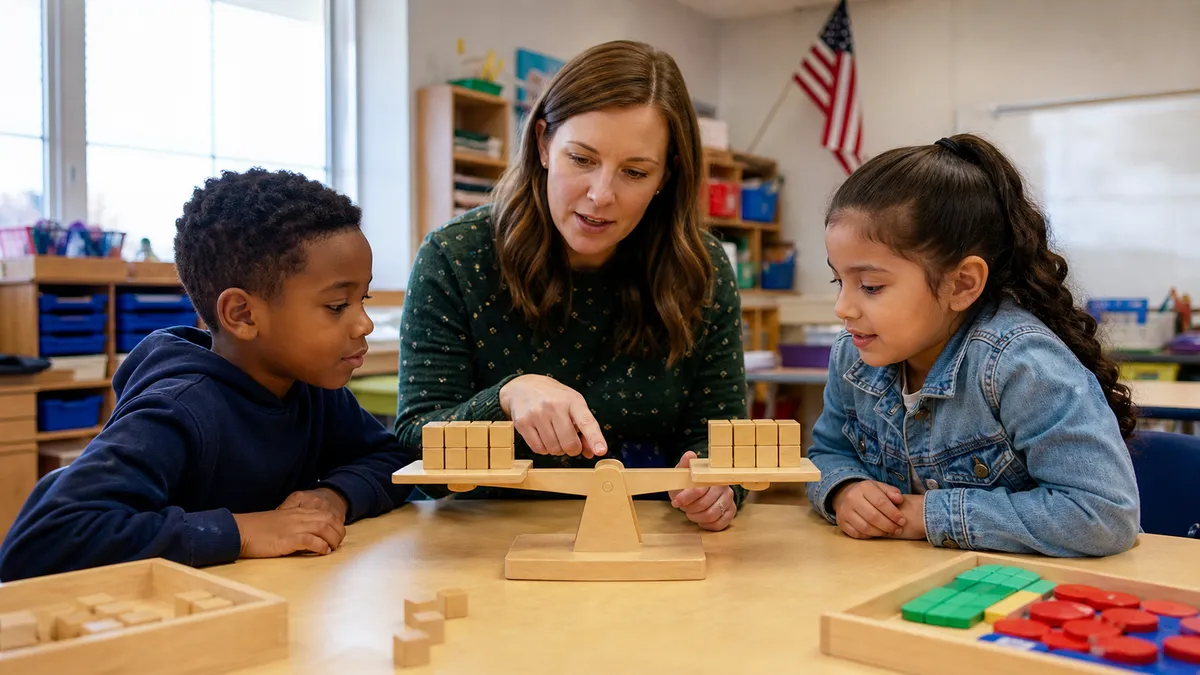
If your child treats the equal sign as “the answer comes next,” they have probably learned a familiar worksheet pattern without yet understanding the relationship the symbol represents. The equal sign means the expression on one side has the same value as the expression on the other side. Help by using objects, true-or-false equations, equations written in different orders, and missing numbers in different positions. The goal is not to make the child repeat a definition; it is to help them decide whether two sides are actually equal.
This misunderstanding is common enough to deserve calm, direct instruction, but one wrong answer does not prove that a child has a lasting misconception. Look at the child’s reasoning across several examples. A learner who solves 4 + 3 = 7 but rejects 7 = 4 + 3, writes 10 for 6 + 4 = 8 + __, or continues calculating after every equal sign is showing you something useful: the symbol is acting like a command in the child’s mind rather than a statement about two values.
What the Equal Sign Actually Means
An equation says that the value on the left of the equal sign is the same as the value on the right. In 5 + 2 = 7, the expression 5 + 2 has a value of 7, so the equation is true. In 7 = 5 + 2, the order looks less familiar, but the relationship is unchanged. Both sides still have the same value.
The Ohio Grade 1 mathematics model curriculum states this idea directly: quantities on both sides must have the same value for an equation to be true. That makes “has the same value as” a more useful reading of = than “makes,” “becomes,” or “the answer is.”
Consider these statements:
8 = 8is true because both sides have the same value.3 + 5 = 6 + 2is true because each side has a value of 8.9 = 4 + 5is true even though the single number appears first.7 + 2 = 10is false because the two sides do not have the same value.6 + 4 = 8 + 2is true without either side being labeled “the question” or “the answer.”
A child does not need formal algebra language to understand these relationships. “This side has the same amount as that side” is enough. The important shift is from seeing a left-to-right instruction to seeing a comparison.
Why “The Answer Comes Next” Feels Reasonable
Many early arithmetic tasks repeatedly use one format: an operation appears on the left, the equal sign appears next, and a blank or total appears on the right. A child who sees 3 + 4 = __, 6 - 2 = __, and 5 + 5 = __ may notice the layout before noticing the relationship. The child learns a successful routine: calculate the numbers on the left and put the result after the symbol.
That routine works for those examples, so the misunderstanding can remain hidden. It becomes visible when the format changes. The peer-reviewed review Equations and the Equal Sign in Elementary Mathematics Textbooks describes the difference between an operational view of the equal sign, where it signals an action, and a relational view, where it expresses equivalence. The article also explains why varied equation formats matter.
This is not a reason to blame a worksheet, teacher, parent, or child. Standard equations are useful. The problem is relying on one arrangement so heavily that the arrangement becomes the meaning. The repair is to broaden the examples while keeping the arithmetic simple enough that the child can focus on the symbol.
For a quick check of whether the issue is the equation rather than the arithmetic, use facts the child already knows. If the child confidently knows that 4 + 3 is 7 but says 7 = 4 + 3 is wrong, the reversal of the format is more important than addition fluency. If fact recall itself is unstable, first use the diagnostic steps in why children forget math facts they knew yesterday so that a recall problem is not mistaken for an equality problem.
A Five-Minute Diagnostic You Can Use
Do not begin with a long explanation. Ask a small set of questions, listen, and note what changes the child’s response. Use counters or drawings if computation would get in the way.
1. Ask What the Symbol Says
Write 5 + 3 = 8 and ask, “What does this symbol tell us?” Accept the child’s first answer without correcting it immediately. A response such as “It tells you the answer” provides useful evidence. Then ask, “Could we read it as ‘has the same value as’?” Read the complete statement aloud: “Five plus three has the same value as eight.”
Avoid asking only, “What is this symbol called?” A child may know the name “equal sign” while still using it as a command. You need to hear what the child thinks it does.
2. Reverse a Familiar Equation
Write 8 = 5 + 3. Ask whether it is true or false and why. If the child says it is backward, ask them to find the value of each side separately. Put a small box around the left side and another around the right side. Write 8 beneath each box after evaluating it.
Do not say that equations can be written “either way” without qualification. You cannot reverse the order of numbers inside subtraction and expect the same result. The precise idea is that when two expressions have the same value, either expression may appear on either side of the equal sign.
3. Use a True-or-False Statement
Try 6 + 2 = 5 + 3. Ask the child to evaluate each side and then decide whether the complete statement is true. This removes the expectation that one side must be a single answer. The existing iBloom guide to Grade 1 true-or-false addition sentences provides a useful next step when the child needs more examples of judging whole equations.
Watch for a child who adds every visible number. If they say 16 because they combined 6, 2, 5, and 3, return to the two boxes. Ask for the value of one box at a time, then compare the values.
4. Move the Missing Number
Compare these:
4 + 5 = ____ = 4 + 54 + __ = 99 = 4 + __6 + 3 = 5 + __
Ask only one at a time. The arithmetic remains small, but the blank changes position and role. If the child succeeds only when the blank is at the far right, the layout is still controlling their reasoning.
The first-grade missing-number addition lesson and its matching missing-number addition worksheet practice can extend this check after you verify that the exact task suits the learner.
5. Ask for a Model or Explanation
Give the child eight counters and ask them to show why 3 + 5 = 4 + 4 is true. They might build two groups, arrange two rows, or count each side. Then ask, “What must stay the same?” The answer you want is not a memorized sentence. You want the child to point to equal quantities or explain that each side is worth 8.
The U.S. Department of Education’s elementary mathematics intervention practice guide includes an early-elementary example that connects counters, equal quantities, and mathematical notation. The practical principle is to connect the symbol to a visible relationship before expecting the child to reason from symbols alone.
How to Teach the Equal Sign as a Relationship
Once you know the child is using “answer comes next” reasoning, teach one idea consistently: the equal sign is a promise that the two sides have the same value. Use the following sequence over several short sessions rather than delivering it as one long lesson.
Start With Equal Quantities, Not a Definition
Place five counters on the left of a line and five on the right. Ask, “Are these amounts equal?” Change one side to four and ask again. Then restore equality. The line can become the equal sign after the child understands the comparison.
A physical balance can help, but it must be used accurately. Equal mass makes the beam level. If the materials have different weights, equal numbers of objects may not balance, so use identical cubes or counters. Explain that the scale is a model: in an equation, we compare values, not physical weight.
Try these object pairs:
- three red counters and three blue counters;
- two counters plus one counter, compared with three counters;
- four counters, compared with one counter plus three counters;
- five counters, compared with two counters plus two counters.
The last pair is deliberately not equal. Ask the child to change one side so the comparison becomes true. Creating a true relationship is often more revealing than merely identifying one.
Read Every Equation in Complete Language
For a week, replace “equals” with “has the same value as” when reading equations aloud:
- “Six plus two has the same value as eight.”
- “Eight has the same value as six plus two.”
- “Five plus three has the same value as four plus four.”
- “Nine minus two has the same value as six plus one.”
Do not require the child to repeat the long phrase forever. It is a temporary bridge that makes the relationship explicit. Return to the word “equals” while preserving the meaning.
Mix Standard and Nonstandard Formats
Use a balanced set rather than replacing every standard equation with an unusual one. A six-question practice set might include:
3 + 6 = __9 = 3 + 64 + 5 = 6 + 310 = __ + 47 + 2 = 8 + __5 + 5 = 12true or false?
Keep the facts easy at first. If the child has to struggle with regrouping or unfamiliar facts, you will not know whether an error came from equality or computation. Increase arithmetic complexity only after the child explains the relationship correctly.
The IES project on improving children’s understanding of mathematical equivalence describes an intervention design that includes nontraditional equation formats, the words “is equal to,” movement from concrete contexts toward symbols, and comparison of formats and strategies. Those components align with the practical sequence here without requiring parents to reproduce a research program at home.
Make “True or False?” a Regular Question
Children often assume every printed equation must be true. Include false statements so the equal sign becomes something they must evaluate:
4 + 4 = 89 = 5 + 46 + 2 = 7 + 110 - 3 = 85 + 4 = 3 + 67 = 7
Ask, “How could you repair the false equation?” For 10 - 3 = 8, a child might change 8 to 7, change 3 to 2, or change 10 to 11. Multiple valid repairs show that an equation is a relationship that can be maintained in different ways.
If you are unsure whether a response is a simple slip or a stable misunderstanding, use the distinctions in math error versus misconception. Look for a repeated reasoning pattern across varied examples before choosing an instructional response.
Worked Examples and What Each Answer Reveals
Example 1: 7 = 4 + 3
Child says: “That is backward.”
What it may reveal: The child expects an operation before the equal sign and one answer after it.
Response: Ask for the value of each side. Read the statement both ways: “Seven has the same value as four plus three” and “Four plus three has the same value as seven.” Then model each side with seven counters.
Example 2: 5 + 4 = __ + 3
Child writes: 9.
What it may reveal: The child calculated the left side and placed that result in the blank without checking the full equation.
Response: Write the value 9 below the left side. Ask, “What number plus 3 also has a value of 9?” Build 9 counters, separate 3, and identify the remaining 6. Check the completed statement: 5 + 4 = 6 + 3.
Example 3: 3 + 2 = 5 + 4 = 9
Child explains: “First I got 5, then I added 4.”
What it may reveal: The child is using equal signs to record a sequence of actions. But the chain claims that 3 + 2, 5 + 4, and 9 all have the same value. They do not.
Response: Put each step on a new line or use an arrow for “then.” For example:
3 + 2 = 5
5 + 4 = 9
Explain that both equations are true separately. They should not be joined by equal signs because 5 and 9 are not equal.
Example 4: 8 - 3 = 4 + 1
Child says: “You cannot have subtraction and addition in one equation.”
What it may reveal: The child is attending to operation symbols instead of comparing values.
Response: Evaluate each side. Both have a value of 5, so the equation is true. Use counters if necessary: remove three from eight on one side, and combine four and one on the other.
Example 5: __ + 2 = 6
Child adds: 8.
What it may reveal: The child may be reading all visible numbers as a cue to add rather than identifying an unknown that preserves equality.
Response: Build six counters as the total on the right. Place two on the left and ask how many more are needed for the sides to show the same amount. The unknown-number addition and subtraction lesson and its corresponding first-grade worksheet offer related practice with the unknown in meaningful positions.
A Short Home Practice Routine
Use five to ten minutes, three or four times across a week. Stop before the task becomes a contest of endurance.
Minute 1: Build Equality
Make two equal groups with counters. Change one side and ask the child to restore equality. Say, “Make this side have the same value as that side.”
Minute 2: Read Two Equations
Read one standard and one reversed equation using “has the same value as.” Keep the numbers familiar.
Minutes 3 and 4: Judge and Explain
Show one true equation and one false equation. Ask for a reason, not only a label. Permit counting, drawing, or mental strategies.
Minute 5: Find an Unknown
Use an unknown somewhere other than the far right. Ask the child to check both sides after filling it.
Finish With a Transfer Question
Change the representation. If you used counters, finish with a drawing. If you used addition, try a simple subtraction equation. If you used a single number on one side, finish with expressions on both sides.
Praise the action you want repeated: “You checked both sides,” “You noticed that the order looked different but the values matched,” or “You repaired the false equation.” Avoid praising speed when the learning goal is relational reasoning.
Classroom Implementation Without a Separate Unit
Teachers can strengthen equality reasoning during ordinary number talks, warm-ups, and exit tickets.
Change One Equation in Each Practice Set
If a page has ten equations in operation = answer form, rewrite one as answer = operation, one with expressions on both sides, and one with an unknown in another position. Three changes can reveal whether students are reasoning about value or following layout.
Ask for More Than an Answer
Useful prompts include:
- “What is the value of the left side?”
- “What is the value of the right side?”
- “Is the complete equation true?”
- “How can you change one number to make it true?”
- “Can you write a different expression with the same value?”
- “What does the equal sign tell us in this example?”
These prompts also make student thinking visible. A correct answer may hide an operational interpretation, while an incorrect answer with a clear comparison strategy may reveal a smaller computation slip. The guide on why a child can solve math but not explain it can help separate explanation difficulty from conceptual understanding.
Keep the Language Consistent
Adults sometimes say “three plus four makes seven” or “the answer is seven.” Those phrases are not always harmful, but they do not explain the equal sign. During targeted instruction, use “is equal to” and “has the same value as.” Ask all adults supporting the student to use the same language for a short period.
Use Exit Tickets Diagnostically
An exit ticket can contain three items:
- Decide whether
9 = 5 + 4is true or false and explain. - Fill
3 + 6 = 7 + __and check both sides. - Write a different expression with the same value as
10.
Do not score only the final numbers. Note whether the student evaluates two sides, uses relational language, and checks the completed equation.
Adjustments by Age and Grade
Kindergarten and Early Grade 1
Begin with equal groups of objects and pictures. Use the words “same amount” before introducing expressions on both sides. Include 5 = 5 so children see that an equation does not require an operation. Keep missing-number tasks concrete.
Grade 1 and Grade 2
Mix addition and subtraction equations within the child’s secure number range. Use reversed equations, true-or-false judgments, and missing numbers in several positions. Ask children to represent each side separately.
Grade 3 and Grade 4
Use multiplication, division, and multi-step calculations while preserving the equality check. Examples such as 4 × 6 = 3 × 8 or 20 ÷ 4 = 2 + 3 show that two sides may use different operations. Address incorrect chains of equal signs when students record intermediate steps.
Grade 5 and Beyond
Connect equality to fractions, decimals, and variables. Examples such as 0.5 = 1/2, 3 × n = 18, and 4 + 5 = x + 2 require the same central idea: the expressions on both sides must have the same value. Do not assume that older students have automatically replaced an operational interpretation. Check their reasoning directly.
Accessibility and Learning-Support Considerations
A child may understand equality but struggle to show it because of language, visual processing, attention, working-memory demands, or handwriting. Change the response mode before concluding that the concept is absent.
- Let the child point to the two sides while an adult records the explanation.
- Use large print and generous spacing around the equal sign.
- Cover the rest of a page so only one equation is visible.
- Use two colored mats to distinguish the left expression from the right expression without implying that one color always means “question” and the other means “answer.”
- Offer counters, ten-frames, drawings, or a number line when the computation itself consumes attention.
- Read the equation aloud while the child follows each part.
- Keep numbers small when assessing the meaning of the symbol.
- Allow extra wait time before asking for an explanation.
If a child consistently struggles across several mathematical ideas or the concern affects school participation, share specific examples with the teacher. Bring the equations attempted, the child’s explanations, and the representations that helped. Ask what the class has been taught and whether the same pattern appears at school. This article cannot diagnose a disability, and one misconception should not be used as a label.
Common Teaching Mistakes to Avoid
Saying “Just Remember That Equals Means Same”
The statement is accurate but insufficient. A child can repeat it and still place every answer on the right. Pair language with objects, varied equations, and explanations.
Using Only a Balance Picture
A balance is a helpful model, not the entire concept. Children also need equations without pictures and examples where both sides contain operations. Otherwise they may learn a new visual routine without transferring the relationship to symbols.
Making the Arithmetic Too Difficult
If the purpose is to assess equality, use familiar numbers. Challenging facts create an extra source of error. Increase arithmetic difficulty later.
Correcting Before Listening
If a child says 7 = 3 + 4 is backward, ask why. Their explanation tells you whether the issue is notation, direction, calculation, or unfamiliarity. A quick correction may produce the right answer without changing the reasoning.
Treating Every Wrong Answer as the Same Problem
Writing 9 in 5 + 4 = __ + 3, adding all numbers, reversing an equation, and making a fact error can arise from different reasoning. Use more than one example and ask the child to explain.
Turning Practice Into a Speed Test
Speed does not show whether the child compared both sides. Give enough time for modeling and checking while the relationship is developing.
How to Tell Whether Understanding Is Improving
Look for flexibility rather than a perfect score on one worksheet. The child is making progress when they can:
- read
=as “has the same value as” in their own words; - accept an equation with a single number on the left;
- compare expressions on both sides;
- find an unknown in different positions;
- identify and repair a false equation;
- explain why an equation is true using values or a model;
- avoid chaining unequal steps with equal signs;
- carry the idea into subtraction, multiplication, fractions, or variables.
Return to a similar check after a day or two and change the numbers and layout. That helps you see whether the child learned the relationship rather than memorized yesterday’s examples.
Frequently Asked Questions
What should I say the equal sign means?
Say, “The two sides have the same value” or “This side has the same value as that side.” You can still use the word “equals,” but connect it to the relationship rather than the location of an answer.
Is 7 = 3 + 4 really correct?
Yes. The left side has a value of 7, and the right side also has a value of 7. The format may be less familiar, but the equation is true.
Why does my child write 9 for 5 + 4 = __ + 3?
The child may calculate 5 + 4 and put 9 in the blank because they expect the blank to contain the answer. Ask them to evaluate each side. The number in the blank must be 6 because both 5 + 4 and 6 + 3 have a value of 9.
Should I use a balance scale?
Yes, if identical objects make the comparison physically accurate. Use it to show equal quantities, then connect the model to drawings and symbolic equations. Do not make the scale the only representation.
How many examples should we practice at once?
Use a small set that includes different formats. Four to six thoughtful equations can be more informative than a long page of identical layouts. Stop when fatigue begins to replace reasoning.
Does this misconception mean my child is bad at math?
No. It shows that the meaning of one important symbol needs clearer connections and varied practice. Look at the child’s reasoning, provide direct instruction, and coordinate with the teacher if the pattern continues.
When should I contact the teacher?
Contact the teacher when the pattern persists across several short sessions, appears in classwork, or is accompanied by broader difficulty with number relationships. Share exact examples and ask how equality is represented in the classroom.
What is the most useful next step?
Use one easy equation today: build both sides with objects, read the equal sign as “has the same value as,” and ask the child to decide whether the complete statement is true. Tomorrow, keep the values simple but move the operation or unknown to a different position.