Why Does My Child Reverse Greater-Than and Less-Than Signs?
A practical U.S. parent and teacher guide to separating number-size understanding from greater-than and less-than symbol direction.
Why Does My Child Reverse Greater-Than and Less-Than Signs?
If your child knows that 58 is bigger than 41 but writes 58 < 41, the most likely problem is not number size. The child may understand the comparison while still treating < and > as pictures to remember instead of symbols that form a sentence. Check the two skills separately: first ask which number is greater without showing a symbol, then ask the child to read a completed comparison aloud from left to right. Repair the gap by connecting quantities, spoken language, and notation in that order.
This distinction matters because “Which number is greater?” and “Which symbol makes this sentence true?” are different tasks. A learner can succeed at one and miss the other. The goal is not merely to make the wide opening face the larger number. The stronger goal is for the child to read 41 < 58 as “41 is less than 58,” explain why it is true, and recognize that 58 > 41 describes the same relationship from the other direction.
First Find Out What Is Actually Going Wrong
Do not begin with a page of symbols. Start with three short checks and record what the child does without correcting immediately.
Check 1: Compare without symbols
Put down cards showing 36 and 63. Ask, “Which number is greater? How do you know?” A child might say 63 because it has six tens while 36 has three tens. That answer shows useful place-value reasoning. If the child cannot decide, the primary need is number comparison, not symbol direction.
Use objects for younger learners. Make one group of seven counters and one group of four. Ask which group has more. Then ask which group has fewer. Change the arrangement so the four counters are spread far apart while the seven counters are close together. The child should compare how many, not how much table space each group covers.
Check 2: Read a completed statement
Show 36 < 63 and ask the child to read the entire statement from left to right. Do not ask what the “alligator” does. Listen for a mathematical sentence: “36 is less than 63.” Then show 63 > 36 and ask again. If the child can identify the larger number but cannot say the sentence, work on symbol language.
Check 3: Create both true statements
Give the cards 36 and 63 plus separate < and > cards. Ask the child to build two true comparisons using the same numbers. The expected statements are 36 < 63 and 63 > 36. Ask, “What stayed the same? What changed?” The relationship stayed the same; the order and the words used to describe it changed.
This quick diagnostic is more useful than marking ten mixed items wrong. It identifies whether the learner needs quantity comparison, place value, vocabulary, left-to-right reading, or symbol placement. If errors appear in several layers, teach one layer at a time.
What the Symbols Mean
The signs < and > compare the value on the left with the value on the right. The statement is read from left to right, just as a sentence is read.
4 < 9means “4 is less than 9.”9 > 4means “9 is greater than 4.”9 = 9means “9 is equal to 9.”
The narrow point is beside the lesser value, and the wide opening is beside the greater value. That visual feature can support memory, but it should not replace reading. Ask the child to say the left number, the relationship, and the right number every time.
Official U.S. elementary guidance connects comparison language, place value, and symbols. The Ohio Grade 1 mathematics model curriculum describes comparing two-digit numbers by considering tens and ones and recording results with >, =, and <. The practical implication is simple: teach the reason for the comparison and the notation together, not the notation as an isolated drawing.
For a child who needs structured digital practice after the concept is clear, the iBloom second-grade comparing two-digit numbers lesson provides a relevant next step. Use it after oral and concrete comparisons, not as a substitute for diagnosing the misunderstanding.
Why Children Reverse the Signs
Several different paths can produce the same written error. Avoid assuming carelessness.
The child learned a picture rule without a sentence
“The mouth eats the bigger number” may help a child place a shape correctly in one familiar format. It does not automatically teach the words “is greater than” and “is less than.” If the worksheet later asks the child to read a statement, compare an expression with a number, or explain the relationship, the picture rule may not transfer.
You do not have to ban the memory aid. Make it secondary. First compare the values. Next state the relationship. Last, use the visual feature to check the symbol. The child should be able to say why the completed sentence is true without mentioning an animal.
The child always searches for the larger number
Some learners hear both “greater than” and “less than” as instructions to find the bigger amount. The language itself needs practice. Ask paired questions about the same two quantities: “Which is greater?” and “Which is less?” Require a complete answer each time: “Eight is greater than five. Five is less than eight.”
Mathematical symbols can become disconnected from the ideas they represent when practice does not promote full understanding. A peer-reviewed review of early numerical competencies and mathematics difficulty discusses how students can misunderstand symbols, including inequality symbols, when instruction or practice does not build the underlying meaning. That supports treating “greater than” and “less than” as concepts to discuss and observe, rather than as interchangeable vocabulary or pictures.
Place value is not secure
A learner may remember the sign but compare 47 and 52 by looking at the ones digits. Ask the child to explain which place is compared first. For whole numbers with the same number of digits, compare the highest place first. Five tens are greater than four tens, so 52 is greater than 47; the ones do not reverse that decision.
Use the comparing numbers with base-ten blocks lesson when a child benefits from seeing tens and ones, and follow it with the matching base-ten-block comparison worksheet. Ask for an explanation before accepting the symbol.
Direction changes when the numbers switch
Children often practice only prompts shaped like small number __ large number. They may learn to insert < by position. Mix the order deliberately: 3 __ 8, 8 __ 3, 6 __ 6, 12 __ 9, and 9 __ 12. Include equal values so the child must compare rather than assume every blank needs < or >.
The worksheet combines too many demands
Small print, crowded rows, handwriting, place-value reasoning, vocabulary, and symbol recall can all compete for attention. A child who succeeds orally but fails on a dense page may need the visual task simplified. Present one comparison at a time, use movable symbol cards, and let the child speak before writing.
A Reliable Teaching Sequence
Step 1: Compare real quantities
Build two groups with counters, blocks, buttons, or snacks. Keep the groups close enough to compare. Ask:
- Which group has more?
- Which group has fewer?
- How do you know?
- What could you change to make them equal?
Pair objects one to one when counting is uncertain. If every object in one group has a partner and the other group has objects left over, the group with leftovers has more. Then count both groups to connect the comparison with numerals.
Step 2: Use comparison words before signs
Place numeral cards beside the groups. Say complete sentences in both directions: “Seven is greater than four” and “Four is less than seven.” Have the child repeat, then produce the sentences independently. Switch which card is on the left so language, not location, determines the response.
Step 3: Add a movable symbol
Introduce one large </> card that can be rotated. Put it between the numeral cards only after the child states the relationship. Point to the narrow end and say that it is next to the lesser value. Point to the wide end and say that it is next to the greater value. Read the whole statement from left to right.
Step 4: Prove the comparison with place value
For 42 and 57, ask the child to build four tens and two ones, then five tens and seven ones. Compare tens first. Because five tens are greater than four tens, 57 is greater than 42. Build both true statements:
42 < 5757 > 42
The iBloom comparing two-digit numbers worksheet can extend this work once the learner can explain a few examples with materials.
Step 5: Read every answer aloud
Make reading part of the routine. A child who writes 57 > 42 should say, “57 is greater than 42.” If the spoken sentence sounds false, the child has a way to self-correct. Do not accept “the mouth points this way” as the only explanation.
Step 6: Include equality
Comparison is not always unequal. Use 6 = 6, 4 + 2 = 6, or two groups with the same count. Ask the child to choose among <, >, and =. This prevents guessing based on the expectation that every item contains a greater-than or less-than sign.
A Ten-Minute Home Practice Routine
Keep the set small enough for explanation.
Minutes 1-2: Quantity warm-up. Show two groups of objects. Ask which has more and which has fewer. Rearrange the objects once to make sure spacing is not driving the answer.
Minutes 3-4: Say both relationships. Use two numeral cards. The child says both true sentences, such as “18 is less than 24” and “24 is greater than 18.”
Minutes 5-6: Build the notation. Add movable <, >, and = cards. The child compares, chooses a card, and reads the completed statement.
Minutes 7-8: Explain place value. Use one two-digit pair. Ask which place decides the comparison and why. Blocks or quick tens-and-ones drawings are appropriate.
Minutes 9-10: Transfer. Present the same relationship in a different form: switch the number order, use a short story, compare two expressions, or ask the child to correct a false statement.
Stop while explanations remain careful. Ten thoughtful comparisons are not necessary; four well-explained comparisons may reveal more. Record the type of error rather than only the score.
Worked Examples and What to Ask
Example 1: The child knows the larger number but chooses the wrong sign
Prompt: 27 __ 61
Ask, “Which number is greater?” If the child says 61, ask for the spoken sentence beginning with 27: “27 is less than 61.” Then choose < and read 27 < 61. Turn the cards around and build 61 > 27.
Example 2: The child compares the ones digits
Prompt: 48 __ 52
Ask, “Which place should we compare first?” Build four tens and eight ones, then five tens and two ones. Five tens are greater than four tens, so 48 < 52. Emphasize that the ones are considered only when the tens are equal.
Example 3: The values are equal in different forms
Prompt: 5 + 3 __ 10 - 2
Evaluate or model each side. Both have value 8, so the correct relationship is equality. This example checks whether the child compares values rather than surface appearance. If equal-sign understanding is also uncertain, use the iBloom guide on why children misunderstand the equal sign before mixing several relational symbols.
Example 4: A false statement needs repair
Prompt: 74 < 47
Ask the child to read it aloud. Then ask whether the sentence is true. The child can repair it by changing the sign to > or by switching the numbers while keeping <. Discuss how each repair changes the written statement.
Classroom Implementation
Start a lesson with an oral comparison and delay symbols for a minute. Ask students to justify which quantity is greater using objects, drawings, a number line, or place value. Collect several explanations before introducing notation.
Use a three-column anchor routine rather than a decorative poster:
- Compare the values. What quantity does each side represent?
- Say the relationship. Is the left value less than, greater than, or equal to the right value?
- Write and read. Choose the symbol and read the entire statement left to right.
During independent work, sort errors by cause. A reversed symbol after a correct oral comparison needs different feedback from an incorrect place-value comparison. The iBloom article on distinguishing a math error from a misconception can help educators decide whether an error is isolated or reflects a repeated rule the learner is applying.
Use prompts that reveal reasoning rather than prompts that name the answer. The Institute of Education Sciences Mathematics Intervention Toolkit workbook on representations uses prediction and explanation prompts around number comparisons and representations. That approach fits the diagnostic sequence here: make the quantities visible, ask for the relationship in words, and only then repair the notation.
For additional comparison practice, use the second-grade three-digit comparison lesson only when hundreds, tens, and ones are appropriate for the student. Keep symbol language consistent while increasing number complexity.
What Not to Do
Do not ask the child to memorize two disconnected drawings. < and > are the same relationship symbol viewed in opposite directions. Tie each one to a sentence.
Do not increase the number size until the child can compare simpler values and read the statement. Larger numbers can hide the actual difficulty.
Do not correct only by saying “the mouth goes the other way.” Ask the child to compare, speak, place, and read. Feedback should identify the step that broke down.
Do not interpret every reversal as a broad learning problem. Look for a stable pattern across oral comparison, notation, and explanation. If the child can correct the sign after reading aloud, the issue may be self-monitoring. If number magnitude is also uncertain, rebuild comparison concepts.
Do not time early repair practice. Speed can encourage guessing before the child has a dependable reasoning routine.
Accessibility and Learning Differences
Use large, high-contrast cards for children who have difficulty visually distinguishing the signs. Present one item at a time and avoid putting several similar symbols in a crowded row.
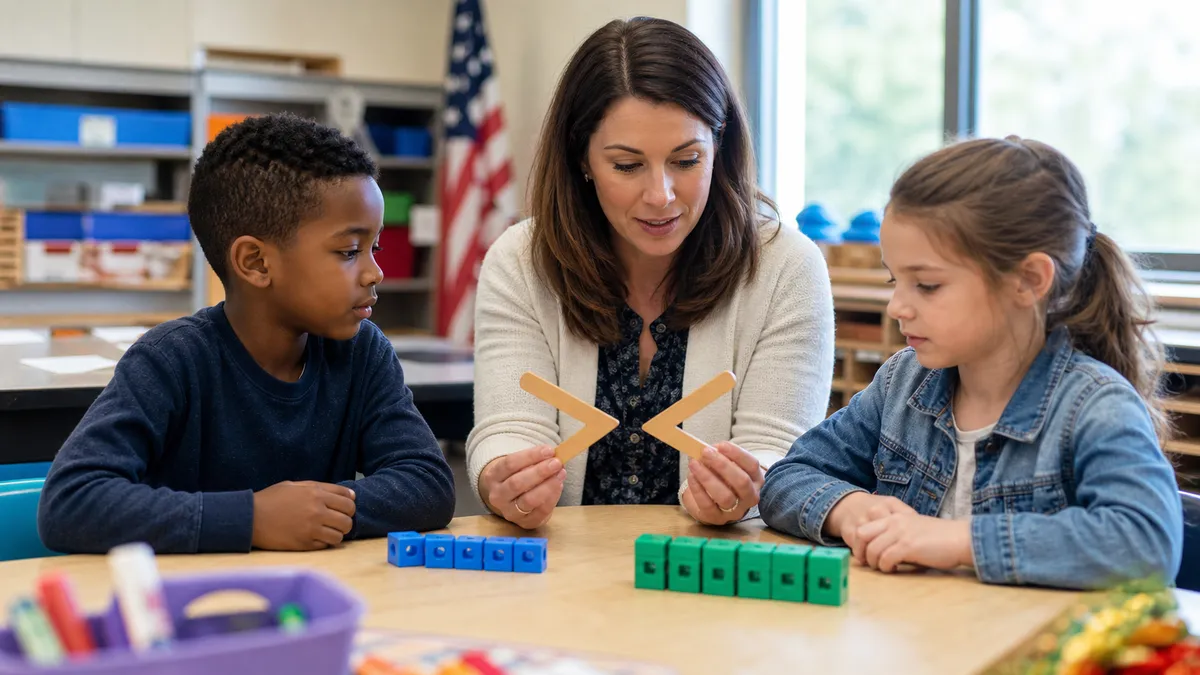
Allow the child to manipulate a physical sign before writing it. A pipe cleaner bent into < or two craft sticks joined at one end can make the narrow and wide ends easy to feel. Pair tactile exploration with accurate spoken language.
For language learners, explicitly teach the sentence frames “___ is greater than ,” “ is less than ,” and “ is equal to ___.” Use the same numbers in all three frames when possible, and check the meaning of “less” and “fewer” in context.
For students who explain better orally than in writing, accept a spoken comparison first and then reduce the written task to choosing a movable card. Add handwriting only after the relationship is clear.
The federal IES elementary mathematics intervention guide recommends systematic instruction and the use of visual representations such as number lines in elementary intervention. Apply that principle narrowly here: use representations to make magnitude visible, and explicitly connect each representation to the comparison sentence and symbol.
When to Contact the Teacher
Share specific observations instead of saying only that the child “doesn’t get the signs.” Useful notes include:
- The child identifies the greater number correctly but reverses the written symbol.
- The child reads
8 < 12as “8 is greater than 12.” - The child compares ones before tens.
- The child succeeds with objects but not numerals.
- The child succeeds one item at a time but not on a crowded page.
- The child cannot explain “less than” even without symbols.
Ask what language and models are used in class so home practice reinforces rather than competes with instruction. If difficulties persist across quantity, number words, place value, and symbols, ask the school what additional assessment or instructional support is appropriate. This article offers educational troubleshooting, not a diagnosis.
How to Track Progress Without Turning It Into a Test
Use the same four-item check once or twice a week, changing the numbers but keeping the demands comparable. Include one pair of concrete quantities, one two-digit comparison, one reversed-order version of the same relationship, and one equality item. For each item, note whether the child compared correctly, used the relationship word correctly, chose the symbol correctly, and read the finished statement accurately.
This record separates improvement in reasoning from improvement in handwriting or recall. For example, a child may move from guessing to stating the relationship correctly while still needing a movable symbol card. That is meaningful progress and points to the next teaching step. Another child may place every sign correctly but be unable to explain the tens comparison; that pattern calls for more place-value work rather than harder symbol drills.
Avoid graphing a single total score when the component skills tell a clearer story. A simple dated note such as “compared 46 and 64 correctly; said less than; reversed the card; corrected after reading aloud” gives a parent or teacher actionable information. Once the child completes all four steps across varied examples, gradually remove the supports. Return briefly to objects or spoken sentences if accuracy falls when the format changes.
Frequently Asked Questions
Should I teach the alligator trick?
You can use it as a final visual check, but not as the main meaning. The child should first compare values, say a complete relationship sentence, choose the symbol, and read the result. If the child can only describe an animal’s mouth, the notation may not transfer to expressions or later algebra.
Which way does the less-than sign point?
The narrow point is beside the lesser value. In 3 < 8, the point is next to 3, and the statement reads “3 is less than 8.” Reading from left to right is more dependable than viewing the sign in isolation.
Why can my child choose the bigger number but still miss the problem?
Choosing the bigger number answers only the magnitude question. The worksheet may also require the child to understand “less than,” track left and right, select notation, and read a mathematical sentence. Test those parts separately.
Should children compare numbers before learning the symbols?
Yes. Begin with quantities and spoken relationships, then connect those ideas to numerals and symbols. Continue using all forms together after notation is introduced.
How many problems should we practice?
Use a small set that leaves time for explanation and correction. Include both number orders and an equality example. Stop if the child begins guessing or repeating a picture rule without comparing.
What if my child reverses the signs only on worksheets?
Reduce visual clutter, show one item at a time, use movable symbol cards, and have the child read each statement aloud. Compare performance with oral questions and physical models. Share the pattern with the teacher if it continues.
Does reversing the sign mean my child does not understand number size?
Not necessarily. If the child consistently identifies and explains the greater quantity without symbols, number-size understanding may be intact. The difficulty may be language, notation, direction, handwriting, or self-checking. The three-part diagnostic at the start separates these possibilities.
How will I know the learning is secure?
The child can compare values, explain the reason, build and read both directions of the relationship, include equality when appropriate, and transfer the idea to new layouts without relying on one fixed picture. Accuracy should remain when the number order changes.